

Odin the Allfather: Origins, Powers, Symbols and Myths Explained
Odin stands at the very heart of Norse mythology — a god feared, revered, admired, and remembered through centuries of oral tradition, poetry, runic inscriptions, and warrior songs echoing across the North. Known as the Allfather, Odin is far more than a king of the gods. He is the seeker of forbidden knowledge, the wanderer of worlds, the master of runes, the god of war and death, and the patron of poets whose whispers shaped the oldest sagas.
Unlike the shining, benevolent deities of other mythologies, Odin is a complex figure — brilliant yet ruthless, wise yet cunning, generous yet terrifying. He sacrifices more than any other god, not to help others, but to gain insight into the great cosmic order. He hangs himself for nine nights. He tears out his own eye. He drinks stolen mead. He bargains with giants, witches, the dead, and destiny itself.
In this article, we explore every aspect of Odin:
his origins, his symbols, his animals, his powers, his role in magic and prophecy, his weapons, his influence in war, his relationship with humans, his doom at Ragnarök, and the profound legacy he carries today.
Who Is Odin in Norse Mythology?
Odin as the Allfather
The title Allfather (Old Norse: Alföðr) does not mean “father of all gods”.
Instead, it means:
- Source of ancient knowledge
- Keeper of fate
- Shaper of humanity
- Spiritual father to kings, heroes and poets
Odin is the architect of cosmic order, not through brute strength, but through intelligence, sacrifice, and an unending hunger for understanding the secrets of existence.
The Many Domains of Odin
Odin is not confined to a single domain. He presides over:
- War – not chaos, but strategy, inspiration, and death on the battlefield
- Wisdom – prophetic insight, runes, visions
- Magic (Seiðr) – shamanic trance, shapeshifting, spellcraft
- Poetry – inspiration, creativity, storytelling
- Death – ruler of fallen warriors
- Kingship – royal lineage, cosmic authority
No other god in Norse mythology holds such a fluid, multifaceted position.
Origins and Family Lineage
The Birth of Odin: Son of Borr and Bestla
Odin was born from the union of Borr and Bestla, a giantess.
His bloodline combines the strength of the gods with the primal chaos of the giants — a recurring theme in Norse myth where creation and destruction intermingle.
Odin and His Brothers Create the World
With his brothers Vili and Vé, Odin slays the primordial giant Ymir.
From Ymir’s corpse, the gods shape:
- the oceans (his blood),
- the mountains (his bones),
- the sky (his skull),
- the clouds (his brain).
Odin’s creative power is thus rooted in destruction, sacrifice, and transformation.
Odin’s Family Tree
Odin’s lineage is vast and important:
- Frigg – his wife, goddess of destiny
- Thor – his son, god of thunder, wielder of Mjolnir
- Baldr – his radiant son, whose death triggers Ragnarök
- Tyr – god of justice
- Heimdall – guardian of Bifrost
- Bragi – god of poetry
- Hermod, Vidar, Váli – sons tied to revenge, silence, and cosmic justice
His family mirrors the complexity of the cosmos — diversity, conflict, prophecy, and power.
Odin’s Endless Quest for Wisdom
The Sacrifice at the Well of Mimir
Odin’s pursuit of knowledge is legendary.
At Mimir’s Well, he offers the ultimate price:
He tears out his own eye and drops it into the waters of wisdom.
In return, he gains prophetic sight — not just of the present, but of the fate of gods and men.

Hanging Nine Nights on Yggdrasil
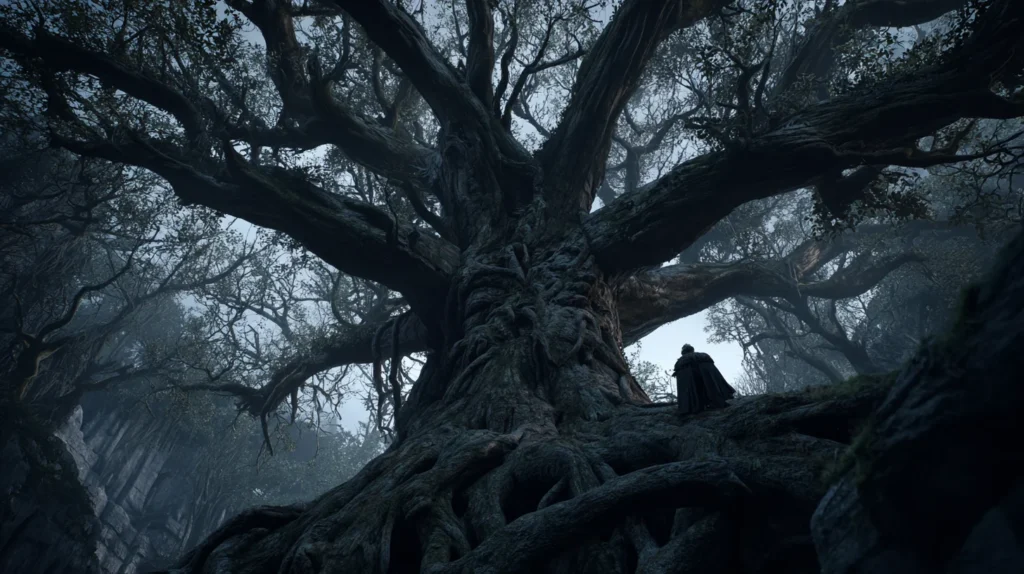
One of the most iconic myths describes Odin hanging himself from the World Tree, pierced by his own spear, without food or drink, for nine nights.
This self-inflicted ordeal reveals the runes to him — ancient symbols of power, destiny, protection, and cosmic laws.
Odin’s Obsession With Knowledge
Why does Odin seek so much wisdom?
Because he fears Ragnarök.
He knows the world will end. He knows he cannot stop it. The Norns have already woven that fate at the Well of Urd, and not even the Allfather can unravel a single thread of what they have decided. But he seeks to understand it, preparing the best possible outcome for the surviving world.
Wisdom, for Odin, is not a gift — it is a burden.
Odin’s Magical Symbols and Artifacts
Gungnir — The Spear That Never Misses
Forged by dwarves, blessed with runes, Gungnir is the ultimate spear of precision. While Gungnir belongs to Odin alone, his son Thor wielded an equally legendary weapon — Mjolnir, the hammer forged imperfect yet judged the greatest treasure in the cosmos.
With it, Odin begins every battle by throwing it over the enemy lines, dedicating the fallen to himself.
Draupnir — The Golden Ring
Every nine nights, Draupnir drips eight new rings.
It symbolizes abundance, wealth, cycles, and eternity.
Sleipnir — The Eight-Legged Horse
Born from Loki (in mare form), Sleipnir is the fastest creature in all realms.
He carries Odin between worlds — Asgard, Midgard, Hel, Jötunheim.
The Three-Triangle Motif (“Valknut”)
The interlaced three-triangle form occurs on a small number of late Iron Age and early medieval objects. “Valknut” is a modern label: no surviving Old Norse text gives that name to the design, and its original meaning is unknown.
Some object contexts have encouraged an association with Odin, death, or the slain, but that remains an interpretation rather than a documented Viking definition. Pete Sandberg’s Aarhus University study, “A ‘Valknut’ in the Capitol: Viking Age Symbol and Modern Myth”, surveys the limited evidence. Our Viking-symbol evidence index compares the form, its modern name, and its level of certainty with other popular designs.
The Helm of Awe & Other Marks of Magic
The name Ægishjálmr has medieval literary history, but the familiar radial “Helm of Awe” stave belongs to later Icelandic magical-manuscript traditions. It should not be presented as one unchanged Viking Age emblem or automatically tied to Odin; each mark has to be dated and sourced separately.
Odin’s Ravens, Wolves and Companions
Odin never travels alone. Around the Allfather gathers a court of creatures and beings, each an extension of one of his powers: his mind, his hunger, his judgment. Together they form the strangest entourage in Norse mythology.
Huginn and Muninn — Thought and Memory
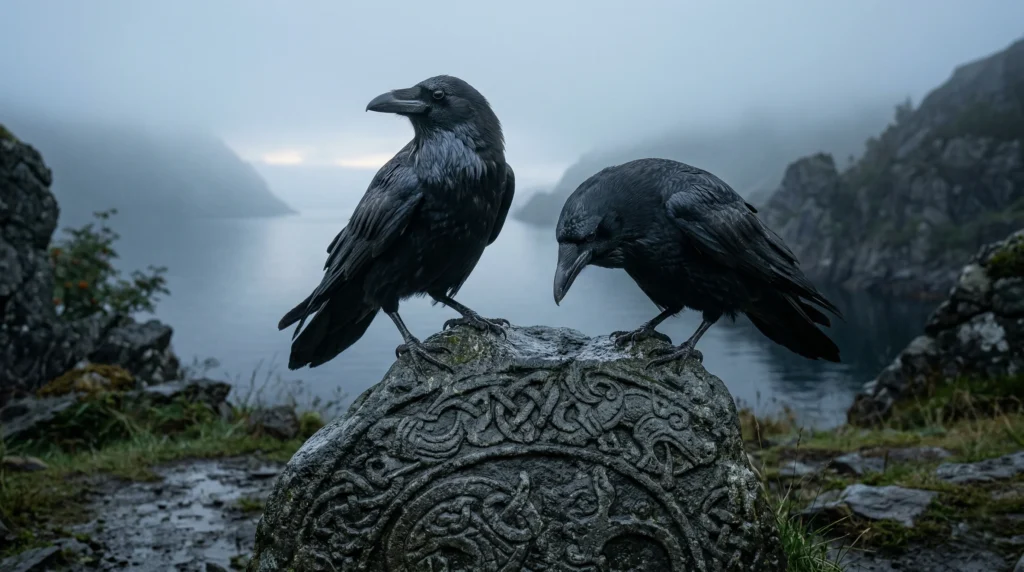
Every morning, Odin sends out his two ravens across the Nine Realms:
- Huginn (Thought)
- Muninn (Memory)
They return at dusk and whisper into his ears everything they have seen. Their presence symbolizes Odin’s omnipresent mind and his constant hunger for knowledge, and their story runs deeper than most realize: the Allfather himself confesses in the Grímnismál that he fears they may not return. We tell that full story, and what it reveals about Odin’s greatest weakness, in our complete guide to Huginn and Muninn, Odin’s ravens.
Geri and Freki — The Wolves
At Odin’s feet rest Geri and Freki.
He gives them all his food, sustaining himself only on wine.
Valkyries — Choosers of the Slain
These divine shield-maidens select which warriors die on the battlefield and escort them to Valhalla, Odin’s hall.
Einherjar — Warriors of Valhalla
The chosen dead train daily, awaiting the final battle of Ragnarök.
Odin as the God of War
Odin’s relationship with war is unlike any other deity in mythology.
While Thor represents raw strength and honorable combat, Odin embodies something far more complex:
- strategy
- psychology
- fate
- the art of choosing who lives and who dies
- inspiration for warriors
- manipulation on the battlefield
Odin does not fight with brute force.
He fights with mind, magic, and prophecy.
Strategic Warfare vs. Blind Rage
To Odin, a battle is a chessboard.
He does not bless warriors with protection — he blesses them with:
- sudden courage
- frenzy
- clarity of thought
- or visions of glory
He is the invisible strategist who plants ideas, doubts, and inspirations in the minds of men.
This is where the famous “battle-fury” comes from — a sudden, supernatural rush that turns an ordinary man into a storm of steel.
Odin’s Role in Choosing the Slain
A chilling line from the sagas says:
“Odin owns all who fall in battle.”
He decides, often before a war even begins, who will die and who will survive.
The Vikings believed that even the strongest warrior could fall if Odin had chosen him.
This is why many warriors went to battle without fear —
their fate was already written.
The Cult of the Berserkers
Berserkers (“bear-shirts”) and Úlfhéðnar (“wolf-warriors”) fought in trance-like states, driven by supernatural ferocity.
Many scholars consider this a form of:
- shamanic possession
- divine inspiration
- Odin’s influence
- or ritual magic
These warriors were believed to be chosen by Odin, transcending human limits.
Odin’s Gifts to Warriors
Odin offers:
- inspiration (Óðr)
- frenzy (óðr)
- victory (sigr)
- death and glory (valr)
But Odin never gives without taking.
Every gift has a price.
Every victory moves fate closer to Ragnarök.
Odin as the God of Death
Odin’s connection to death is deep, mystical, and fearsome.
He is not a god of kindness — he is a god of transition, judgment, and destiny.
Leader of the Dead in Valhalla
Odin’s hall, Valhalla, is the home of the Einherjar, warriors who died bravely in battle.
Here, the dead:
- fight all day
- die and rise again
- feast all night
- prepare for Ragnarök
Odin does not seek compassionate souls — he seeks the strongest, the boldest, the most unbreakable.
The Wild Hunt
In winter storms, Odin leads a phantom host across the sky — the Wild Hunt.
Features:
- spectral riders
- hounds
- dead warriors
- terrifying winds
- Odin riding Sleipnir at the front
This myth symbolizes death, transition, and the thin line between the living and the dead.
Odin vs. Hel: Two Realms of the Dead
The afterlife in Norse mythology is not simple:
- Odin rules Valhalla, the fallen warriors
- Freyja rules Fólkvangr, another realm for the brave
- Hel rules the realm of the dead, those who die of age, sickness, or natural causes
Odin’s domain is the elite of the fallen.
Hel’s domain is the rest of humanity.
This division shows how Odin’s power is not absolute, it is selective, strategic, and bound to warrior culture.
Where a Norse person actually ended up was decided by the gods, but what happened to the body was decided by the living: fire or earth, a mound or a ship, and in one recorded case a killing. We set out the evidence in our guide to Viking funeral rites.
Odin as the God of Poetry and Magic
Odin is not just a god of war — he is also a god of poetry, song, and magic.
The Mead of Poetry
The Mead of Poetry (Óðrørir) grants:
- inspiration
- eloquence
- artistic genius
- prophetic vision
Odin stole this mead from giants through a mixture of seduction, trickery, and shapeshifting — typical Odin behavior.
Every poet, musician, singer, or skald was believed to carry a drop of Odin’s mead.
Odin as a Shamanic Figure
Odin practices Seiðr, a form of Norse magic often associated with women and seeresses.
He performs:
- trances
- shapeshifting
- visions
- spirit-travel
- communication with the dead
The fact that Odin practices a magic considered “unmanly” shows something important:
Odin seeks power above all, regardless of taboo.
Galdr — The Magic of Words
This is the magic of chanting, singing spells, and weaving fate with sound.
It is deeply tied to:
- runes
- poetry
- the breath of life
- the art of storytelling
Every Mythic Harmonies song rooted in the old North is, in essence, a modern echo of Galdr.
Odin’s Role in Ragnarök
Ragnarök is the doom of the gods — and Odin knows it.
Prophecies of His Death
The Völva (seeress) tells Odin that he will die fighting Fenrir, the monstrous wolf.
Despite all his wisdom, power, and sacrifices, Odin cannot escape fate.
Odin Against Fenrir
This battle is the core of Ragnarök:
- Odin charges
- Fenrir breaks his chains
- The two clash in the final war
- Fenrir devours Odin
But Odin’s son Víðarr avenges him, tearing the wolf apart.
The Meaning of Odin’s Death
Odin’s end is a symbol of:
- inevitability
- cosmic cycles
- the limits of wisdom
- the end of an era
- the rebirth of the world
Odin fights not because he expects to win, but because it is his duty.
After Ragnarök — Odin’s Legacy Lives On
Even after his death:
- his sons survive
- the world is reborn
- humanity returns
- new gods rise
Odin’s wisdom, runes, and sacrifices shape the new world.
His legacy becomes eternal.
Odin in the Norse Sources: What the Eddas Tell Us
To understand Odin, we must look at the two pillars of Norse literature:
the Poetic Edda and the Prose Edda.
Together, they reveal a god who is contradictory, fascinating, and deeply human in his ambition.
The Poetic Edda — Ancient Echoes of the Allfather
The Poetic Edda contains the oldest surviving poems of the North — raw, mysterious, and filled with riddles.
Odin appears in:
Völuspá (The Prophecy of the Seeress)
Here, the Völva recounts:
- the creation of the world
- Odin’s sacrifices
- the coming of Ragnarök
- Odin’s destined death
This is one of the most important poems in Norse mythology, and Odin stands at its center.
Hávamál (The Words of the High One)
This poem is essentially Odin’s wisdom manual.
It includes:
- moral advice
- reflections on courage
- warnings about trust
- the story of how he gained the runes
A famous stanza reads:
“I know that I hung
on the windy tree
for nine full nights…”
This passage describes his self-sacrifice — one of the most powerful myths in world mythology.
Grímnismál (The Sayings of the Masked One)
Odin, disguised as Grímnir, delivers deep cosmic knowledge about the realms, creatures, halls, and structure of the universe.
Grímnir is only one of the dozens of names Odin gives himself across the sources: Gautr, Grímr, Hárr and many more. Yet here lies a striking paradox: while Thor’s name echoes through a quarter of Iceland’s settlers, Norse parents almost never named a child after Odin directly. Invoking the Allfather was for poetry and sacrifice, not for the cradle, a taboo our guide to real Viking names explores in full.
The Prose Edda — Snorri’s Careful Crafting
Written by Snorri Sturluson, the Prose Edda organizes myths into a coherent narrative.
Snorri presents Odin as:
- a strategist
- a seeker of wisdom
- a king of the gods
- a figure who builds Asgard
- a god linked to poetry and magic
- a doomed warrior
Snorri also goes into detail about Odin’s weapons, companions, and magical abilities — much of what we know today comes from him.
Skaldic Poems — Odin as Patron of Poets
Odin appears in numerous skaldic verses, where he is often invoked to grant:
- eloquence
- bravery
- inspiration
- victory
The idea of Odin as the giver of poetic vision is essential to understanding his nature.
Odin in Modern Culture
Odin survived untouched through centuries of Christianization, folklore, reinterpretation, academic study, and fiction.
Today, he appears in many forms, some faithful, others imaginative — but always compelling.
Odin in Neo-Paganism and Heathenry
Modern practitioners of Ásatrú or Heathenry honor Odin as:
- a guide
- a teacher
- a god of self-transformation
- a symbol of will and sovereignty
These groups see Odin not as a fictional character, but as a living deity.
Odin in Popular Culture: Marvel, Games, and More
Odin appears in:
- Marvel’s Thor films (though heavily modified)
- God of War (as a manipulative, cunning mastermind)
- Assassin’s Creed Valhalla
- countless novels, comics, series, board games, and artworks
While these portrayals vary, they often emphasize:
- wisdom
- power
- prophecy
- the weight of destiny
Common Misconceptions About Odin
Because of pop culture, many errors circulate:
- ❌ Odin is NOT simply a “wise old man”
- ❌ Odin did NOT have a horned helmet
- ❌ Odin is NOT only the god of war
- ❌ Odin is NOT a benevolent all-loving father
- ❌ Odin DID practice Seiðr, despite taboos
Understanding Odin means accepting both his brilliance and his darkness.
The Symbolic Meaning of Odin Today
Why does Odin still matter today?
Why does his name echo in songs, novels, games, artworks — and in the hearts of people seeking strength and guidance?
Because Odin embodies eternal archetypes:
Wisdom Through Sacrifice
Odin teaches that real knowledge requires:
- suffering
- effort
- sacrifices
- courage
His missing eye is a symbol of the price of insight.
The Relentless Pursuit of Self-Improvement
Odin is never satisfied.
He constantly evolves, learns, experiments, transforms.
He is a god who refuses stagnation.
Embracing Fate Yet Fighting It
He knows he will die in Ragnarök — yet he fights anyway.
This paradox embodies the Norse idea of honor, will, and nobility.
Leadership Through Vision
Odin commands not by force alone but by:
- knowledge
- charisma
- foresight
- inspiration
- mystery
The Power of Words, Art, and Song
Odin gives:
- poetry
- music
- prophecy
- runes
This mirrors your artistic universe perfectly.
Every Mythic Harmonies track inspired by Odin becomes a modern drop of the Mead of Poetry.
FAQ — Odin, the Allfather
Was Odin a real god worshipped by Vikings?
Yes. Odin was one of the most important gods in Viking religion, especially for warriors, kings, and poets.
Is Odin good or evil?
Neither. Odin is complex — a god of wisdom, war, death, poetry, and magic. He is both inspiring and terrifying.
Why is Odin called the Allfather?
Because he is seen as the spiritual father of gods, men, and knowledge — not literally the biological father of all beings.
Why did Odin sacrifice his eye?
To drink from Mimir’s Well and gain wisdom. The sacrifice symbolizes the price of knowledge.
What animals are associated with Odin?
Ravens (Huginn and Muninn), wolves (Geri and Freki), and Sleipnir, the eight-legged horse.
Did Odin use magic?
Yes. Odin practiced Seiðr, a form of Norse shamanic magic involving visions, trance, and prophecy.
Who kills Odin during Ragnarök?
The giant wolf Fenrir devours Odin during the final battle.
What weapon does Odin use?
The spear Gungnir, a flawless weapon forged by dwarves and inscribed with runes.
Did Vikings believe they would meet Odin after death?
Only warriors who died bravely in battle could join Odin in Valhalla.
How is Odin related to music and poetry?
He stole the Mead of Poetry, which grants inspiration to artists, poets, and musicians.
Is Odin Thor’s father?
Yes. Thor is the son of Odin and Jörð, the personification of the earth, not of Odin’s wife Frigg. The pairing is deliberate: the god of the sky and the goddess of the earth produce the storm. Marvel’s version, where Frigg raises Thor, simplifies a more interesting original arrangement.
How many names does Odin have?
The sources preserve over 170 names for Odin, more than any other figure in Norse mythology: Grímnir (the Masked One), Hárr (High One), Gautr, Vegtam (Way-Tamer), and dozens more. Each name marks a disguise, a function, or a story. A god who seeks all knowledge needs a name for every road.
Conclusion — The Everlasting Shadow of the Allfather
Odin’s story is one of ambition, sacrifice, wisdom, magic, and fate.
He is a god who transforms himself constantly, wandering across worlds in search of meaning.
A ruler who sees everything yet cannot avoid his doom.
A poet who drinks inspiration from divine mead.
A warrior who stands at the front of the final battle, knowing he will fall.
Odin is the embodiment of the ancient North — fierce, mysterious, poetic, and eternal.
His presence lives on in the sagas…
in the runes carved on stone…
and in every melody, chant, and rhythm inspired by the Norse world.
Hear him judge. Our track Óðins Dómr (Odin’s Judgment), sung in Old Norse, is the sound of the Allfather weighing the fates he cannot escape himself.
Music to read by
Each article has a soundtrack. Listen to Mythic Harmonies while you read.
Explore the music
thanks for info.