

Heimdall: The Watchman God & His Gjallarhorn Explained
On this page 10 sections
- Who Is Heimdall? The Watchman of the Gods
- The Nine Mothers: Heimdall’s Impossible Birth
- Rígr: The God Who Created the Social Classes
- Heimdall and Loki: Enemies to the End
- More Than an Alarm: The Horn of Wisdom
- The Sound That Ends the World
- The Real Viking War Horn: Archeology vs. Myth
- How Did a Viking Horn Actually Sound?
- Conclusion: The Echoes of Destiny
- Frequently Asked Questions
Imagine standing on the edge of the Bifröst, the shimmering rainbow bridge that connects the realm of humanity to the realm of the gods. The air is freezing, the sky is dark, and the silence is absolute. Suddenly, a sound rips through the atmosphere—a blast so loud, so resonant, that it vibrates through the roots of the world tree, Yggdrasil, and echoes across all Nine Worlds.
This is not just any sound. It is the beginning of the end. It is the sound of the Gjallarhorn.
When we talk about Norse mythology, we often focus on the visual: the striking of Thor’s hammer, the shimmering halls of Valhalla, or the terrifying jaws of the Fenrir wolf, son of Loki. But the Vikings were a deeply oral and auditory culture. To them, the apocalypse wasn’t just something you saw; it was something you heard.
If you are searching for the true Gjallarhorn meaning, you must look beyond the simple translation of a “Viking war horn.” It is an instrument of cosmic alarm, a drinking vessel of wisdom, and the ultimate symbol of duty, held by the most vigilant god in the Norse pantheon: Heimdall.
In this guide, we will explore the myth of the Gjallarhorn, the unique biology of its guardian, and what the historical Viking horns actually sounded like in the real world.
🎧 Immerse Yourself in the Sounds of the North Before diving into the myth of Ragnarök, set the atmosphere. Listen to epic, historically-inspired Norse soundscapes and Viking songs by subscribing to Mythic Harmonies. Press play, and let the ancient chants transport you to Asgard as you read.
Who Is Heimdall? The Watchman of the Gods
You cannot understand the horn without understanding the man who blows it.
Heimdall (Old Norse: Heimdallr) is one of the most mysterious and fascinating figures in the Aesir tribe. He is the designated watchman of the gods, stationed at his fortress, Himinbjörg (Heaven’s Cliffs), which sits exactly where the Bifröst bridge meets Asgard.
His one and only job is to watch for the coming of the giants and the onset of Ragnarök. To do this, Odin gifted him with physical traits that are almost terrifying in their perfection:
- The Sight of an Eagle: Heimdall can see for hundreds of miles, both in the blinding light of day and the pitch black of night.
- The Hearing of a God: His hearing is so acute that he can literally hear the grass growing from the dirt in Midgard, and the wool growing on the backs of sheep.
- The Endurance of a Mountain: He requires less sleep than a bird, standing guard eternally without fatigue.
Heimdall is the ultimate sentinel. But all that perception would be useless if he couldn’t warn the other gods when danger finally approached. For that, he needed an instrument that matched his divine senses.
He needed the Viking war horn to end all war horns. Its earthly cousins had a humbler but decisive job: their signals commanded the shield wall, the formation that decided every Norse battle, where discipline mattered more than fury.
The Nine Mothers: Heimdall’s Impossible Birth
Heimdall has the strangest birth story in Norse mythology: he was born of nine mothers, all of them sisters. A surviving fragment of the lost poem Heimdalargaldr preserves his own words: “I am the child of nine mothers, the son of nine sisters.” The Hyndluljóð names them, and scholars have long argued they represent the nine waves of the sea, daughters of the ocean giant Ægir, which would make Heimdall the son of the sea itself, born at the edge of the world where the waves meet the land.
The sources add strange, vivid details. He is called Gullintanni, “gold-toothed,” because his teeth were made of gold. His horse is Gulltoppr, “golden mane.” He was nourished, the sources say, by the strength of the earth, the cold sea, and the blood of a boar. Nothing about Heimdall is ordinary, and the myth seems designed to say so: the watchman who guards the boundary between worlds was himself born on a boundary, of the sea and yet a god of the sky.
Rígr: The God Who Created the Social Classes
One poem gives Heimdall a role no other god holds: the father of human society. In the Rígsþula, a god calling himself Rígr walks the roads of Midgard and visits three homes. From these visits are born three sons: Þræll, ancestor of the thralls, the enslaved; Karl, ancestor of the free farmers; and Jarl, ancestor of the nobles. The prose introduction of the poem identifies Rígr as Heimdall.
This is why the very first stanza of the Völuspá, the most important poem in Norse mythology, addresses humanity as “the sons of Heimdall.” Every listener, from slave to king, was being told that the watchman of the gods was also, in some sense, their common father. The god who guards the boundary between gods and humans is the god who crossed it to create the human order.
Heimdall and Loki: Enemies to the End
Every watchman needs a thief, and Heimdall’s opposite is Loki. Their rivalry runs through the sources. In the skaldic poem Húsdrápa, the two fight in the shape of seals over the Brísingamen, the necklace of Freyja that Loki had stolen. Heimdall wins and returns the necklace. The vigilant god beats the trickster at his own game of shapeshifting: it is the only time in the myths that someone out-Lokis Loki.
The rivalry is fated to end in mutual destruction. At Ragnarök, after Heimdall’s horn has called the gods to the field, the watchman and the trickster meet one final time, and each kills the other. The pairing is deliberate: order and chaos, the guardian of the boundary and the breaker of every boundary, cancelling each other out at the end of the world.
More Than an Alarm: The Horn of Wisdom
If you ask a casual fan the Gjallarhorn meaning, they will tell you it is simply a loud trumpet used to signal the end of the world. While that is its final purpose, its daily use was actually much quieter—and much more profound.
The name Gjallarhorn translates to “Yelling Horn” or “Resounding Horn.” But in Norse mythology, this object had a dual purpose.
According to the Prose Edda, written by Snorri Sturluson, the Gjallarhorn was not always kept at Heimdall’s lips. Before Ragnarök, the horn was kept at the roots of the World Tree, specifically at Mímisbrunnr (Mímir’s Well)—the well of cosmic wisdom.
A Vessel for Knowledge
Mímir was an ancient being known for his unparalleled wisdom, which he gained by drinking from his own well every day. But he didn’t drink from a cup. He used the Gjallarhorn as a drinking vessel.
This detail is crucial to understanding the Viking mindset. To the Norse people, a horn was a tool of both life (drinking/feasting) and death (war/signaling). The fact that the same horn used to absorb the ultimate knowledge of the universe is the exact same horn used to announce its destruction is a brilliant piece of poetic symbolism.
It connects sound, wisdom, and destiny into one single artifact.

The Sound That Ends the World
Despite its use as a drinking vessel, the Gjallarhorn’s true destiny is tied to Ragnarök—the doom of the gods
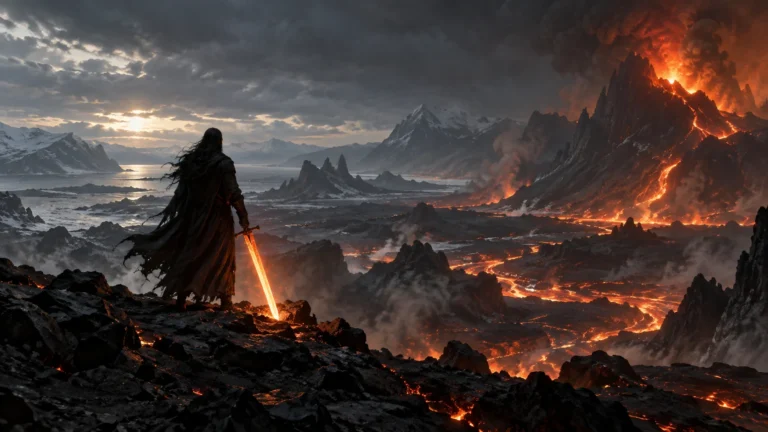
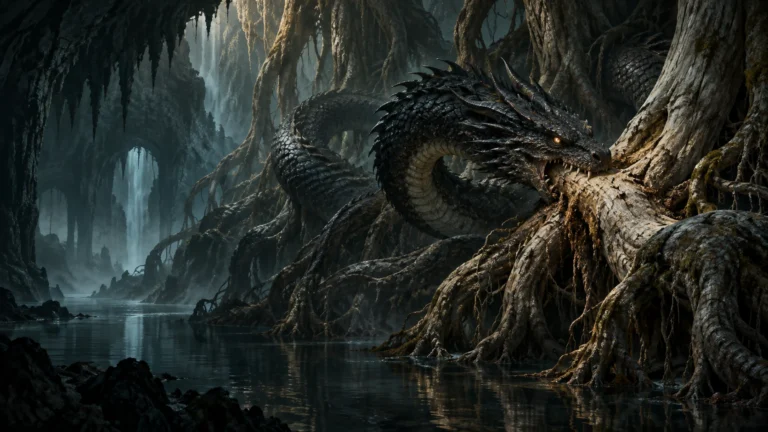
When the prophecy begins to unfold, the cosmos will fall into chaos. The Fenrir wolf will break his chains, the Midgard Serpent (Jörmungandr) will rise from the ocean, causing massive tidal waves, and the fire giant Surtr will march his army of destruction from the south.
As the enemies of the gods approach the Bifröst bridge, Heimdall will finally perform the duty he has waited centuries for.
The Final Blast
He will lift the Viking war horn to his lips and blow a single, devastating note. The myth states that the blast of the Gjallarhorn will be so powerful that it will be heard in all Nine Realms simultaneously. From the golden halls of Asgard to the deepest, darkest pits of Helheim, every god, giant, dwarf, and human will hear it.
- The Reaction: The sound is not a call to run or hide. It is the ultimate call to arms. Upon hearing the horn, Odin will immediately ride to Mímir’s well for one final piece of advice, while the dead warriors of Valhalla (The Einherjar) will grab their swords and march out of their 540 doors to face the apocalypse. Thor, too, will answer the call — reaching for Mjolnir one last time before marching to face Jörmungandr, the World Serpent, in the final battle.
The Gjallarhorn is the starting gun for the end of the universe.
The Real Viking War Horn: Archeology vs. Myth
While Heimdall’s Gjallarhorn could be heard across nine dimensions, the physical horns used by actual Norsemen were grounded in the brutal reality of the Viking Age.
If you were a chieftain organizing a raid or defending a settlement, you couldn’t rely on shouting over the roar of the North Sea or the clash of wooden shields. You needed a Viking war horn.
What Were They Made Of?
Unlike the brass trumpets of the Roman legions, Viking horns were strictly organic. Archeological finds, such as those near the Oseberg ship burial, reveal that blowing horns were typically crafted from:
- Cattle Horns: The most common material. The inside marrow was boiled out, and the tip was cut off to create a blowing hole.
- Goat or Sheep Horns: Used for smaller, higher-pitched signaling devices.
- Wood and Birch Bark: Some horns were carved from wood and wrapped in tightly wound birch bark to seal the air leaks and provide a deep, resonant chamber.
The Metal Myth: You might have seen giant, curved bronze horns in museums (called Lurs). While these are magnificent Scandinavian artifacts, they actually belong to the Nordic Bronze Age—thousands of years before the Vikings. A true Viking Age warrior carried a horn made of bone or wood.

How Did a Viking Horn Actually Sound?
If you want to understand the Gjallarhorn meaning, you have to understand the acoustic terror of a real blowing horn.
A traditional Viking war horn does not play a cheerful melody. It does not have finger holes like a flute. It is designed to do one thing: project a massive, guttural blast of sound over long distances.
The Acoustic Experience
When blown with vibrating lips (like playing a modern tuba), the raw animal horn produces a deep, vibrating drone. It sounds less like music and more like the roar of a massive beast.
- Signaling: Different rhythms and lengths of blasts were used to communicate orders. One long blast might mean “Form the shield wall,” while a series of short, sharp blasts could mean “Retreat to the longships.”
- Psychological Warfare: Imagine standing in the fog of the English coast in the 9th century. Before you see the dragon-headed ships, you hear a chorus of deep, atonal horns echoing through the mist. The sound was designed to intimidate enemies before the battle even began.
🎶 Hear the Echoes of the Past Words can only describe so much. To truly feel the vibrating, primal power of Norse instruments and chanting, you need to listen. Dive into the deep, rhythmic beats of the North with Mythic Harmonies. Let the music set the scene for your own epic saga.
Conclusion: The Echoes of Destiny
So, what is the ultimate Gjallarhorn meaning?
It is the physical manifestation of fate. For the Norse gods, the sound of Heimdall’s horn is not a surprise; it is a promise. It is the inescapable alarm clock of the universe, waking the gods and the dead to fulfill their final destiny at Ragnarök.
But down in Midgard, the realm of humanity, the Viking war horn was a tool of survival. Carved from bone and blown with lungs full of freezing sea air, it was the voice of the chieftain. It directed fleets, intimidated enemies in the fog, and called warriors to the shield wall.
When a Viking blew his horn before a battle, he was, in a way, echoing Heimdall. He was signaling that the time for talking was over, and the time for glorious action had begun.
Read Next: What happens after the horn is blown? The dead must rise to fight. Discover where the fallen warriors were actually waiting in our definitive guide: Valhalla vs. Folkvangr: Where Do Viking Warriors Really Go?
Frequently Asked Questions
What does the Gjallarhorn symbolize?
The Gjallarhorn symbolizes vigilance, cosmic wisdom, and the inescapable fate of Ragnarök. It represents the transition from the silent waiting of the gods to the chaotic final battle of the universe.
Who blows the Gjallarhorn?
Heimdall, the watchman of the Norse gods, is the keeper of the horn. He resides at Himinbjörg, where the rainbow bridge Bifröst meets Asgard, waiting for the enemies of the gods to appear.
Did Vikings actually use war horns?
Yes. While Heimdall’s horn is myth, real Vikings used blowing horns made from cattle or goat horns. They were used on ships and battlefields to signal troop movements and intimidate enemies over the loud noise of combat.
What did the Gjallarhorn sound like?
A historical Viking horn produces a deep, atonal, and resonant drone. It sounds less like a musical instrument and more like a loud, guttural roar designed to carry over long distances.
Who are Heimdall’s nine mothers?
The Hyndluljóð names nine sisters who together bore Heimdall. Most scholars interpret them as the nine waves of the sea, daughters of the giant Ægir, making Heimdall a son of the ocean itself. The surviving fragment of the Heimdalargaldr confirms the tradition in Heimdall’s own voice: “I am the child of nine mothers.”
How does Heimdall die?
Heimdall dies at Ragnarök in a final duel with Loki, his lifelong enemy. After sounding the Gjallarhorn to summon the gods, the watchman and the trickster kill each other simultaneously, order and chaos cancelling out at the end of the world.
Why is Heimdall called the whitest of the gods?
The Þrymskviða calls Heimdall “the whitest of the Aesir,” an epithet scholars read as describing radiance rather than appearance: he is the shining god, associated with light, the gleaming Bifröst, and gold. The same logic gives him golden teeth and a golden-maned horse.





All five albums and every single: 86 songs in WAV and MP3, yours to keep.