
Yggdrasil: The World Tree in Norse Mythology
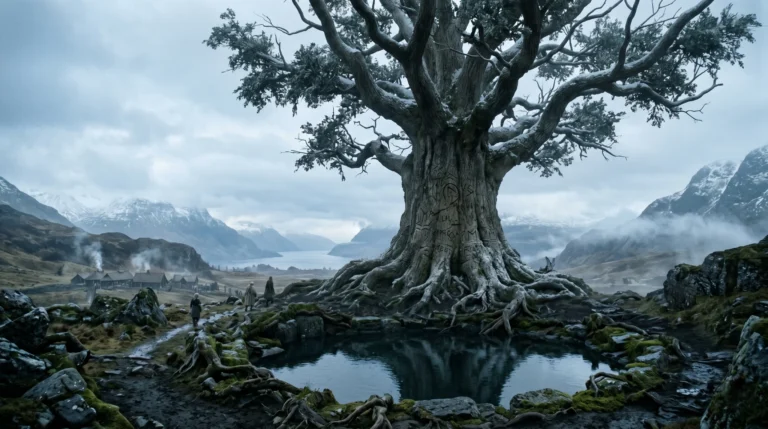
What is Yggdrasil? Yggdrasil is the great ash of Norse myth: a named tree in the Poetic Edda and the central sacred tree in Snorri Sturluson’s Prose Edda. The sources place the Well of Urðr beneath it, send three roots into different regions, describe gods assembling nearby, and fill its branches and roots with animals. They do not provide the familiar modern diagram of nine realms arranged on the tree.
The evidence is vivid but incomplete. Völuspá calls Yggdrasil an ash and says it trembles at Ragnarök. Grímnismál describes its roots and creatures. Snorri gives the most orderly account of three roots and three wells. Yet no surviving text says that Yggdrasil falls at Ragnarök, and Vafþrúðnismál places the human survivors in Hoddmímis holt without explicitly identifying that refuge as Yggdrasil.
Evidence boundary: this guide separates what the poems say, what Snorri systematizes, and what later diagrams or comparative interpretations add.
| Question | Best-supported answer |
|---|---|
| What is Yggdrasil? | The named ash associated with the Well of Urðr, cosmic regions, divine assembly, and multiple creatures. |
| What does the name mean? | Conventionally “Yggr’s horse” or “Odin’s horse,” usually read in relation to Odin’s hanging. |
| Are nine worlds mapped on it? | Nine worlds are mentioned, but no complete list or ancient diagram survives. |
| What happens at Ragnarök? | The tree shudders and groans; its final fate is not explicitly stated. |
| Do Líf and Lífþrasir hide inside it? | They hide in Hoddmímis holt. Identifying that place with Yggdrasil is possible, not certain. |
What Does Yggdrasil Mean?
The Old Norse form is Yggdrasill. Yggr, “the Terrible” or “the Fearsome,” is one of Odin’s names; drasill is a poetic word for a horse. The conventional translation is therefore “Yggr’s horse” or “Odin’s horse.”
The usual explanation treats the “horse” as a gallows. In Hávamál 138–139, Odin says that he hung for nine nights on a windswept tree, wounded by a spear and given to himself, before taking up the runes. A hanging person can be imagined as “riding” the gallows. The connection is persuasive and widely accepted, but one precision matters: Hávamál does not call that tree Yggdrasil in those stanzas. The identification comes from reading the poem together with the name and the wider Odin tradition.
Two other names are often brought into the discussion. Mímameiðr, “Mímir’s tree,” appears in Fjölsvinnsmál; Hoddmímis holt, “Hoddmímir’s wood,” shelters Líf and Lífþrasir in Vafþrúðnismál. Both may have been associated with Yggdrasil by medieval audiences or later interpreters, but neither poem explicitly equates its tree or wood with Yggdrasil.
Did Odin Hang on Yggdrasil?
The short answer is probably in the combined tradition, but not explicitly in the stanza itself. Hávamál 138–139 has Odin speak in the first person. He hangs for nine nights on a windswept tree, is wounded with a spear, receives no bread or drink, looks downward, and takes up the runes before falling back. The scene is one of self-sacrifice: Odin is “given to Odin,” sacrificed by himself to himself.
The passage never names Yggdrasil, never calls the tree an ash, and never says that the nine worlds are arranged around Odin during the ordeal. The identification is built from several pieces: Yggdrasil’s conventional meaning as “Odin’s horse,” Odin’s association with hanging and the gallows, and the tree’s central place in Snorri’s cosmology. This is a strong synthesis, not a direct label inside Hávamál.
The poem also does not say that Odin created the runes as an alphabet or assigned the modern divinatory meanings found in many handbooks. Historically, the Elder Futhark was a writing system attested in inscriptions. The myth dramatizes the acquisition of hidden knowledge and runic power; it should not be made to authenticate every later rune-reading system.
What the Norse Sources Actually Say
The main evidence comes from poems preserved in the 13th-century Poetic Edda and from Snorri’s Gylfaginning. The poems preserve material of different dates and do not form one systematic handbook. Snorri, writing in Christian Iceland around 1220, arranges scattered traditions into a clearer narrative. His account is indispensable, but it must be attributed to him rather than projected unchanged into the Viking Age.
| Source | Passage | What it contributes |
|---|---|---|
| Völuspá | 2, 19–20, 47 | Nine worlds remembered; the ash named Yggdrasil by Urðr’s well; the Norns; the tree shuddering at Ragnarök. |
| Hávamál | 138–139 | Odin hangs for nine nights on an unnamed tree and takes up the runes. |
| Grímnismál | 29–35 | The divine journey to judgment, three roots, an eagle, Ratatoskr, four stags, serpents, and Níðhöggr. |
| Vafþrúðnismál | 43, 45 | Nine worlds; Líf and Lífþrasir sheltered in Hoddmímis holt and fed by morning dew. |
| Snorri, Gylfaginning | 15–16 | The most systematic description of the ash, its three roots, three wells, divine assembly, Norns, and creatures. |
Yggdrasil Claims: Source, Inference, or Modern Addition?
| Popular claim | Verdict | Why |
|---|---|---|
| Yggdrasil holds exactly nine realms on its branches. | Modern reconstruction | The texts mention nine worlds but provide no complete list or branch-by-branch map. |
| Yggdrasil is called the “Tree of Life” in Old Norse. | Modern label | No surviving Eddic passage records that title. |
| Yggdrasil falls when Ragnarök begins. | Unsupported | Völuspá says the ash shudders and groans, not that it falls. |
| Líf and Lífþrasir hide inside Yggdrasil. | Possible interpretation | The poem names Hoddmímis holt; its identity is not explained. |
| Viking seeresses used a nine-level Yggdrasil map. | No direct evidence | No surviving ritual description gives that procedure. |
| Every animal has one fixed symbolic meaning. | Modern interpretation | The texts describe actions and locations, not a symbolic key. |
This three-part test—source, inference, or modern addition—protects both history and imagination. It allows a reader to enjoy contemporary art, games, tattoos, and spiritual readings without silently turning them into Viking Age evidence.
Is Yggdrasil an Ash Tree?
The clearest answer is yes. Völuspá 19 begins its description with an askr—an ash—called Yggdrasil. Snorri likewise calls it the greatest and best of all trees and describes it as an ash. That is the strongest primary evidence and should be the default answer.
The yew theory belongs to later scholarship and comparison. It is sometimes connected with the longevity of yews, place-name evidence, or the separate tree Mímameiðr. Those arguments may be worth studying, but no medieval passage says “Yggdrasil is a yew.” Modern rune symbolism does not settle the question either: the familiar spiritual meanings attached to the Eihwaz rune are not evidence for the species of Yggdrasil. For the attested writing system, see the Elder Futhark guide.
The Three Roots and Three Wells
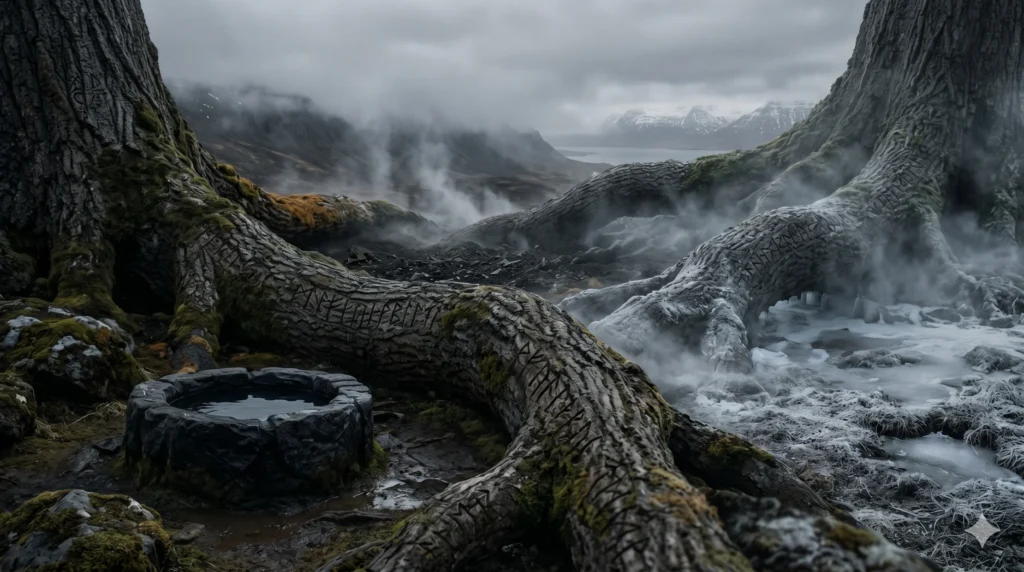
The phrase “three roots and three wells” sounds like a single ancient blueprint, but the texts preserve two different arrangements.
| Account | Destinations of the three roots |
|---|---|
| Grímnismál 31 | One root reaches humans, one the frost giants, and one Hel. |
| Snorri, Gylfaginning 15 | One root reaches the gods, one the frost giants, and one extends over Niflheim. |
Urðarbrunnr, the Well of Urðr. Völuspá places the ash beside this well. Snorri places it beneath the root that reaches the gods and says the gods hold judgment there. The Norns draw water and clay from the well and apply them to the ash so that its branches do not wither. The name links the place to Urðr and the Norns, but the popular image of three women weaving threads is later visual shorthand; Völuspá instead says they set laws, chose lives, and shaped destinies.
Mímisbrunnr, Mímir’s Well. In Snorri’s account it lies beneath the root reaching the frost giants. Wisdom and intelligence are contained there, Mímir drinks from it with the Gjallarhorn, and Odin pledges an eye for a drink. This is Snorri’s systematic version of the well; it should not be merged automatically with every poetic reference to Mímir.
Hvergelmir. Snorri locates this spring under the Niflheim root and places Níðhöggr below, gnawing the root. Elsewhere in Gylfaginning, Hvergelmir is the source from which named rivers flow. The text supplies a mythic hydrology, not a measurable map of the physical world.
The Creatures of Yggdrasil
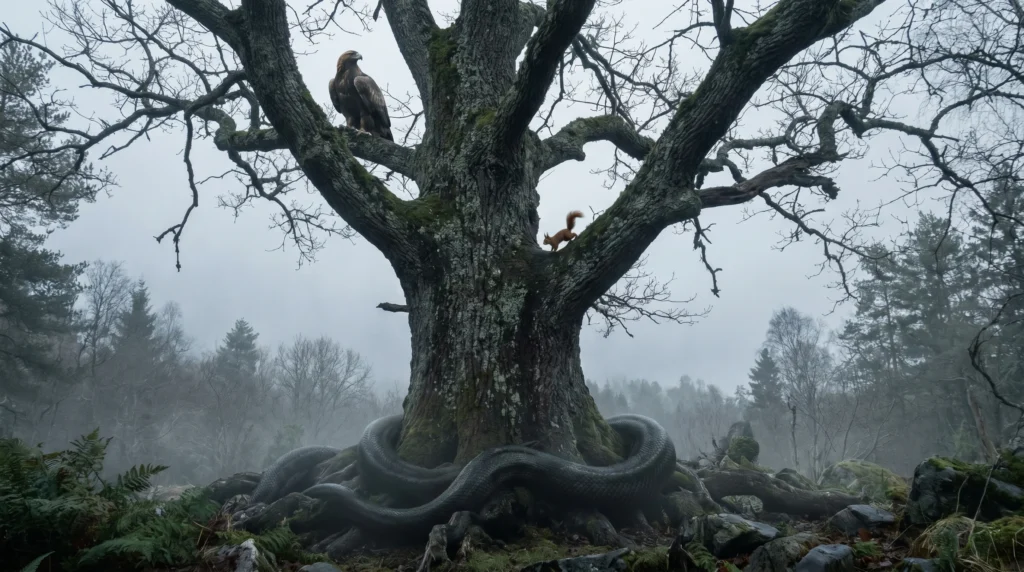
Grímnismál and Snorri populate the tree with creatures, but the poem gives compressed images while Snorri supplies names and motives.
- The eagle and Veðrfölnir: an unnamed eagle sits in the branches. Snorri adds that the hawk Veðrfölnir sits between its eyes.
- Ratatoskr: the squirrel runs between the eagle above and Níðhöggr below. Snorri says it carries malicious words between them.
- Níðhöggr: the being gnaws a root from below. The poems and Snorri also place other serpents beneath the ash.
- Four stags: Dáinn, Dvalinn, Duneyrr, and Duraþrór stretch their necks into the branches and feed on the shoots.
The texts emphasize damage rather than a tidy allegory. Grímnismál says Yggdrasil suffers more than people know: stags bite above, its side decays, and Níðhöggr gnaws below. Snorri balances that damage with the Norns’ daily care. A modern reader may see a cosmos that survives through maintenance, but the sources do not assign each animal a fixed symbolic definition.
Two famous animals require a separate note. The goat Heiðrún and the stag Eikþyrnir feed on a tree called Læraðr above Valhalla in Grímnismál. Some interpreters identify Læraðr with Yggdrasil, but the poem uses a different name and never makes that equation explicit. They should not be presented as unquestionably living in Yggdrasil.
The Nine Worlds of Yggdrasil: What Is Actually Known?
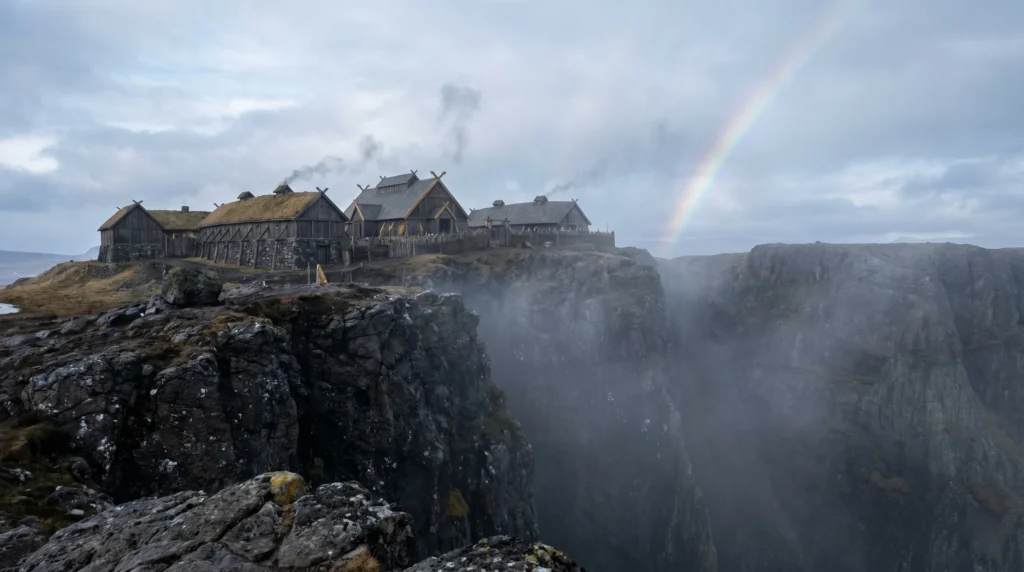
The phrase níu heimar, “nine worlds,” is genuinely old. The seer of Völuspá remembers nine worlds, and the giant Vafþrúðnir says he has travelled through nine worlds. What does not survive is a canonical list of nine, a statement that all nine sit on Yggdrasil, or a diagram showing their positions.
The familiar list below is therefore a modern reconstruction assembled from names found across different texts. It is useful as an index, not as a lost Viking map:
| Name used in modern lists | What the sources support |
|---|---|
| Ásgarðr | The enclosure or stronghold associated with the Æsir. |
| Miðgarðr | The middle enclosure associated with humankind. |
| Jötunheimr | A region or home of the jötnar, often beyond the gods’ enclosure. |
| Vanaheimr | A place connected with the Vanir; Njörðr speaks of being raised there. |
| Álfheimr | The place given to Freyr as a tooth-gift in Grímnismál. |
| Niflheimr | A mist-world central to Snorri’s account of origins and the lower root. |
| Muspell or Muspellsheimr | The fiery region and forces associated with Surtr in Snorri. |
| Hel | A being and a destination of the dead; the texts do not always use the term in one uniform way. |
| Niðavellir / Svartálfaheimr | Different dwarf-associated names in different passages; treating them as one fixed realm is a later harmonization. |
This distinction matters. It preserves the evidence while still answering the modern search for “the nine realms.” It also explains why online diagrams disagree: their creators must choose positions and equivalences that the medieval texts leave unresolved.
Can Yggdrasil Be Drawn as a Map?
Only as a reconstruction. The texts use several spatial ideas at once: roots extend toward peoples or regions; a well lies beneath the ash; gods travel to an assembly; an eagle occupies the height; Níðhöggr works below; Bifröst links the gods’ stronghold with other places. These relations are real within the narratives, but they do not resolve into one scale drawing.
Even the two root schemes resist a single diagram. Grímnismál organizes the roots around humans, frost giants, and Hel. Snorri organizes them around the gods, frost giants, and Niflheim, then assigns a well to each. A modern illustrator must choose one version, combine them, or invent a compromise. The finished picture can teach effectively only if it is labeled as a reconstruction.
The same caution applies to vertical stacks that place Asgard at the top, Midgard in the middle, and Hel at the bottom. Some passages support relative directions, but the complete nine-level arrangement belongs to modern visualization. The mythology is better understood as a network of roads, boundaries, wells, enclosures, and journeys than as a single diagram supplied by the Eddas.

Yggdrasil, the Gods, and the Norns
Snorri makes Yggdrasil a place of action rather than a decorative background. In Gylfaginning 15, the gods ride each day to hold judgment at Urðarbrunnr. Thor does not ride over Bifröst with the others; Snorri has him wade through named rivers. The scene joins cosmic geography with law and assembly.
The Norns also stand at the boundary between evidence and later imagery. Völuspá names Urðr, Verðandi, and Skuld and says they establish laws, choose lives, and determine destinies. Snorri makes them caretakers of the ash with water and clay. Neither passage says that the three women sit beneath Yggdrasil weaving one universal cloth. For the linguistic and historical distinction between Old English wyrd, Old Norse urðr, and the modern Web of Wyrd, see the guide to Wyrd.
The combined image is powerful without invention: judgment takes place by the tree, fate is declared beside it, animals consume it, and daily care prevents decay. Yggdrasil is not described as an invulnerable pillar. Its continued life depends on attention.

What Happens to Yggdrasil at Ragnarök?
Völuspá 47 gives the secure answer: the ash of Yggdrasil shudders, and the old tree groans as the crisis unfolds. The stanza does not say that the tree falls. Snorri describes the world burning and later renewed, but he does not provide a separate, unambiguous account of Yggdrasil’s destruction or survival.
The human survivors belong to a related but distinct passage. In Vafþrúðnismál 45, Líf and Lífþrasir hide in Hoddmímis holt and live on morning dew until generations return. Translators and scholars sometimes connect Hoddmímis holt with Yggdrasil or Mímameiðr. The poem itself, however, does not say “inside Yggdrasil.” Presenting that identification as certain turns a plausible interpretation into a quotation the source never gives.
The safest conclusion is deliberately narrow: Yggdrasil participates in the terror of Ragnarök by trembling, while the fate of the tree and the exact identity of the survivors’ refuge remain open.
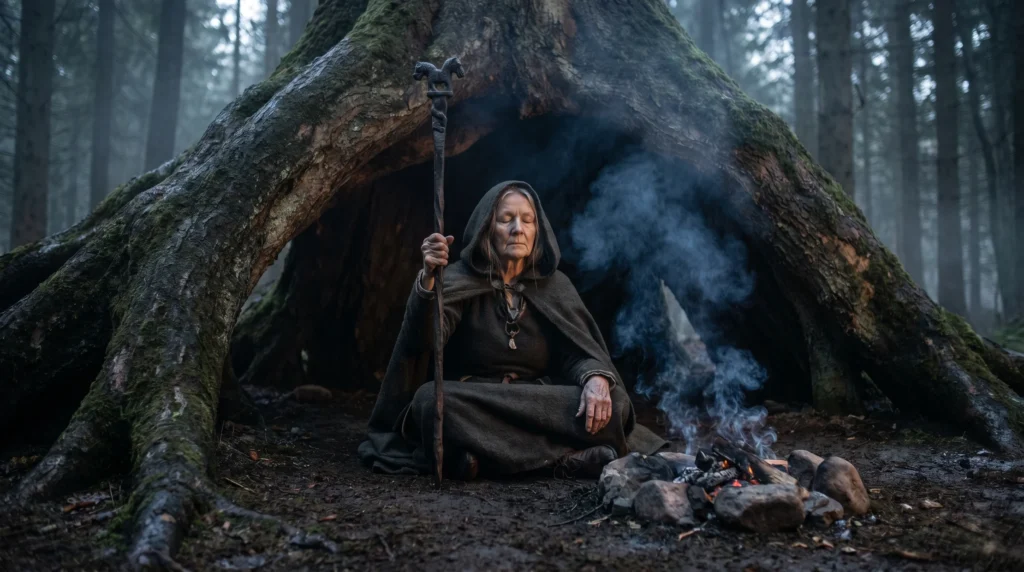
World Tree Symbolism and Later Interpretation
“World Tree” and “Tree of Life” are modern comparative labels, not titles spoken by a character in the Eddas. They can still be useful if they are kept downstream from the evidence. Yggdrasil connects divine judgment, the dead, giants, humans, water, animals, decay, and renewal-related traditions. Modern readers can reasonably interpret it as an image of interdependence and vulnerability.
Comparisons with Sámi or northern Eurasian ritual trees have also influenced modern discussions of Yggdrasil. They may help scholars ask how vertical cosmologies work across cultures, but similarity is not proof of a direct historical borrowing. Most importantly, no Eddic poem or saga describes a völva travelling through a fixed nine-level Yggdrasil map during seiðr. That reconstruction belongs to comparative interpretation and modern practice, not to the securely attested procedure of a Viking Age ritual.
Yggdrasil needs no invented doctrine to be extraordinary. The medieval texts preserve a living, suffering ash beside the well of fate: a meeting place, a habitat, a structure under pressure, and a name entangled with Odin’s search for knowledge. Where those texts stop, the honest account stops too.
What is Yggdrasil?
Yggdrasil is the great ash named in the Poetic Edda and described systematically by Snorri as the foremost or holiest of trees. The sources place the Well of Urðr beneath it, describe roots extending into different regions, and populate it with an eagle, Ratatoskr, four stags, serpents, and Níðhöggr.
What does Yggdrasil mean?
Yggdrasill is conventionally understood as “Yggr’s horse” or “Odin’s horse”: Yggr is a name of Odin and drasill is a poetic word for a horse. Scholars commonly connect the name with Odin’s hanging in Hávamál, although that poem does not name the tree in that passage.
What are the nine worlds of Yggdrasil?
The poems mention nine worlds, but no surviving Old Norse text supplies a definitive list of nine or a diagram showing them arranged on Yggdrasil. Familiar modern lists combine realm names drawn from different poems and from Snorri’s Prose Edda.
What creatures live in Yggdrasil?
Grímnismál and Snorri describe an eagle above, the hawk Veðrfölnir between its eyes, the squirrel Ratatoskr, four stags feeding on the tree, many serpents below, and Níðhöggr gnawing a root. Heiðrún and Eikþyrnir feed on a tree called Læraðr, which the texts do not explicitly identify as Yggdrasil.
What happens to Yggdrasil at Ragnarök?
Völuspá says Yggdrasil shudders and the old tree groans during the onset of Ragnarök. The surviving sources do not explicitly say that it falls, burns, or survives. Líf and Lífþrasir hide in Hoddmímis holt, but the poem does not explicitly call that refuge Yggdrasil.
Is Yggdrasil an ash tree or a yew tree?
The clearest primary evidence calls Yggdrasil an ash: Völuspá names an askr called Yggdrasil, and Snorri likewise describes the great ash. Identifying it as a yew is a later scholarly proposal, not a statement made by the medieval sources.
Is Yggdrasil the Tree of Life?
“Tree of Life” is a useful modern comparative label, but it is not an Old Norse title recorded for Yggdrasil. “World Tree” is the clearer modern description for the tree that links major places, divine assembly, fate, danger, and cosmic change.
Where is Yggdrasil located?
The sources do not provide a modern-style map. Grímnismál sends three roots toward humans, frost giants, and Hel, while Snorri gives a different arrangement involving the gods, frost giants, and Niflheim. The disagreement is part of the evidence.
What does Yggdrasil symbolize?
The medieval texts do not provide a single symbolic definition. Modern readers may reasonably see connection, dependence, maintenance, and vulnerability in an ash that joins regions while animals consume it and the Norns preserve it, but that is interpretation rather than a quoted Norse doctrine.
Sources consulted: Carolyne Larrington, The Poetic Edda (Oxford University Press), especially Völuspá, Hávamál, Grímnismál, and Vafþrúðnismál; Anthony Faulkes, ed. and trans., Edda: Prologue and Gylfaginning (Viking Society for Northern Research); John Lindow, Norse Mythology: A Guide to Gods, Heroes, Rituals, and Beliefs (Oxford University Press); Rudolf Simek, A Dictionary of Northern Mythology (Boydell & Brewer).
Music to read by
Each article has a soundtrack. Listen to Mythic Harmonies while you read.
Explore the music
Great work. Question: I heard of a story that a great wedge was pulled from one of the roots of Yggdrasil and that caused the great world flood. Have you heard this story? Source?
Thanks! I haven’t come across that story in the Old Norse sources I’ve read. It may come from a later retelling or another tradition. If you happen to know the source, I’d genuinely be interested to read it!