
Viking Funeral Rites: What the Norse Actually Did With Their Dead
- Viking funeral rites did not include a burning ship pushed out to sea. That image comes from the funeral of the god Baldr in the Prose Edda. No account of a human Norse funeral describes it, and no excavation has ever produced one.
- There was no single Viking funeral. Cremation and burial ran side by side for three centuries, varying by region, period and wealth, and the great ship graves belonged to a tiny elite.
- One eyewitness account survives, written by an Arab diplomat on the Volga in 922. This guide separates what he saw from what has been built on top of it since.
The most famous image of a Viking funeral is a longship drifting out to sea, sail alight, struck by a flaming arrow from the shore.
No Norse person was ever buried that way, as far as any evidence goes. But the image is not something Hollywood invented from nothing, and the usual debunking gets that part wrong.
It comes from a god.
In the Prose Edda, Snorri Sturluson describes the funeral of Baldr, killed by his brother’s hand and mourned by everything that exists. His body is carried to his ship Hringhorni, the greatest of all ships. The gods cannot launch it. A giantess named Hyrrokkin arrives riding a wolf bridled with vipers, and shoves the vessel out with a single push so violent that fire springs from the rollers and the earth shakes. Baldr’s wife Nanna dies of grief on the spot and is laid beside him. Thor consecrates the pyre with his hammer. Odin places the ring Draupnir on it. Baldr’s horse is led onto the fire in full harness.
That is where the burning ship comes from. It is one of the great scenes in Norse literature, and it is a story about the death of a god, written down by a Christian Icelander around 1220, more than two centuries after the conversion.
What actual Norse people did with their actual dead is a separate question, better documented, and stranger in its own way. It involved fire, ships, horses, mounds raised high enough to be seen from the sea, ale drunk in a dead man’s hall by the man about to inherit it, and in one recorded case a killing that no modern reader gets through comfortably.
This guide sets out what the evidence supports, where the evidence stops, and which parts of the story we have been telling ourselves.
The Ship That Belongs to a God
Baldr’s funeral is the only ship funeral in the entire Norse corpus that puts fire and open water together. Everything else points the other way.
Every ship burial ever excavated was buried in the earth or burned on land, with the remains then covered by a mound. Not one has been found adrift, and none of the medieval chroniclers who wrote about the Norse, often with considerable hostility, mentions the practice at all.
There is a practical argument too. A ship was the single most valuable object a Norse community could own, worth more than a farm and representing years of skilled labour. Burning one was already an extraordinary act of destruction. Burning one and then losing it to the tide, where it would drift, ground, and be stripped by strangers, makes little sense in a culture that built its mounds to be seen and remembered.
The flaming arrow is a different matter again. It appears nowhere, in any source, mythological or historical. It is a good shot in a film and nothing more.
One burning ship, then, for one god, in one story. As a description of what happened when a person died in ninth century Norway, there is nothing behind it.
Viking Funeral Rites: Fire and Earth
There was never one Viking funeral, and anyone who tells you otherwise is selling a simplification.
Across the Viking Age, roughly 793 to 1066, two practices ran alongside each other. The dead were burned, or the dead were buried. Which one you got depended on where you lived, when you lived, how much your family had, and possibly on what you or they believed, though that last part is the hardest to recover.
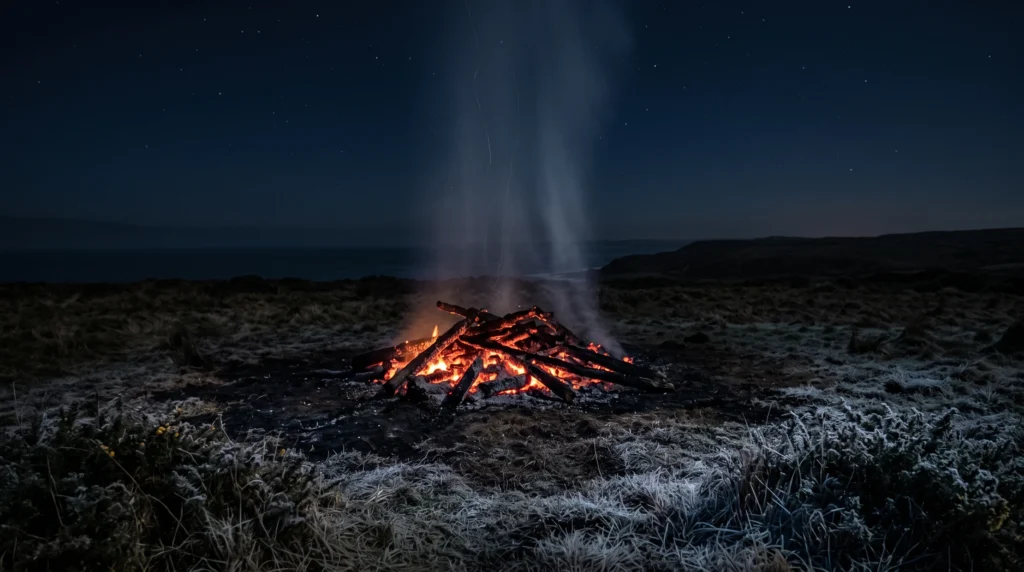
Cremation was widespread in Sweden and parts of Norway, and it remained common late. The body was burned on a pyre, often with grave goods, and the burned remains were then gathered and placed in the ground, sometimes in a pot, sometimes simply covered with earth or stones. In the Ynglinga saga, Snorri attributes the practice to a law of Odin: the dead should be burned with their possessions, and the higher the smoke rose, the higher the dead would be raised.
Snorri is writing around 1225, reconstructing a pagan past he never saw. His account is solid evidence of what medieval Icelanders believed about their ancestors. Whether those ancestors believed it too is a different question, and it stays open. Keep that gap in mind: it sits under almost every written source in this guide.
Inhumation, burial of the intact body, was common in Denmark, spread through Norway during the tenth century, and became the norm everywhere after Christianisation. The body was laid in a grave, sometimes in a chamber built of timber, often with goods around it, and covered with a mound.
The vast majority of Norse people, in either tradition, received something modest: a pit, a few personal items, a covering of stones. The graves that fill the museums are the exceptions, and it is worth holding on to that. What we know best about Viking funerals is what happened to the rich.
The Ship Graves
A handful of burials are so extravagant that they have shaped the entire popular image of the Viking Age. They deserve their reputation, and they deserve their context: a few dozen ship burials are known, against tens of thousands of ordinary graves.
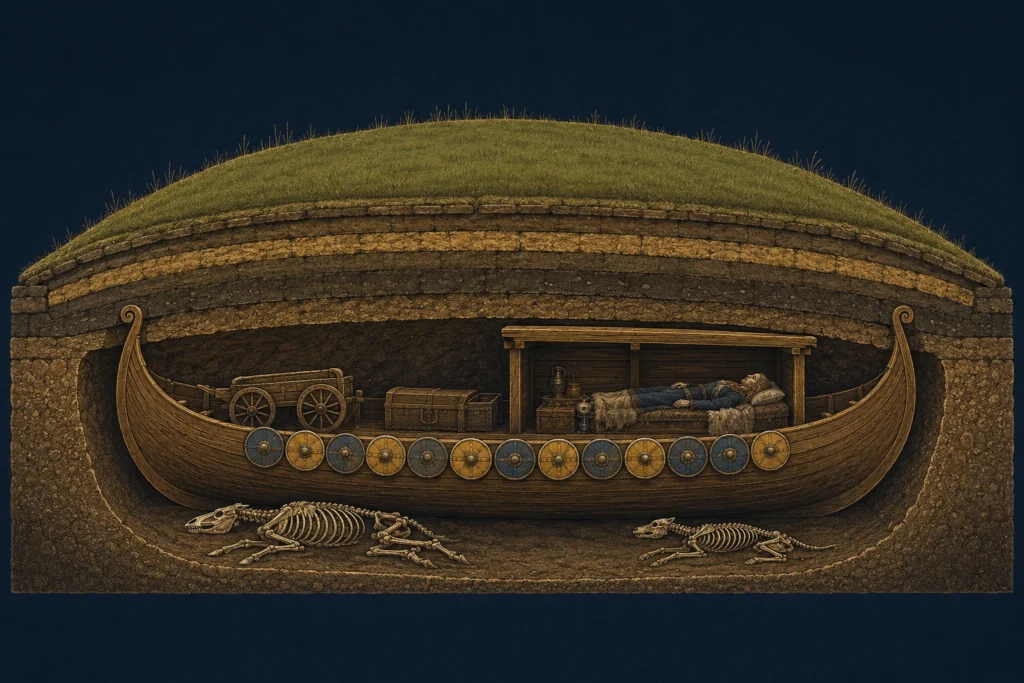
Oseberg, in Norway, is the richest burial of the Viking Age ever excavated. A ship built around 820, some twenty-two metres long, its prow carved into a spiral of gripping beasts, was hauled ashore and buried in the autumn of 834 under a mound of turf that sealed out the air and preserved wood, textile and leather for eleven centuries.
Two women were inside. One was between seventy and eighty, probably dead of cancer. The other was just over fifty, with no identifiable cause. Neither has been identified, and the Museum of the Viking Age in Oslo, which holds them, still poses the harder question openly on its own pages: which of the two was the principal burial, and was one of them killed to follow the other?
With them went a carved wagon, four sledges, beds, chests, looms, buckets, a full kitchen, and textiles including silk imported from far to the east. Animals too, though the counts differ between publications: fourteen or fifteen horses, three to six dogs, one or two oxen, depending on which you open. The mound was broken into in antiquity and the human remains disturbed, which is part of why the picture is not cleaner than it is.
The identification of the older woman with Queen Åsa is a guess that hardened into a caption. It may be right. Nothing establishes it.
Gokstad, further along the Oslofjord, held a man buried around 900 in a ship built about a decade earlier. He was between forty and fifty, powerfully built, 181 to 183 centimetres tall, with cut marks on both legs that indicate he died in a fight. His burial chamber was roofed with birch bark and hung with silk woven in gold thread. He went into the ground with sixty-four shields along the ship’s sides, three smaller boats, six beds, a sledge, a gaming board with horn pieces, and then the animals: twelve horses, eight dogs, two goshawks and two peacocks. The peacocks had travelled a very long way to be killed in a Norwegian field.
Ladby, in Denmark, around 925, is the only ship burial known in that country. The timber had rotted away entirely, leaving the ship’s ghost in the soil: a hull-shaped stain studded with the iron rivets that once held it together, the anchor still lying at the bow, horses and dogs among the outline.
| Oseberg | Gokstad | Ladby | |
|---|---|---|---|
| Country | Norway | Norway | Denmark |
| Buried | 834 | c. 900 | c. 925 |
| Occupant | Two women, 70 to 80 and just over 50 | Man, 40 to 50, died in a fight | Unknown, robbed in antiquity |
| Ship | Built c. 820, c. 22 m | Built c. 890, c. 24 m | Timber gone, only the rivets remain |
| Animals | 14 to 15 horses, 3 to 6 dogs, 1 to 2 oxen | 12 horses, 8 dogs, 2 goshawks, 2 peacocks | Horses and dogs |
| Notable | Richest Viking Age burial ever found | 64 shields, silk woven with gold | The only ship burial in Denmark |
The ship as a vessel for crossing to an afterlife is a reasonable reading, and no source states it. What the evidence does carry is display. These burials were enormously expensive, deliberately visible, and built to be looked at. A mound on a headland says as much about the family still living as about the person underneath.
What Went Into the Grave
Norse graves were furnished, and the furnishings were not random.
Weapons appear with some men and, less often, with some women. Tools appear with craftsmen. Jewellery, keys, spindle whorls and textile equipment appear with women. Gaming pieces turn up often enough to be notable. Food and drink were provided. Ships, wagons and sledges appear at the top end.
The most consistent inclusion at that top end is the horse, killed and placed in the grave. Dogs are nearly as common. No source spells out the belief behind it, but these were not symbolic substitutes. They were real animals of real value, destroyed. Baldr’s horse walking onto the pyre in full harness is the mythological version of something the archaeology finds in the ground again and again.
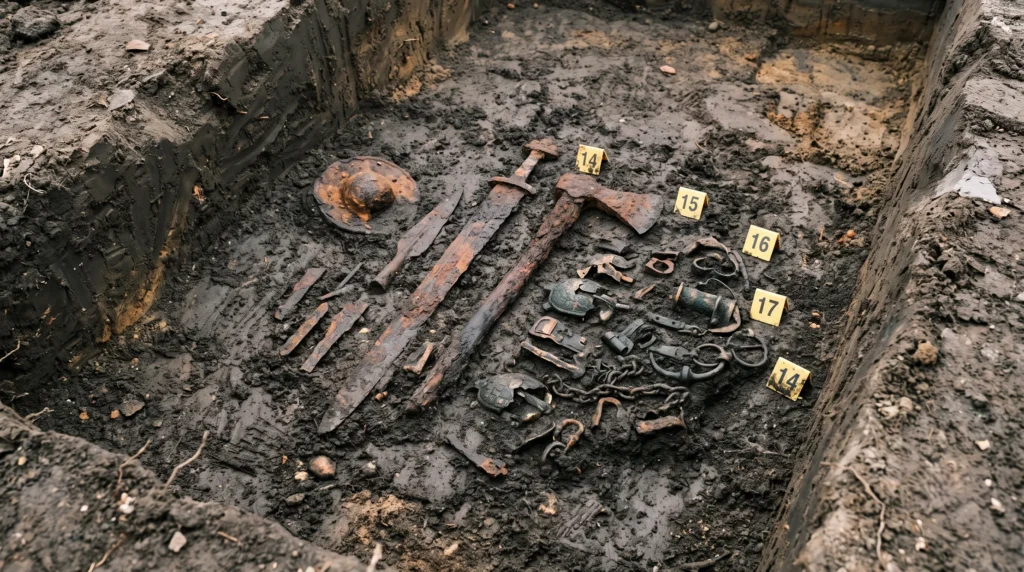
One grave deserves its own paragraph. Birka Bj 581, in Sweden, was excavated by Hjalmar Stolpe in 1878 and catalogued for well over a century as the burial of a high-ranking warrior. The chamber held a sword, an axe, a spear, armour-piercing arrows, a battle knife, two shields, and two horses, a mare and a stallion, one of them bridled for riding. A bag of gaming pieces lay in the occupant’s lap and a gaming board stood propped beside them, a combination often read as the mark of someone who commanded rather than simply fought.
In 2017, a genomic study led by Charlotte Hedenstierna-Jonson, published in the American Journal of Physical Anthropology, established that the individual was biologically female, confirming an earlier osteological reading. That finding is not seriously disputed.
What it means is. A follow-up paper in Antiquity in 2019 restated the case for a female professional warrior; other scholars have argued from the 1878 excavation records that the chamber may hold a primary male burial with a secondary female one. Whether grave goods describe the life of the person buried or the claims of the family burying them has been argued ever since, and it remains argued. That is the state of it, and it is more interesting than either headline version.
Ibn Fadlan on the Volga
We have exactly one detailed eyewitness account of a Norse funeral, and it comes from an Arab diplomat who found the whole thing repellent.
Ahmad ibn Fadlan travelled from Baghdad to the Volga in 921 as part of an embassy from the Abbasid caliph. There he met the Rus, traders and settlers of Scandinavian origin operating along the river, and in 922 he watched the funeral of one of their chieftains. His account is precise, dated, and unlike anything else that survives.
He begins with the accounting, which is worth noting because it will matter later. A wealthy man’s estate, he was told, was divided into three: one third to his heirs, one third to pay for the elaborate clothes he would be burned in, and one third to buy the drink for his funeral.
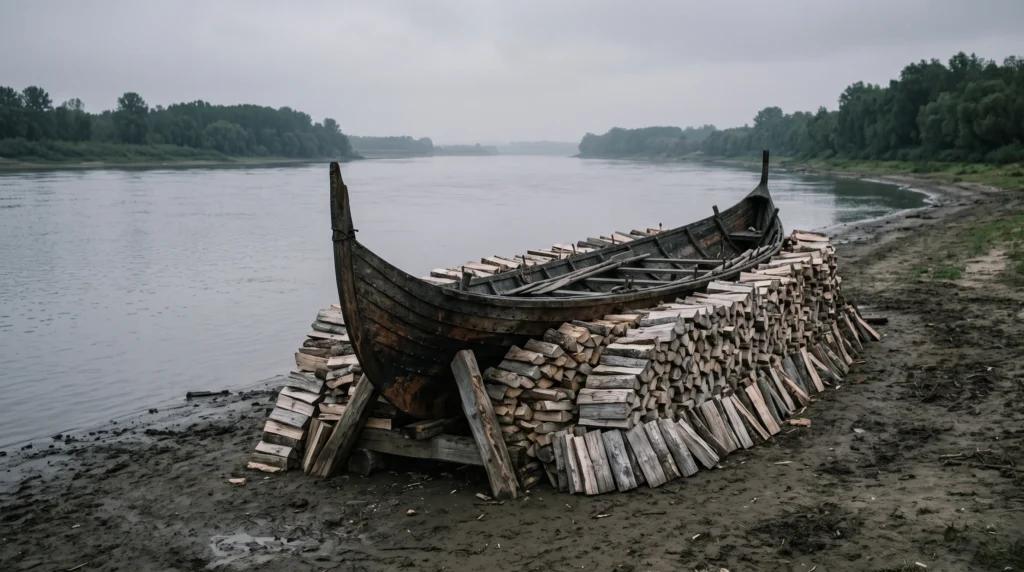
The dead man was placed in a temporary grave for ten days while those clothes were sewn. His ship was drawn up onto the shore, propped on birch timbers, and surrounded by a great stack of wood. A bench was set aboard and covered with Byzantine silk brocade. Then an old woman arrived whom the Rus called the Angel of Death, and Ibn Fadlan watched her take charge of everything: the sewing, the arrangement of the corpse, and the killing.
A slave woman of the dead man’s household had agreed to die with him, and spent the days that followed drinking and singing. On the day itself, men lifted her three times above a wooden frame so that she could look over it, and each time she described what she said she saw beyond: her father and mother, then her assembled dead kin, then her master in a place that was green and beautiful, calling her to him. She beheaded a hen and threw the body aboard the ship. She gave away the bracelets she was wearing.
Then she was taken into a chamber on the deck. Men beat their shields with sticks outside so that her cries could not be heard by the other slave women. She was held down by the hands and feet, a cord was crossed around her neck and pulled by two men, and the Angel of Death drove a broad-bladed knife between her ribs, again and again, until she was dead. She was raped by six men before this happened. The account does not soften it and neither should any retelling of it.
The animals followed: a dog, two horses run until they sweated and then cut apart, two cows, a cock and a hen. The dead man’s closest relative approached the pyre naked, walking backwards with a lit brand held behind him, and set the wood alight. Ship, chieftain, goods, animals and the woman burned together on the shore. A mound was raised over the ashes, and a birch post was set on top with the dead man’s name cut into it.
Four things need saying about this account, and most retellings say none of them.
It describes the Rus on the Volga, not a farm in Norway. The Rus were of Scandinavian origin, which is not the same as saying their practice matched Scandinavian practice.
It is one funeral, of one wealthy man, on one day. It is not a rulebook, and there is no reason to assume every Norse funeral resembled it.
Ibn Fadlan was an outsider writing for a Muslim readership, and his disgust is on the page. That does not make him a liar, and the sheer specificity of his account argues strongly that he saw what he describes. It does mean he was interpreting while he watched, through an interpreter, in a language he did not speak.
And the human sacrifice is real. It is in his account, it is echoed in scattered archaeological evidence of multiple burials where one individual shows signs of a violent death, and the Museum of the Viking Age raises the same possibility about the two women at Oseberg. The Viking Age was not gentle, and a guide that presents it as gentle is not telling you about the Viking Age.
Where the Dead Were Going
The funeral tells you what was done. Where the Norse thought the dead went is a separate question, and the sources for it are later, mostly Icelandic, and mostly written by Christians recording a religion that had already ended.
What they preserve is not one afterlife but several.
Valhalla, Odin’s hall, receives those who fall in battle, chosen by the valkyries, to feast and fight until Ragnarök. It is the version everybody knows, and it is only half the story, because Grímnismál states plainly that Freyja takes half of the slain to her own field, Fólkvangr. Two halls, an even split, and the second is almost always left out. We took that division apart in the guide to Valhalla and Fólkvangr.
Hel, the realm below, receives those who die of sickness and old age, which is to say almost everybody. The Prose Edda describes it without much relish and without much horror either. It is not a punishment. It is where you go.
The drowned belong to Rán, who draws sailors down in her net. The idea is old, and it is felt rather than systematised: when Egil Skallagrímsson lost his son to the sea, the poem he wrote in his grief, Sonatorrek, turns on his inability to take revenge on an ocean.

Underneath all of this runs something else, more persistent and less tidy: a sense that the dead stayed near their mound. The sagas are full of it, the dead who sit in their howes, who must be dealt with, who are not entirely gone. That belief, more than any hall in the sky, may explain why the mound mattered so much.
The Stones That Stayed Above Ground
Not every memorial was a grave.
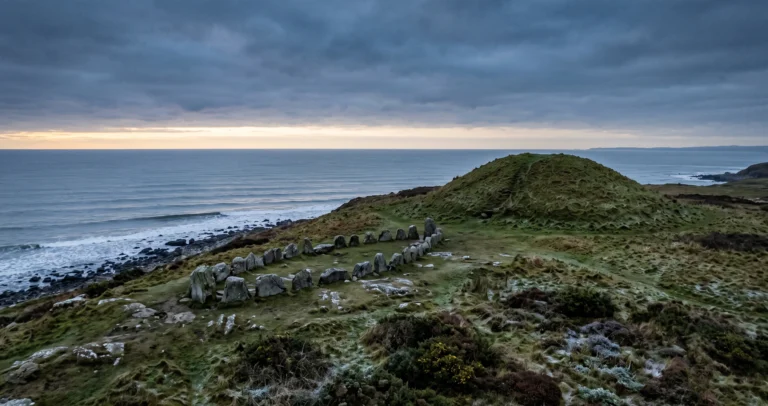
Stone ships, hull outlines laid out in standing stones, are found across Scandinavia. The most spectacular is Ale’s Stones in Skåne, southern Sweden, where fifty-nine boulders trace a vessel sixty-seven metres long on a clifftop above the Baltic.
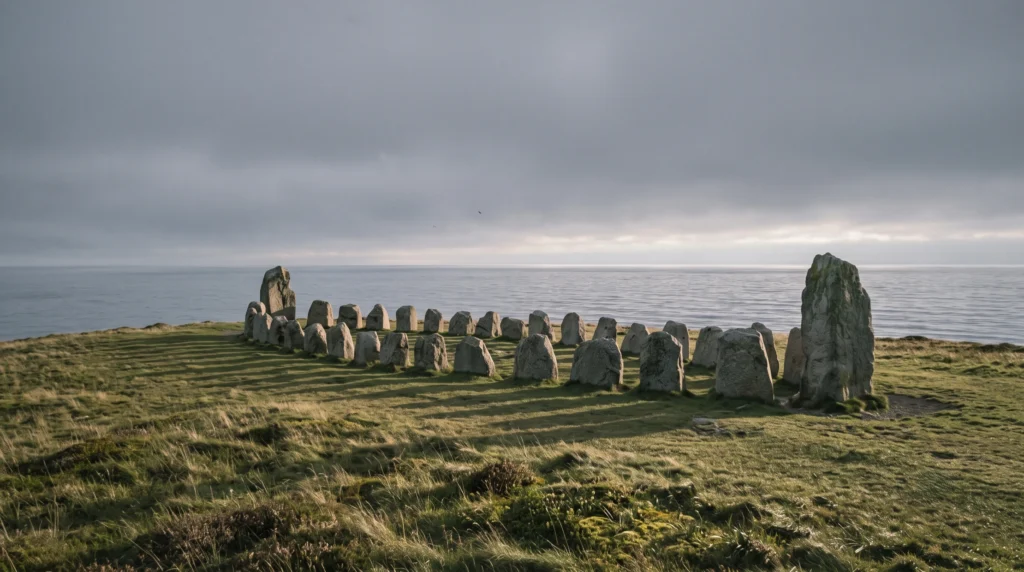
It is worth being exact about it, because almost every article calls it Viking. Radiocarbon dating carried out for the Swedish National Heritage Board points to roughly 600 CE, at the end of the Nordic Iron Age, a century and a half or more before the Viking Age begins. A pot containing burnt human bone was found within the setting in 1989, which supports a funerary reading. A grave monument, a cult site and a solar calendar have all been argued in print, and the argument has not been settled.
Runestones are later, mostly tenth and eleventh century, and mostly raised after the conversion. They are memorials, and they are frequently something else at the same time: a public record of who inherited. A very large number follow the same formula, that one named person raised this stone in memory of another, and the naming is doing legal work alongside the grief. The Elder Futhark had long given way to the shorter younger row by the time most of them were cut.
The person named on a runestone is very often not buried anywhere near it. Many died abroad, in Byzantium, in England, on rivers whose names the carver spelled as best he could.
The Feast That Followed
The funeral did not end at the grave, and what came afterwards may say the most about what it was for.
The Norse held a funeral feast, the erfi, sometimes called the funeral ale or inheritance ale. It was not held immediately. It could come days later, and in some accounts as much as a year later, giving the family time to gather guests and brew provisions worth the occasion. Ibn Fadlan’s third of the estate set aside for drink is the same institution seen from the outside.
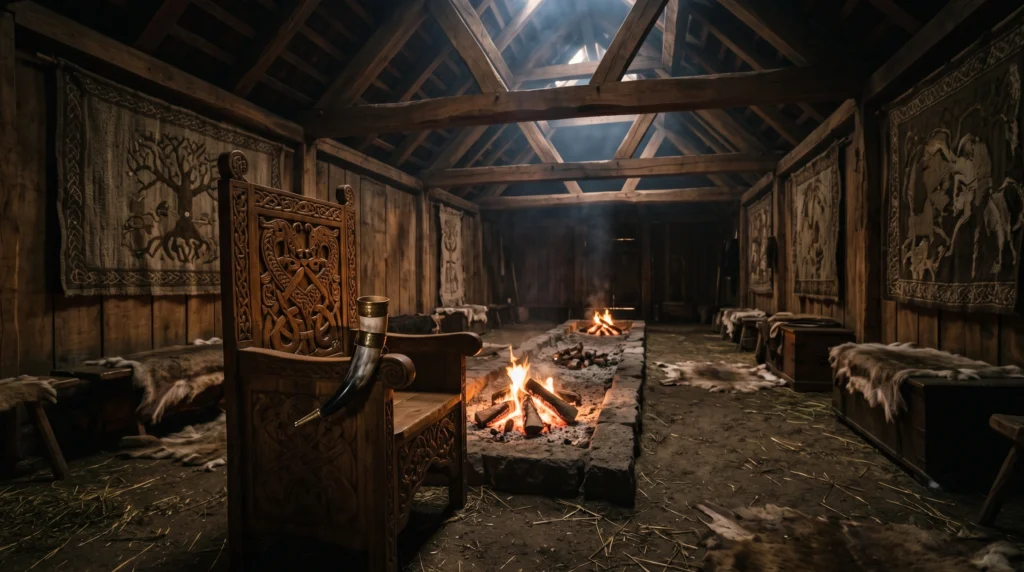
At its centre was a formal moment, described in the Ynglinga saga and again in Fagrskinna. The heir sat on the step in front of his father’s high seat, not on the seat itself, while the memorial cups went round. Then the cup called the bragarfull was carried in. He stood, swore a vow aloud, drank the cup down, and only then climbed into the high seat his father had occupied. At that instant, in front of witnesses, the inheritance was his.
All of that reaches us through thirteenth century Icelandic writers, at the usual distance. But something older survives, and it is carved in runes.
The Tune stone, from Østfold in Norway, was cut in the Elder Futhark around 400 CE, four centuries before the Viking Age. Its inscription commemorates a man named Woduridaz, and one line of it reads þrijoz dohtriz dalidun arbija: three daughters did something involving arbija.
What they did turns on one word, and runologists have argued over it for more than a century. Read one way, the three daughters prepared the funeral ale. Read another, they shared the inheritance. Both readings have serious scholarship behind them, and the debate was still going in the journal Futhark as recently as 2012.
Either way, the stone is remarkable. It is the oldest surviving evidence in Scandinavia that connects a death, an inheritance and a rite, it names women as the ones carrying it out, and the two possible meanings of that single word are the same two things the erfi was for. Grief and law in the same room, eight hundred years before Snorri wrote it down.
That combination reaches its clearest expression in a stanza of the Hávamál that has outlived every institution around it. Cattle die. Kinsmen die. You will die yourself. What does not die is the judgement passed on a man once he is gone.
The mound, the ship, the horses, the feast, the stone: all of it was aimed at that last line.
What We Still Do Not Know
This is the part most guides skip, so it gets its own section.
What the Norse thought was happening at the moment of cremation is beyond recovery. Snorri offers an explanation, two centuries too late to be a witness.
How far Ibn Fadlan’s funeral represents anything beyond itself, nobody can say.
Why some regions burned their dead while their neighbours buried them, and why the practice shifted when it did, has never been satisfactorily explained.
The meaning of the ship in a ship burial is open. Vessel for a crossing, statement of wealth, symbol of a life at sea, all three at once: no source says, and confident answers are interpretations wearing the costume of evidence.
On the Tune stone, three daughters either brewed the ale or divided the land, and one disputed word stands between the two.
And nobody knows what an ordinary funeral sounded like. Whether anything was sung, whether anything was spoken aloud, whether there was silence at all. Nothing survives. That absence is the one this project works in, and naming it is more honest than filling it.
Before you close this tab
The silence at the end of this article
Every source in this guide is a description written by someone standing outside the fire. Ibn Fadlan watched through an interpreter. Snorri wrote two centuries after the last pyre went cold. The stones give us names and one disputed verb.
None of them recorded a sound.
That is where this project starts. Mythic Harmonies builds from the same Eddas, the same inscriptions, the same archaeology you have just read about, using only the instruments the evidence supports, in the language the skalds actually used. Valhöll Kallar is a funeral chant written from the hall that calls the slain: not a reconstruction of what was sung at a graveside, because nobody can reconstruct that, but an honest reach toward it.
Every song is published with its Old Norse text and its translation, and where the sources fall silent, the songs say so.
Frequently Asked Questions
Did Vikings really burn their dead on ships pushed out to sea?
There is no evidence that they did. The image comes from Norse mythology rather than from history: the Prose Edda describes the god Baldr laid on his ship Hringhorni, which is launched by a giantess and set alight. No account of a human Norse funeral describes the practice, and every ship burial ever excavated was buried in the earth or burned on land before being covered by a mound. The flaming arrow appears in no source at all.
What was a Viking funeral actually like?
There was no single form. Cremation and burial were both practised throughout the Viking Age, varying by region, period and wealth. Most people received a simple grave with a few personal possessions. A small elite received ship burials, timber chamber graves and mounds, sometimes with horses, dogs and goods worth a fortune.
Why were Vikings buried with their horses?
Horses appear in a large number of high-status graves, along with dogs and occasionally hawks. Gokstad held twelve horses and eight dogs, Oseberg fourteen or fifteen horses depending on which publication you follow. No source explains the practice directly. What is clear is that these were real animals of real value, killed for the burial rather than represented symbolically, which places the custom among the most expensive elements of an already expensive funeral.
Did Viking funerals include human sacrifice?
In at least some cases, yes. Ibn Fadlan’s eyewitness account of a Rus chieftain’s funeral in 922 describes a slave woman being killed and burned with her master, and archaeology has produced multiple burials in which one individual shows signs of a violent death. The Museum of the Viking Age raises the same possibility about the two women buried together at Oseberg. How common the practice was across Scandinavia is not known.
Where did Vikings believe the dead went?
To several places, not one. Those who fell in battle were divided between Odin’s Valhalla and Freyja’s Fólkvangr, an even split stated in Grímnismál. Those who died of sickness or old age went to Hel, the realm below, which the sources describe without horror. The drowned belonged to Rán. Alongside all of this ran a persistent belief that the dead remained close to their burial mound.
Is Ale’s Stones a Viking monument?
Not quite. The stone ship at Ale’s Stones in southern Sweden is usually described as Viking, but radiocarbon dating carried out for the Swedish National Heritage Board points to around 600 CE, at the end of the Nordic Iron Age, which places it before the Viking Age. Its purpose is disputed: a burial monument, a cult site and a solar calendar have all been proposed, and a pot of burnt human bone was found within the setting in 1989.
What is a Viking funeral feast?
The erfi, or funeral ale, held after the burial and sometimes as much as a year later. Its central moment was the heir sitting on the step before his father’s high seat until the cup called the bragarfull was brought in, then standing, swearing a vow, draining it, and only then taking the seat. The inheritance passed publicly, in front of witnesses. The description comes from thirteenth century Icelandic sources, but the Tune stone, carved in Elder Futhark around 400 CE, may record the same institution a full four centuries earlier.
Snorri Sturluson, Prose Edda, Gylfaginning chapter 49, c. 1220, for the funeral of Baldr aboard Hringhorni; Ynglinga saga, c. 1225, for cremation attributed to Odin and for the bragarfull and the high seat, with a parallel account in Fagrskinna. Ahmad ibn Fadlan, Risala, account of the embassy to the Volga Bulgars, 921 to 922 CE, cited here from the annotated English translation by James E. Montgomery, for the only surviving eyewitness description of a Rus funeral. The Poetic Edda, in particular Grímnismál stanza 14 for the division of the slain between Valhalla and Fólkvangr, and the Hávamál for the stanza on reputation after death. Egil Skallagrímsson, Sonatorrek, for grief at a drowning.
Runic material: the Tune stone, Østfold, Elder Futhark, c. 400 CE, and the continuing debate over dalidun arbija, most recently in Thórhallur Eythórsson, “Three Daughters and a Funeral: Re-reading the Tune Inscription”, Futhark: International Journal of Runic Studies 3 (2012).
Archaeological material and museum documentation: the Oseberg ship burial, dendrochronologically dated to the autumn of 834, and the Gokstad ship burial, ship built c. 890 and buried c. 900, both held and published by the Museum of the Viking Age, University of Oslo; the Ladby ship burial, Denmark, c. 925; grave Bj 581 at Birka, excavated by Hjalmar Stolpe in 1878, with Charlotte Hedenstierna-Jonson et al., “A female Viking warrior confirmed by genomics”, American Journal of Physical Anthropology (2017) and the follow-up reassessment in Antiquity (2019); the stone ship at Ale’s Stones, Skåne, radiocarbon dated for the Swedish National Heritage Board to c. 600 CE.
Music to read by
Each article has a soundtrack. Listen to Mythic Harmonies while you read.
Explore the music