
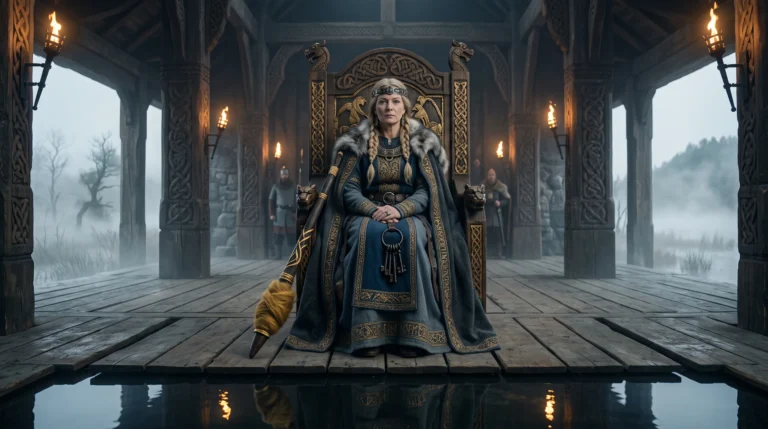
Frigg: The Norse Goddess Who Knew Everything and Said Nothing
She knew her son would die. She knew who would cause it, and she knew that nothing she did would change it. So Frigg, queen of Asgard, did the only thing a mother with her power could do: she made the entire world swear an oath, and the world obeyed. Fire swore. Iron swore. Sickness, stones, serpents and oak trees swore. Only one small plant was overlooked, and the nine worlds would weep for it.
That is Frigg in a single story: the most powerful seeress in Norse mythology, and the only one who never speaks her visions aloud. Odin hung himself from a tree for wisdom. The Norns carve fate into wood. Frigg simply knows, and keeps her silence, and that silence is the most haunting thing in the entire mythology.
“Frigg knows all fates, though she herself does not speak out.”
Lokasenna, the Poetic Edda
- Frigg is the queen of Asgard and its greatest seeress: wife of Odin, mother of Baldr, goddess of marriage and motherhood, she knows the fate of every being and reveals none of it.
- The sources are thin but extraordinary: from the Merseburg Charm in Old High German to the Lombard origin legend, her handful of stories show her outwitting Odin twice and breaking her silence exactly once, at the cost of her son.
- Her legacy is hiding in plain sight: Friday literally means Frigg’s day, and the name of Lombardy still carries the trick she played at dawn.
Who Is Frigg?
Frigg (pronounced “FRIG”, Old Norse Frigg) is the queen of the Norse gods, wife of Odin, mother of Baldr, and the goddess of marriage, motherhood and foresight. She rules Asgard at Odin’s side, dwells in her own hall called Fensalir, and holds a power no other god shares: she knows the fate of every living being, though she never reveals what she sees.
Among the Aesir her authority is second only to Odin’s, and in some stories not even that. Snorri Sturluson, writing in the Prose Edda, ranks her first among the goddesses. The poets called her Sky Queen, Lady of the Aesir, and mother of the slain god. Her name likely descends from a Proto-Germanic word meaning “beloved”, the same root that gave us the word “free”, and versions of her were worshipped far beyond Scandinavia: the Lombards knew her as Frea, the Old High Germans as Frija, the Anglo-Saxons as Frig.
| Role | Queen of Asgard, goddess of marriage, motherhood and foresight |
| Family | Wife of Odin, mother of Baldr and Höðr |
| Hall | Fensalir, the Marsh Halls |
| Powers | Knows all fates, speaks none; weaves the clouds |
| Symbols | The distaff and spindle, keys, mistletoe, the marsh |
| Companions | Fulla, Gná and Hlín, her three handmaidens |
| Legacy | Friday literally means Frigg’s day |
What the Sources Actually Say
Honesty first, because it is what separates real mythology from fantasy filler: Frigg is one of the most important goddesses in the Norse pantheon and one of the least documented. The surviving sources give us a handful of scenes, and everything else written about her online is reconstruction.
Here is what actually survives. In the Prose Edda, Snorri names her queen of the gods, describes her hall Fensalir, and makes her the emotional center of the Baldr story. In the poem Lokasenna, she trades insults with Loki, and it is there that Freyja delivers the line that defines her: Frigg knows all fates, though she herself does not speak. In the prologue to the poem Grímnismál, she outmaneuvers Odin himself in a wager over two royal foster sons, proof that her quiet is not weakness. The poem Vafþrúðnismál opens with Odin asking her advice before the most dangerous journey of his life, because even the god of wisdom consults his wife first.
The sources also preserve her one scandal, and a serious article should not hide it. In Lokasenna, Loki accuses Frigg of having taken Odin’s brothers Vili and Vé into her embrace, and the Ynglinga saga backs the story: during one of Odin’s long exiles, his two brothers ruled in his place and, the saga says plainly, shared his wife. When Odin returned, he took her back without a recorded word of reproach. Scholars read the episode less as gossip than as archaic myth, the queen as sovereignty itself, held by whoever holds the throne, but it shows how unflinching the tradition was about its own gods.
And then there is the oldest evidence of all, from outside Scandinavia entirely. The Second Merseburg Charm, a healing spell written down in Old High German around the ninth or tenth century, shows Frija and her sister Volla working magic to heal the injured leg of Balder’s horse. It is one of the very few pieces of Germanic paganism preserved in German, and there she is at its center, already a healer, already beside Baldr, centuries before the Icelandic manuscripts were written. For the wider Viking world these figures traveled with the language itself, the same way the runes of the Elder Futhark did, carried from one Germanic people to another until every land had its own spelling of her name.
Frigg vs Freyja: One Goddess or Two?
No question about Frigg gets asked more often, and no honest article can dodge it: is Frigg the same goddess as Freyja?
In the Icelandic sources, they are clearly two separate figures. Frigg is the wife of Odin, queen of the Aesir, goddess of marriage; Freyja is of the Vanir, married to the absent Óðr, goddess of love, war and seiðr magic. They appear in the same scenes, speak to each other, and are never confused by the poets.
And yet the deeper you dig, the stranger it gets. Freyja’s husband Óðr bears a name that is essentially Odin’s. Both goddesses weep for an absent beloved. Both are accused by Loki, in the same poem, of the same kind of infidelity. Both practice or embody foresight. And when the Germanic peoples translated the Roman weekday dies Veneris, the day of Venus, they chose Frigg for the honor, giving the love goddess’s day to the marriage goddess, as if the two roles had not yet fully separated.
That is why many scholars believe Frigg and Freyja descend from a single great Germanic goddess, a Frija figure who split into two personalities somewhere on the road between the migration age and the Viking Age: the sovereign wife on one side, the wild lover on the other. Others point out that the evidence is thin and the two are firmly distinct in every text we actually possess. The honest answer is that both positions are defensible, and the mystery itself tells you something true about Norse religion: it was never a tidy system, it was a living thing with regional dialects, and Frigg and Freyja may be the clearest surviving seam.
| Frigg | Freyja | |
|---|---|---|
| Tribe | Aesir | Vanir |
| Husband | Odin | Óðr |
| Domain | Marriage, motherhood, fate | Love, war, magic |
| Hall | Fensalir | Sessrúmnir in Fólkvangr |
| Style of power | Silent foresight | Active seiðr sorcery |
| Weekday | Friday bears her name | Sometimes claimed, less likely |
Her Powers: Foresight and Silence
Every important god in the Norse cosmos pays for knowledge. Odin gave an eye at Mímir’s well and hung nine nights on the world tree. The völva must be raised from the grave to prophesy. Even the Norns are bound to the roots of Yggdrasil, endlessly carving.
Frigg alone simply knows. No sacrifice is recorded, no ordeal, no price. The knowledge of every fate sits with her like breath, and she does not use it. She does not warn, does not bargain, does not intervene, with one shattering exception we will come to. The poets present this not as passivity but as a form of power too large to wield: she sees the whole tapestry, and perhaps that is exactly why she stays silent, because she knows better than anyone that fate in the Norse world cannot be changed, only met well.
Her silence should never be mistaken for meekness. In the prologue to Grímnismál, she and Odin each raised a human foster son, and Odin mocked her boy as a failure. Frigg answered with a masterstroke: she engineered events so that Odin’s own favorite would torture a disguised Odin between two fires, and her accusation of stinginess against the king’s protégé came true by Odin’s own test. The all-father, who wins every riddle contest in the mythology, loses to his wife. She also shares his high seat Hliðskjálf, the throne from which all worlds can be seen, a privilege granted to no other god.
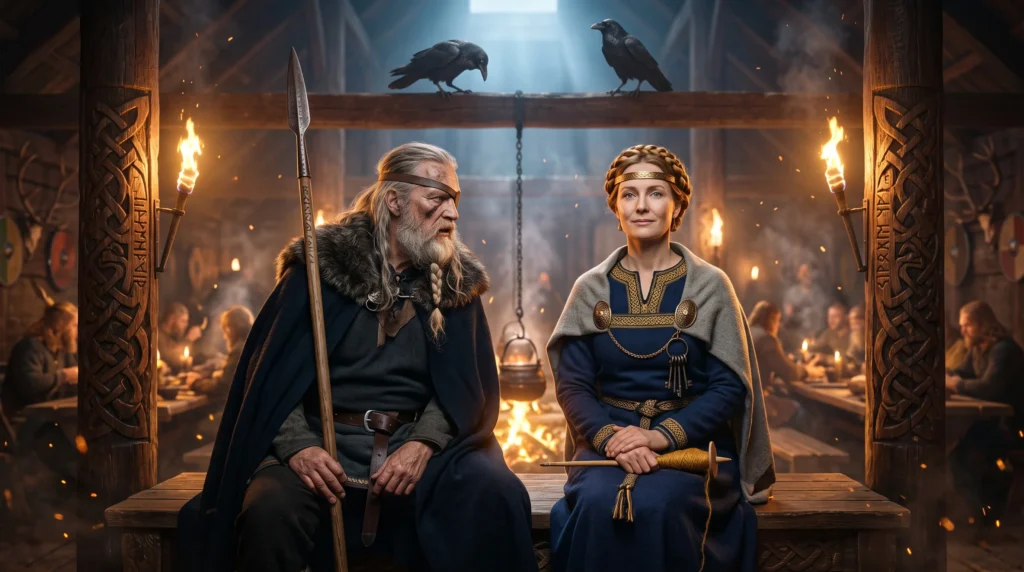
One more power belongs to her, quieter and lovelier: she spins. Late Scandinavian folklore remembered the constellation we call Orion’s Belt as Friggerock, Frigg’s distaff, and the image fits the oldest layer of her character perfectly. The queen of heaven sits at her spinning wheel, drawing out the clouds like wool, spinning the thread that the Norns will measure and cut. She makes the thread of fate; she just refuses to tell you where it ends.
Fensalir and Her Handmaidens
Frigg’s hall is called Fensalir, the Marsh Halls, and the name is stranger than it first sounds. The other gods build on mountains and plains; the queen of Asgard builds over wetland, the in-between ground that is neither water nor earth. Marshes were places of sacrifice in the real Viking world, where offerings were sunk into dark water, and they are places of hidden depth, where still surfaces conceal everything beneath. It is hard to imagine a better address for a goddess whose entire character is calm surface over bottomless knowledge.
She does not keep her court alone. Three handmaidens serve her, and they read like three aspects of the queen herself. Fulla, the maiden with flowing golden hair, carries Frigg’s ash box and, Snorri says plainly, shares her secrets, the only being in the nine worlds who knows what Frigg knows. Gná is her messenger, riding a horse called Hófvarpnir that runs on air and sea, the queen’s will made swift. And Hlín is the protector, sent out to shield the people Frigg wishes to save, so central to her mistress that in the great poem Völuspá, Frigg’s grief at Ragnarök is called the second sorrow of Hlín. Secret keeper, messenger, shield: a complete government of quiet power.
The Death of Baldr: The Day the Silence Broke
Everything in Frigg’s story bends toward one catastrophe. Her son Baldr, the shining god, the best loved being in all the worlds, began to dream of his own death. And Frigg, who knew every fate, knew these dreams were true.
For the first and only time in the mythology, she acted against what she saw. She traveled the nine worlds and took an oath from everything in existence: from fire and water, from iron and every metal, from stones, earth, trees, sicknesses, beasts, birds, venoms and serpents. Nothing would harm Baldr. The oath held so completely that the gods invented a game from it, hurling weapons at Baldr in the assembly and laughing as spears bounced off him like reeds.
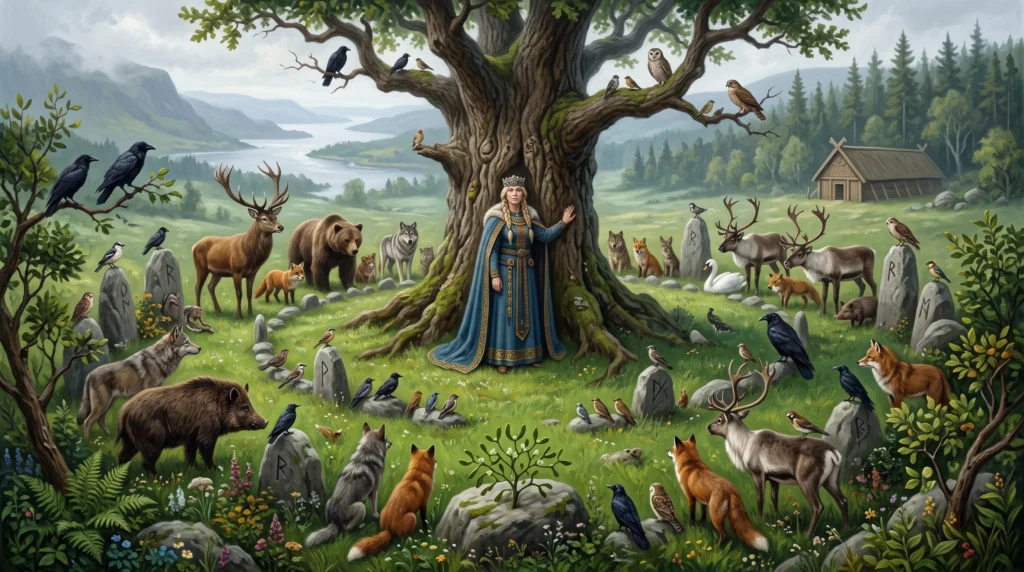
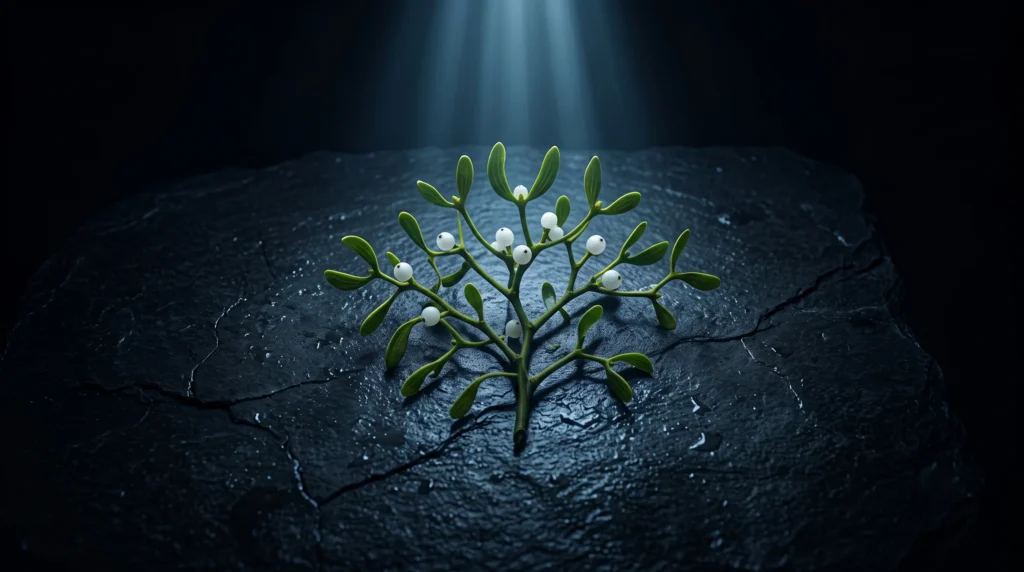
One being did not laugh. Loki, in the shape of a woman, came to Fensalir and asked Frigg an innocent question: had truly everything sworn? And here the mythology delivers its cruelest stroke, because it is Frigg’s own answer that kills her son. One small plant, she said, growing west of Valhalla, called mistletoe: it seemed too young to demand an oath from. The goddess who never speaks spoke once too often. Loki cut the mistletoe, placed it in the hands of Baldr’s blind brother Höðr, guided his aim, and the one thing in creation that had made no promise went through the shining god like a spear.
Even then she did not surrender. At her urging, Hermóðr rode nine nights down the dark road to Hel, and the queen of the dead offered a bargain: if every thing in the world would weep for Baldr, he could return. Once more Frigg’s messengers went out, and once more everything obeyed, humans, beasts, stones and metals weeping as they still do when frost turns to thaw. Everything wept but one giantess in a cave, who said Baldr had brought her nothing and Hel could keep what she held. Most tellers agree the giantess was Loki in another mask. By one withheld oath her son died; by one withheld tear he stayed dead. Frigg’s story is a perfect tragic machine, and she saw every gear of it in advance. You can follow where it leads on our timeline of Norse mythology, because the death of Baldr is the hinge of the whole cosmos: the first grief, the arrest of Loki, and the long road to Ragnarök.
The Queen Who Named a People
One story survives that no reader of the Eddas alone would ever find, because it was written down in Italy. The Origo Gentis Langobardorum, a seventh century Lombard chronicle, and Paul the Deacon after it, tell how a small people called the Winnili faced war against the mighty Vandals. The Vandals prayed to Godan, the southern name for Odin, who declared he would grant victory to whichever army he saw first at sunrise. The Winnili prayed instead to his wife Frea, our Frigg, and she gave them a plan worthy of Fensalir.
She told the Winnili women to loose their long hair and tie it across their faces like beards, then stand with their men in the dawn light. And overnight she turned the bed of the sleeping Godan to face them. When the god woke and looked out, he startled: “Who are these longbeards?” And Frea sprang the trap of his own words: whoever names a people must grant them the naming gift, and he had seen them first besides. Victory went to the Winnili, who bore their new name forever after: the Langobards, the Longbeards, the Lombards who would one day rule Italy and leave their name on Lombardy itself.
Count what this little tale contains: Frigg outwitting Odin for the second time in the surviving record, victory granted through cunning rather than battle, and a real European people carrying, in their very name, the fingerprints of the silent queen. Every time a map says Lombardy, Frigg is on it.
Why Friday Is Frigg’s Day
Every time you say the word Friday, you are speaking her name. When the Germanic peoples adopted the Roman seven day week, they translated the gods rather than the words: the day of Mars became Tiw’s day, the day of Mercury became Woden’s day, the day of Jupiter became Thor’s day. The day of Venus, dies Veneris, became Frīgedæg in Old English, Frigg’s day, and it has worn down through a thousand years of speech into Friday. Norse speakers said frjádagr. The French say vendredi and the Spanish viernes, still carrying Venus, while English quietly carries the queen of Asgard into every weekend. She outlived her own religion by ten centuries and counting, hidden in plain sight on every calendar in the English speaking world.
Frigg in Modern Culture
For a goddess of silence, she has had a loud century. In the Marvel films she appears as Frigga, mother of Thor and adoptive mother of Loki, and the films kept the essential truth of her: a queen whose power is quieter than her husband’s and somehow deeper, who sees what is coming and meets it with composure. Her death scene in the Thor films is built on exactly the mythological bones this article has described: foresight, sacrifice, a mother’s shield.
God of War took a different and fascinating path. The Freya of the games is explicitly both goddesses at once, named Freya but living Frigg’s myth: a mother who strips every weakness from her son and loses him through the single thing she could not protect. The writers did not confuse the two goddesses; they deliberately fused them, taking a side in the same scholarly debate covered above. And in the series Vikings, queens and völvas carry her fingerprints even where her name is rarely spoken. Modern creators keep rediscovering what the Eddas knew: the most dramatic figure in a pantheon of warriors is the woman who already knows how the story ends.
Worship, Then and Now
How the Viking Age actually worshipped Frigg is mostly lost to us, which is itself worth saying plainly. A scatter of place names, her presence in a German healing charm, her weekday, and her rank in the poems: that is the archaeology of her cult. As goddess of marriage and childbirth she almost certainly received the prayers that written sources rarely bother to record, the ones spoken at bedsides and births rather than at great sacrifices, the women’s religion that ran beneath the sagas like water under the marsh halls.
Where her older worship connected to magic, it ran close to the practice the Norse called seiðr, the art of seeing and shaping fate, and our deep dive into seiðr, Norse shamanism maps that hidden half of the religion. Today she has worshippers again: modern heathens honor Frigg as a goddess of hearth, family, sovereignty and quiet strength, keep her feast alongside other full moons and mothers’ nights, and often take up the spindle as her devotional craft. Whatever one’s own beliefs, there is something fitting in her return. The loud gods needed sagas to survive. Frigg only needed Friday.
The Queen Who Keeps Her Counsel
Set her beside her husband one last time. Odin trades, schemes, sacrifices and travels for wisdom, and tells the poets all about it. Frigg is given the same knowledge whole, and turns it inward. He is the god of what can be won; she is the goddess of what must be carried. The Norse, who admired doomed courage above every other virtue, put at the very top of their pantheon a mother who knew the ending, tried once, with all creation as her witness, to rewrite it, failed by the width of one small plant, and then bore it. If Ragnarök is the mythology’s thesis, that fate comes for gods too, then Frigg is its living proof, and its dignity.
She still sits in the Marsh Halls, in the old poems, spinning clouds and saying nothing.
Hear the Halls of Asgard
The gods of this article live in sound as well as story. Hear Odin’s judgment thunder through Óðins Dómr, then wander the whole Mythology & Gods shelf: Old Norse hymns to the family Frigg watched over, built on drums, tagelharpa and massed choirs. Somewhere behind them all is the room the skalds always left: the silence of the queen who knew.
Frequently Asked Questions About Frigg
What is Frigg the goddess of?
Frigg is the Norse goddess of marriage, motherhood, and foresight. As wife of Odin she is queen of Asgard and the highest ranked goddess of the Aesir. She knows the fate of every being but never reveals it, and she is also associated with spinning, the hearth, and childbirth.
Is Frigg the same as Freyja?
In the surviving Norse sources they are two distinct goddesses: Frigg is Odin’s wife and queen of the Aesir, while Freyja is a Vanir goddess of love and magic. Many scholars believe both developed from one older Germanic goddess, which explains their overlapping traits, but the texts always treat them separately.
Who are Frigg’s children?
Frigg’s son is Baldr, the shining god whose death she foresees and tries to prevent. The blind god Höðr, who unwittingly kills Baldr, is also counted as her son in the main sources. Through her marriage to Odin she is stepmother to Thor and several other gods.
Did Frigg cause Baldr’s death?
Not intentionally. Frigg took oaths from everything in creation to protect Baldr, but judged mistletoe too young to swear. When a disguised Loki asked, she revealed that one exception, and Loki used mistletoe to arrange Baldr’s death. Her single moment of openness undid her only intervention against fate.
What are Frigg’s symbols?
Frigg’s main symbols are the distaff and spindle, tools of spinning linked to weaving fate and clouds; household keys, marking her authority as queen; mistletoe, from the Baldr story; and the marsh, after her hall Fensalir. Scandinavian folklore even called Orion’s Belt “Frigg’s distaff.”
is friday named after frigg or freyja?
Friday comes from Frigg: Old English Frīgedæg, Frigg’s day, translating the Roman day of Venus. Freyja is sometimes credited because the two goddesses overlap, and a few scholars keep the question open, but the Old English and Old Norse forms both point to Frigg. Either way, the day belongs to a Norse goddess.
Snorri Sturluson, the Prose Edda (Gylfaginning), translated by Anthony Faulkes; the Poetic Edda (Lokasenna, Grímnismál, Vafþrúðnismál, Völuspá), translated by Carolyne Larrington (Oxford University Press); the Second Merseburg Charm, Old High German, ninth to tenth century; Origo Gentis Langobardorum and Paul the Deacon, History of the Lombards, on the Frea and Godan naming story; the Ynglinga saga on Vili and Vé; Rudolf Simek, Dictionary of Northern Mythology, on Frigg, Fulla, Gná, Hlín and the Frigg and Freyja question.
Music to read by
Each article has a soundtrack. Listen to Mythic Harmonies while you read.
Explore the music