
Berserkers: Who the Viking Warriors Really Were
On this page 12 sections
- Berserkers at a glance: quick facts
- What was a Viking berserker?
- The earliest sources on berserkers, and how late they are
- Berserkers in the sagas
- What did “going berserk” (berserksgangr) look like?
- Were berserkers real? What archaeology can and cannot show
- Were berserkers outlawed? The Icelandic law against going berserk
- Why did berserkers rage? The theories
- Berserkers and Odin: bears, wolves and shape-changers
- Where does “going berserk” come from?
- Frequently asked questions
- Sources and editorial notes
Berserkers (Old Norse berserkir, singular berserkr) were Norse warriors of the Viking Age and of saga legend, remembered for a battle fury called berserksgangr (often written berserkergang today), the source of our word “berserk”: in the texts they howl, bite their shields and shrug off iron and fire, then collapse exhausted. They were real enough to appear in a poem of about 900 and in an Icelandic law of the 1120s, but almost everything else we read about them comes from sagas written two to four centuries after the events they describe.
This guide sorts the evidence by date, from the earliest poem to the sagas, the law and the few images that may show such warriors, then weighs the theories about the “rage”, naming who proposed each. Quotations come from public-domain translations or are our own translations from the Old Norse.
- Kings’ men first: the oldest witness, a poem of about 900 for King Harald Fairhair, has berserkers and “wolf-skins” (úlfheðnar) howling at the battle of Hafrsfjörðr, and its later stanzas make them the king’s rewarded men.
- Bear-shirt or bare-shirt? The Oxford English Dictionary and the classic Icelandic dictionary lean to “bear-shirt”, and so does Roderick Dale; “bare-shirt”, fighting without mail, still has defenders, and nothing proves either.
- The famous description is late: Snorri’s shield-biting, fireproof warriors of Odin were written in Iceland around 1230.
- Outlawed in Iceland: the Christian law of the 1120s punished going berserk with lesser outlawry.
- No mushrooms in the sources: the fly-agaric idea dates from 1784; no medieval text mentions any drug.
Berserkers at a glance: quick facts
| Question | Short answer |
|---|---|
| Old Norse | berserkr, plural berserkir; the fury is berserksgangr, “berserk-going” (modern form berserkergang). Wolf-warriors: úlfheðinn, plural úlfheðnar (ulfhednar), “wolf-skins”. |
| Meaning of the name | Disputed: “bear-shirt” (ber-, bear), the reading the Oxford English Dictionary prefers, or “bare-shirt” (berr, bare), serkr being a shirt. |
| Were they real? | Yes, as a word, a role and a recognized fit: a law of the 1120s punishes it. The fireproof shape-changers belong to the sagas. |
| Earliest source | Haraldskvæði (Hrafnsmál), a praise poem for Harald Fairhair traditionally dated about 900. |
| Classic description | Snorri Sturluson, Ynglinga saga 6 (about 1230): Odin’s men fight without mail, bite their shields, and neither fire nor iron harms them. |
| Main sagas | Egils saga, Eyrbyggja saga, Vatnsdæla saga, Grettis saga (13th–14th century); legendary Hrólfs saga kraka and Hervarar saga. |
| Law | Icelandic Christian Laws Section (Grágás), about 1122–1133: going berserk is punished with lesser outlawry. |
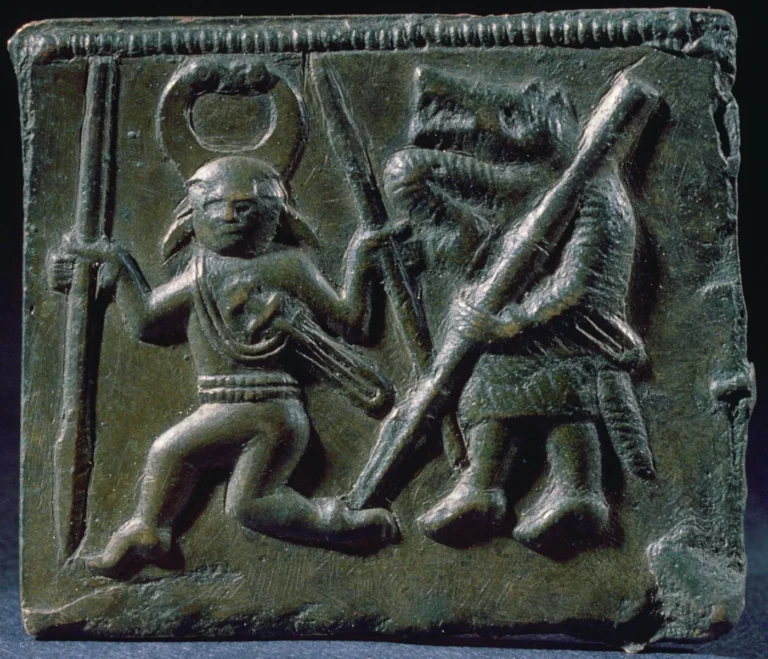
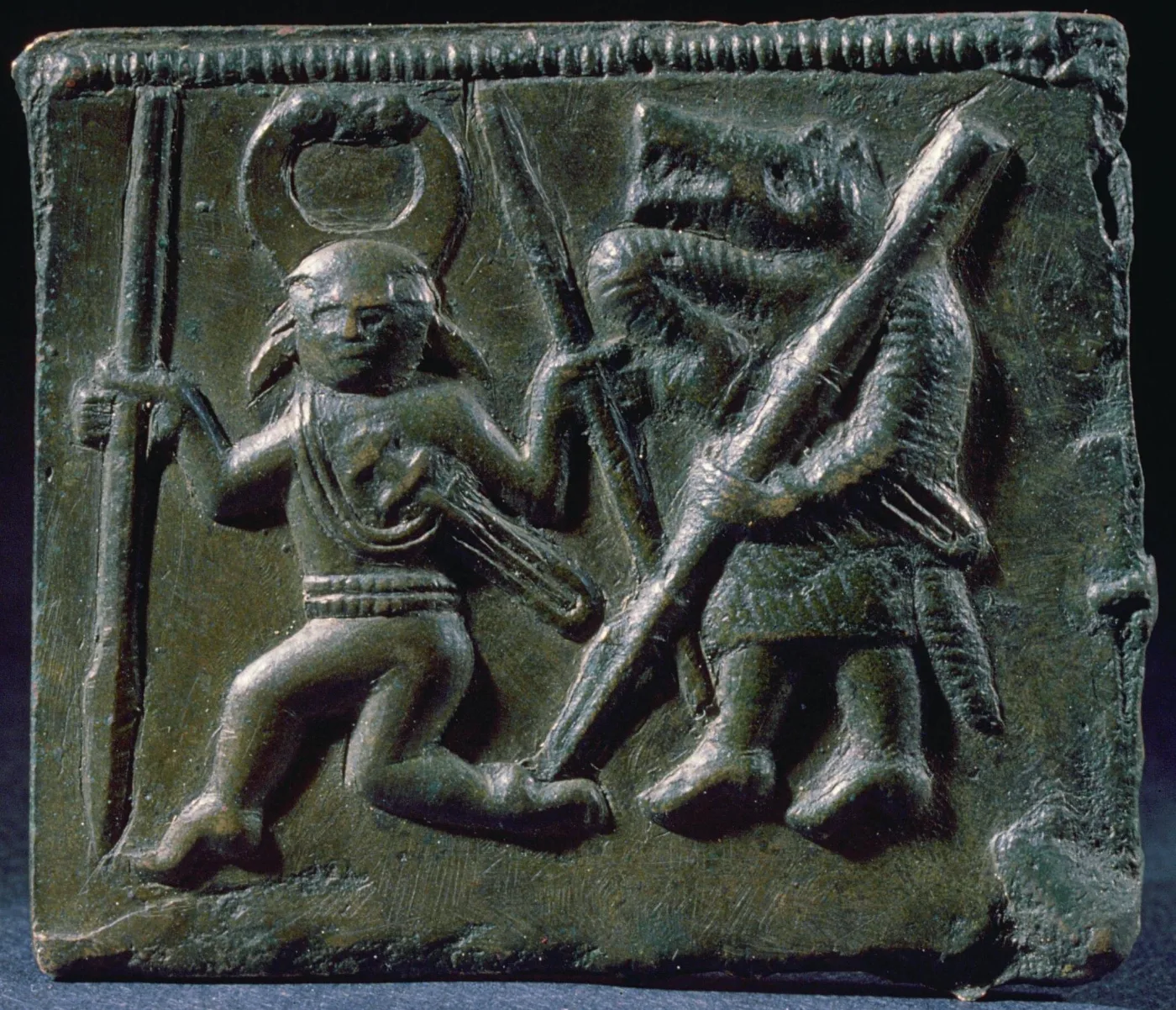
| Images | Torslunda dies, Öland, Sweden (550–800): a dancing figure and an animal-headed warrior. Lewis chessmen (late 12th century): shield-biting warders. |
| Drugs? | Not in any medieval source. Fly agaric (1784) and henbane (2019) are modern hypotheses. |
What was a Viking berserker?
In the sources a berserkr is a warrior of exceptional strength and aggression who serves a king, challenges men to duels, or raids. Cleasby and Vigfússon’s Icelandic-English Dictionary (1874) sums up the saga picture: twelve berserkers as “the chief followers of several kings of antiquity”, and in Norway “gangs of professional bullies”. Roderick Dale, after a critical review of the Old Norse literature (PhD thesis, Nottingham, 2014; book, 2022), concludes that Old Norse berserkr “may be best translated” as “champion”, and that the uncontrollable warrior most people picture belongs to the modern English word.
Were there female berserkers? Not in the texts: every berserker in the sources quoted here is a man. The nearest thing we know of is “the brides of the Berserkers” whom Thor boasts of having killed on the island of Hlésey, in the mythological poem Hárbarðsljóð (stanza 37, trans. Bellows), and the poem says nothing more about them.
What does berserker mean? Bear-shirt or bare-shirt
The second half is clear: serkr is a shirt or coat (Scots “sark”). The first half is the problem. Snorri says Odin’s warriors went brynjulausir, “without mail-coats”, and the translator Samuel Laing drew the obvious conclusion in 1844: Bersærker was “so called from ber, bare; and serkr, shirt: that is, bare of any shirt of mail” (note to Ynglinga saga 6). Thirty years later Cleasby and Vigfússon rejected this: the “bare” etymology “is inadmissible, because ‘serkr’ is a subst. not an adj.”, while a derivation from an old word for bear “is greatly to be preferred”, since champions wore the hides of bears and wolves, as the parallel name úlfheðinn, wolf-skin, shows.
The debate never closed. Mikkel Klausen’s 2023 master’s thesis (University of Oslo) traces the swings: “bare” until the mid-19th century, “bear” after Sveinbjörn Egilsson, “bare” again with Erik Noreen (1932), Hans Kuhn and Kim McCone, while Otto Höfler and Gerard Breen argued for the bear. Anatoly Liberman favors “bare”; Michael Speidel (2002) suggests that “bear-shirt” was later reinterpreted as “bare-shirt”. Dale prefers the bear but warns that an etymology tells us where a word came from, not what a 13th-century reader understood by it. The reference works lean the same way: Bellows (1923) thought the word “probably” meant “bear-shirt”, and the Oxford English Dictionary, as quoted by the Grammarphobia blog, gives “probably bear-shirt or bear-coat”. The Store norske leksikon (Ellen Næss, 2026) keeps both open. In short: “bear-shirt” is the likelier meaning, not a proven one.
Úlfheðnar (ulfhednar): the wolf-skins
The wolf-warriors carry a name nobody disputes: úlfr, wolf, and heðinn, a skin or fur coat. They appear beside the berserkers in the earliest poem, and Vatnsdæla saga (chapter 9) explains them at the same battle: “the berserkers who were called úlfheðnar; they had wolf-coats instead of mail-shirts and defended the prow of the king’s ship” (our translation). Grettis saga (chapter 2) says Harald’s berserkers “were called the Wolf-coats, for on them would no steel bite” (trans. Magnússon and Morris). Whether berserkers and wolf-skins were two groups or two names for one is unclear; the earliest poem already seems to treat them as one.
The earliest sources on berserkers, and how late they are
| Source | Written | Distance from the events | What it says about berserkers |
|---|---|---|---|
| Haraldskvæði (Þorbjörn hornklofi?) | About 900 (first half); second half possibly later | Contemporary, if the dating holds | Berserkers bellow and wolf-skins howl at Hafrsfjörðr; berserkers are rewarded king’s men |
| Grágás, Christian Laws Section | About 1122–1133 | A law of its own day | Going berserk punished by lesser outlawry |
| Snorri, Ynglinga saga and Haralds saga hárfagra | About 1230 | Two to four centuries after | Odin’s men; berserkers in Harald’s ship |
| Egils saga | Probably before 1240 | Three centuries after | Kveldúlfr and Skalla-Grímr, shape-strong; Ljótr the duelist |
| Eyrbyggja saga | Mid-13th century | About 250 years after | Two Swedish berserkers, a road and a bath-house |
| Vatnsdæla saga | Second half of the 13th century | About 300 years after | Wolf-coats; a berserker cured; two berserkers burned |
| Grettis saga | About 1300 or later | About 300 years after | Berserkers as bandits, outlawed by Earl Eiríkr |
| Hervarar saga, Hrólfs saga kraka | 13th century and later; Hrólfs saga a “very late” compilation (Finnur Jónsson, our translation) | Legendary, set before the Viking Age | Twelve berserker brothers; kings’ bands of twelve |
Haraldskvæði: berserkers at Hafrsfjörðr
Haraldskvæði, also called Hrafnsmál, is a dialogue in which a valkyrie questions a raven about King Harald Fairhair. Its account of the sea battle of Hafrsfjörðr, near Stavanger, fought at the end of the 9th century, holds the oldest known mention of berserkers:
grenjuðu berserkir, / guðr vas þeim á sinnum, / emjuðu ulfheðnar / ok ísǫrn dúðu.
“The berserkers bellowed, battle was upon them; the wolf-skins howled and shook their irons.”
Haraldskvæði, stanza 8 (numbering of Finnur Jónsson, Den norsk-islandske skjaldedigtning, 1912–1915), our translation
Whose berserkers were they? The “them” of this stanza are the ships that, in stanza 7, “came from the east” to fight Harald, and in stanza 9 they attack the king “who lives at Utstein” (our translations). Laing (1844) and Finnur Jónsson both read it that way, so in the poem’s own battle scene the howling berserkers may well be on the enemy side. The prose sagas, by contrast, put them in Harald’s ship.
Later the valkyrie asks about “the berserkers’ keep”: how are the battle-bold men treated who wade into the host? The raven answers: “Wolf-skins they are called, who carry bloody shields in battle; they redden spears when they come to the fight” (stanzas 20–21, our translation), and they are men of courage the wise king trusts. Here the berserkers are a rewarded part of the king’s following, not lone madmen. Two cautions. The poem is attributed to Þorbjörn hornklofi, but the Store norske leksikon notes that the Hafrsfjörðr stanzas may be by Þjóðólfr of Hvinir. And Klaus von See suspected the second half, with the “wolf-skins” stanza, of being a later addition; Mikael Males rejects von See’s arguments without settling the question, but notes the stanza’s antiquarian tone and suggests that, if it was added, it was added in the 12th century (both as summarized by Klausen). Stanza 8 is the safer witness.
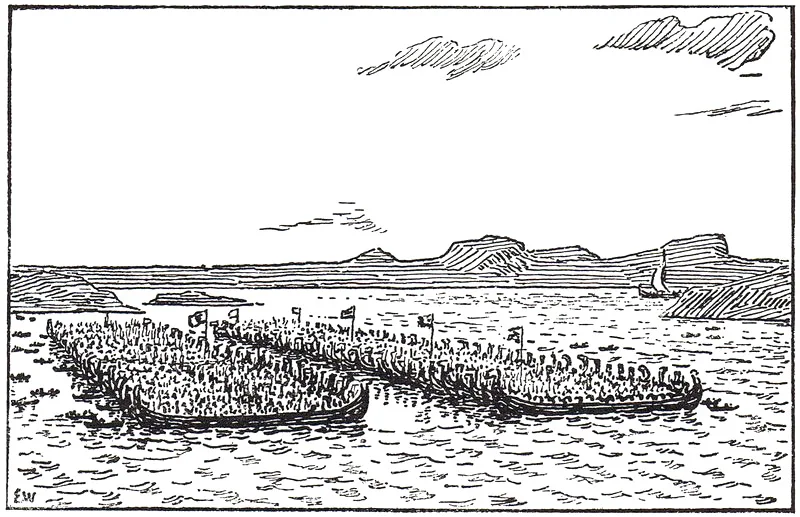
Snorri quotes stanza 8 in his saga of Harald (chapter 19), where Laing’s 1844 verse turns it into “Savage berserks roaring mad”. He also says Harald manned his great dragon ship with his berserkers in the prow, picked men “remarkable for strength, courage, and all kinds of dexterity” (chapter 9, trans. Laing); Egils saga puts “twelve Berserks of the king” in the prow of his longship at the same battle (chapter 9, trans. Green).
Snorri’s Ynglinga saga 6: Odin’s warriors
The description everyone quotes comes from Snorri Sturluson, writing in Iceland around 1230. In his euhemerized history, Odin is a king from Asia who could make his enemies blind, deaf or terror-struck and blunt their weapons, while
“… his men rushed forwards without armour, were as mad as dogs or wolves, bit their shields, and were strong as bears or wild bulls, and killed people at a blow, and neither fire nor iron told upon them. These were called Bersærkers.”
Snorri Sturluson, Ynglinga saga, chapter 6, translated by Samuel Laing (1844)
Laing’s last sentence is looser than Snorri’s. The Old Norse ends Þat er kallaðr berserksgangr, “that is called berserk-going”: Snorri names the state, not the men. The passage is a learned reconstruction written more than two centuries after the conversion, and Cleasby and Vigfússon already suspected that it partly paraphrases the charms of Hávamál, where Odin boasts “Blunt do I make mine enemy’s blade” (stanza 149, trans. Bellows). It tells us how a 13th-century Icelander imagined Odin’s warriors, not what a 9th-century battle looked like.
Berserkers in the sagas
Egils saga: Kveldúlfr, Skalla-Grímr and the shape-strong
Egils saga opens with the poet Egill’s grandfather Úlfr, whose friend Kári of Berðla “was a Berserk”. Úlfr himself grew sullen every evening, “and it was commonly said that he was very shape strong. He was called Kveldulf”, Evening-Wolf (chapter 1, trans. Green). The Old Norse word is hamrammr, “shape-strong”, used of men believed able to change their shape. When Kveldúlfr and his son Skalla-Grímr take revenge at sea, the saga explains what happened next:
“It is said of shape-strong men, or men with a fit of Berserk fury on them, that while the fit lasted they were so strong that nought could withstand them; but when it passed off, then they were weaker than their wont. Even so it was with Kveldulf.”
Egils saga, chapter 27, translated by W. C. Green (1893)
Years later, at a ball game in Iceland, Skalla-Grímr grows unnaturally strong after sunset, kills Egill’s 20-year-old game partner Þórðr and seizes Egill, until the boy’s nurse Þorgerðr brák draws him off and is killed herself (chapter 40). In chapter 67 of Green (64 in the Old Norse editions) Egill meets the professional duelist Ljótr the Pale, “a Berserk and a duellist”, on whom “a fit of Berserk fury seized him; he began to bellow hideously, and bit his shield.” Egill kills him.
Eyrbyggja saga: the two Swedish berserkers
Earl Hákon of Norway held two Swedish brothers, Halli and Leiknir, a gift from King Eiríkr of Sweden. “They wrought Bareserkgang, and were not of the fashion of men when they were wroth, but went mad like dogs, and feared neither fire nor steel” (chapter 25, trans. Morris and Magnússon, 1892). Through the Icelander Vermundr they pass to his brother Styrr. When Halli asks for Styrr’s daughter, Styrr sets a bride-price: a road through the lava field, a boundary wall across it and an enclosure. The brothers build them; meanwhile Styrr has a sunken bath-house made. The berserkers come home “very weary, as is the way of men who are not of one shape: they become very weak when the berserk-going leaves them” (chapter 28, our translation). Styrr shuts them in the overheated bath, kills them as they break out, and buries them in a hollow of the lava beside their own road.
Vatnsdæla saga: a berserker cured, two berserkers burned
Vatnsdæla saga, strongly marked by Christian ideas, shows the fury as an affliction. Þórir, a son of the settler Ingimundr, admits to his brother that berserk-going comes on him “always when I least want it” (chapter 37, our translation). His brother vows to “the one who made the sun”, the two save a child left out to die, and “berserk-going never came on Þórir again”. In chapter 46 two berserkers, both named Haukr, reach Iceland just as the first missionaries arrive:
“They howled like dogs, bit the rims of their shields and waded barefoot through burning fire.”
Vatnsdæla saga, chapter 46, our translation from the Old Norse (Íslendinga sögur text, sagadb.org)
Bishop Friðrekr hallows three fires; the berserkers wade through the first and second, are badly burned, and are clubbed to death by men waiting with heavy staves, because iron, the bishop says, will not bite them. It is a conversion story.
Grettis saga: berserkers as bandits
In Grettis saga, written around 1300, the berserker has become the villain a hero proves himself on. Chapter 19 is set in Norway: berserkers challenge “high-born men for their fee or womankind”, so “Earl Eric did away with all holm-gangs and outlawed all bearserks who fared with raids and riots” (trans. Magnússon and Morris). Grettir then destroys a band of twelve at a farm whose master is away; the last two die of cold and wounds in their flight. In chapter 40 the berserker Snækollr rides up to claim a farmer’s daughter:
“… he began to roar aloud, and bit the rim of his shield, and thrust it up into his mouth, and gaped over the corner of the shield, and went on very madly.”
Grettis saga, chapter 40, translated by Eiríkr Magnússon and William Morris (1869)
Grettir kicks the shield up into his mouth and beheads him: a joke that depends on the audience knowing the stock gesture.
Hrólfs saga kraka and Hervarar saga: legendary berserkers
The legendary sagas, set before the Viking Age, multiply berserkers by the dozen. King Aðils of Uppsala keeps twelve berserkers to defend his land (Hrólfs saga kraka, chapter 16 in Guðni Jónsson’s edition). Hrólfr has his own twelve, who on their return to his court one Yule eve stride into the hall “all gray with iron” and challenge every man present (chapter 37, our translation). The saga’s most famous scene is not about berserkers at all: in the last battle a huge bear fights in front of Hrólfr’s army while the champion Böðvarr bjarki sits motionless in the hall (chapters 50–51). The saga never calls him a berserker.
In Hervarar saga the twelve sons of Arngrímr, led by Angantýr, “were all berserkers” (chapter 1, our translation). At the island of Sámsey they “drew their swords and bit the rims of their shields, and berserk-going came over them”; afterwards the fury left them, “and then they are weaker than at other times, as after some kind of illness” (chapter 3, our translation).
The dueling berserker: a stock villain
Put these stories side by side and a formula appears: a foreign berserker arrives, demands a woman or money, offers a duel (hólmganga), and is killed by the hero. Cleasby and Vigfússon noticed it in 1874, and that the berserkers who come to Iceland are presented as Norwegians or Swedes. Dale lists other roles, from king’s champion to Christian champion, and finds men with the byname berserkr in 14th-century documents: the word was not purely a monster’s label.
What did “going berserk” (berserksgangr) look like?
Gathered from the texts above, berserksgangr has a consistent set of signs:
- Animal noise: bellowing and howling (Haraldskvæði 8; Egils saga 67; Vatnsdæla saga 46; Grettis saga 19). Klausen argues, from the Dictionary of Old Norse Prose, that the poem’s verb grenja is otherwise a word for the roar of dangerous animals.
- Shield-biting: Ynglinga saga 6, Egils saga 67, Vatnsdæla saga 46, Grettis saga 40, Hervarar saga 3.
- Invulnerability: iron does not bite them (Egils saga 9, Grettis saga 2) and they fear neither fire nor steel (Ynglinga saga 6, Eyrbyggja saga 25).
- Strength beyond normal: “strong as bears or wild bulls” (Ynglinga saga 6).
- Exhaustion afterwards: Egils saga 27, Eyrbyggja saga 28, Hervarar saga 3.
- Not chosen: it comes on Þórir unwanted (Vatnsdæla saga 37), yet Ljótr and Snækollr seem to use it as a threat before a duel.
Dale reads these signs as display: berserksgangr, he argues, was “a calculated form of posturing and a ritual activity designed to bolster the courage of the berserkr”, and in the texts berserkers “do not go berserk” in the modern sense. Others take the descriptions as a real altered state. The texts allow both readings.
No drug. No saga or poem mentions a mushroom, plant or potion taken to bring on the fury. The Store norske leksikon states that such drug use “is not known from the sources” (our translation).
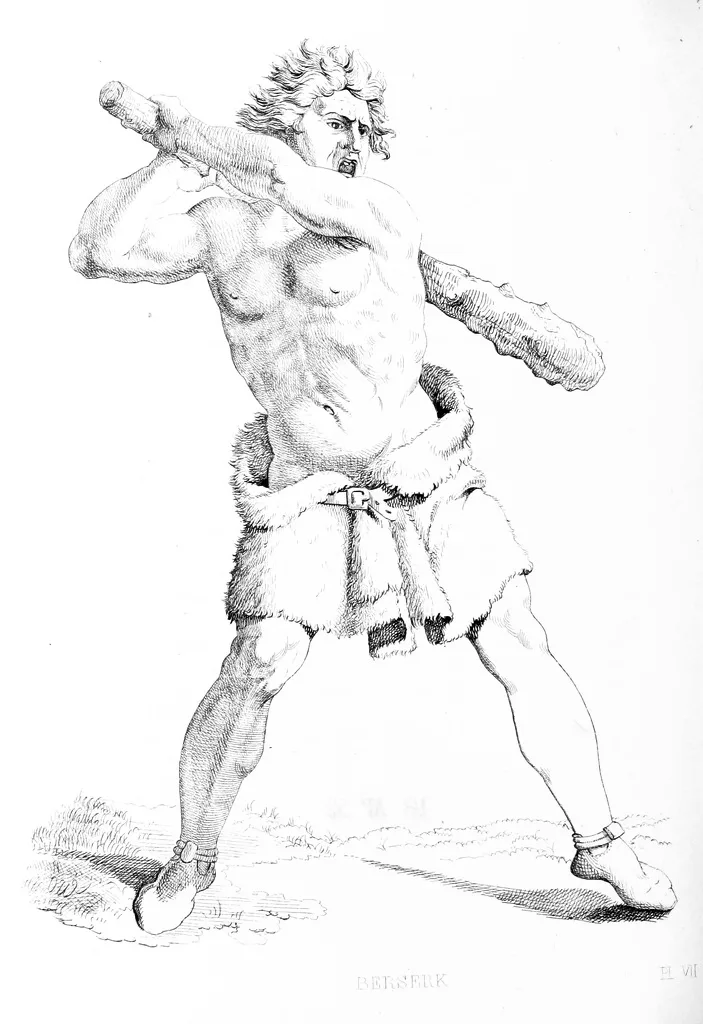
No naked fighting. Snorri says brynjulausir, “without mail-coats”, not without clothes; the half-naked berserker in fur pants is largely a 19th-century picture (see the 1850 engraving above).
No bearskin in the descriptions. The texts quoted here give wolf-coats (Vatnsdæla saga 9) and shape-changing, but none of them describes a berserker putting on a bear’s hide. The bear survives in the name, if the “bear-shirt” etymology is right, and in the bear that fights for Hrólfr kraki.
Were berserkers real? What archaeology can and cannot show
Yes, in the sense that matters most: a poem of about 900 names them, and an Icelandic law of the 1120s punished going berserk, which makes sense only if men really did it. What cannot be proved is the saga picture of warriors whom iron could not bite. Archaeology does not settle the question either way: no grave can be labeled “berserker”, and no object names one. What it offers are images of animal-warriors, older than the Viking Age and open to interpretation.
The best known are the Torslunda dies: four bronze dies for stamping decorative helmet plates, found in a cairn on the Swedish island of Öland and dated by the Swedish History Museum to 550–800, the Vendel period. On one, the museum describes two men: one with a tall helmet crest, two spears and a sword; the other with “a helmet resembling an animal head”, a spear in his left hand and his right on his sword hilt (our translation). Many scholars see the second as a wolf-warrior and the first, one of whose eyes appears to have been struck out, as Odin or a dancer in his service. The museum does not say so; Klausen counts the damaged eye as the only confidently Odinic feature and finds the cult reading in need of more support. The crest is not a horned Viking helmet either; our guide to Viking helmets and shields explains why.
Further back lie comparisons rather than evidence. Speidel (2002) traced “berserk”-style warriors to the half-naked Germanic fighters on Trajan’s Column. Tacitus, writing in 98 CE, describes the Harii (“Arii” in this translation) of eastern Germania, whose “shields are black; their bodies painted: they choose the darkest nights for an attack” (Germania 43, Oxford translation revised). Such warriors, eight centuries before Hafrsfjörðr, show that the idea of a terrifying warrior band is old, not that a berserker tradition ran continuously. More of these images, from picture stones to bracteates, are weighed in our evidence index of Viking symbols.
Did Viking armies have berserker units?
The sources point to small elite groups, not regiments: berserkers in a king’s ship or household, often twelve of them, a number that recurs too often in the sagas to be taken as a head count. Dale adds a practical argument: Viking-Age battles relied on men holding a shield wall, where a lone warrior running amok would be a liability, so the berserker is better seen as a champion than as shock infantry.
Were berserkers outlawed? The Icelandic law against going berserk
The strongest sign that something called berserksgangr was real comes from a law. The Christian Laws Section of the Icelandic lawbook later known as Grágás, chapter 7, lists it among heathen practices, next to sacrifices to spirits and sorcery:
Ef maðr gengr berserksgang, ok varðar honum þat fjörbaugsgarð …
“If a man goes berserk, the penalty for him is lesser outlawry, and the same for the men present with him, unless they restrain him. Then none of them is liable, if they manage to restrain him. But if it happens again, the penalty is lesser outlawry.”
Grágás, Konungsbók, Christian Laws Section, chapter 7, ed. Vilhjálmur Finsen (Copenhagen, 1852), p. 23; our translation
Lesser outlawry (fjörbaugsgarðr) was the milder grade of outlawry: three years of exile from Iceland, with protection at three homes and on the ways between them until the convict found a ship (as Sveinbjörn Rafnsson summarizes it). He also paid a “life-money” fee; as Cleasby and Vigfússon explain, if he did not pay, he became a full outlaw. From the bishops it names as its makers, Peter Foote dated it “between 1122 and 1133, say about 1125”. The manuscript that preserves it, Konungsbók, was written in the mid-13th century (about 1250 for Foote, about 1260 for the Store norske leksikon), so later changes to the wording cannot be ruled out. The law punishes bystanders who fail to hold the man down, which suggests a fit others could see coming and stop.
For Norway we found a story rather than a statute: Grettis saga 19 credits Earl Eiríkr Hákonarson with outlawing berserkers and abolishing duels shortly before he left to visit his brother-in-law King Knútr in England, a decree Cleasby and Vigfússon dated to 1012 (Wikipedia and many websites give 1015). It is known only from the saga.
What happened to the berserkers?
The texts show them fading with the new religion rather than in a single event. The Christian law of the 1120s treats going berserk as a heathen practice; in Vatnsdæla saga a bishop hallows the fires that undo two berserkers; and the 13th- and 14th-century sagas turn the king’s champion into a bandit for heroes to kill. The word itself lived on: Dale found men with the byname berserkr in 14th-century documents.
Why did berserkers rage? The theories
| Theory | Proposed by | Evidence for | Main problem |
|---|---|---|---|
| Fly agaric mushroom | Samuel Ödman, 1784 | Siberian use of the mushroom reported by 18th-century travelers | No source mentions it; the mushroom tends to sedate |
| Henbane | Karsten Fatur, 2019 | Symptoms closer to the texts; seeds known from Viking-Age sites | No source mentions it; toxicologists doubt it allows effective fighting |
| Alcohol | Hans Jacob Wille, 1786, and others | Drinking scenes in the sagas | Saga berserkers drink without going berserk |
| Mental disorder | Fredrik Grøn, 1908, and others | Sudden fits; comparison with Malay “amok” | Diagnosis at a distance of a literary motif |
| Combat trauma | Jonathan Shay, 1994; Lily Geraty, 2015 | Similar rages in modern veterans | Explains individuals, not a named class of king’s men |
| Ritual and cult | Otto Höfler, 1934; Kris Kershaw, 2000; Neil Price (shape-shifters within battle magic), 2002 | Odin, animal-warrior images, warrior bands | Reconstructed from late texts and ambiguous images |
| Performance, not madness | Roderick Dale, 2014 and 2022 | The texts themselves; shield-wall warfare | Downplays the uncanny features the texts stress |
Did berserkers take mushrooms? The fly-agaric theory
The idea has a precise birthday. In 1784 the Swedish naturalist Samuel Ödman published, in the proceedings of the Royal Swedish Academy of Sciences, an “attempt to explain the berserk-going of the old Nordic champions from natural history” (our translation). After ruling out opium, belladonna and hemp, he turned to reports of Siberian peoples who ate fly agaric (Amanita muscaria) and fell into fits of strength followed by exhaustion. His clinching argument was mythological: “What in particular seems to me to speak for the fly agaric … is that its use is properly a custom from that part of Asia from which Odin, with his Æsir, made the famous migration to our North” (our translation). That is Snorri’s euhemerized Odin, read as history. The idea was taken up again by F. C. Schübeler (1885) and by Howard D. Fabing in a 1956 paper titled “On Going Berserk: A Neurochemical Inquiry” (as Klausen summarizes).
Most scholars now reject it. Klausen’s survey cites Liberman on the complete silence of the sources and Are Skarstein Kolberg (2018) on the pharmacology: the mushroom’s main active compound, muscimol, is a sedative more likely to cause stupor than fury. Ödman asked a scientific question; his answer rested on no Norse evidence.
Henbane, alcohol and other substances
In 2019 Karsten Fatur, of the University of Ljubljana’s Faculty of Pharmacy, proposed black henbane (Hyoscyamus niger), whose tropane alkaloids fit the reported symptoms better than fly agaric, including rage and reduced pain. He points to henbane seeds from Viking-Age sites in Denmark and Finland, among them a pouch of seeds in a Danish woman’s grave of about 980 (finds Klausen calls inconclusive). He was candid: “there is not enough archaeological and historical evidence to prove or disprove this theory”. Two toxicologists from the Oregon Poison Center, Adam Blumenberg and Zane Horowitz, replied in the same journal under the title “The Saga continues: Solanaceae may cast too much shade for effective berserking” (2020). Alcohol has been proposed since Hans Jacob Wille in 1786, yet in Grettis saga the berserkers drink themselves tired, not berserk, as Dale points out. All these theories share one weakness: the texts never mention a substance.
Mental illness and combat trauma (PTSD)
In 1908 Fredrik Grøn called berserksgangr an acute psychosis comparable to Malay amok, and later linked it to stress and fear in the light of First World War shell shock. The psychiatrist Jonathan Shay, in Achilles in Vietnam (1994), used “berserk” for the rage of combat veterans and named its triggers: betrayal by commanders, a shrinking moral horizon, grief at the death of a special comrade, and guilt. Lily Geraty (MA thesis, University of Iceland, 2015) proposed bringing Shay’s model into the study of Norse berserkers. It suits men like Þórir in Vatnsdæla saga, less well a recognized class of king’s men.
Warrior cults and ritual
A line of scholars has read berserkers as members of warrior bands devoted to Odin. Otto Höfler argued for such cultic warrior societies in Kultische Geheimbünde der Germanen (“Cultic secret societies of the Germanic peoples”, 1934). Kris Kershaw’s The One-Eyed God: Odin and the (Indo-)Germanic Männerbünde (2000) takes the same line; its publisher describes Odin in the book as “the god of the Einheriar, of the Germanic and Viking mannerbunde”, the men’s warrior bands, and of wolf-men. Neil Price’s The Viking Way (2002; second edition 2019), which reads Norse sorcery against Sámi and wider circumpolar shamanism, treats shape-shifters among the “supernatural facets of Viking Age violence” (as its reviewer Oren Falk sums up the chapter). The Torslunda dies and Snorri are cited in support, but the texts are late and the images ambiguous. Dale is more cautious: a performance whose religious meaning is now lost.
Berserkers and Odin: bears, wolves and shape-changers
The clearest link with Odin is Snorri’s Ynglinga saga 6, though a poem in which a valkyrie questions a raven already belongs to the world of Odin’s battle-dead. The animal side is older and broader. The texts compare berserkers to dogs, wolves and bears; they are called “wolf-skins”; and the word hamrammr, shape-strong, ties the fury to the belief that some people were “not of one shape” (eigi einhamr) and could take animal form, like Hrólfr kraki’s bear and Kveldúlfr, the Evening-Wolf. Whether that belief reflects ritual, a way of describing extreme violence, or both, is what the theories above dispute.
Where does “going berserk” come from?
From the Old Norse berserkr, by way of Walter Scott. According to the Oxford English Dictionary, as quoted by the Grammarphobia blog, Scott brought the word into English in 1814 as “Berserkar”, in an article summarizing Eyrbyggja saga. In his novel The Pirate (1822), young Mordaunt compares his father’s rage to “the fury of those ancient champions, those Berserkars” that the old Shetland woman Swertha sings about, and a note in the novel repeats the “without armour” etymology and a drug explanation. The adjective follows in Charles Kingsley’s novel Yeast (1851): “Yelling, like Berserk fiends”. The earliest “going berserk” Grammarphobia found is in a Colorado newspaper of 1894. Today to go berserk is simply to lose control: the phrase keeps the frenzy and forgets the warriors.
Berserk, the manga. Kentaro Miura’s dark-fantasy series, running since 1989, takes its title from the word and follows the swordsman Guts; it is not a Viking story.
God of War Ragnarök (2022). Its “Berserker” bosses, found at gravestones across the game’s Nine Realms, culminate in King Hrolf, and one of them is named Beigadr after a champion of the saga: a game’s nod to Hrólfs saga kraka, not a reconstruction.
Vikings: Valhalla. Netflix’s own Tudum article on the series asks “Who Were the Tripped-Out, Nearly Naked Berserkers?” and quotes Hornklofi as saying “gods were in their minds”. The Old Norse guðr in stanza 8 means “battle”, not “god”.
Where to go next
Follow the berserkers to their god and their battles
Snorri made berserkers Odin’s warriors, and the oldest poem sets them in a sea battle told by a valkyrie and a raven.
Mythic Harmonies’ Berserkir Rís is an original song in Old Norse.
Frequently asked questions
What was a berserker?
A berserker (Old Norse berserkr, plural berserkir) was an elite Norse warrior known for a battle fury called berserksgangr. The oldest source, a poem of about 900 for King Harald Fairhair, has berserkers and wolf-skinned warriors howling at the battle of Hafrsfjörðr and, in its later stanzas, makes them the king’s rewarded men. In the later sagas they appear as kings’ champions, raiders and duelists who howl, bite their shields and seem proof against iron and fire, then collapse exhausted when the fit passes.
What does the word berserker mean?
The second part, serkr, means shirt or coat. The first part is disputed: either ber-, an old word for bear (“bear-shirt”), or berr, bare (“bare-shirt”, fighting without a mail-coat). Laing in 1844 favored “bare”; Cleasby and Vigfússon in 1874 favored “bear”, pointing to the parallel name úlfheðinn, wolf-skin. Scholars still disagree, but “bear-shirt” is the likelier reading: the Oxford English Dictionary, Cleasby and Vigfússon and Roderick Dale all prefer it.
Were berserkers real?
Yes, in the sense that the word and the practice existed. A poem of about 900 names berserkers in a king’s army, and the Icelandic Christian law of about 1122-1133 punishes anyone who goes berserk with lesser outlawry. Most details, however, come from sagas written in the 13th and 14th centuries, which turned the berserker into a stock villain. No grave or object can be identified as a berserker’s. For Norway, Grettis saga says Earl Eiríkr Hákonarson outlawed berserkers early in the 11th century, but we found no law text that confirms it.
Did berserkers take mushrooms or drugs?
No medieval source says so. The fly-agaric theory was proposed by the Swedish naturalist Samuel Ödman in 1784, based on reports of mushroom use in Siberia and the belief that Odin came from Asia. Most scholars reject it, and the mushroom’s main compound is a sedative. Karsten Fatur suggested henbane in 2019, but admitted the evidence can neither prove nor disprove it. Alcohol has also been proposed; the sagas show berserkers drinking without going berserk.
What does “going berserk” mean, and where does it come from?
Berserksgangr, “berserk-going” (often written berserkergang today), is the Old Norse name for the berserker’s fit. The texts describe bellowing or howling like animals, biting the rim of the shield, great strength, a belief that iron and fire could not harm them, and severe weakness afterwards (Ynglinga saga 6, Egils saga 27, Eyrbyggja saga 28, Vatnsdæla saga 46, Hervarar saga 3). Roderick Dale argues it was a calculated display to build courage rather than true madness. English borrowed the word in the 19th century: Walter Scott introduced “Berserkar” in 1814, and the earliest “going berserk” found so far is in an 1894 newspaper. Today it simply means to lose control.
Why did berserkers bite their shields?
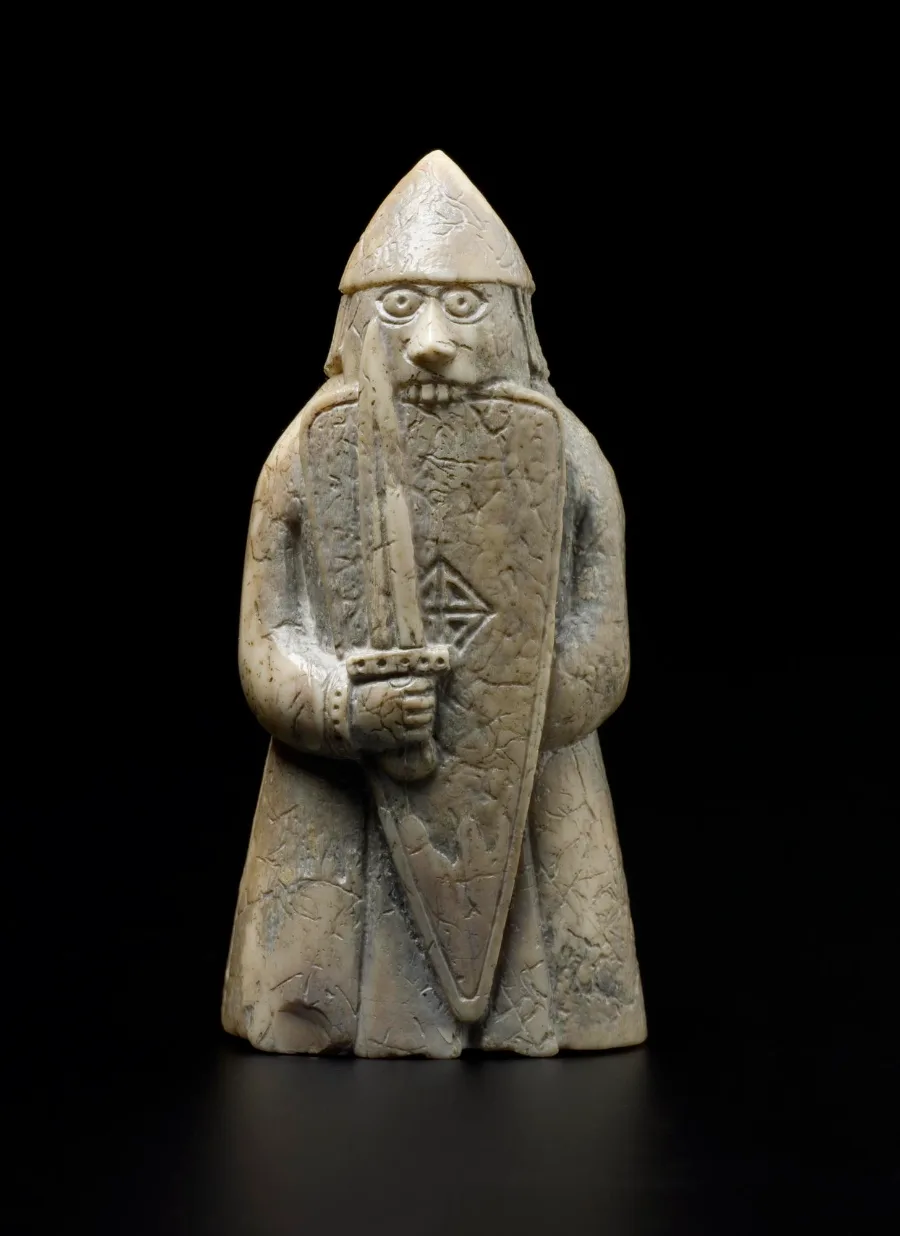
The sources never explain it; they present shield-biting as the visible sign that the fury has come on (Ynglinga saga 6, Egils saga, Grettis saga 40, Hervarar saga 3). The gesture was well enough known that late 12th-century carvers of the Lewis chessmen gave some of their warder pieces this pose, and Grettis saga makes a joke of it when Grettir kicks a berserker’s shield into his mouth.
What is the difference between berserkers and úlfheðnar?
Úlfheðnar (ulfhednar) means “wolf-skins”. The earliest poem, Haraldskvæði, names berserkers and wolf-skins side by side, and in a later stanza seems to treat them as the same men. Vatnsdæla saga speaks of “the berserkers who were called úlfheðnar”, who wore wolf-coats instead of mail. Whether they were two groups or two names for one is unclear.
Were there female berserkers?
Not in the sagas quoted in this guide: every berserker in them is a man. The nearest thing we know of in Old Norse literature is “the brides of the Berserkers” whom Thor boasts of killing on the island of Hlésey in the mythological poem Hárbarðsljóð (stanza 37, trans. Bellows); the poem tells us nothing else about them. Female warriors in general, the shield-maidens, are a separate question.
Did berserkers fight naked or in bearskins?
Neither is stated in the sources. Snorri says Odin’s men went without mail-coats, not without clothes. Vatnsdæla saga gives Harald’s wolf-warriors wolf-coats instead of mail, but no saga scene shows a berserker wearing a bearskin; the bear survives in the possible “bear-shirt” etymology. The half-naked berserker in fur is largely a 19th-century image.
Were berserkers connected to Odin?
Snorri Sturluson makes them Odin’s warriors in Ynglinga saga 6, written about 1230, and the oldest poem about them is a dialogue between a valkyrie and a raven. Scholars such as Otto Höfler and Kris Kershaw read them as members of Odin-worshipping warrior bands; the Torslunda dies, dated 550-800, with a dancing figure and an animal-headed warrior, are often cited in support. The link is plausible but rests on late texts and ambiguous images.
Sources and editorial notes
Written in November 2026. Dates of composition follow the Store norske leksikon unless stated. Translations marked “our translation” are ours from the Old Norse, Swedish or Norwegian; other quotations follow the public-domain translations named. Saga chapter numbers follow the translation quoted; where the Old Norse edition differs, both are given.
- Texts: Haraldskvæði, ed. Finnur Jónsson, Den norsk-islandske skjaldedigtning B1 (1912–1915), on heimskringla.no; Snorri Sturluson, Heimskringla, trans. S. Laing (1844): Ynglinga saga (vol. 1, Wikisource) and the later sagas (Project Gutenberg); Egils saga, trans. W. C. Green (1893); Eyrbyggja saga, trans. W. Morris and E. Magnússon (1892); Grettis saga, trans. E. Magnússon and W. Morris (1869); Vatnsdæla saga (sagadb.org), Hrólfs saga kraka and Hervarar saga (ed. Guðni Jónsson and Bjarni Vilhjálmsson, heimskringla.no); Poetic Edda (Hávamál, Hárbarðsljóð), trans. H. A. Bellows (1923); Grágás, ed. V. Finsen (1852); Tacitus, Germania, Oxford translation revised.
- Studies: R. Cleasby and G. Vigfússon, Icelandic-English Dictionary (1874), “ber-serkr”, “úlf-héðinn”, “ham-ramr”; R. Dale, Berserkir: a re-examination of the phenomenon in literature and life (PhD, Nottingham, 2014) and The Myths and Realities of the Viking Berserkr (Routledge, 2022); M. Klausen, To Bare or not to Bear (MA thesis, University of Oslo, 2023); E. Næss, “berserk”, Store norske leksikon; P. Foote, The Early Christian Laws of Iceland (Cambridge, 2004); Sveinbjörn Rafnsson, “Um grið og griðastaði á Sturlungaöld”, Saga 54 (2016), English summary “Asylum and Sanctuaries in the Age of the Sturlungs”; S. Ödman, Kongl. Vetenskaps Academiens nya handlingar 5 (1784), pp. 240–246; K. Fatur, “Sagas of the Solanaceae”, Journal of Ethnopharmacology 244 (2019); A. Blumenberg and Z. Horowitz, Journal of Ethnopharmacology 248 (2020); M. P. Speidel, “Berserks: a history of Indo-European ‘mad warriors’”, Journal of World History 13 (2002); H. D. Fabing, “On Going Berserk: A Neurochemical Inquiry” (1956), cited through Klausen; J. Shay, Achilles in Vietnam (1994); The Grammarphobia Blog, “Going Berserk with a capital ‘B’” (25 June 2018), for the Oxford English Dictionary citations; K. Kershaw, The One-Eyed God (2000); N. Price, The Viking Way (2002; 2019).
- Museums: Swedish History Museum, Torslunda dies; National Museums Scotland, Lewis chessmen. Illustrations: Norwegian edition of Snorri’s Heimskringla (J. M. Stenersen & Co, 1899), drawing by Erik Werenskiold (1855–1938).




All five albums and every single: 86 songs in WAV and MP3, yours to keep.