

Fenrir: The Wolf Who Will Kill Odin (Norse Mythology)
On this page 15 sections
- Who Is Fenrir? A Quick Introduction
- The Birth of a Monster
- Why the Gods Raised Their Killer
- The First Two Chains: Leyding and Dromi
- Gleipnir: The Chain That Did Not Exist
- The Binding on Lyngvi Island
- The Imprisonment
- Fenrir’s Children: The Wolves Who Eat the Sun and Moon
- Ragnarök: The Wolf Devours the King
- What Does Fenrir Mean? The Deeper Reading
- Fenrir in the Primary Sources
- Fenrir in Archaeology
- Fenrir Today
- Frequently Asked Questions
- The Wolf Waits
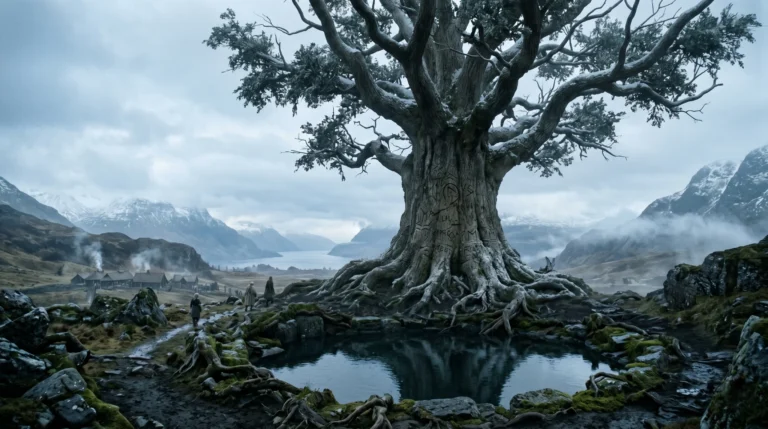
On a windswept island in the middle of a black lake, a wolf the size of a mountain is bound to a stone. His jaws are forced open by a sword. A ribbon thinner than silk holds him in place, woven from things that do not exist: the sound of a cat’s footsteps, the breath of a fish, the roots of a mountain. He has been there for centuries. He will be there for centuries more.
And one day, he will break free.
When he does, he will kill the king of the gods.
This is Fenrir, the most feared creature in Norse mythology, and one of its most misunderstood. He is not simply a monster. He is a child raised by the gods who knew, from the moment of his birth, that they would have to destroy him. He is a prophecy made flesh. He is the wolf at the end of the world, and his story is one of the strangest and most tragic in any mythological tradition.
This article tells that story in full, drawing on the primary sources of the Norse tradition: the Poetic Edda, the Prose Edda of Snorri Sturluson, and the archaeological record of Viking Age Scandinavia. By the end, you will understand not only what Fenrir does in the myths, but why he matters, and why his story has haunted the Northern imagination for more than a thousand years.
While you read, the atmospheric music of Mythic Harmonies on YouTube draws from the same Old Norse tradition that produced the story of Fenrir.
Who Is Fenrir? A Quick Introduction
Fenrir, also called Fenrisúlfr (“Fenris Wolf”) in Old Norse, is a giant wolf in Norse mythology. He is the son of the trickster god Loki and the giantess Angrboða, and the brother of Jörmungandr (the World Serpent) and Hel (the ruler of the underworld).
He has two other names in the sources:
- Hróðvitnir, meaning “fame-wolf” or “famous wolf”
- Vánagandr, meaning “monster of the river Ván”
Fenrir’s importance to the pre-Christian Scandinavians is suggested by wolf imagery on several surviving monuments and by his presence throughout Old Norse literature. The most accessible scholarly overviews of his significance can be found on World History Encyclopedia and in Daniel McCoy’s analysis on Norse Mythology for Smart People. He is not a minor figure. He is one of the central forces in the Norse cosmology, the wolf whose chains hold back the apocalypse.
The Birth of a Monster
Fenrir’s story begins with one of the strangest unions in Norse mythology: Loki, the shape-shifting trickster god, and Angrboða, a giantess whose name means “She Who Brings Grief.”
From this pairing came three children, and each one represented a different kind of doom:
- Jörmungandr, the great serpent who would grow large enough to circle the entire world and bite his own tail
- Hel, the half-living, half-corpse being who would rule over the realm of the dead
- Fenrir, the wolf who would devour the king of the gods

The gods of Asgard learned of these three children through Odin’s gift of prophecy. They saw, in visions, what each child was destined to do. They saw the world ending because of them.
And so they acted. Odin sent his warriors to seize the three children from Jötunheim. He cast Jörmungandr into the deep ocean, where the serpent grew so vast that he encircled the entire human world. He sent Hel to Niflheim, the realm of mist and ice, where she became queen of the dishonored dead.
But for Fenrir, Odin made a different decision. He brought the wolf back to Asgard, the realm of the gods, and decided to raise him there.
Why the Gods Raised Their Killer
This is the moment in the myth that modern readers find hardest to understand. The gods knew, through prophecy, that Fenrir would one day kill Odin and devour him. Snorri says they knew what he would become, though the sources are vague about how that knowledge reached them. What they are consistent about is that it could not be undone: fate in Norse cosmology is woven by the Norns at the Well of Urd, beyond even Odin’s power to change.
And yet they raised him as one of their own.
The reasoning, as the Prose Edda describes it, was strategic. The gods believed they could control Fenrir if they kept him close. They could observe him, manage his growth, and perhaps influence his nature. Only one god dared approach him daily to feed him: Týr, the god of justice and oaths. The rest stayed away.
But Fenrir grew. And grew. And grew faster than any creature the gods had ever seen.
The prophecy was unfolding. The wolf was becoming the doom that had been foretold.
The First Two Chains: Leyding and Dromi
The gods decided they could no longer let Fenrir roam free. They had to bind him. But because they did not want to provoke him into open hostility, they framed the binding as a game, a contest of strength.
Leyding
The first chain the gods brought was called Leyding. It was a heavy iron fetter, and they presented it to Fenrir with smiles, suggesting he could prove his strength by breaking free of it.
Fenrir agreed. The gods bound him. Fenrir flexed his shoulders and the chain shattered like glass.
The gods praised him. The wolf was pleased with himself.
Dromi
The second chain, Dromi, was twice as strong as Leyding. The gods showed it to Fenrir and challenged him again. The wolf hesitated this time, he sensed something. But his pride was too great. He agreed to be bound a second time.
When the gods fastened Dromi around him, Fenrir struggled. He thrashed. He kicked. The chain held longer than Leyding had. But eventually, with a tremendous effort, Fenrir broke free again.
Now the gods knew that no ordinary chain could hold him.
Gleipnir: The Chain That Did Not Exist
Odin sent a messenger to the dwarves of Niðavellir, the underground realm where the greatest craftsmen of the Nine Worlds lived. He asked them to forge a chain that no force could break.
The dwarves accepted the commission. And they did something remarkable. They created a chain so strong that it could hold the wolf at the end of the world, but to do so, they used materials that did not exist in any ordinary sense.
The chain was called Gleipnir, “the open one” or “the deceptive one.” It was forged from six impossible things:
- The sound of a cat’s footsteps
- The beard of a woman
- The roots of a mountain
- The sinews of a bear
- The breath of a fish
- The spit of a bird
This is why, the Prose Edda tells us, you do not see these things in the world anymore. The dwarves used them all up to make Gleipnir. A cat’s feet now make no sound. Women now do not grow beards. Mountains have no visible roots. And so on.
Gleipnir was as smooth as silk and as light as ribbon. But it was stronger than any iron chain that had ever been forged. It would hold until Ragnarök.

The Binding on Lyngvi Island
The gods lured Fenrir to a remote island called Lyngvi, in the middle of a dark lake named Amsvartnir. They told him they had a new game for him, a third chain to test his strength.
When they showed him Gleipnir, Fenrir laughed. The ribbon looked so thin, so delicate, that he could see no honor in breaking it. But then he looked more carefully. He saw how the gods watched him. He sensed the magic in the chain.
He agreed to be bound on one condition.
“One of you,” Fenrir said, “must place his hand in my mouth as a pledge of good faith. If the chain is honest, I will be released and no harm will come to the hand. If the chain is a trick, the hand is forfeit.”
The gods looked at one another. None of them volunteered.
None except Týr.
The Sacrifice of Týr
Týr was the god of justice, of law, and of sworn oaths. He stepped forward, fully aware of what was about to happen, and placed his right hand into the jaws of the wolf.
The other gods bound Fenrir with Gleipnir. The chain held. Fenrir strained against it with all his strength, and could not break free.
He realized he had been deceived.
And then he closed his jaws on Týr’s hand and bit it off.
Týr did not cry out. He had known the cost. He had paid it willingly, for the good of the world.

This is why, in the surviving Norse iconography, Týr is depicted as a one-handed god, the only god of the Aesir to bear a physical wound. His sacrifice is one of the foundational moral acts of Norse mythology: the willing payment of a personal price for a greater good. The story of Týr’s hand is one reason the rune Tiwaz (ᛏ) became associated with justice, honor, and sacrifice in the Elder Futhark runic system.
The Imprisonment
With Fenrir bound, the gods completed their work. They tied one end of Gleipnir to a massive stone called Gjöll, which they buried deep in the earth. The other end they fastened to a boulder called Thviti.
Then, as a final precaution, they wedged a sword into Fenrir’s open jaws, the pommel against his lower jaw and the point against his upper jaw, so that he could not close his mouth. From his open mouth flowed a river of saliva called Ván. This is the river referenced in one of Fenrir’s other names: Vánagandr, the monster of the river Ván.
And there Fenrir would lie. For centuries. For millennia. Bound on the empty island of Lyngvi, in the middle of the lake Amsvartnir, gagged with a sword, howling silently into the dark.
Until Ragnarök.
Fenrir’s Children: The Wolves Who Eat the Sun and Moon
Before his binding, Fenrir fathered two sons of his own. These wolves are named in the Grímnismál of the Poetic Edda:
- Sköll, who chases the sun across the sky every day
- Hati Hróðvitnisson (“Hati, son of Hróðvitnir”), who chases the moon
For all of cosmic time, these two wolves pursue the sun and moon through the heavens. They have never caught them. But at Ragnarök, they will.
Sköll will swallow the sun. Hati will swallow the moon. The sky will go dark.
And that is when Fenrir’s chains will break.
Ragnarök: The Wolf Devours the King
The signs of Ragnarök are described in detail in the Völuspá, the most famous poem of the Poetic Edda. Three consecutive winters with no summer in between. Brothers killing brothers. The collapse of all moral order. And then, finally, the breaking of Fenrir’s chains.
The wolf will rise from Lyngvi after centuries of imprisonment. His jaws will gape wider than any creature has ever been able to open, his lower jaw scraping the earth, his upper jaw touching the sky. Fire will pour from his eyes and nostrils. He will run across the world, devouring everything in his path.
And at the final battle on the plain of Vígríðr, he will meet Odin.
The Duel of Odin and Fenrir
Odin, mounted on his eight-legged horse Sleipnir, will ride into battle wielding his spear Gungnir. He will charge directly at the wolf.
And he will lose.
The Völuspá describes the outcome in a single, devastating line: Fenrir will swallow Odin whole.
This is the moment the entire mythology has been building toward. The king of the gods, the seeker of all wisdom, the father of poetry and magic, will be devoured by a wolf he himself raised in his own halls. The prophecy he tried to delay for a thousand years will finally come to pass.
The Vengeance of Víðarr
But the story does not end there.
Odin has a son named Víðarr, called “the Silent God.” Víðarr wears a special shoe made from all the leather scraps that humans have ever thrown away while making their own shoes, every offcut, every discarded piece, gathered across all of history.
When Fenrir swallows Odin, Víðarr will step forward. He will plant his reinforced shoe on Fenrir’s lower jaw. With his hands, he will grip the wolf’s upper jaw. And he will tear Fenrir’s mouth apart, killing him.
The wolf at the end of the world will himself be ended.

What Does Fenrir Mean? The Deeper Reading
Fenrir is not simply a monster in Norse mythology. He is something stranger and more philosophically interesting.
Consider his story from his own perspective. He is born to parents who love him. He is taken from them as a child by the gods. He is raised in Asgard, where he grows alongside the divine beings who will one day fear him. Týr feeds him. The gods watch him.
And then, when he becomes powerful, the same gods who raised him decide to bind him for eternity. They trick him. They take his trust. They take Týr’s hand. They wedge a sword into his mouth so he cannot even close his jaws.
Fenrir, in the original sources, does nothing wrong before his binding. He does not attack the gods. He does not kill anyone. He commits no act of evil. He is simply punished, in advance, for what prophecy says he will do.
His revenge at Ragnarök is, in a sense, the prophecy fulfilling itself because of the binding. Had the gods not bound him, would he have grown into the destroyer they feared? The myth does not answer this. But the question hangs over the entire narrative.
Fenrir is the Norse expression of a profound idea: that fear of the future can create the very thing we are trying to prevent. That those who try hardest to escape fate often become its instruments. That the gods, in their wisdom and prophecy, cannot escape what they themselves help bring about.
Fenrir in the Primary Sources
For readers interested in going to the sources themselves, here is where Fenrir appears in the medieval Norse texts:
The Prose Edda (Snorri Sturluson, c. 1220 CE)
The most complete account of Fenrir’s story appears in the Gylfaginning section of the Prose Edda, written by the Icelandic chieftain Snorri Sturluson around 1220 CE. This is the source for the detailed narrative of the binding, the three chains, Týr’s sacrifice, and the construction of Gleipnir.
The Poetic Edda (compiled c. 1270 CE from older material)
Fenrir is referenced in several poems of the Poetic Edda:
- Völuspá (The Prophecy of the Seeress) — describes Fenrir’s role at Ragnarök
- Vafþrúðnismál (The Lay of Vafþrúðnir) — confirms Fenrir as the killer of Odin
- Grímnismál (The Lay of Grímnir) — names Fenrir’s sons Sköll and Hati
- Lokasenna (Loki’s Quarrel) — references Fenrir indirectly through Loki’s family
Heimskringla and the Sagas
Snorri’s later work Heimskringla contains additional references to wolves in the Norse cosmology, including possible alternative names for Fenrir (Garm, Mánagarmr) that some scholars interpret as the same creature appearing under different names in different contexts.
Fenrir in Archaeology
Fenrir is not just a literary figure. He appears in Viking Age material culture across Scandinavia. Several runestones depict wolves consuming figures who are interpreted as Odin, including the Ledberg stone in Sweden. The Thorwald’s Cross on the Isle of Man, dating to the 10th century, shows a clear scene of a wolf devouring a man, widely interpreted as Fenrir killing Odin at Ragnarök. Many of these artifacts are documented in the collections of the Swedish History Museum.
The wolf appears as a recurring motif in Viking jewelry, weapons, and ceremonial objects. He was not a peripheral character in the Norse imagination. He was central.

Photo: Wikimedia Commons, CC BY-SA license.
Fenrir Today
Fenrir has had an extraordinary afterlife. He appears in fantasy literature (J.R.R. Tolkien’s wolf imagery owes much to him), in video games (God of War, Assassin’s Creed Valhalla, Smite), in tabletop role-playing games, and in countless works of contemporary art.
What is striking is how often the modern depictions miss the philosophical depth of the original. Fenrir is rarely portrayed in modern media as the tragic figure the Eddas describe, the child raised by his enemies, bound before he had committed a crime, destined to fulfill a prophecy because of the very actions taken to prevent it.
For those interested in exploring this dimension of Norse mythology in its original depth, the complete Norse mythology timeline traces the full arc of the cosmology from the creation of the world to the rebirth after Ragnarök, and Fenrir’s story is one of its most important chapters.
Frequently Asked Questions
Who are Fenrir’s parents?
Fenrir’s father is Loki and his mother is Angrboða, a giantess whose name means “She Who Brings Grief.” Loki is himself the son of the giant Fárbauti, so Fenrir is of giant descent on both sides, raised among the gods rather than born one of them. He has two siblings, equally fated: Jörmungandr, the World Serpent, and Hel, who rules the realm of the dead.
Who kills Fenrir?
Fenrir is killed at Ragnarök by Víðarr, the silent son of Odin. After Fenrir swallows Odin, Víðarr plants his reinforced shoe on Fenrir’s lower jaw and tears the wolf’s mouth apart, killing him.
What is Gleipnir made of?
Gleipnir, the magical ribbon that binds Fenrir, was forged by the dwarves of Niðavellir from six impossible ingredients: the sound of a cat’s footsteps, the beard of a woman, the roots of a mountain, the sinews of a bear, the breath of a fish, and the spit of a bird. According to the Prose Edda, this is why these things no longer exist in the world.
Why did Týr lose his hand?
Týr placed his right hand in Fenrir’s mouth as a pledge of good faith when the gods asked the wolf to be bound by Gleipnir. When Fenrir realized he had been deceived and could not escape, he bit off Týr’s hand in retaliation. Týr’s sacrifice represents one of the most important moral acts in Norse mythology: the willing payment of a personal cost for the good of the world.
Is Fenrir evil?
This is a debated question. In the original sources, Fenrir does not commit any wrongful act before his binding. He is punished by the gods because of a prophecy about what he will do, not because of what he has done. His destruction at Ragnarök can be read as the fulfillment of a self-creating prophecy, in which the gods’ actions to prevent the doom they fear actually bring it about.
What does the name Fenrir mean?
The name Fenrir is generally interpreted as meaning “He Who Dwells in the Marshes” in Old Norse. His other names include Fenrisúlfr (“Fenris Wolf”), Hróðvitnir (“fame-wolf”), and Vánagandr (“monster of the river Ván”).
Where is Fenrir bound?
Fenrir is bound on the desolate island of Lyngvi, located in the middle of a dark lake called Amsvartnir. He is chained there with Gleipnir, with a sword wedged into his open jaws to keep them apart, until Ragnarök.
How big was Fenrir?
The sources never give measurements, which makes him more terrifying. Fenrir grew faster than any creature the gods had seen, and at Ragnarök his gape stretches from the earth to the sky: his lower jaw scrapes the ground while his upper jaw touches the heavens. He is, functionally, as big as the end of the world.
Why does Fenrir kill Odin?
Prophecy and vengeance intertwined. The Norns wove Fenrir’s fate as Odin’s killer before the wolf had done anything wrong, and the gods’ preemptive binding, the deception, and the sword in his jaws turned prophecy into motive. At Ragnarök, Fenrir swallows Odin whole, fulfilling the doom the binding was meant to prevent.
Who are Fenrir’s children?
Fenrir fathered two wolves named in the Grímnismál: Sköll, who chases the sun across the sky, and Hati Hróðvitnisson, who chases the moon. At Ragnarök they finally catch their prey: Sköll swallows the sun and Hati the moon, plunging the world into darkness as their father breaks free.
The Wolf Waits
Somewhere, in the deepest layer of the Norse imagination, a wolf lies bound on an empty island. He has been there for as long as the world has existed in its current form. His jaws are forced open by a sword. A river of saliva flows from his mouth. He cannot howl. He cannot escape. He waits.
And one day, the prophecies say, he will rise.
The gods knew this when they raised him. Týr knew it when he placed his hand in the wolf’s mouth. Odin knew it every time he gathered another warrior into Valhalla, building an army against the very wolf he had raised. The wolf at the end of the world has always been coming. The binding only delays him.
Fenrir is not just a monster. He is the Norse expression of one of humanity’s oldest fears: that the things we love and raise may turn against us, that our attempts to prevent disaster may bring it about, that fate, in the end, is not negotiable.
The story has been told for more than a thousand years. It is still worth telling.
And worth hearing. Our tracks Fenrir Ris (Fenrir Rises), Fenrir Rís (Cover), and Howl of Fenrir give the bound wolf the voice the sword denied him.






All five albums and every single: 86 songs in WAV and MP3, yours to keep.