

How Vikings Survived Harsh Winters: Ancient Survival Tactics from a Frozen World
- Viking winter was an adversary, not a season: months of minus 20 to minus 30 degrees, polar darkness in the north, and a mythology that made the cold older than the gods and the agent of the world’s end.
- The Norse beat it with engineering: turf walls up to two meters thick, a hearth-and-smoke heating system, a three-layer wool wardrobe, and a pantry of stockfish and fermented stores prepared in autumn.
- And they beat it together: the Yule feast, the sagas told by the fire, the seeress in the dark months, and skis on the white road turned survival into culture.
The wind claws at the longhouse walls. The snow has risen past the door. The sun, when it appears at all, slides low along the horizon like a dying ember, and in the far north it does not appear at all. Winter in the Viking world was not a season. It was an adversary: a force with a place in the myths, a shape in the darkness, and a body count.
And yet the Norse did not merely endure it. They out-engineered it, out-cooked it, out-dressed it and out-sang it, building a civilization that thrived through six months of cold that would break most modern routines in a week. How Vikings survived harsh winters is really the story of how a culture turned its worst enemy into its identity, and every piece of the answer, from turf walls to fermented fish to the songs by the fire, still holds lessons a thousand years later.
This is the complete guide: the enemy itself, the myths that gave it meaning, the engineering that beat it, and the rituals that kept the mind alive until the sun came back.
The Enemy: What Viking Winter Was Really Like
Start with the scale of the problem. Despite the slightly milder summers of the Medieval Warm Period, Scandinavian winters remained brutal: inland valleys regularly dropped to minus 20 or minus 30 degrees Celsius, coastal storms battered farms for weeks, fjords froze shut, and daylight shrank to a few pale hours. In the far north came the mørketid, the polar night, when the sun stayed below the horizon entirely and the world ran on firelight, memory and nerve.
Scandinavian tradition remembers the járnnætur, the “iron nights” of the first hard autumn frosts, as the opening shots of winter’s siege: the nights that killed the last of the growing season and announced that everything from here on would be survived on what was already stored. What followed was months of confinement. Snow sealed the paths, families lived pressed together in one hall, and the darkness worked on the mind as hard as the cold worked on the body. The Norse had no word for seasonal depression, but they engineered against it anyway: storytelling marathons, carving and weaving, games, poetry, and the deliberate maintenance of the community’s warmth alongside the fire’s.
Their worldview drew the battle line explicitly. Everything ordered, warm and human was innangard, “within the enclosure”. Everything outside (the ice, the dark, the wolves, the hungry spirits of the waste) was utangard. Winter was the annual siege of the utangard against every lit doorway in the North, and surviving it meant holding the wall.
Winter in the Norse Mind
Before the Norse fought winter with tools, they fought it with meaning, and their mythology gave the cold a biography.
Winter was older than the gods. In the creation myth of the Gylfaginning, before anything lived, there was Niflheim: the realm of primordial mist and ice, whose frozen rivers layered rime upon rime into the void. Where that ancient cold met the fire of Muspelheim, the melt gave rise to Ymir, the first being, and from Ymir’s body the world was made. Read that again as a northern farmer would: life itself is what happens when fire meets ice. The cold is not an intruder in the world. It is half of the world’s parentage.
And winter would end the world. The Eddas describe Fimbulvetr, the Great Winter: three winters with no summer between them, snows from every direction, hunger that dissolves the bonds of kinship, and then Ragnarök itself. Every historically severe winter carried the same whispered question: is this the one? The belief had practical teeth. Preparing for winter was not mere prudence; it was a sacred duty, and a household that faced the frost unprepared was not just foolish but fey, marked by fate. Some scholars even suggest the Fimbulwinter myth preserves the memory of a real climate catastrophe, the volcanic dust veil of the 530s that darkened northern skies for years, a theory we explore in our Ragnarök guide.
And winter had faces. Skaði, the mountain giantess of skiing and bow-hunting, embodied the beautiful, lethal high country: independence, precision, and the truth that winter favors the prepared. Ullr, the god invoked for skiing, archery and winter travel, was important enough that his name survives in dozens of Scandinavian place names, a god worn into the map itself. The Norse did not worship winter, but they gave it gods worth respecting, which is its own kind of survival strategy.
The Longhouse: Warmth Engineered from Earth
Now from myth to engineering, because the Viking longhouse is a thermal design masterpiece that modern efficiency standards would recognize immediately.
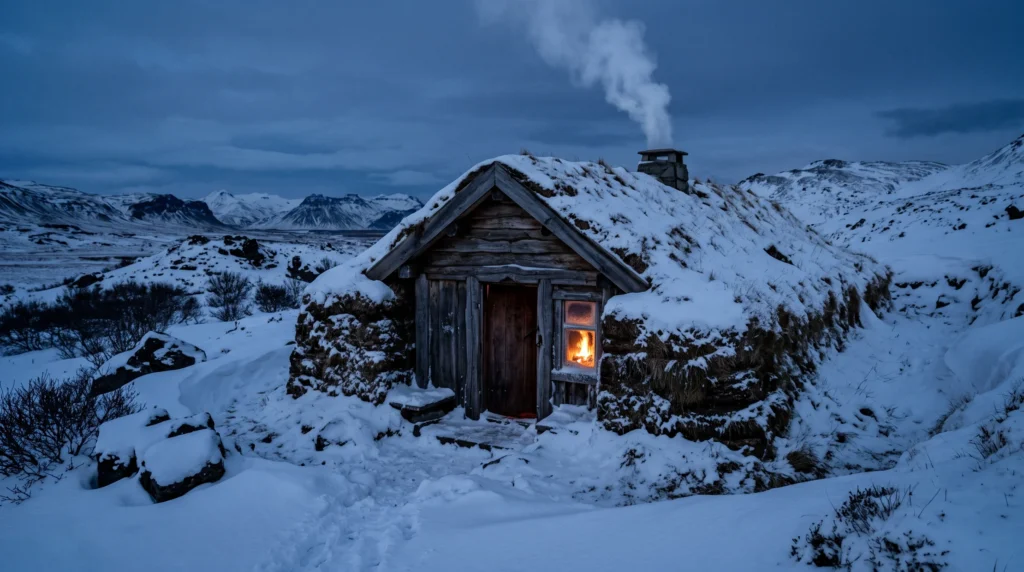
The walls were the landscape. Where wood was scarce, above all in Iceland, walls were built from turf: blocks of living sod stacked like masonry, one to two meters thick, under a growing roof. Turf insulates superbly, shrugs off wind, and holds interior temperature steady; from a distance, a turf longhouse is barely distinguishable from a hill, because thermally speaking, it IS one.
The shape fought the wind. The bowed, ship-curved walls deflected storm gusts and carried snow loads, and the deliberately low ceilings kept the precious warm air down at the level where people actually sat and slept.
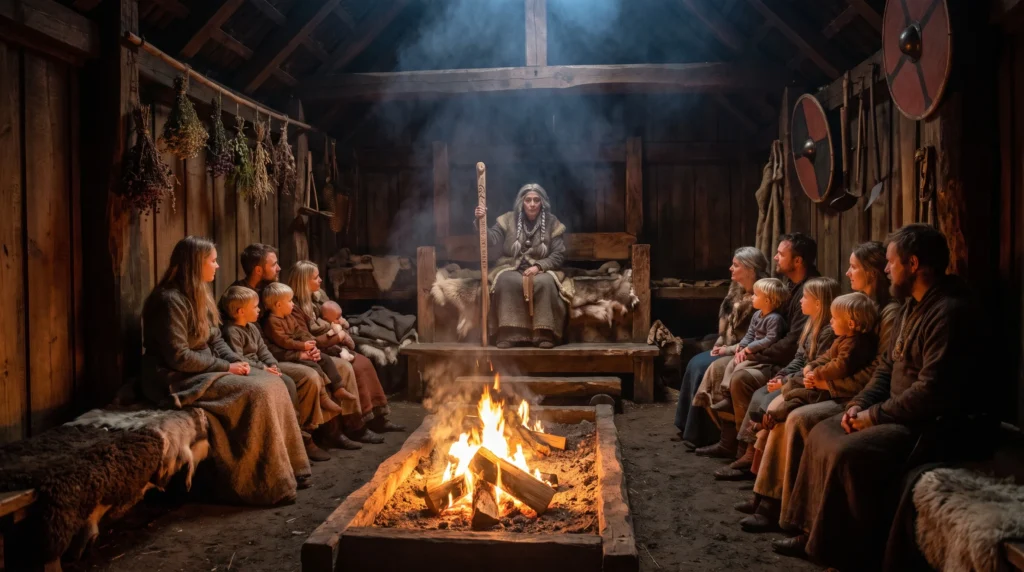
The fire ran the whole system. At the center burned the long hearth, the langeld, with no chimney, only a roof vent (the ljóri). The resulting smoke layer under the rafters was not a flaw but a feature: it dried and preserved the roof timbers, cured the meat hung above the fire, and pushed the heat down into the living zone. Letting the fire die was an unspoken sin: where the fire fails, life fails. The hearth was the reactor of the household, running heating, cooking, food preservation and lighting off the same flame.
The Norse Layering System
Modern outdoor experts preach layering as if it were new. The Norse mastered it a millennium ago, and their system reads like a gear guide.
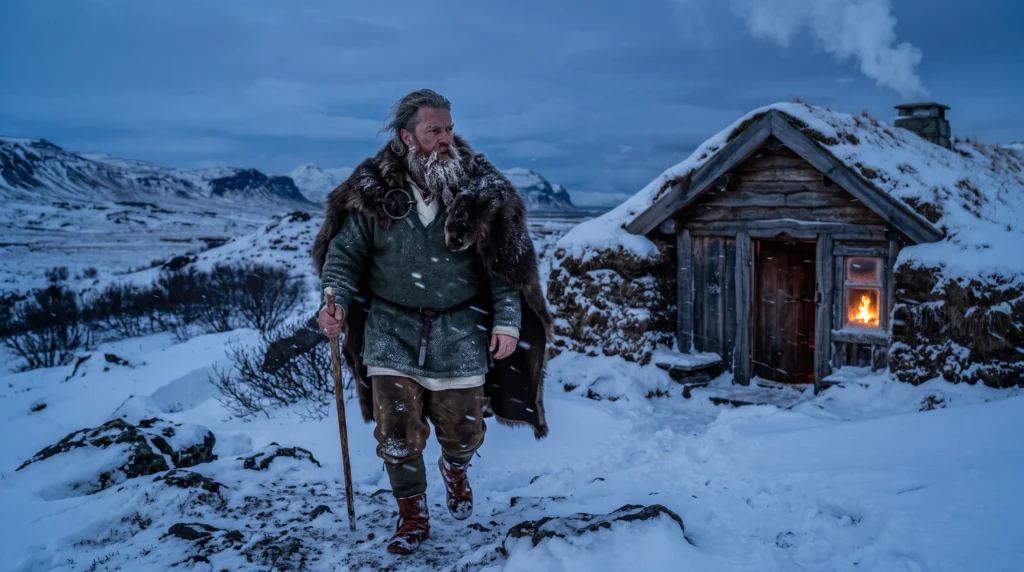
The base layer was linen: soft against the skin, breathable, wicking sweat away before it could freeze, which in serious cold is the difference between damp and dead. The insulation layer was wool, above all the dense homespun vaðmál: warm even when soaked, thick enough to break the wind, and so central to the economy that lengths of it served as legal currency in Iceland. The shell was fur and oiled leather (sheepskin, goat, reindeer for those who traded north), shedding wind and wet. Feet got leather turnshoes stuffed with dry grass or felted wool, the same insulation trick Arctic peoples still use. The full wardrobe behind this system, its colors, its construction and its myths, has its own complete guide in our deep dive into what Vikings really wore.
The Winter Pantry: Outsmarting the Cold
Nothing grows in a Scandinavian January. Winter survival was therefore an autumn discipline: the entire cold season was eaten out of storage, and the Norse pantry was a masterclass in preservation without refrigeration or, often, even salt.
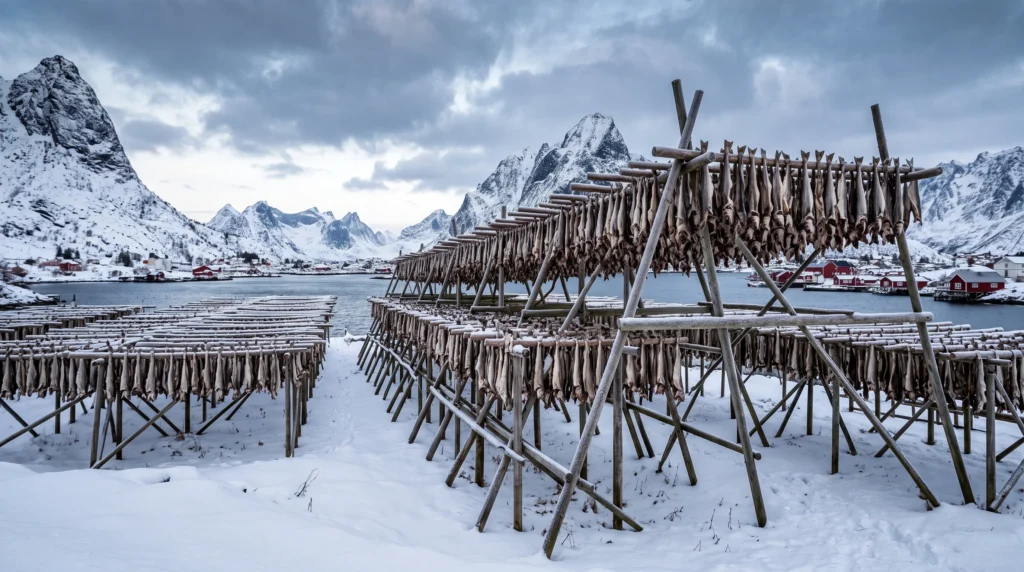
Stockfish was the foundation. Cod caught in the cold months was cleaned, split and hung on open wooden racks, where the dry Arctic air and sea wind did the rest. No salt, no smoke, nearly no spoilage: stockfish kept for years, packed absurd amounts of protein per kilo, and became one of Scandinavia’s great export goods. It is not an exaggeration to say the dried cod carried the North through a thousand winters.
Fermentation handled the rest. Meat was preserved in soured whey, vegetables went into brine, milk became skyr and hard cheese, and butter was packed into barrels, salted or buried in bogs where the cold, acidic, oxygen-poor ground kept it for months. Add dried berries, nuts, hard bread and winter-brewed ale, and the longhouse larder could feed a household through half a year of darkness, provided the autumn work had been done. That proviso was the whole game: the harvest feast was followed by the slaughter month, and every carcass, catch and churn was a deposit in the only bank that mattered.
Skis and the White Road
When stores ran low or opportunity called, the Norse went out INTO the winter, and they went on skis.
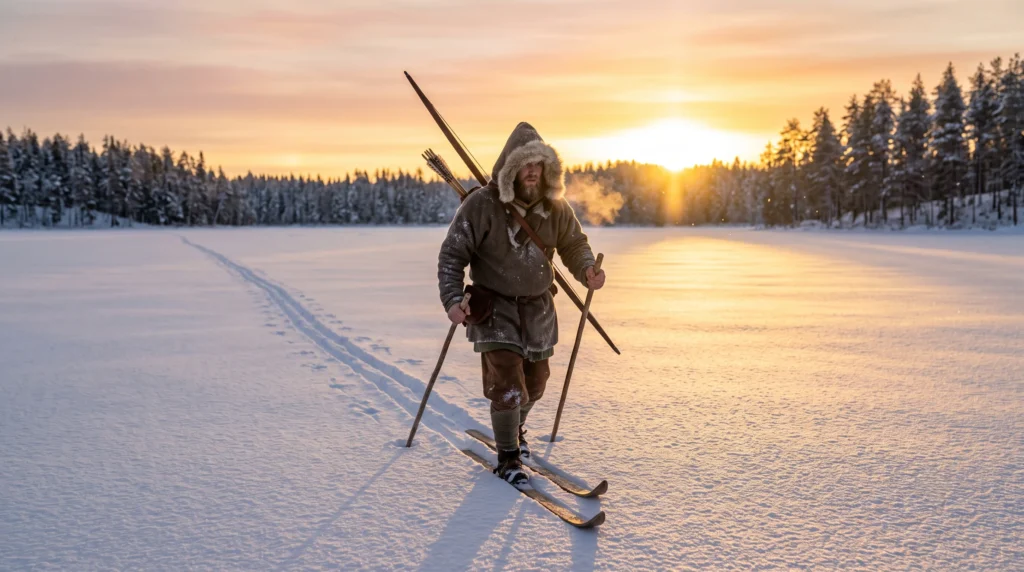
Wooden skis (skíð) are attested in Scandinavia thousands of years before the Viking Age, and by the Norse period they were simply how a northerner moved across deep snow: hunting reindeer, elk and hare, checking traplines, visiting neighbors, carrying news. Coastal communities added seal hunting on the ice. The bow did the killing, the skis did the reaching, and the skill mattered enough to live in religion: Ullr the ski-god and Skaði the ski-goddess are the divine stamp of approval on a technology the North never stopped using. Skiing was not sport. It was the winter road, and occasionally the winter battlefield, since ski-borne scouts and raiders appear in the historical record for centuries after.
Winter Wisdom of the Sagas
The sagas and Eddic poems treat winter as a recurring character, and they carry practical wisdom polished by generations of survivors.
The Hávamál, the sayings attributed to Odin himself, keeps returning to winter’s essentials. Stanza 68 lays out the hierarchy of blessings with perfect winter logic: “Fire is best for the sons of men, and the sight of the sun; health, if a man can keep it, and a life without shame.” Fire and sunlight, the two things winter rations, top the list. And stanza 38 warns the winter traveler in the language of preparation: a man away from home should never be more than a step from his weapons, because need arrives unannounced. Replace “spear” with “fire steel and wool” and it is a modern survival checklist.
The sagas add case studies. Egils saga sends its heroes across frozen rivers and storm-blind mountain passes, skiing for days on short rations, sheltering where the land allows, and it records the costs without glamour: winter travel kills the careless, and the sagas name the dead. Told aloud through the dark months, by the hearth, under the wool blankets, these stories were doing three jobs at once: teaching survival, keeping morale, and reminding every listener that endurance was the family trade. The storytelling itself was survival equipment.
The Rituals of the Dark: Yule, Seidr and Wolves
The physical war against winter had a spiritual front, and its great battle was fought at midwinter.
Jól, the Yule feast, marked the longest night and the sun’s fragile turn toward return. It looks, at first glance, like reckless indulgence in the hungriest season, but the logic is sound: the feast redistributed food between households, used up stores that would not last until spring anyway, and detonated a charge of light, warmth and community at the exact bottom of the year, when despair was most dangerous. Later Scandinavian tradition added the Yule log, whose burning and preserved ashes were credited with protecting the house; how far those customs reach back into the Viking Age is debated, but the midwinter feast itself is solidly attested. Yule was morale, weaponized.
Winter was also the season of seiðr. In the sagas, the wandering Völva, the seeress with her carved staff, travels from farm to farm in the dark months, and households gather to hear her prophesy the year: the harvest, the marriages, the luck of the livestock, the deaths. Whatever one believes about the magic, the function is clear as daylight: in the deepest uncertainty of the year, the community bought certainty, hope for some, preparation for others. The full world of that practice, the trance, the staff, the price Odin himself paid to learn it, lives in our guide to seiðr, Norse shamanism.
And through it all ran the wolf. The predator of the deep snow became the season’s great symbol: hunger on four legs. The myths scaled the image up to Fenrir, the world-wolf whose breaking free belongs to the last winter of all, and the everyday fear scaled it down to the wolves, real and figurative, that circled every lean month. Winter, in the Norse imagination, was not cruel. It was honest: it stripped away pretense and showed what a household, and a person, was actually made of.
The Modern Legacy of Viking Winter
The Viking winter never really ended; it just changed clothes. Scandinavia’s beloved friluftsliv, the “open-air life” philosophy of embracing the outdoors in every season, is the direct descendant of a culture that refused to let winter win, and the sauna-and-snow rituals of the North carry the same defiance. Pop culture keeps the aesthetic alive, from the fire-and-shelter mechanics of Valheim to the snowbound longhouses of Assassin’s Creed Valhalla. And survival instructors still teach the Norse playbook, because physics has not changed: turf insulates, wool warms when wet, dried fish keeps, and a group around a fire outlasts a hero alone in the snow. The Vikings were survivalists a thousand years before the word, and their winter is still the exam that their methods still pass.
Hear the Iron Nights
Understanding the Viking winter is one thing. Feeling it is another. The soundscape below was created for this article: tagelharpa drones like cracking ice, slow ritual drums, wind, and low chants for the longest nights. Press play, dim the lights, and read the sagas the way they were meant to be received: by firelight, with winter at the door.
Conclusion: Forged by Frost
So how did Vikings survive harsh winters? With turf and fire, wool and whey, skis and stockfish, and, just as decisively, with myth, feast, story and each other. They took the season that should have broken them and made it their forge: the cold tested every wall, every garment, every friendship and every plan, and what passed the test became Norse culture. Winter did not merely happen to the Vikings. It made them, and in every turf wall and wool layer and midwinter fire, you can still read the signature of the only teacher they never argued with.
The Poetic Edda (Hávamál stanzas 38 and 68, Grímnismál), translated by Carolyne Larrington (Oxford University Press, 2014); Snorri Sturluson, the Prose Edda (Gylfaginning), on Niflheim and Fimbulvetr; Egils saga Skallagrímssonar, on winter travel; the turf architecture of Iceland (Þjóðminjasafn / National Museum of Iceland); stockfish production and trade, the Lofoten tradition; skiing finds and rock art of prehistoric Scandinavia; research on the 536 CE dust veil event and the Fimbulwinter hypothesis.
Frequently Asked Questions
Did Vikings hibernate during winter?
No. Humans cannot hibernate. Vikings reduced outdoor activity but spent winter repairing tools, preserving food, weaving textiles, and telling sagas.
How cold were Viking winters?
Temperatures often dropped below –20°C (–4°F), and northern settlements sometimes reached –30°C or lower. Coastal storms were frequent and violent.
What did Vikings eat in winter?
Preserved foods: stockfish, salted meat, skyr, cheese, pickled vegetables, dried berries, nuts, and occasionally fresh game from winter hunting.
How did Vikings heat their homes?
With a central open hearth. Heat was trapped using turf walls, low ceilings, and strategic airflow through a roof vent (ljóri).
Did Vikings ski?
Yes. Skiing was essential for winter hunting and travel. The god Ullr and the giantess Skadi are associated with skis in Norse mythology.
How long did Viking winters last?
Six to eight months, depending on the region. In northern areas, the sun did not rise for weeks during the polar night.
How did Vikings keep warm?
Through a three-layer clothing system (linen base, thick wool vadmal, fur or leather outer shell), a constantly burning central hearth, and buildings engineered for heat: turf walls up to two meters thick, low ceilings, and a smoke layer insulating the rafters. Warmth was a full-time technology, not a luxury.
Music to read by
Each article has a soundtrack. Listen to Mythic Harmonies while you read.
Explore the music