

Valhalla vs. Folkvangr: Where Do Viking Warriors Really Go?
The image is iconic: a Viking warrior falls on the battlefield, axe in hand, a smile on his lips. As his vision fades, he sees the winged Valkyries descending from the clouds to whisk him away to the golden hall of Odin. He is going to Valhalla.
Whether a warrior fell under a giant’s club or beside a companion fighting under the thunder of Mjolnir, the hammer of Thor, the destination of his soul was never guaranteed, and rarely what popular culture suggests.
But is that the whole story?
If you ask the average person what is Valhalla, they will likely tell you it is the “Viking Heaven.” A place where all brave Norsemen go to feast and drink forever. But historical texts and Norse sagas paint a much more complex, and divided, picture.
The truth is that Valhalla was not the only destination for the glorious dead. It wasn’t even the first choice.
In the intricate geography of the Viking afterlife, there was a massive schism. Half of the warriors belonged to the Allfather, Odin, in Valhalla. But the other half? They went to a place that modern pop culture often forgets: Folkvangr, the realm of the Goddess Freya.
In this definitive guide, we will answer the question “what is Valhalla” with historical accuracy, explore the rivalry between these two realms, and reveal where the Vikings truly believed they would end up when they took their final breath.
What Is Valhalla in Norse Mythology?
To understand the myth, we must first define the location. What is Valhalla exactly?
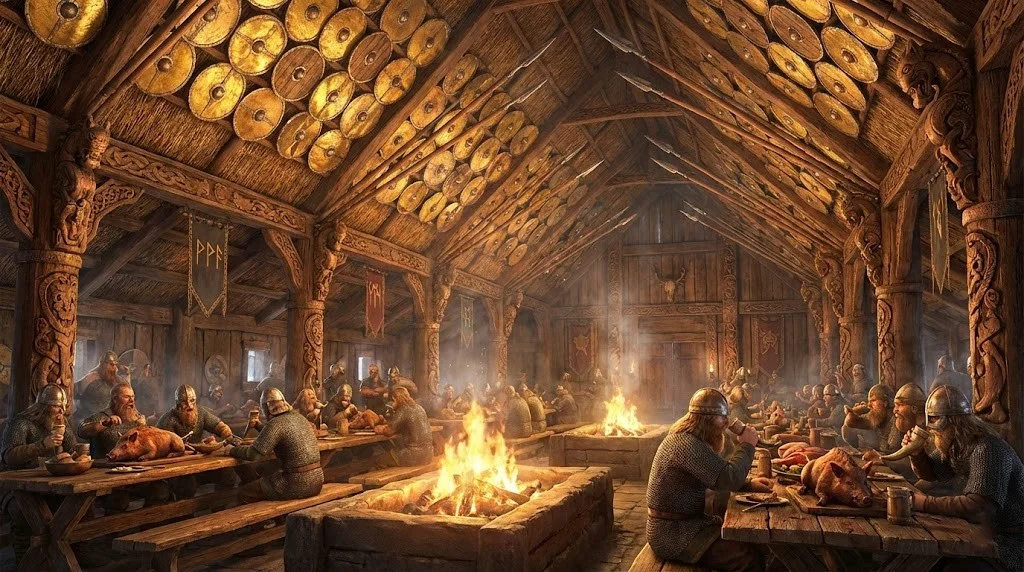
In Old Norse, Valhöll translates literally to “Hall of the Fallen.” It is not a paradise of clouds and harps; it is a majestic, fortified military hall located in Asgard, the realm of the gods.
According to the Poetic Edda (specifically the poem Grímnismál), Valhalla is a massive structure designed for war. Its roof is thatched with golden shields, its rafters are made of spear shafts, and chainmail coats lie on the benches instead of cushions. It has 540 doors, and through each door, 800 warriors can march shoulder-to-shoulder.
The Purpose of Odin’s Hall
Unlike the Christian concept of Heaven, which is a reward for a virtuous life, Odin Valhalla is a training camp.
Odin, the Allfather, is obsessed with the prophecy of Ragnarök, the end of the world. He knows that one day, the giants and monsters will attack Asgard. To prepare for this apocalypse, he needs an army.
This is the sole purpose of Valhalla. It is a holding pen for the Einherjar (the army of one), the elite warriors who will fight beside the gods at the end of time.
Life Inside the Hall
For those chosen, daily life is a cycle of violence and feasting:
- The Battle: Every morning, the warriors march out to the courtyard to fight each other to the death. They hack each other to pieces, honing their skills.
- The Resurrection: At sundown, their wounds magically heal, and the dead rise again.
- The Feast: They return to the hall to drink mead from the udder of the goat Heidrun and eat the meat of the boar Sæhrímnir, which is slaughtered and resurrected every single day.
Who Goes to Valhalla?
A common misconception is that all Vikings go to Valhalla. This is false. Access to Odin’s hall was incredibly exclusive.
To even be considered for Valhalla Norse mythology states you must meet two strict criteria:
- You must die in battle (a “straw death” in bed from old age or sickness disqualifies you).
- You must be chosen.
The Role of the Valkyries
Dying with a sword in your hand was not an automatic ticket. The Valkyries (literally “Choosers of the Slain”) were female spirits who surveyed the battlefields. Acting on Odin’s will, they selected only the bravest, most skilled, or most “useful” warriors to be taken up to Asgard Valhalla.
If you were a brave warrior but simply died of an infection after the battle, or if you were a mediocre fighter who got lucky, the gates of Valhalla would likely remain closed to you.
Historical Note: The Vikings prepared for this journey meticulously. They were often buried with their weapons, like the Seax Knife, and grooming tools like the Horn Comb, ensuring they arrived in the afterlife armed and dignified.
What Is Folkvangr?
Here lies the great forgotten truth of the Viking afterlife. Before Odin gets his army, someone else gets the first pick.
Folkvangr (Old Norse for “Field of the People” or “Field of the Host”) is the realm ruled by the Goddess Freya.
According to the Grimnismal, Freya is not just a goddess of love and beauty; she is a goddess of war. The text explicitly states:
“The ninth hall is Folkvangr, where bright Freya decides where the warriors shall sit. Some of the fallen belong to her, and some belong to Odin.”

The “First Pick” Rule
The mythology suggests a strict arrangement between the two gods. Of all the warriors who die in battle:
- The first half go to Freya Folkvangr.
- The second half go to Odin Valhalla.
This means that statistically, a Viking hero had a 50% chance of ending up in Freya’s meadow rather than Odin’s hall.
What is Folkvangr Like?
While Valhalla is described in detail as a loud, boisterous mead hall, Folkvangr is more mysterious. It is described as a vast, beautiful meadow. Within this field lies Freya’s hall, Sessrúmnir (“Seat-Roomy” or “Many Seats”).
Scholars speculate that while Valhalla is an army camp preparing for Ragnarök, Folkvangr might have been a place of rest, preservation, or a different kind of preparation. As a Vanir goddess (associated with nature and magic), Freya’s realm may have been more connected to the cycle of life and rebirth than the strict militarism of Asgard.
And here is the humbling truth behind this entire debate: nearly everything we know about Folkvangr comes from a single stanza. One verse of the Grímnismál, echoed by Snorri, carries the whole doctrine of Freya’s half. Valhalla fills poems, sagas and royal eulogies; Folkvangr gets four lines. Whether that silence means the tradition was fading, regional, or simply lost with the poems that never survived, is one of Norse mythology’s most tantalizing open questions.
Valhalla vs Folkvangr: Key Differences Explained
Why the split? Why do we have Valhalla vs Folkvangr?
The division represents the union of the two tribes of gods: the Aesir (Odin’s tribe, focused on order and war) and the Vanir (Freya’s tribe, focused on nature and fertility). By sharing the glorious dead, they maintain the peace treaty between their clans.
Here is the breakdown of the two realms:
| Feature | Valhalla | Folkvangr |
| Ruler | Odin (The Allfather) | Freya (Goddess of War & Love) |
| Location | Asgard | Vanaheim (or Asgard, debated) |
| Meaning | Hall of the Fallen | Field of the People/Host |
| Selection | The 2nd Half of the Slain | The 1st Half of the Slain |
| Atmosphere | Martial, Boisterous, Training | Natural, Mystical, Preserving |
| Purpose | Army for Ragnarök | Unknown (Protection? Rebirth?) |
| Housing | A Great Hall of Shields | A Hall (Sessrúmnir) in a Meadow |
It is fascinating to note that Freya gets to choose first. This implies that the warriors in Folkvangr might actually be the “cream of the crop”, the absolute best of the best, or perhaps those who possessed noble qualities beyond just brute strength.
Viking Afterlife: Were There Other Realms?
If you ask where do Vikings go when they die, and you only answer Valhalla or Folkvangr, you are ignoring 90% of the population.
Most Vikings were not warriors. They were farmers, weavers, traders, and craftsmen. They did not die in battle. So where did they go?
1. Helheim (The Realm of Hel)
Contrary to the Christian “Hell,” Hel was not necessarily a place of punishment or fire. It was simply the land of the dead, located in Niflheim.
Ruled by the goddess Hel (Loki’s daughter), it was a grey, damp, and somewhat boring place where life continued in a shadowy reflection of the living world. Relatives would reunite here. It was the destination for those who died of “sickness or old age.”
2. Ran’s Net
For the Vikings who spent their lives at sea, drowning was a real possibility. Those lost to the ocean were said to be caught in the net of Rán and taken to her hall at the bottom of the sea. She is the wife of Ægir, the sea-giant, though the sources never settle whether she is a giantess herself or a goddess of the sea in her own right.
3. The Burial Mound
Many Norse people believed the dead simply stayed in their grave mounds. This is why they were buried with so many goods, Viking Bags filled with coins, food, and tools. They believed the deceased lived a “mound life,” watching over the family farm.
The mound itself is the one part of all this that archaeology can actually see. What went into it, how it was built, and whether the body was burned first: we set out the evidence in our guide to Viking funeral rites.
Common Myths and Misconceptions About Valhalla
Thanks to centuries of romanticism and modern media, the definition of what is Valhalla has been distorted. Let’s debunk the biggest myths.
Myth 1: Valhalla is a Paradise
Reality: It is a slaughterhouse. If you don’t like fighting to the death every single day, receiving mortal wounds, and dealing with the smell of sweat, blood, and roasting meat, Valhalla would be a nightmare, not a paradise.
Myth 2: You Just Need to Be Brave
Reality: Bravery wasn’t enough. You had to die in battle. A legendary king who ruled wisely for 50 years and died peacefully in his sleep would go to Hel, not Valhalla.
Myth 3: Only Men Go to Valhalla
Reality: While primarily focused on male warriors, the mythology is not explicitly “men only.” Valkyries themselves are female. However, mythological texts focus on the Einherjar as men. Folkvangr, on the other hand, is sometimes interpreted as being more open to noble women, though strict textual evidence is scarce.
Valhalla and Folkvangr in Modern Pop Culture
Why is Folkvangr so forgotten?
Modern media, from Wagner’s operas to the Marvel Cinematic Universe (MCU), has simplified Norse mythology for mass consumption.
- Marvel’s Thor: Depicts Valhalla as a shimmering gold heaven for all good Asgardians, stripping away the blood and grit.
- Assassin’s Creed Valhalla: Did a better job of visualizing the “Great Heathen Army” mentality, but still focuses heavily on Odin’s hall as the ultimate goal.
- The TV Show “Vikings”: Popularized the idea of seeking death to enter Valhalla, often ignoring the fear of Helheim that real Norse people likely felt.
This pop culture simplification is why the keyword valhalla vs folkvangr is becoming trending: people are finally digging deeper than the movies and discovering the Goddess Freya’s role.
Conclusion: The Two Paths of Glory
So, what is Valhalla?
It is the Hall of the Fallen, a grim and glorious fortress where Odin hoards the souls of warriors to fight a losing war against the end of the world. It is a place of honor, yes, but also a place of desperate preparation.
But we must remember that it is only half the story.
The Viking afterlife was not a single destination. It was a choice made by the gods. While Odin gathered his army in the shield-roofed hall, Freya gathered hers in the beautiful meadows of Folkvangr.
Whether a Viking warrior hoped for the roar of Odin’s feast or the peace of Freya’s field, one thing remained constant: the belief that death was not the end, but merely a transfer to a new service.
You can hear the gates open. Our track Valhalla Rising is the sound of that transfer of service: the Valkyries’ choice, the 540 doors, the feast that never ends.
Ready to explore more Viking mysteries?
Now that you know where they went after death, discover the tools they used in life. Read our guides on the Visby Lenses and the hidden meanings behind Odin’s Ravens.
Frequently Asked Questions
What is Valhalla in Norse mythology?
Valhalla (“Hall of the Fallen”) is a majestic hall in Asgard ruled by Odin. It is the afterlife destination for half of the warriors who die in combat, who prepare there to fight in Ragnarök.
Did all Vikings go to Valhalla?
No. Only warriors chosen by Valkyries who died in battle went to Valhalla. The other half went to Freya’s Folkvangr. Those who died of sickness, old age, or drowning went to Helheim or Ran’s Net.
What is the difference between Valhalla and Folkvangr?
Valhalla is ruled by Odin and resembles a military training hall. Folkvangr is ruled by Freya and is described as a meadow or field. Freya gets to choose the first half of the fallen warriors, while Odin takes the rest.
Is Valhalla real in Viking beliefs?
Yes, it was a central part of the Norse pagan belief system. The hope of entering Valhalla gave warriors the courage to fight fearlessly, believing that death in battle was a promotion, not an end.
What does Valhalla mean?
Valhalla comes from the Old Norse Valhöll, meaning “Hall of the Fallen” (from valr, the slain, and höll, hall). The name describes its function precisely: it is the hall where half of the warriors slain in battle are gathered by Odin to prepare for Ragnarök. It never meant “heaven”.
What does “Victory or Valhalla” mean?
“Victory or Valhalla” is a modern battle cry, not an attested Viking phrase, but it compresses a real Norse idea: a warrior either wins the battle or dies fighting, and death in combat opens the way to Odin’s hall. Popularized by shows and games, it captures the mentality that made a straw death more feared than a sword.
Music to read by
Each article has a soundtrack. Listen to Mythic Harmonies while you read.
Explore the music