

Mjolnir: The True Meaning of Thor’s Hammer (And Everything Marvel Got Wrong)
Mjolnir (Old Norse: Mjölnir) is Thor’s hammer in Norse mythology. The medieval sources describe it both as a weapon against giants and as an instrument of hallowing and restoration. Archaeologists also know roughly 1,000 Viking Age hammer amulets, generally interpreted as protective objects, although their exact use varied by place and context.
Picture the hammer. The rectangular head, the long elegant handle, the perfect symmetry. Chris Hemsworth wielding it with effortless grace across a CGI battlefield.
Now forget all of it.
In Skáldskaparmál, the hammer’s handle is too short because Loki interrupts its forging. The same source says it returns to Thor and can be carried inside his shirt. Archaeological finds add another dimension: the National Museum of Denmark reports about 1,000 known hammer amulets across northern Europe, worn by women as well as men and most often interpreted as protective.
That gap between the Marvel icon, the medieval texts, and the archaeological record is where the real meaning of Mjolnir begins.
The Myth-Buster: Two Things Marvel Never Told You
Before diving into the mythology, let’s dismantle the two biggest misconceptions head-on.
Misconception 1: Mjolnir has a long, elegant handle.
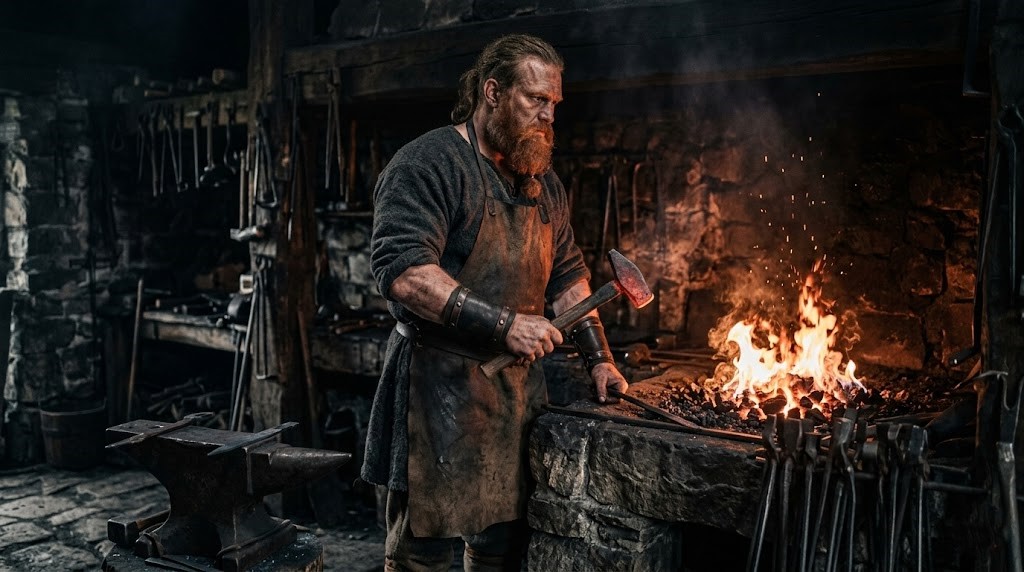
The Prose Edda tells the story of Mjolnir’s creation explicitly. The dwarf Brokkr was forging the hammer in his furnace when Loki, disguised as a fly, bit his eyelid. Brokkr flinched for just a moment, and the bellows stopped. The result: the handle came out too short.
This is not a minor detail in Snorri’s narrative: the finest treasure emerges from sabotage with a visible limitation. It is tempting to read that as a philosophy of power through imperfection, but the source itself does not state that lesson. The damaged handle is evidence; the philosophy is a modern interpretation.
Misconception 2: Mjolnir was only a warrior’s symbol.
Archaeology supports a broader role. The National Museum of Denmark reports roughly 1,000 known hammer amulets across Scandinavia, the British Isles, Russia, and the Baltic region. They occur often in women’s graves and were worn by women as well as men. That evidence argues against an exclusively male warrior badge, but it does not prove that every pendant carried the same meaning. Protection is the museum’s leading interpretation.
That breadth matters. Thor fights constantly in myth, but the archaeological evidence does not let us reduce his hammer to an emblem of warriors alone.
The Forging of Mjolnir: Loki’s Wager
The origin of Mjolnir is one of the most entertaining stories in the entire Norse corpus, and it begins, as so many Norse stories do, with Loki causing chaos.
One day, Loki cut off the golden hair of Sif, Thor’s wife, while she slept. Thor’s rage was immediate and absolute. To save himself, Loki promised to travel to Svartalfheim, the realm of the dwarves, and have the sons of Ivaldi craft new golden hair for Sif.
The sons of Ivaldi delivered. But Loki, never content with simply solving a problem, made a wager with another pair of dwarf brothers: Sindri and Brokkr. He bet his own head that they could not forge three treasures equal to those of the sons of Ivaldi.
Sindri and Brokkr accepted. They began work on three objects: the golden boar Gullinbursti, the ring Draupnir, and the hammer Mjolnir.
It was during the forging of Mjolnir that Loki intervened. Transformed into a fly, he bit Brokkr’s eyelid as he worked the bellows. The momentary interruption was enough. The handle came out too short.
When the treasures were presented to the gods, the judgment was unanimous: despite the short handle, Mjolnir was the greatest treasure of all. It would be the best defense against the giants who constantly threatened the cosmic order.
Loki lost the bet, then argued that the dwarfs could take his head but not damage his neck. The loophole saved his head; it did not leave him unpunished. In Snorri’s account, Brokkr has Loki’s lips sewn together.
What Does Mjolnir Mean? The Linguistics
The name Mjolnir (Old Norse: Mjölnir) does not have one universally accepted etymology. The nineteenth-century Cleasby–Vigfusson dictionary calls a connection with words meaning “to grind” or “crush” probable, but not certain, and also records a comparison with words for cloud or darkness.
“Crusher” is therefore a useful proposed sense, not a settled literal translation. A connection with lightning has also been proposed through comparative linguistics, but the medieval narratives identify Mjolnir most securely by what it does: it is Thor’s hammer, the weapon that strikes the giants and the object used to hallow or restore.
| Proposed connection | Evidence | How certain is it? |
|---|---|---|
| Grinding or crushing | Old Norse mala and related Germanic words | Probable proposal, not certain |
| Cloud or darkness | Germanic comparative forms | Recorded alternative |
| Lightning | Comparative linguistic hypothesis | Possible association, not a definitive translation |
Thor: The God the Common People Actually Prayed To
To understand Mjolnir, we need to separate what the sources actually show from what later retellings make certain. Thor is the son of Odin the Allfather and the personified earth, Jörð, and his best-known mythic role is defending the ordered world from giants.
Evidence also places the hammer beyond the battlefield. In stanza 30 of Þrymskviða, Mjolnir is laid in the bride’s lap to hallow the marriage. This is strong literary evidence for a consecrating role, but it is not proof that every Viking Age wedding followed an identical ritual.
The Swedish History Museum likewise connects Thor’s-hammer rings with protection, fertility, and care for the dead, while stressing that their exact archaeological use remains uncertain. The safest conclusion is therefore also the most interesting: Mjolnir could signify protective and hallowing power as well as Thor’s destructive force.
Thor’s hammer was a weapon against the giants, but it was not only a weapon. In myth and material culture, destruction and protection belong to the same object.
The Archaeological Evidence: 1,000 Hammers and What They Tell Us
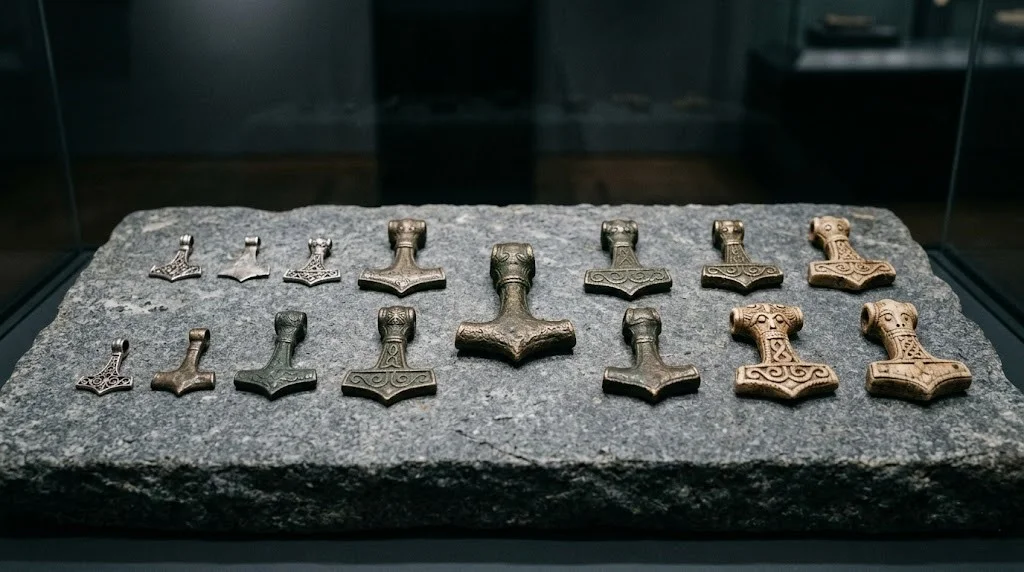
Thor’s-hammer amulets are among the most recognizable objects associated with late Viking Age belief. The National Museum of Denmark counts roughly 1,000 examples from Scandinavia, the British Isles, Russia, and the Baltic region. That scale is meaningful, but it does not make every find identical in date, context, or purpose.
To compare that unusually strong archaeological record with runes, picture stones, later Icelandic staves, and modern emblems, see which Viking symbols are historically attested—and which familiar designs belong to later periods.
The Købelev Hammer (Denmark)
The small bronze amulet from Købelev bears the inscription Hmar x is, interpreted by the National Museum as “This is a hammer.” The museum describes it as the only known Thor’s-hammer amulet with a runic inscription. Its value is precision: where the shape alone might look ambiguous to a modern viewer, the maker labelled the object.
Thor’s-hammer rings (Sweden)
Iron rings carrying several small hammer-shaped pendants occur in cremation graves and at settlement sites. The Swedish History Museum presents protection, fertility, and hallowing of the dead as plausible interpretations, not established facts. These assemblages show ritual importance without giving us a single universal meaning.
What the evidence does—and does not—prove
Hammer amulets occur often in women’s graves and were worn by women and men. This rules out the simplistic idea of an exclusively male warrior emblem. It does not establish that most examples belonged to women or children, nor does it let us reconstruct a fixed ceremony for every pendant. Good archaeology preserves that distinction.
Mjolnir’s Powers: What the Eddas Actually Say
The fullest medieval descriptions come from Snorri Sturluson’s thirteenth-century Edda, written after Iceland’s conversion to Christianity. It preserves indispensable material, but it is a medieval literary source—not a transcript of one uniform Viking Age religion.
It returns after being thrown. In Skáldskaparmál, the gods are told that Mjolnir will never miss and will never fly so far that it does not return to Thor’s hand. The text gives the property directly; interpreting it as a symbol of a cyclical storm is a modern reading, not part of Snorri’s explanation.
It can be carried inside Thor’s shirt. The same passage says Thor can make the hammer small enough to keep inside his shirt. This is a feature of the mythic weapon; the text does not say that pendant amulets were miniature copies created because of that power.
It restores Thor’s goats. In Gylfaginning, Thor lays Mjolnir over the skins and bones of his slaughtered goats and hallows them; the animals rise again. This is a specific act of restoration, not evidence that the hammer could resurrect any dead being at will.
It hallows. In Þrymskviða, the giant Thrym demands Freyja as his bride. Thor goes in her place, disguised, and stanza 30 has the hammer brought in to hallow the bride. The scene demonstrates Mjolnir’s consecrating function within the poem; it should not be presented as a direct record of a standardized historical wedding rite.
Taken together, the sources give Mjolnir a coherent double role: it breaks threats to cosmic order, and it restores or hallows what belongs within that order.
Who Can Lift Mjolnir in Norse Mythology?
The surviving Norse sources contain no “worthiness enchantment” like the one Marvel made famous. Odin does not place a moral test on the hammer, and no poem says that only a person judged worthy can move it. That rule belongs to modern comics and films.
The medieval texts give us different constraints. In Gylfaginning, Thor owns iron gloves that he cannot do without when gripping the hammer’s shaft, along with a belt that increases his divine strength. In Þrymskviða, Thrym possesses the stolen hammer and orders it brought forward to hallow the supposed bride. The poem never stages a contest of moral worth.
Mjolnir also outlives Thor. Stanza 51 of Vafþrúðnismál says that his sons Móði and Magni will possess it after Ragnarök. The hammer is therefore not locked to one “worthy” user: in the poem, it becomes part of the inheritance of the renewed world. Our guide to Ragnarök follows that survival in its wider context.
Mjolnir vs the Cross: A Symbol Under Pressure
The Viking Age overlapped with the Christianization of Scandinavia, and hammer pendants became especially visible during this long transition. It is tempting to reduce every hammer to a badge of pagan resistance, but the archaeological record is more complicated.
The National Museum of Denmark notes that hammers and crosses sometimes occur together and explicitly questions whether opposition to Christianity can explain the hammer’s popularity by itself. The Swedish History Museum, meanwhile, points to runestones where the hammer appears in visual contrast to the Christian cross.
Context probably mattered. A hammer might communicate protection, allegiance to Thor, continuity with local practice, or several meanings at once. Some objects could mark religious difference; others may have sought protection without demanding a simple either-or identity. The evidence does not support one explanation for every wearer.
Thor’s Hammer Necklace: What Wearing Mjolnir Means Today
Today a Mjolnir necklace can express modern Heathen devotion, Scandinavian heritage, personal resilience, admiration for Norse myth, or simply an aesthetic preference. These meanings are contemporary and varied; none can be projected automatically onto every Viking Age amulet.
Wearing Thor’s hammer is not inherently disrespectful, but context and conduct matter. The Anti-Defamation League notes that Mjolnir has traditional, non-racist origins and is used by many people without extremist meaning, even though some racist groups have appropriated it. The symbol alone does not tell you a wearer’s politics. Respect begins with accurate history and with not claiming that one modern interpretation is the only authentic one.
In the Viking Age, the hammer pendant was one piece of a broader visual language of dress and status, which we explore in our full guide to Viking clothing.
The Short Handle: A Modern Interpretation
We return to the flaw. In Snorri’s account, Loki’s interference leaves the hammer with a shorter handle than intended, yet the gods still judge it the finest defense against the giants.
A modern reader can see in that story a powerful image of capability despite imperfection: the greatest treasure succeeds without being flawless. That reading fits the narrative, but it remains an interpretation. No surviving source tells us that Viking Age audiences treated the short handle as a formal philosophical doctrine.
The distinction strengthens the story rather than weakening it. The medieval text gives us the damaged handle; the lesson we draw from it belongs to us.
FAQ: People Also Ask
What does Mjolnir mean in Norse mythology?
Mjolnir is Thor’s hammer. Its exact etymology is disputed: “crusher” or “grinder” is a probable proposal, while cloud, darkness, and lightning connections have also been suggested. Its secure mythic role is both destructive and protective: it strikes giants, returns to Thor, hallows, and restores his goats.
Why did Mjolnir have a short handle?
In Skáldskaparmál, Loki takes the form of a fly and bites Brokkr’s eyelid while the dwarf works the bellows. The interruption causes the handle to come out shorter than intended. Despite that flaw, the gods judge the hammer the finest defense against the giants.
Did Viking women wear Mjolnir?
Yes. The National Museum of Denmark says Thor’s-hammer amulets occur often in women’s graves and were worn by women as well as men, probably for protection. The evidence does not show that women wore them at exactly the same rate as men or that every pendant had one fixed meaning.
What powers does Mjolnir have in Norse mythology?
Skáldskaparmál says Mjolnir does not miss, returns to Thor after being thrown, and can be kept inside his shirt. Gylfaginning describes Thor hallowing the remains of his goats so they rise again, while Þrymskviða uses the hammer to hallow a bride. The sources do not grant it unlimited power to resurrect any dead being.
Is Mjolnir related to the Christian cross?
Hammer pendants became especially visible during Scandinavia’s conversion, and some finds place hammers and crosses in the same wider context. A hammer could mark protection, devotion to Thor, religious difference, or several meanings at once. Archaeologists caution against treating every pendant as a simple badge of anti-Christian resistance.
Who can lift Mjolnir in Norse mythology?
The Norse sources contain no Marvel-style worthiness enchantment. Thor uses iron gloves when gripping the hammer, Thrym possesses the stolen weapon in Þrymskviða, and Vafþrúðnismál says Thor’s sons Móði and Magni will possess it after Ragnarök. The moral test belongs to modern comics, not the medieval texts.
What does a Mjolnir necklace mean today?
A modern Mjolnir necklace can express Heathen devotion, Scandinavian heritage, protection, resilience, admiration for Norse myth, or simply an aesthetic choice. Meanings vary by wearer and should not be projected automatically onto every Viking Age amulet.
Is it disrespectful to wear Thor’s hammer?
Not inherently. Respect depends on context: learn the symbol’s history, avoid presenting speculation as archaeology, and do not assume one modern interpretation is universal. Mjolnir has traditional non-racist meanings, although some extremist groups have also appropriated it, so surrounding context matters.
Conclusion: The Hammer That Was Never Just a Weapon
Mjolnir is more than the most famous weapon in Norse mythology. The medieval texts make it Thor’s defense against the giants, but they also give it powers of return, restoration, and hallowing.
Archaeology tells a parallel, less tidy story. Roughly 1,000 hammer amulets are known across northern Europe. Women and men wore them, probably often for protection, yet their precise meanings changed with context. During Christianization, some may have signalled allegiance to Thor, while finds involving both hammers and crosses warn against treating every wearer as part of a simple religious opposition.
The most accurate interpretation is therefore not the weakest one. Mjolnir could destroy and protect, mark identity and seek safety, carry a deliberate inscription or none at all. Where the evidence stops, we should name the uncertainty instead of filling it with a modern legend.
We forged that prayer into sound: Þrumr Þórs (Thunder of Thor) is the hammer’s voice in Old Norse.
Sources & Further Reading
- Snorri Sturluson, Edda: Skáldskaparmál, ed. Anthony Faulkes, Viking Society for Northern Research
- Snorri Sturluson, Edda: Prologue and Gylfaginning, ed. Anthony Faulkes, Viking Society for Northern Research
- Þrymskviða, Old Norse text, Heimskringla.no
- National Museum of Denmark, “Runes confirm: Thor’s hammer is a hammer”, Købelev find and archaeological context
- Swedish History Museum, “Thor’s hammer rings”
- Richard Cleasby and Gudbrand Vigfusson, An Icelandic-English Dictionary, entry “Mjölnir”
- Anti-Defamation League, “Thor’s Hammer”, modern political context and symbol use
Music to read by
Each article has a soundtrack. Listen to Mythic Harmonies while you read.
Explore the music