
Yule: What the Norse Sources Really Say About the Midwinter Feast
On this page 17 sections
- Yule at a glance: quick facts
- What does Yule mean? Jól, Giuli and the Gothic jiuleis
- The oldest description: Bede’s Giuli and Modranecht, “Mothers’ Night” (725)
- “Drinking Yule”: the earliest Norse verse
- When is Yule? Midwinter, the solstice and the moon
- How long did Yule last? Were there twelve days of Yule?
- What did the Vikings do at Yule? Ale, toasts and sacrificial meat
- Yule oaths and the sacred boar
- Yule and Odin: why is Odin called Jólnir?
- Trolls and the walking dead: the dark side of Yule in the sagas
- How Yule became Christmas
- Is Yule pagan? Yule vs Christmas
- Yule traditions: what is Viking Age and what is later
- Yule today
- Where to read about Yule in the sources
- Frequently asked questions
- Sources and editorial notes
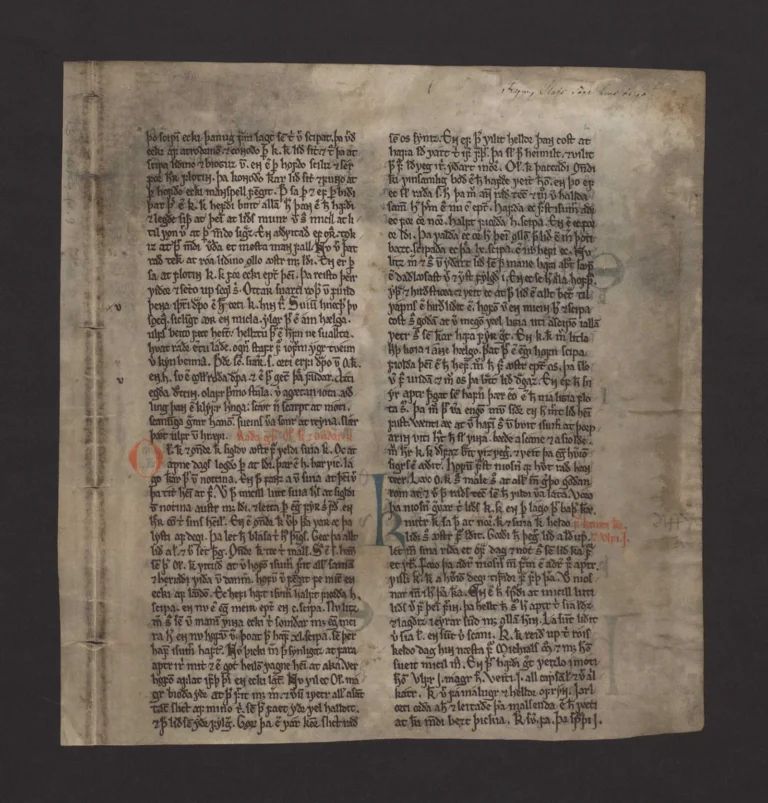
Yule (Old Norse jól) was the great midwinter feast of the pre-Christian North, a time of ale, sacrificial meat, toasts and oaths that, according to Snorri Sturluson, a Christian king of Norway moved to Christmas in the tenth century. The word is older than the Vikings and survives in English Yule and Yuletide and Scandinavian jul, but most Yule customs sold as Viking today, from the Yule log to the straw goat, were first recorded centuries later.
The evidence for the old feast is thin but real: a line of court poetry from about 900, an eighth-century monk’s calendar, a Gothic month name, and a few chapters in sagas written down in Iceland around 1200–1300. This guide sets those texts side by side, with chapter and stanza numbers, and separates them from the folklore that grew up later.
- Yule is a real pre-Christian feast: a court poem traditionally dated to about 900 says King Harald Fairhair would rather “drink Yule” out at sea than sit by the fire (Haraldskvæði 6).
- It was not fixed on 21 December: Snorri Sturluson says it began on hǫkunótt, “midwinter night”, and lasted three nights until King Hákon the Good moved it to the Christian date (Hákonar saga góða 15). Medieval Norse reckoning put midwinter in January.
- The word is very old: the Gothic calendar has fruma jiuleis, “first Yule month”, and in 725 Bede recorded two Anglo-Saxon months called Giuli on either side of the winter solstice.
- Many “Yule traditions” are later: the Yule log, the straw goat, the Christmas tree, mistletoe kisses and Iceland’s Yule Lads are first documented in early modern or modern times.
Yule at a glance: quick facts
| Question | Short answer |
|---|---|
| Name | Old Norse jól (often typed jol), a plural noun; Old English Giuli (in Bede) and geola; Gothic jiuleis. Today Norwegian, Danish and Swedish jul and Icelandic jól, all meaning Christmas; English Yule and Yuletide. |
| What it was | A midwinter feast of drinking, sacrificial meals, toasts to gods and ancestors, and vows, attested mainly at the halls of kings and chieftains. |
| When is Yule today? | Modern Pagans keep Yule at the winter solstice, 21 or 22 December (Monday 21 December in 2026). In Scandinavia jul is Christmas, celebrated above all on Christmas Eve, 24 December. |
| When was it in the Viking Age? | At “midwinter”, which in medieval Norse reckoning fell in mid-January; the Anglo-Saxon months of Giuli straddled the winter solstice. King Hákon the Good moved it to Christmas in the tenth century. |
| How long | Three nights before Christianization, according to Snorri; the Christian Yule ran from Christmas to Epiphany, the thirteenth day. The “twelve days” are a Christian reckoning. |
| Is Yule pagan? | Yes, in origin: the word and the feast are pre-Christian. Since the conversion, Yule has been the Scandinavian name for Christmas. |
| Gods named in the sources | Freyr (“Freyr’s game”, the boar), Odin (called Jólnir), and Odin, Njörðr and Freyr in the toasts of Snorri’s general account of sacrificial feasts (Hákonar saga góða 16). |
| Main sources | Haraldskvæði (c. 900); Bede, De temporum ratione 15 (725); Snorri’s Heimskringla (c. 1230); Ágrip (c. 1190); the Eddic poem Helgakviða Hjörvarðssonar; Hervarar saga; Thietmar of Merseburg’s chronicle (c. 1015). |
What does Yule mean? Jól, Giuli and the Gothic jiuleis
Nobody knows for certain what the word Yule originally meant. Old Norse jól, Old English geola and Giuli, and Gothic jiuleis go back to a common Germanic word, reconstructed as *jehwlą in the Norwegian encyclopedia Store norske leksikon. Cleasby and Vigfússon’s Old Norse dictionary (1874) already called the etymology “much contested”, noting that Jacob Grimm derived it from hjól, “wheel”, as if Yule marked the turning sun. The historian of religion Sophie Bønding (Aarhus University, 2013) sums up the present position: many explanations, the “sun wheel” among them, have been proposed and rejected, and none convinces. The “wheel” is still the explanation most often repeated in popular articles, so treat it as an old hypothesis, not a fact.
Two details matter more than the etymology. First, Old Norse jól is a plural noun, like English “holidays”: it may have named a run of feast days rather than a single one. Second, the word is attested before the Viking Age, outside Scandinavia:
- Gothic. A sixth-century Gothic church calendar, preserved as a palimpsest in the Ambrosian Library in Milan, heads one month, usually equated with November, fruma jiuleis, “the first (or former) Yule month”. Bernhardt’s edition (1884) compares Old English ǽrra geola and æftera geola, the “earlier” and “later” Yule months. The reading Naubaimbair, November, printed beside it in older editions, has been challenged from digital images by David Landau in a 2018 conference paper.
- Old English. Bede gives Giuli as the name of both December and January (below), and the Bosworth–Toller dictionary records ǽrra geola, “the ere or former Yule month, December”.
- Old Norse. Jól appears in poetry from about 900, and the Icelandic month name ýlir, which Cleasby and Vigfússon describe as answering to December and “prob. related to Jól”, belongs to the same family.
Yule is therefore not a Viking invention, and not specifically Norse: it is a shared Germanic name for a season around midwinter. Only in Scandinavia and England did that old name survive the conversion: in Scandinavia it is still the ordinary word for Christmas, while in English Yule lived on beside Christmas, above all in the North.
How do you say Yule in Old Norse?
The Old Norse word is jól, pronounced roughly “yohl” (Old Norse j sounds like English y, and the accent marks a long vowel). “Yule-eve” is jólaaptan, a Yule feast jólaveizla, Yule ale jólaöl, and “to keep Yule” is halda jól. The modern Icelandic greeting Gleðileg jól (“Merry Christmas”) uses the same word; no Viking Age Yule greeting has come down to us.
The oldest description: Bede’s Giuli and Modranecht, “Mothers’ Night” (725)
The earliest text that explains the name is not Scandinavian at all. In De temporum ratione (“The Reckoning of Time”), finished in Northumbria in 725, the year he uses as “the present year” in his worked examples, the monk Bede pauses to describe the calendar of his pagan ancestors. They counted months by the moon, he says, and their year began on 25 December:
“Incipiebant autem annum ab octavo Calendarum Januariarum die, ubi nunc natale Domini celebramus. Et ipsam noctem nunc nobis sacrosanctam, tunc gentili vocabulo Modranicht, id est, matrum noctem appellabant.”
They began the year on the eighth day before the Kalends of January [25 December], where we now celebrate the birth of the Lord. And that very night, now sacred to us, they then called by the heathen name Modranicht, that is, the night of the mothers.
Bede, De temporum ratione, chapter 15, Latin text ed. J. A. Giles (1843), vol. 6, p. 178; our translation
Bede suspects the name came from ceremonies “which they performed through that night”, but says no more about them. December and January were both called Giuli, and he explains why: Menses Giuli a conversione solis in auctum diei, quia unus eorum praecedit, alius subsequitur, nomina accipiunt, “the months of Giuli take their name from the turning of the sun toward the increase of the day, because one of them goes before it and the other follows” (chapter 15, Giles p. 179; our translation). Following the traditional Roman reckoning, Bede placed the winter solstice on 25 December (De temporibus 7; De temporum ratione 30), so the two Giuli months framed the solstice and the year’s first night.
This is the strongest early evidence for a link between Yule and the solstice. But it is English, not Norse, and it describes a calendar season, not a festival: Bede never says what was celebrated “at Giuli”, and he does not explain the “mothers” of Modranecht, as the name is usually cited (Giles prints Modranicht).
“Drinking Yule”: the earliest Norse verse
The first Scandinavian witness is a praise poem for Harald Fairhair, the king who united much of Norway in the late ninth century. Usually called Haraldskvæði (or Hrafnsmál, “The Raven’s Speech”, both modern titles), it is attributed to the court poet Þorbjörn hornklofi and traditionally dated to about 900. A valkyrie questions a raven about the king, and the raven answers that young Harald hates sitting indoors:
“Úti vill jól drekka,
ef skal einn ráða,
fylkir enn framlyndi,
ok Freys leik heyja.”
Out [at sea] he will drink Yule,
if he alone may decide,
the forward-minded prince,
and play Freyr’s game.
Haraldskvæði, stanza 6, lines 1–4 (numbering of Finnur Jónsson, Den norsk-islandske skjaldedigtning B1, 1912, followed by Finlay and Faulkes’s 2011 translation of Heimskringla); our translation
The stanza continues that the king “grew weary of the hearth and of sitting indoors, of the warm women’s room or of mittens full of down”. This stanza survives because two thirteenth-century kings’ sagas quote it, Fagrskinna and Snorri’s Heimskringla (Haralds saga hárfagra 16 in Laing, 15 in the Íslenzk fornrit edition), and both name Þorbjörn as its poet. The rest of the poem is scattered through those sagas, Flateyjarbók and Snorri’s Edda, and its twenty-three stanzas were only put together as one poem by nineteenth-century editors, as Klaus von See pointed out in 1961. Fagrskinna gives the stanzas on the battle of Hafrsfjörður to another poet, Þjóðólfr of Hvinir, and von See argued that stanzas 13–23 are a later imitation, probably of the early twelfth century. Stanza 6 is not among those. Note too that the poem is in an eddic metre (málaháttr), looser than the court metre usually trusted to keep verse intact, so its date of about 900 is the traditional one rather than a proven fact. Samuel Laing’s 1844 translation of Heimskringla renders the line loosely as “On the wild waves his Yule keeps he.”
Two things are certain from these four lines. Yule was already a named occasion around 900, and its core was drinking: one did not “celebrate” Yule, one “drank” it (jól drekka). What “Freyr’s game” means is not certain. Snorri, quoting the stanza in a story of winter warfare, took it as a phrase for battle, and most editors agree. Bønding points out that Freyr is the least warlike of the gods, and lists other readings proposed by scholars: a ritual weapon dance, a sacrifice, or fertility rites for the god of harvests. None is proven.
When is Yule? Midwinter, the solstice and the moon
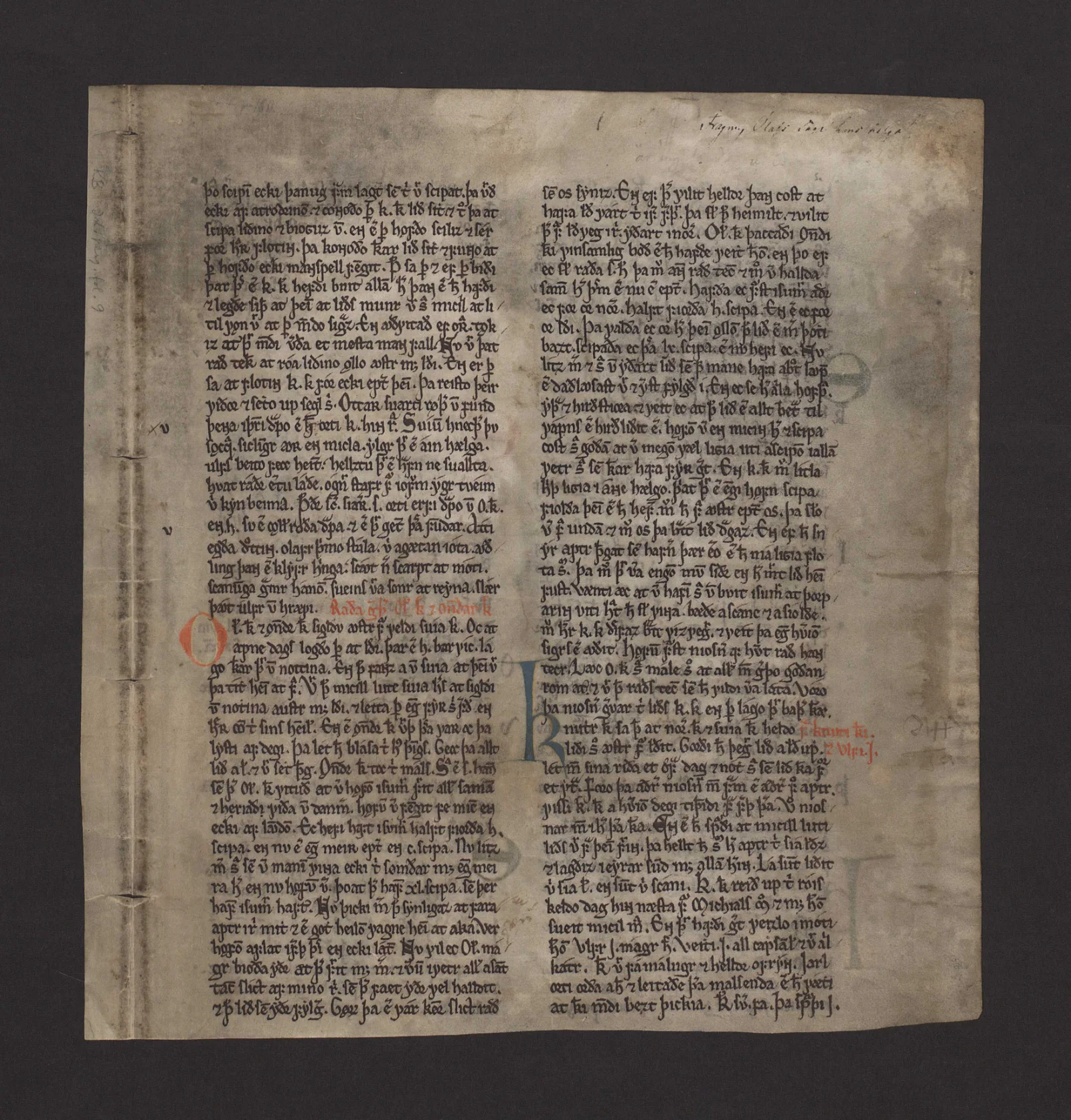
Today, people who celebrate Yule as a pagan festival usually keep it at the winter solstice, 21 or 22 December in the Northern Hemisphere (21 December in 2026), while in Scandinavia jul is simply Christmas. The medieval evidence points elsewhere. Viking Age Yule was held at “midwinter”, but not on a fixed day, and probably not on 21 December. The only explicit statement in Old Norse comes from Snorri Sturluson, in his saga of King Hákon the Good, who was raised as a Christian in England and ruled Norway in the mid-tenth century:
“He made a law that the festival of Yule should begin at the same time as Christian people held it, and that every man, under penalty, should brew a meal of malt into ale, and therewith keep the Yule holy as long as it lasted. Before him, the beginning of Yule, or the slaughter night, was the night of mid-winter (Dec. 14), and Yule was kept for three days thereafter.”
Hákonar saga góða, chapter 15, translated by Samuel Laing (1844)
Read this passage with the Old Norse beside it. Snorri writes En áðr var jólahald hafit hökunótt, þat var miðsvetrar nótt, ok haldin þriggja nátta jól: “Before, Yule was begun on hǫkunótt, that was midwinter night, and a three-night Yule was held” (our translation). The date “(Dec. 14)” is an addition in Laing’s English text and is not in the saga (the 2011 translation by Alison Finlay and Anthony Faulkes glosses the same night as “12th January” instead, again outside the Old Norse). Laing’s “slaughter night” is an interpretation, not a translation: Bønding notes that hǫkunótt occurs nowhere else in Old Norse and that its meaning is unknown.
When was “midwinter night”? In the medieval Norse year, which counted winter from mid-October, midwinter fell in January. The Icelandic month Þorri, “the first after mid-winter” in Cleasby and Vigfússon’s words, began between 9 and 16 January in the old Julian calendar, and Bønding places midwinter night between 19 and 21 January in our reckoning. Store norske leksikon puts midwinter day on 12 January, halfway between the winter and summer markers of 14 October and 14 April. Other medieval witnesses also point to January:
| Source | Date of writing | What it says about timing |
|---|---|---|
| Bede, De temporum ratione 15 | 725 | Two months called Giuli, one before and one after the winter solstice; the year began on 25 December, “Modranicht” |
| Haraldskvæði 6 | c. 900 | Harald “drinks Yule” in winter; no date |
| Thietmar of Merseburg, Chronicon I.17 | c. 1015 | Every nine years the Danes met at Lejre “in the month of January, after the time when we celebrate the Lord’s Epiphany” to sacrifice; he does not call it Yule |
| Snorri, Hákonar saga góða 15 | c. 1230 | Yule began on hǫkunótt, “midwinter night”, and lasted three nights until Hákon moved it to Christmas |
| Snorri, Ynglinga saga 8 | c. 1230 | Odin decreed sacrifices “in the middle of winter for a good crop” |
| Óláfs saga helga 114–115, 123 | c. 1230 | Trøndelag farmers hold a “mid-winter sacrifice”; a chieftain replaces his midwinter sacrifice with a Christian Yule feast |
How can Bede’s solstice months and Snorri’s January midwinter both be right? The Swedish historian of religion Andreas Nordberg (2006), as summarized by Bønding, proposed a lunisolar calendar, kept in step with the sun by adding a thirteenth month about every third year: months began with new moons, the second Yule month with the first new moon after the solstice, and if the feast culminated at the following full moon it fell between early January and early February, around Snorri’s midwinter night. Yule would then be tied to the solstice in the calendar but celebrated around midwinter. It is a reconstruction, and a reviewer doubted that a single pre-Christian calendar can be assumed for all of Scandinavia, but it fits the scattered evidence better than any fixed date.
Is Yule on 21 December?
For modern Pagans, yes; in the medieval sources, no. The 21 December date comes from modern Pagan calendars that celebrate Yule at the winter solstice, a legitimate modern choice, but no Old Norse text puts Yule on the solstice. The only earlier report of a northern midwinter festival is Procopius, writing in the mid-sixth century about “Thule”, probably northern Scandinavia. There the sun is not seen for forty days “at about the time of the winter solstice”; when, after some thirty-five days without sun, watchers on the mountains announce its return within five days, the people celebrate in the darkness “the greatest festival which the natives of Thule have” (History of the Wars VI.15, trans. H. B. Dewing, 1919). If those forty days are centered on the solstice, the festival fell some two weeks after it, in early January, not on the solstice itself. Procopius does not name it, and Bønding notes that he may be describing the Sámi rather than Scandinavians.
How long did Yule last? Were there twelve days of Yule?
Three nights, according to the only explicit source: ok haldin þriggja nátta jól, “and a three-night Yule was held” (Hákonar saga góða 15). In the nineteenth-century edition we quote, Hákon’s new law told men to keep it holy meðan jólin ynnist, “while Yule lasted”; the modern Íslenzk fornrit text, translated by Bønding and by Finlay and Faulkes, reads “as long as the ale lasted”, fitting a law that required every household to brew ale for the feast.
The Christian Yule that replaced it was longer. In the sagas Olaf the Saint inspects his treasures on the seventh day of Yule to prepare friendship gifts for hit átta kveld jóla, “the eighth evening of Yule” (Óláfs saga helga 172; our translation), and Icelanders called Epiphany Þrettándi, “the thirteenth”. The famous “twelve days” are Christian too. Clement A. Miles, in Christmas in Ritual and Tradition (1912), noted that older mythologists took them for a Germanic festal season, but concluded that the Twelve Days were “simply a creation of the Church”, first declared a festal season in the West by the Council of Tours in 567 (p. 239). Cleasby and Vigfússon’s claim that “the heathen Yule lasted thirteen days” (1874) has no medieval support: it projects the Christian season back onto the pagan feast.
What did the Vikings do at Yule? Ale, toasts and sacrificial meat
The sources agree on three elements: a large gathering at a chieftain’s or king’s hall, the drinking of consecrated toasts, and a meal of sacrificial meat. The most detailed account is Snorri’s story of how the farmers of Trøndelag forced their Christian king to take part. At a Yule feast at Mære, the farmers threatened King Hákon until Earl Sigurðr of Hlaðir arranged a compromise: “the king took some bits of horse-liver, and emptied all the goblets the bondes filled for him without the sign of the cross” (Hákonar saga góða 19, trans. Laing). Eating horse, an animal the written sources often single out as a sacrifice (Bønding), and drinking the toasts without a Christian blessing made the king a participant in the sacrifice.
Snorri also describes how a sacrificial feast, a blót, worked in general (chapter 16: þá er blót skyldi vera, “when there was to be a sacrifice”). Modern Heathens often call their Yule rite a jólablót, “Yule sacrifice”; we have not found that compound in the medieval texts quoted here. Everyone brought ale; cattle and horses were slaughtered; their blood, hlaut, was sprinkled on the altars, the temple walls and the people; the meat was boiled in kettles over fires in the middle of the floor. The chieftain blessed the cups and the food. “And first Odin’s goblet was emptied for victory and power to his king; thereafter, Niord’s and Freyja’s goblets for peace and a good season” (trans. Laing). Then many drank the bragafull, and toasts were drunk to dead kinsmen, called minni.
Freyr, not Freyja. Laing’s much-copied translation says “Niord’s and Freyja’s goblets”, but the Old Norse reads Njarðar full ok Freys full til árs ok friðar, “Njörðr’s toast and Freyr’s toast, for a good year and peace”. The toast is to Freyr, the god of harvests, not to his sister Freyja.
Not every feast is Yule. Snorri’s general description of sacrifice (chapter 16) gives no season, and the feast at Hlaðir where Hákon refused horse meat and the earl explained away his sign of the cross as Thor’s hammer took place “in autumn at the Winter Nights” (um haustit at vetrnóttum, chapter 18). Only the feast at Mære (chapter 19) is called a Yule feast.
Chapter numbers differ. We cite Laing’s 1844 translation, whose chapters match the nineteenth-century Old Norse editions. The modern Íslenzk fornrit edition, used by most scholars, numbers the same Hákonar saga góða chapters 13 (Yule law), 14 (sacrifices), 17 (Hlaðir) and 18 (Mære), and Bønding cites Óláfs saga helga 108 and 117 for Laing’s 114 and 123.
Other passages confirm that midwinter was one of the great sacrificial seasons. In Ynglinga saga 8, Odin decrees a sacrifice “in the middle of winter for a good crop” (trans. Laing). In Óláfs saga helga, set around 1020, King Olaf hears that the farmers of inner Trøndelag held “a great sacrifice in the middle of winter, at which they sacrificed offerings for peace and a good season” at Mære. Their spokesman, Ölvir of Egg, denies it: “We had,” said he, “Yule feasts and drinking feasts wide around in the districts” (chapter 114, trans. Laing). The king’s informant later explains that they sacrifice three times a year, “in autumn for a good winter, a second at mid-winter, and a third in summer” (chapter 115).
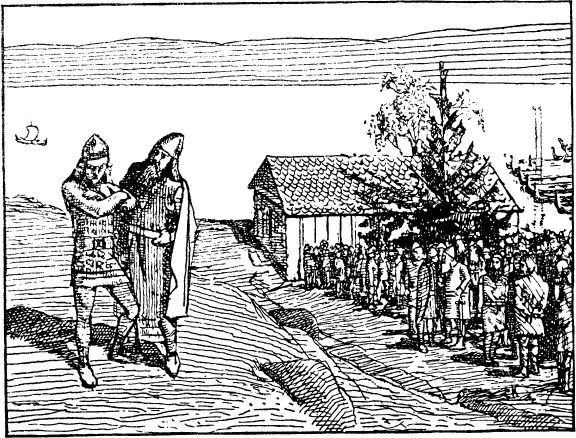
Snorri wrote about two and a half centuries after Hákon, and his scenes dramatize the clash between a Christian king and his pagan subjects. Bønding judges details such as blood-sprinkled altars uncertain, while the toasts and the sacrificial meal are the elements most likely to reflect real practice. Thietmar of Merseburg’s report of a January sacrifice at Lejre every nine years, with “ninety-nine people and as many horses” (Chronicon I.17, ed. Kurze 1889; our translation), shows the season but not the name: he never says Yule, and his numbers are hardly credible.
Yule oaths and the sacred boar
Yule-eve was a time for solemn vows. In the prose of the Eddic poem Helgakviða Hjörvarðssonar, preserved in the Codex Regius manuscript of about 1270, Prince Heðinn meets a troll-woman riding a wolf on his way home on Yule-eve and refuses her company. She warns him that he will pay for it “at the king’s toast”:
“That evening the great vows were taken; the sacred boar was brought in, the men laid their hands thereon, and took their vows at the king’s toast.”
Helgakviða Hjörvarðssonar, prose after stanza 30, translated by Henry Adams Bellows (1923)
Bewitched, Heðinn swears to win his own brother’s beloved, and leaves home in remorse. The Old Norse names the animal sónargöltr and the cup bragarfull. Hervarar saga has the same custom. In the version of the early fourteenth-century manuscript Hauksbók, King Heiðrekr sacrifices to Freyr, keeps the largest boar for him, and jólaaptan skyldi leiða sónargöltinn í höll fyrir konung, “on Yule-eve the sacrificial boar was to be led into the hall before the king” (spelling normalized; our translation), where men laid their hands on its bristles and swore oaths. Another chapter of the same saga has the berserk sons of Arngrímr make their vows at bragarfulli “one Yule-eve, as the custom is”.
Both texts are late and legendary, and the vow often sets up a tragedy, so the motif may be partly literary. But the boar points to Freyr, the god of fertility and owner of a golden boar, and together with “Freyr’s game” in Haraldskvæði it suggests a Yule link with Freyr. Bellows, in his 1923 note, calls the boar “consecrated to Freyr, an integral part of the Yule rites”, which is more confident than the evidence allows. The Christmas ham of modern Scandinavia is often said to descend from this boar; that is a plausible guess, not a documented line.
Yule and Odin: why is Odin called Jólnir?
One of Odin’s many names is Jólnir (often written Jolnir), “the Yule one”, and the gods as a group could be called by a related word. Snorri lists it among poetic terms for the gods and quotes the poet Eyvindr skáldaspillir, who ended Háleygjatal, his genealogy of Earl Hákon of Hlaðir (about 985 in Finnur Jónsson’s dating), with the words Jólna sumbl / enn vér gǫ́tum, “we have made the feast of the Yule-beings”, that is, the poem itself, the mead of poetry. Brodeur’s translation reads:
“We have fashioned
The Feast of Jólnar,
The Prince’s praise-song,
Strong as a stone bridge.”
Eyvindr skáldaspillir, Háleygjatal, quoted in Skáldskaparmál, chapter 54 (Brodeur’s LIV), translated by Arthur Gilchrist Brodeur (1916)
The philologist Hjalmar Falk (Odensheite, 1924) also records Jólnir in Eilífr Goðrúnarson’s Þórsdrápa and in the name lists attached to Snorri’s Edda. Two later texts explain the name. Ágrip, a short history of the Norwegian kings written about 1190, says that the heathens held their Yule feast in honor of Odin, who had many names, “and was called Jólnir, and Yule was named after Jólnir” (chapter 1; our translation). The story of Hálfdan the Black in the late fourteenth-century Flateyjarbók reverses the logic: Odin was called Jólnir “because they derived it from Yule”. Falk and Bønding both think the second explanation the more likely.
Either way, the link between Odin and Yule is old. Bønding suggests that it belonged to the aristocracy: Odin was the god of kings, warriors and poets, the lord of Valhalla, and the first toast at a royal feast was drunk to him “for victory and power”. Freyr and Njörðr received the toasts for “a good year and peace”. Our guide to Odin the Allfather covers his other names and roles.
No medieval source shows Odin riding through the sky at Yule. Ghostly hunts in the sky are reported in medieval Europe, for instance the “household of Herlechin” seen in January 1091 by Orderic Vitalis’s informant, but without Odin. The Scandinavian Yule form is known from early modern and nineteenth-century folk tradition: in Norway the åsgårdsreia (also aaskereia) was said to ride at Yule, and households painted tar crosses on doors to keep it away. In the Norwegian legend Jacob Grimm retold from Andreas Faye’s collection, the host is led not by Odin but by Guro Rysserova, a woman with a long tail; it makes its journeys “at Yule-tide, when there is much carousing” (Grimm, Teutonic Mythology, trans. Stallybrass, vol. 3, p. 945). Grimm, drawing on north German peasants who said “de Wode tüt” when they heard the noise, made Wodan its leader (“Wuotan, the god of war and victory, rides at the head of this aerial phenomenon”, vol. 3, p. 919) and treated Christmas figures such as Knecht Ruprecht and the Scandinavian julbock as survivals of heathen spirits (vol. 2, pp. 515–516).
Is Santa Claus Odin? The popular claim that Santa Claus “is” Odin on Sleipnir goes further than Grimm. It grew out of this nineteenth-century habit of reading Christmas figures as heathen survivals, was repeated in twentieth-century popular books on Christmas folklore, and now circulates online in a sharper form: Santa’s eight reindeer as Sleipnir’s eight legs, children’s boots filled with straw for Odin’s horse. None of it has medieval support. Santa’s reindeer first appear in two American poems, “Old Santeclaus with Much Delight” (1821) and “A Visit from St. Nicholas” (1823), and leaving hay or carrots in children’s shoes for the saint’s horse is a Sinterklaas custom of the Low Countries, not a Norse one.
Trolls and the walking dead: the dark side of Yule in the sagas
Sagas written in Christian Iceland often set encounters with the supernatural at Yule. In Snorri’s saga of Hálfdan the Black (chapter 8), all the food and ale vanish from the king’s table “one Yule evening”, and Heðinn meets his troll-woman on Yule-eve. Grettis saga, a late saga about an eleventh-century outlaw, makes Yule the season of horror. The shepherd Glámr, who refuses to set foot in church, demands meat on the fast day before Christmas, telling the farmer’s wife that “the ways of men were better when they were called heathens”, and is found dead on Christmas Day; he returns as one of the most famous revenants in Old Norse literature (chapters 32–33 in Magnússon and Morris’s 1869 translation). His successor is killed on the next Yule-eve, and later Grettir wrestles a troll-woman who attacks a farm at Sandhaugar on Yule-eve (chapters 64–65). In chapter 19, Grettir defends a farm against berserks while its master is away for Yule.
These stories reflect a medieval Christian imagination of the dark season, with Christmas fasts and church services in the background. They are useful evidence for how Icelanders around 1300 thought about Yule, not for Viking Age ritual. The giants and trolls who visit at Yule belong to that later world.
How Yule became Christmas
Christmas on 25 December is a Roman Christian feast: Miles traced its celebration in Rome back to 336, and no further (p. 20). In the North the Christian kings did not abolish Yule; they moved and rebaptized it. Hákon the Good set it on the Christian date and made the ale compulsory (Hákonar saga góða 15). According to Ágrip (chapter 19), Olaf Tryggvason “abolished sacrifices and sacrificial drinking, and in their place, to please the people, had feast-drinking at Yule and Easter, ale at Midsummer [St John’s Mass] and autumn ale at Michaelmas” (our translation). The Norwegian Gulathing Law (chapter 7) required farmers to brew ale and “bless it on the holy night, in thanks to Christ and St Mary, for a good year and for peace”, til árs ok til friðar: the same formula as the old toast to Njörðr and Freyr, now addressed to new powers.
Continuity of form is visible in the sagas. Sigurðr Þórisson, a rich chieftain in northern Norway, had held three sacrifices a year, “one on winter-night’s eve, one on mid-winter’s eve, and the third in summer”; as a Christian he kept the same feasts, with “a Yule feast in winter, to which he invited many” (Óláfs saga helga 123, trans. Laing). Gift-giving belonged to the Christian Yule of kings and chieftains: in Egils saga, Arinbjörn gives Egill “as a Yule-gift a trailing robe made of silk” (chapter 70 in W. C. Green’s 1893 translation), and Olaf the Saint hands his poet Sigvatr a gold-mounted sword at Yule (Óláfs saga helga 172).
Is Yule pagan? Yule vs Christmas
Yes: Yule began as a pagan feast. The word and the original feast are pre-Christian; everything the Old Norse word means from the eleventh century on is Christmas. Bønding notes that in the Old Norse texts jól most often refers to the Christian feast and only rarely to a heathen one. So both answers are true: Yule was a pagan midwinter feast, and for nearly a thousand years the Scandinavian word for Christmas has been Yule. The idea that Christmas was simply placed on top of a solstice Yule is too neat: the Christian date came from Rome, the Norse Yule appears to have fallen later, and Hákon had to move it by law.
Yule traditions: what is Viking Age and what is later
Most customs now called “Yule traditions” are first recorded in early modern Europe. Some may continue older practices, but the medieval Norse sources do not mention them.
| Custom | Earliest evidence we found | Viking Age? |
|---|---|---|
| Drinking Yule, toasts, sacrificial meal | Haraldskvæði 6 (c. 900); Hákonar saga góða 19 (16 for sacrificial feasts in general) | Yes for the drinking; toasts and meal described c. 1230 |
| Vows on a sacred boar | Helgakviða Hjörvarðssonar; Hervarar saga (13th–14th-century manuscripts) | Possibly; late, literary sources |
| Yule log | Robert Herrick’s “Christmas log”, Hesperides (1648) | No evidence |
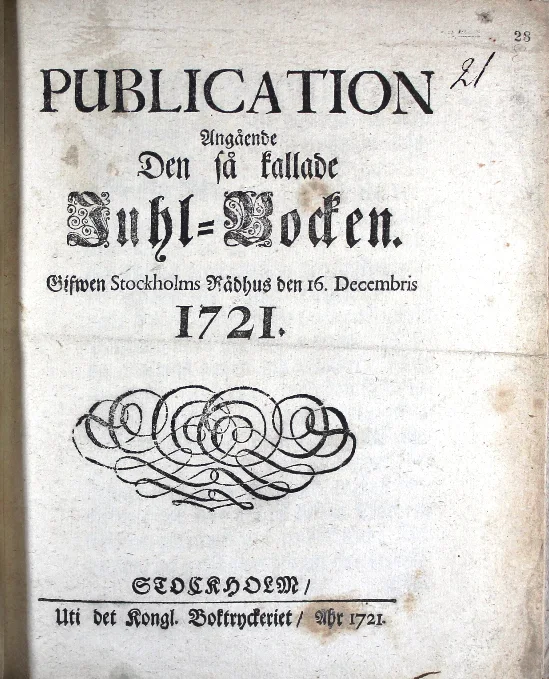
| Yule goat (julbock) | Disguised “Yule goat” in Swedish custom, banned in Stockholm in 1721 | No evidence |
| Christmas tree | Strasbourg, 1605 (Miles); Sélestat claims a 1521 record | No |
| Kissing under the mistletoe | A song in the London comic opera Two to One (1784); Washington Irving, The Sketch Book (1820) | No; Baldr’s mistletoe is a separate myth |
| Yule Lads and Grýla | 17th-century Grýla poems; 13 named Yule Lads in Jón Árnason’s collection (1862) | No |
| Wassail | English drinking custom; the toast wæs hæil (Old English wes hál, Old Norse ves heill, “be healthy”) | Not a Norse custom |
| Twelve days of Yule | Council of Tours, 567 (Christian) | No |
Where does the Yule log come from?
Burning a great log at Christmas is recorded across Europe, from the Serbian badnjak to the French souche de Noël, as Miles documented in 1912. A well-known early English description is Robert Herrick’s “Ceremonies for Christmas” in Hesperides (1648): “Come, bring with a noise, / My merry, merry boys, / The Christmas log to the firing.” Miles mentions “some form of Yule log” in Sweden, but no medieval Norse source does.
What is the Yule goat?
The Swedish julbock began as a person, not a straw ornament. On 16 December 1721 the Stockholm authorities issued a proclamation “concerning the so-called Yule goat”, threatening to arrest people who went from house to house disguised as the Juhl-Bocken; the Stockholm City Archives note that the custom is known from the 1600s. Nordiska museet describes the julbock as an unruly masked visitor who later became a gift-bringer until the jultomte replaced him; today’s straw goats are his last trace. Links with Thor’s goats or with heathen spirits are interpretations: no medieval source mentions a Yule goat. The best-known modern example is the giant straw goat put up every Advent in Gävle, Sweden, since 1966, and famous for being set on fire.
Where does the Christmas tree come from?
Miles gave “the first historical mention of the Christmas-tree” as the notes of an anonymous Strasbourg citizen of 1605, who saw fir trees in parlors hung with paper roses, apples and sweets (p. 265). The Alsatian town of Sélestat displays a 1521 account entry paying forest wardens to guard the meyen, the green trees, on St Thomas’s Day, 21 December, which it presents as the earliest record. Either way, the decorated tree is first documented in German-speaking Alsace in the sixteenth and seventeenth centuries, and according to Store norske leksikon it became common in Norway only in the late nineteenth.
Mistletoe: Baldr’s myth and the English kiss
In Snorri’s myth Frigg tells the disguised Loki that “There grows a tree-sprout alone westward of Valhall: it is called Mistletoe; I thought it too young to ask the oath of”, and the mistletoe becomes the dart that kills Baldr (Gylfaginning 49). The story has nothing to do with Yule or kissing. The kissing custom is English and first appears in the late eighteenth century, for instance in a song from the London comic opera Two to One (1784); Washington Irving reported in 1820 that mistletoe hung in farmhouses at Christmas and “the young men have the privilege of kissing the girls under it, plucking each time a berry from the bush”.
The Yule Lads and Grýla
Grýla is an old Icelandic ogress name (a rhyme in Sturlunga saga gives her fifteen tails, according to Cleasby and Vigfússon), but her role as a Christmas child-snatcher and mother of the jólasveinar comes from seventeenth-century Grýla poems and later folklore. Jón Árnason’s collection of 1862 lists thirteen Yule Lads, one arriving each day before Christmas, while noting that some said there were nine. They belong to Christian Iceland, not the Viking Age.
Ham, boar and wassail
Miles read the boar’s head carried in at Christmas at Queen’s College, Oxford, as a relic of animal sacrifice, and derived wassail from the Anglo-Saxon greeting wes hál, “be whole” (pp. 284–286); modern dictionaries prefer the Norse-influenced Middle English wæs hæil. Both are English customs. The Norse Yule boar of the oath scenes is the nearest medieval parallel, but no source draws a line from it to the Christmas ham.
Yule today
For most Scandinavians, jul or jól simply means Christmas, with Christmas Eve as the main celebration. In modern Paganism, including Wicca and many Heathen groups, Yule is usually celebrated at the winter solstice, around 21 December. These are modern religious practices with their own legitimacy. They draw on the old name and on folklore, not on a continuous tradition documented from the Viking Age, and the medieval sources would place the feast later, around midwinter in January.
Where to read about Yule in the sources
- Snorri’s kings’ sagas: Heimskringla, trans. S. Laing: Hákonar saga góða 12, 15–19 for Hákon’s law and the Mære feast; Haralds saga hárfagra 16 for the stanza on drinking Yule; Óláfs saga helga 114–115, 123 and 172.
- Old Norse texts: Saga Hákonar góða on heimskringla.no, and Haraldskvæði in Finnur Jónsson’s Skjaldedigtning on the same site.
- Poetry: the Poetic Edda, trans. H. A. Bellows (Helgakviða Hjörvarðssonar, prose after stanza 30) and Skáldskaparmál, trans. A. G. Brodeur, chapter 54.
- Bede and the later customs: Bede’s Latin works, ed. J. A. Giles, vol. 6 (chapter 15, pp. 178–179), and Clement A. Miles, Christmas in Ritual and Tradition (1912).
Where to go next
Follow Yule into the myths
The gods toasted at the midwinter feast have their own stories, from Odin the Yule-lord to Baldr and the mistletoe.
Mythic Harmonies’ song Mjǫðhǫll Fagnaðr is a modern Old Norse feast song inspired by these sources, not a reconstruction of anything sung at a Viking Age Yule.
Frequently asked questions
What is Yule?
Yule (Old Norse jól) was the pre-Christian midwinter feast of the Germanic North: a gathering at a chieftain’s or king’s hall with ale, consecrated toasts, sacrificial meat and solemn vows. The oldest Norse evidence is a poem of about 900 in which King Harald Fairhair would rather “drink Yule” at sea than sit by the fire (Haraldskvæði 6). After the conversion the name passed to Christmas, which is still called jul in Norway, Denmark and Sweden and jól in Iceland.
What does the word Yule mean?
No one knows for certain. The word is old and widespread: Old Norse jól (a plural noun), Old English geola and Giuli, and Gothic jiuleis in a sixth-century calendar that calls one month fruma jiuleis, “the first Yule month”. Older scholars, Jacob Grimm among them, tried to link it with hjól, “wheel”, as if Yule marked the turning sun, but that explanation has not held up, and scholars such as Sophie Bønding consider the origin unexplained.
When is Yule?
Today most people who celebrate Yule as a pagan festival keep it at the winter solstice, 21 or 22 December (21 December in 2026), and in Scandinavia jul simply means Christmas. The Viking Age feast fell later. Snorri Sturluson says that before King Hákon the Good moved it to Christmas, Yule began on hǫkunótt, “midwinter night”, and lasted three nights (Hákonar saga góða 15); in the medieval Norse calendar midwinter fell in mid-January. Bede, writing in 725, gives two Anglo-Saxon months called Giuli on either side of the winter solstice.
How long did Yule last? Were there 12 days of Yule?
Three nights, according to Snorri’s account of the pre-Christian feast (Hákonar saga góða 15). The Christian Yule that replaced it ran from Christmas to Epiphany, which Icelanders called the thirteenth day. The “twelve days” are a Christian reckoning, declared a festal season by the Council of Tours in 567; no medieval Norse source speaks of twelve days of pagan Yule.
Is Yule a pagan holiday?
Yes, in origin: the word and the original feast are pre-Christian. From the tenth century Norwegian kings moved Yule to 25 December and replaced the sacrifices with Christian feast-drinking, and in most Old Norse texts jól already means Christmas, as jul still does in Scandinavia. The old toast formula “for a good year and peace” even survives in the Gulathing Law, which orders ale to be blessed to Christ and St Mary on Christmas night. Modern Pagans, including Wiccans and Heathens, celebrate Yule again as a solstice festival.
What did the Vikings do at Yule?
The sources describe drinking (“to drink Yule”), consecrated toasts, a meal of sacrificial meat and vows. At a Yule feast at Mære the farmers made King Hákon eat horse liver and drink their toasts without the sign of the cross (Hákonar saga góða 19). Snorri’s general account of sacrificial feasts has toasts to Odin for victory and to Njörðr and Freyr for a good year and peace (chapter 16). Later texts add vows made with hands on a sacred boar on Yule-eve (Helgakviða Hjörvarðssonar; Hervarar saga).
Is Odin connected to Yule? Is Santa Claus Odin?
Odin has a Yule name, Jólnir, found in skaldic poetry and in name lists, and Ágrip (about 1190) says the heathens held their Yule feast in his honor. No medieval source shows Odin bringing gifts or riding through the sky at Yule. The Wild Hunt at Yule comes from later folklore, linked to Odin by Jacob Grimm in the nineteenth century. The claim that Santa Claus is Odin is modern speculation: Santa’s reindeer first appear in American poems of 1821 and 1823, not in Norse myth.
Are the Yule log and the Yule goat Viking traditions?
There is no Viking Age evidence for either. A well-known early English description of the Christmas log is Robert Herrick’s poem in Hesperides (1648). The Swedish julbock was originally a person disguised as a goat, banned in Stockholm in 1721; the straw goat is its modern descendant. The Christmas tree is first recorded in Alsace in the sixteenth and seventeenth centuries, and kissing under the mistletoe in late eighteenth-century England.
How do you say Yule in Old Norse?
Jól, pronounced roughly “yohl”: the Old Norse j sounds like English y, and the accent marks a long vowel. Related words include jólaaptan (Yule-eve), jólaveizla (Yule feast) and jólaöl (Yule ale). Modern Icelanders wish each other Gleðileg jól, “Merry Christmas”; no Viking Age Yule greeting has survived.
Sources and editorial notes
Written in October 2026 from the texts and studies below. Translations marked “our translation” are ours from the Old Norse or Latin; other quotations follow the public-domain translations named.
- Old Norse texts: Heimskringla, trans. S. Laing (1844), checked against the Old Norse text on heimskringla.no; Haraldskvæði and Háleygjatal, ed. Finnur Jónsson, Den norsk-islandske skjaldedigtning B1 (1912) (the current standard edition of Haraldskvæði is R. D. Fulk’s in Skaldic Poetry of the Scandinavian Middle Ages 1, 2012); Heimskringla I, trans. A. Finlay and A. Faulkes (2011), for the Íslenzk fornrit text and chapter numbers; Ágrip, ed. G. Indrebø (1936); Hervarar saga (Hauksbók text); Gulathing Law ch. 7, Norges gamle Love I (1846); Poetic Edda, trans. H. A. Bellows (1923); Skáldskaparmál and Gylfaginning, trans. A. G. Brodeur (1916); Egils saga, trans. W. C. Green (1893); Grettis saga, trans. E. Magnússon and W. Morris (1869).
- Latin, Gothic and Greek: Bede, De temporum ratione 15 and De temporibus 7, ed. J. A. Giles (1843); Thietmar of Merseburg, Chronicon I.17, ed. F. Kurze (1889); Gothic calendar in E. Bernhardt, Die gotische Bibel des Vulfila (1884); Procopius, History of the Wars VI.15, trans. H. B. Dewing (1919).
- Studies and reference works: S. Bønding, “Førkristen jul” (2013), written when she was a doctoral researcher in the study of religion at Aarhus University, summarizing A. Nordberg, Jul, disting och förkyrklig tideräkning (2006; not consulted directly), reviewed by G. Nordanskog in RIG 90 (2007); K. von See, “Studien zum Haraldskvæði”, Arkiv för nordisk filologi 76 (1961); H. Falk, Odensheite (1924); R. Cleasby and G. Vigfússon, An Icelandic-English Dictionary (1874); Bosworth–Toller, Anglo-Saxon Dictionary; Store norske leksikon, “jul”; D. Landau, SBL/EABS Helsinki paper (2018); J. Grimm, Teutonic Mythology, trans. J. S. Stallybrass (1880–1883); C. A. Miles, Christmas in Ritual and Tradition (1912); Nordiska museet, object NM.0130676; Stockholm City Archives, “Publication angående den så kallade Juhl-Bocken” (1721); J. Árnason, Íslenzkar þjóðsögur og æfintýri (1862); R. Herrick, Hesperides (1648); W. Irving, The Sketch Book (1820).
The featured image, if any, should be a historical image or be labeled as a contemporary illustration. The historical images are credited where they appear.


All five albums and every single: 86 songs in WAV and MP3, yours to keep.