
Freyr: What the Norse Sources Say About the God of Harvest, Peace and the Yule Boar
On this page 15 sections
- Freyr at a glance: quick facts
- What does the name Freyr mean?
- What is Freyr the god of?
- Freyr’s family: Njörðr (Njord), Freyja and the Vanir
- Freyr’s treasures: Gullinbursti, Skíðblaðnir and Álfheimr
- Freyr’s wife Gerðr (Gerd): the myth of Skírnismál
- How does Freyr die? Ragnarök, Surtr and the antler
- Yngvi-Freyr and the Ynglings, kings of the Swedes
- How was Freyr worshipped?
- Freyr and Yule: the boar, the toast and “Freyr’s game”
- Freyr vs Freyja: what is the difference?
- Freyr’s symbols: the boar, the ship and the sword
- Freyr in pop culture: God of War, Vikings and Marvel
- Frequently asked questions
- Sources and editorial notes
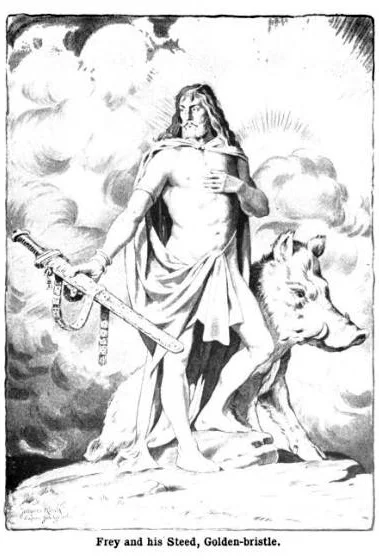
Freyr (often written Frey) is the Norse god of rain, sunshine, good harvests, peace and wealth: Snorri Sturluson calls him “the most renowned of the Æsir”, though he was born among the Vanir, the son of Njörðr (Njord) and the brother of Freyja. His myths tell how he gave away his self-fighting sword to win the giantess Gerðr (Gerd), how he owns the golden boar Gullinbursti and the folding ship Skíðblaðnir, and how he will fall, swordless, against the fire-giant Surtr at Ragnarök.
Freyr was also worshipped: Swedish kings claimed descent from him, and Christian writers described his idol and his priests. This guide sets the texts side by side, with stanza and chapter numbers, and separates them from modern lore.
- God of the good year: Freyr “rules over the rain and the shining of the sun, and therewithal the fruit of the earth” (Gylfaginning 24).
- His name means “lord”: Frey is the same name, anglicized.
- Not Freyja’s twin: they are brother and sister, but no medieval source calls them twins.
- The sword was the price of love: he gave it away to win Gerðr, and its loss costs him his life against Surtr at Ragnarök. The antler was for an earlier fight, against Beli.
- A god of kings and of Yule: the Swedish Ynglings claimed descent from him, and late sources tie the Yule boar to him.
Freyr at a glance: quick facts
| Question | Short answer |
|---|---|
| Name | Old Norse Freyr, “lord”; also Yngvi-Freyr and Ingunar-Freyr. Anglicized Frey; Swedish Frej or Frö, Danish Frej, Norwegian Frøy. |
| God of | Rain, sunshine and crops; good seasons, peace and prosperity (Gylfaginning 24). Adam of Bremen adds peace, pleasure and weddings. |
| Family | Son of Njörðr (Njord), brother of Freyja (not her twin in any medieval source); one of the Vanir. Wife: the giantess Gerðr (Gerd); son: Fjölnir. |
| Home | Álfheimr (Alfheim), the world of the elves, a “tooth-gift” (Grímnismál 5). |
| Possessions | The boar Gullinbursti; the ship Skíðblaðnir (Skidbladnir); a sword that fights by itself and a horse, both given to Skírnir. |
| Death | Killed by the fire-giant Surtr at Ragnarök: Völuspá 53 sets them face to face, and Snorri says Freyr falls for lack of his sword (Gylfaginning 51). |
| Main sources | Poetic Edda (Codex Regius, c. 1270); Snorri’s Edda (c. 1220) and Heimskringla (c. 1230); Adam of Bremen (c. 1075); Saxo Grammaticus (c. 1200); sagas of Icelanders; the Old English Rune Poem. |
What does the name Freyr mean?
Freyr is a title rather than a personal name. Cleasby and Vigfússon’s Icelandic-English Dictionary (1874) sets it beside Gothic frauja, the word the Gothic Bible uses for “the Lord”, Old English frēa and Old Saxon frô, all meaning “lord”. His sister’s name, Freyja, is the feminine, “lady”.
The sources also give him a second name, Yngvi: “Freyr was called by another name, Yngve” (Ynglinga saga 12, trans. Laing). Lokasenna 43 calls him Ingunar-Freyr, a rare form and the only one in the Eddic poems, which Bellows thought might hide an unknown mother, Ingun, or the old name Ing (see below).
Frey or Freyr: which spelling is right?
Both name the same god. The final -r is the Old Norse nominative ending, as in Þórr for Thor, and drops in other cases: the toast in Hákonar saga góða is Freys full, “Freyr’s cup”. Older translators wrote Frey; modern scholars mostly prefer Freyr. Say roughly “FRAY-r”.
What is Freyr the god of?
The clearest answer comes from Snorri Sturluson’s Edda, written in Iceland around 1220:
“Njördr in Nóatún begot afterward two children: the son was called Freyr, and the daughter Freyja; they were fair of face and mighty. Freyr is the most renowned of the Æsir; he rules over the rain and the shining of the sun, and therewithal the fruit of the earth; and it is good to call on him for fruitful seasons and peace. He governs also the prosperity of men.”
Gylfaginning, chapter 24, translated by Arthur Gilchrist Brodeur (1916)
Behind “fruitful seasons and peace” stands the Old Norse formula til árs ok friðar, “for a good year and peace”. Ár is the yield of the year, a harvest that does not fail; friðr is peace and the security in which farms prosper. The same formula returns in the toasts and sacrifices described below.
Snorri’s handbook for poets, Skáldskaparmál (chapter 7 in Brodeur), calls him “God of the Fertile Season, and God of Wealth-Gifts”. In Lokasenna 37 the god Týr adds a moral portrait: “He harms not maids nor the wives of men, and the bound from their fetters he frees” (trans. Bellows). Freyr stands, then, for a whole state of well-being: harvest, peace, wealth and children.
Freyr’s family: Njörðr (Njord), Freyja and the Vanir
Freyr belongs to the Vanir, the second family of gods. In Snorri’s Ynglinga saga 4 the Æsir and Vanir make peace after a war and exchange hostages: “The Vanaland people sent their best men, Niord the Rich, and his son Frey” (trans. Laing). In Gylfaginning 23–24 Njörðr alone is the hostage and his children are born later, in Nóatún. Either way Freyr counts among the Æsir while remaining a Van; Gerðr calls him a vaningi, “one of the Vanir” (Skírnismál 37; 38 in Bellows).
His mother is never named. Loki taunts Njörðr: “With thy sister hadst thou so fair a son” (Lokasenna 36, trans. Bellows), and Ynglinga saga 4 says Njörðr had married his sister among the Vanir, “for that was allowed by their law”. Njörðr’s later wife, the giantess Skaði, is a stepmother at most: in the manuscripts of Skírnismál she opens the poem and calls Freyr “our son” (okkarn mög, stanza 1), a reading Bellows emends away; no text calls her the woman who bore him.
Are Freyr and Freyja twins?
Not in any medieval source. Snorri says only that Njörðr “begot afterward two children”. The twin idea is modern, common in popular retellings and games. Nerthus, whom some pages make Freyr’s mother, appears only in Tacitus’s Germania (chapter 40, about 98 CE); her link with Njörðr is a scholarly comparison of names, not a Norse text.
Freyr’s treasures: Gullinbursti, Skíðblaðnir and Álfheimr
Gullinbursti, the golden boar
The boar’s origin is told in Skáldskaparmál (chapter 35 in Brodeur). Loki bets his head that the dwarf Brokkr’s brother cannot match the treasures made by the sons of Ívaldi (Sif’s golden hair, the spear Gungnir and Skíðblaðnir). While a fly stings Brokkr at the bellows, the smith draws from the forge “a boar, with mane and bristles of gold”, then the ring Draupnir and the hammer Mjöllnir. The boar goes to Freyr: it “could run through air and water better than any horse”, and its glowing bristles light up the darkest night (trans. Brodeur).
Brodeur and the Old Norse edition on heimskringla.no call the smith Sindri; many modern editions call him Eitri. The boar is named Gullinbursti, “Gold-Bristle”, or Slíðrugtanni, “Fearful-Tusk” (Skáldskaparmál 7; Gylfaginning 49). The oldest witness is Húsdrápa, a poem traditionally dated to about 985, which Snorri quotes:
“The battle-bold Freyr rideth
First on the golden-bristled
Barrow-boar to the bale-fire
Of Baldr, and leads the people.”
Úlfr Uggason, Húsdrápa, quoted in Skáldskaparmál, chapter 7, translated by Arthur Gilchrist Brodeur (1916)
Snorri tells the scene in prose: at Baldr’s funeral “Freyr drove in his chariot with the boar called Gold-Mane, or Fearful-Tusk” (Gylfaginning 49). Hildisvíni, “Battle-Swine”, is a different boar, the one Freyja rides in Hyndluljóð.
Skíðblaðnir (Skidbladnir), the folding ship
Skíðblaðnir is “best of ships”: all the Æsir can sail in it fully armed, it has a fair wind as soon as the sail is raised, and when not needed it “may be folded together like a napkin and kept in one’s pouch” (Gylfaginning 43, trans. Brodeur).
“In days of old did Ivaldi’s sons
Skithblathnir fashion fair,
The best of ships for the bright god Freyr,
The noble son of Njorth.”
Grímnismál, stanza 43 (same number in the Old Norse edition of Guðni Jónsson), translated by Henry Adams Bellows (1923)
Stanza 44 ranks it first among ships, as Yggdrasil among trees; Bellows took both stanzas for later additions.
Álfheimr (Alfheim), a tooth-gift
“Alfheim the gods to Freyr once gave / As a tooth-gift in ancient times” (Grímnismál 5, trans. Bellows). A tooth-gift (tannfé) was a present for a child’s first tooth: the gods gave the baby Freyr the world of the elves. Snorri places the Light-Elves there (Gylfaginning 17) but never says what Freyr does with it.
Freyr’s wife Gerðr (Gerd): the myth of Skírnismál
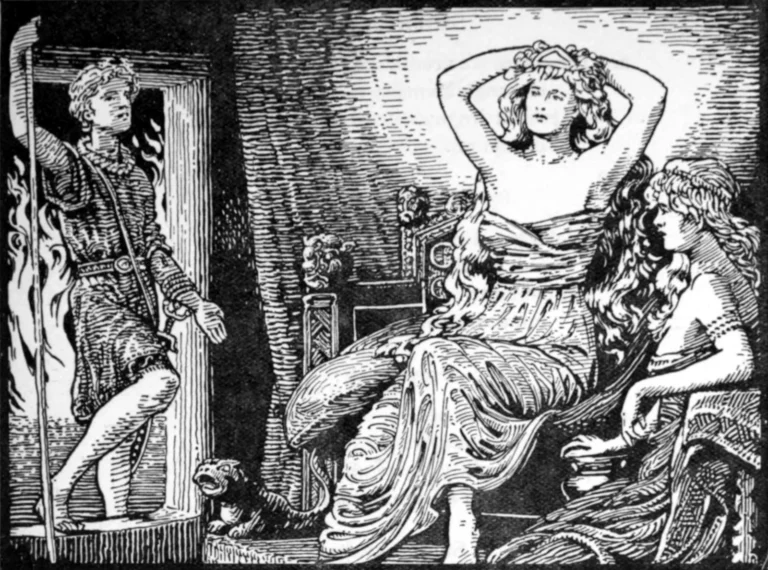
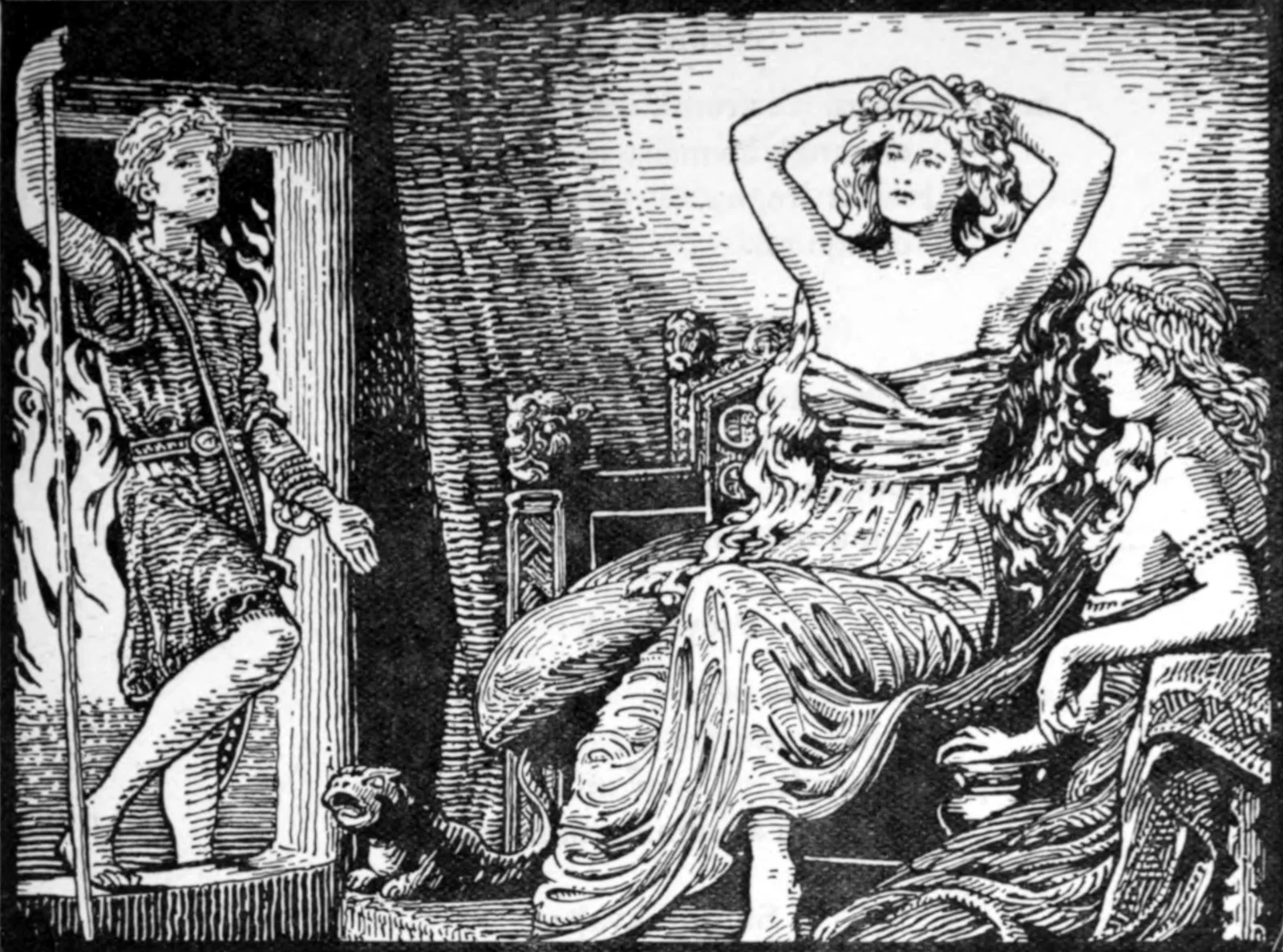
The longest myth about Freyr is the Eddic poem Skírnismál, “The Lay of Skírnir”. Its prose opening: “Freyr, the son of Njorth, had sat one day in Hlithskjolf, and looked over all the worlds. He looked into Jotunheim, and saw there a fair maiden” (trans. Bellows). Hliðskjálf is Odin’s high seat; Snorri (Gylfaginning 37) makes the trespass the cause of Freyr’s grief.
The girl is Gerðr, daughter of the giant Gymir and of Aurboða (Hyndluljóð 32; Gylfaginning 37): “Her arms glittered, and from their gleam / Shone all the sea and sky” (stanza 6). Freyr stops eating and speaking, and his servant Skírnir agrees to ride to the giants on one condition:
“Then give me the horse that goes through the dark
And magic flickering flames;
And the sword as well that fights of itself
Against the giants grim.”
Skírnismál, stanza 8, translated by Henry Adams Bellows (1923)
Freyr agrees: the sword will fight of itself “if a worthy hero wields it” (stanza 9). Skírnir rides through the flames around Gymir’s hall and offers Gerðr eleven golden apples and the ring that drops eight rings every ninth night; she refuses. He threatens to behead her and kill her father; she refuses again. Then he strikes her with a magic staff and lays on a curse: she will sit at the world’s edge gazing towards Hel, be married to a three-headed giant or to no one, and drink goats’ urine (stanza 35 in Guðni Jónsson; Bellows, stanza 36, softens it to “horns of filth”). It ends with runes:
“I write thee a charm and three runes therewith,
Longing and madness and lust;
But what I have writ I may yet unwrite
If I find a need therefor.”
Skírnismál, stanza 37 in Bellows (36 in Guðni Jónsson’s Old Norse edition), translated by Henry Adams Bellows (1923)
The “charm” is literally the rune þurs, “giant”. Gerðr gives way and names a meeting place: “Barri there is, which we both know well, / A forest fair and still; / And nine nights hence to the son of Njorth / Will Gerth there grant delight.” The poem ends with Freyr’s impatience: “Long is one night, longer are two; / How then shall I bear three?” (stanzas 40–43 in Bellows, 39–42 in Guðni Jónsson). Hyndluljóð 32 confirms that “Freyr’s wife was Gerth”, and in Ynglinga saga 12 she is the mother of Fjölnir.
Freyr’s sword: why did he give it away?
Because Skírnir asked for it as the price of the journey, and Freyr was too lovesick to refuse: “Freyr did not refuse, but gave him the sword” (Gylfaginning 37). It never comes back. Loki throws the bargain in his face: “The daughter of Gymir with gold didst thou buy, / And sold thy sword to boot; / But when Muspell’s sons through Myrkwood ride, / Thou shalt weaponless wait, poor wretch” (Lokasenna 42, trans. Bellows). Nor does the sword have a name: no medieval text gives one. “Sumarbrandr”, “summer sword”, repeated on many websites, is a modern invention.
How should the story be read?
A bride won by bribes, threats and a curse: the tale is harsh. It has often been read as a fertility myth, the god of good seasons uniting with a woman of the giants. A second reading, set out most fully in Gro Steinsland’s study of the hierogamy myth in Skírnismál, Ynglingatal and related poems (Det hellige bryllup og norrøn kongeideologi, 1991), sees a “sacred marriage” between a god and a giantess from which a ruling line descends, a myth that legitimized kings. It fits Ynglinga saga, where Gerðr bears the Swedish kings’ ancestor. Both are interpretations; the poem explains nothing.
How does Freyr die? Ragnarök, Surtr and the antler
Völuspá, the seeress’s prophecy, foretells Freyr’s last fight, against the fire-giant Surtr:
“Now comes to Hlin yet another hurt,
When Othin fares to fight with the wolf,
And Beli’s fair slayer seeks out Surt,
For there must fall the joy of Frigg.”
Völuspá, stanza 53 (same number in Guðni Jónsson’s Old Norse edition), translated by Henry Adams Bellows (1923)
“Beli’s fair slayer” (bani Belja bjartr) is Freyr, named by an exploit no Eddic poem narrates; the stanza does not say how his fight ends. Snorri fills the gaps: the gift of the sword “was to blame for Freyr’s being so weaponless, when he fought with Beli, and slew him with the horn of a hart” (Gylfaginning 37). At Ragnarök: “Freyr shall contend with Surtr, and a hard encounter shall there be between them before Freyr falls: it is to be his death that he lacks that good sword of his, which he gave to Skírnir” (Gylfaginning 51, trans. Brodeur).
The antler is for Beli, not Surtr. Snorri gives Freyr the hart’s horn only against Beli (Gylfaginning 37); at Ragnarök he says only that Freyr lacks his sword (Gylfaginning 51).
Not bare-handed either. Some retellings, following Bellows’s notes, say he killed Beli “bare-handed”. Snorri’s Old Norse says drap hann með hjartarhorni, “killed him with a hart’s horn”, and adds that Freyr could have killed him with his bare hand.
Surtr does not use Freyr’s sword. That idea is a modern guess; no source says where the sword went after Skírnir.
Yngvi-Freyr and the Ynglings, kings of the Swedes
Snorri’s Ynglinga saga (about 1230) retells the gods as human rulers in Sweden, worshipped after death. This euhemerism is a medieval Christian device, not older myth, but it is our main source for Freyr as a royal ancestor:
“Freyr built a great temple at Upsal, made it his chief seat, and gave it all his taxes, his land, and goods. Then began the Upsal domains, which have remained ever since. Then began, in his days, the Frode-peace; and then there were good seasons in all the land, which the Swedes ascribed to Freyr, so that he was more worshipped than the other gods …”
Ynglinga saga, chapter 12, translated by Samuel Laing (1844); chapter 10 in the Íslenzk fornrit edition
When Freyr died, his men carried him secretly into a mound with three windows and for three years poured the taxes in, gold, silver and copper, “peace and good seasons continued”. Learning the truth, the Swedes “would not burn his remains, but called him the god of this world, and afterwards offered continually blood-sacrifices to him, principally for peace and good seasons” (chapters 12–13, trans. Laing; chapter 10 in Íslenzk fornrit). And: “Freyr was called by another name, Yngve; and this name Yngve was considered long after in his race as a name of honour, so that his descendants have since been called Ynglingers.”
Snorri did not invent the ancestry: Ynglingatal, the poem on the Swedish kings he quotes throughout, calls them Freys afspring, “Freyr’s offspring” (chapter 23 in Laing), and King Aðils Freys áttungr, “Freyr’s descendant” (chapter 33). It is traditionally attributed to the ninth-century poet Þjóðólfr of Hvinir; the historian Claus Krag (Ynglingatal og Ynglingesaga, 1991) argued instead for a twelfth-century composition, while other scholars defend the early date.
Ing and the Old English Rune Poem
Yngvi has a counterpart in England. The Old English Rune Poem gives a stanza to the rune ing, Ingwaz (ᛜ) in the Elder Futhark:
“Ing wæs ǣrest mid Ēast-Denum
gesewen secgun, oþ hē siððan ēst
ofer wæg gewāt; wæn æfter ran;
ðus Heardingas ðone hæle nemdun.”
Ing was first seen by men among the East-Danes, until he afterwards went east over the wave; the wagon ran after him. So the Heardings named the hero.
Old English Rune Poem, lines 67–70, text after Bruce Dickins, Runic and Heroic Poems (1915), p. 20; our translation
The poem never mentions Freyr. Dickins’s 1915 notes set out the clues: Beowulf calls the Danes Ingwine, “Ing’s friends”, and their king frēa Ingwina, “lord of the Ingwine”, the same two elements as Yngvi-Freyr; Tacitus names coastal peoples the Ingaevones (Germania 2); and the wagon recalls Tacitus’s Nerthus, who travels among the nations in a sacred chariot drawn by cows (Germania 40), and the Swedish Freyr in his wagon (below). Dickins, drawing on H. M. Chadwick, linked Ing with the Swedish Ynglings and Yngvi-Freyr, and traced Freyr’s cult back to Nerthus. The Ing–Yngvi link is widely accepted; the full chain from Nerthus to Freyr remains a hypothesis.
How was Freyr worshipped?
Every written report of Freyr’s cult comes from Christians, so each must be read for what it is.
Adam of Bremen: Fricco at Uppsala
The only description written while the cult was still alive comes from Adam, a canon of Bremen, about 1075. He never went to Uppsala, relied on informants and wrote to show the heathenism his church had to overcome: a hostile witness. In a temple “all made of gold” he places three statues, Thor in the middle, Wodan and Fricco on either side:
“Tercius est Fricco, pacem voluptatemque largiens mortalibus. Cuius etiam simulacrum fingunt cum ingenti priapo.”
The third is Fricco, who bestows peace and pleasure on mortals. His image, too, they fashion with an enormous phallus.
Adam of Bremen, Gesta Hammaburgensis ecclesiae pontificum, book IV, chapter 26, Latin text ed. B. Schmeidler (1917), p. 258; our translation
“If plague and famine threaten, libation is made to the idol Thor; if war, to Wodan; if weddings are to be celebrated, to Fricco” (IV, 27; our translation). Every nine years, Adam adds, all Sweden met at Uppsala for sacrifices of men and animals. Fricco is generally taken as a Latin form of Freyr’s name. Note that Adam gives the crops to Thor, “who governs thunder and lightning, winds and rains, fair weather and crops”, not to Fricco.
Saxo Grammaticus: Frø and the Froblod
The Danish historian Saxo Grammaticus wrote his Gesta Danorum around 1200. In book I the hero Hadding, to appease the gods, “sacrificed dusky victims to the god Frey” and repeated the rite every year: “This rite the Swedes call Froblod (the sacrifice or feast of Frey).” In book III “Frey, the regent of the gods” settles near Uppsala and replaces the old sacrifices with human victims (trans. Oliver Elton, 1894). A late and hostile witness, Saxo still confirms Adam’s picture of Uppsala as Freyr’s center.
Freyr in the sagas of Icelanders
These thirteenth-century sagas about tenth-century settlers are literature, but they show how Icelanders imagined the old faith.
- Hrafnkels saga Freysgoða. Hrafnkell “loved no other god more than Freyr” and gave him half of his best possessions, hence his nickname, “Freyr’s priest” (chapter 2; our translation). That included half of his stallion Freyfaxi, and he swore to kill anyone who rode it; when his shepherd does, he keeps his oath. His enemies later drown the horse and burn his temple, and Hrafnkell answers: “I think it folly to believe in gods” (chapter 16 in the edition on heimskringla.no; our translation).
- Víga-Glúms saga. Before leaving his farm, Thorkel the Tall leads an old ox to Freyr’s temple: “Thou, Frey,” he says, “wert long my protector, and many offerings hast thou had at my hands, which have borne good fruit to me” (chapter 9, trans. E. Head, 1866). The ox bellows and drops dead, a sign that the god accepts it. The saga’s field “Sure-giver”, “which was never without a crop” (chapter 7), is often called Freyr’s sacred field; the saga never says so.
- Gísla saga. Thorgrim, “the priest of Frey”, sacrifices to Frey at a feast on the first night of winter. After his death “no snow lodged on the south side of Thorgrim’s howe”, and men guessed that he was “so dear to Frey” that the god “would not suffer the frost to come between them” (chapters 9–10, trans. G. W. Dasent, 1866).
The god in the wagon: Gunnar helmingr
A comic conversion tale in the great saga of Olaf Tryggvason (also in the late fourteenth-century Flateyjarbók) sends the Norwegian Gunnar helmingr to Sweden at the time of the great sacrifices to Frey. A young woman serves the idol as its wife, and in winter the god goes “on a progress through the country to grant men fruitful seasons” in a wagon. In a snowstorm Freyr wrestles Gunnar and loses once Gunnar vows to return to Christ: “the fiend leapt forth from the idol in which he had lain concealed, and the mere stock of a tree remained” (trans. J. Sephton, 1895, chapter 173). Gunnar then plays the god himself, to the Swedes’ delight. The tale mocks paganism, but its wagon procession recalls Nerthus and Ing.
Archaeology: the Rällinge figure and the gold-foil couples
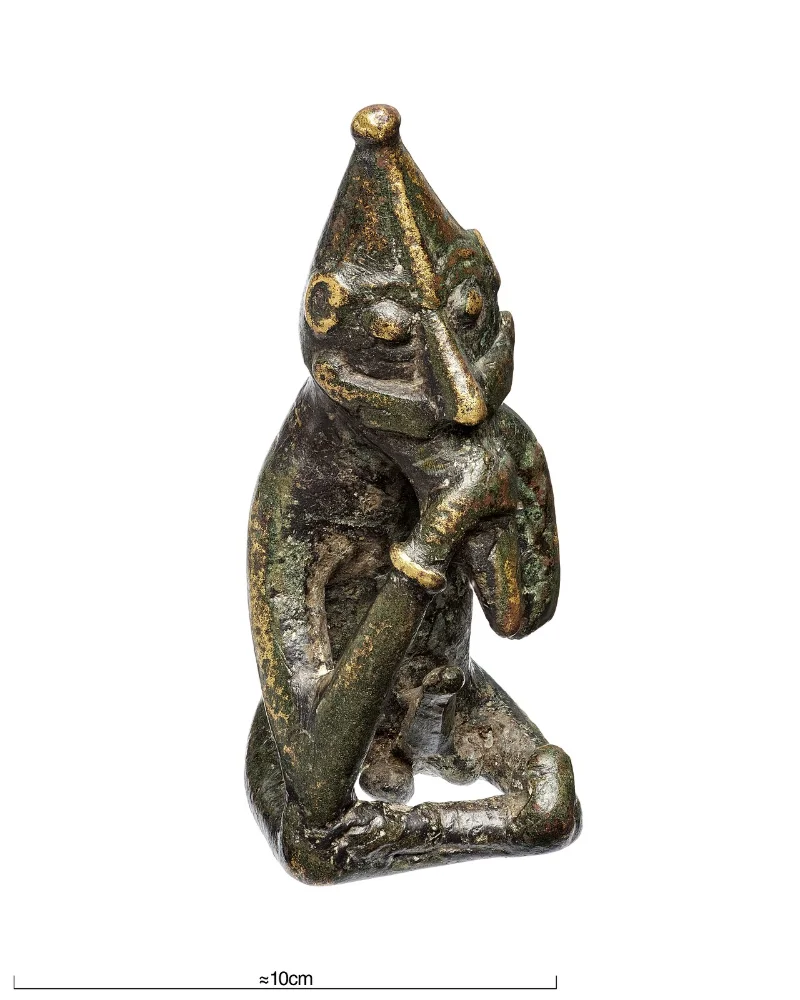
No object names Freyr. The best-known candidate is a small bronze figure found in 1904 at Rällinge in Södermanland and acquired by the Swedish History Museum in 1910: a seated naked man with a pointed cap, staring eyes, an upturned moustache and an erect phallus, holding his pointed beard; the left arm is broken off at the elbow. The museum dates it to the Viking Age (800–1100) and identifies it as Freyr, pointing to Adam’s idol. That comparison is the whole case: the identification is plausible but cannot be proved.
The guldgubbar are tiny stamped gold foils, about a square centimeter, from the Merovingian period and early Viking Age. Some show a man and a woman embracing. Several scholars have read these couples as Freyr and Gerðr in a fertility cult; others as the union of a god or giant with a human, the founder of a ruling line (Store norske leksikon, “Frøy”). No inscription settles it, so “couple foils” is the honest name. Place names such as Frøyshov (“Freyr’s temple”) and Frøysland in Norway, cited by the same encyclopedia, and Frösön (“Freyr’s island”) in Sweden suggest a widespread cult.
Freyr and Yule: the boar, the toast and “Freyr’s game”
Several texts connect Freyr with the midwinter feast, though none calls Yule his feast. Our guide to Yule, the Norse midwinter feast sets out the evidence in full. The Freyr threads:
- “Freyr’s game” (about 900). In Haraldskvæði 6 King Harald Fairhair would rather “drink Yule” at sea “and play Freyr’s game” (ok Freys leik heyja). Snorri took the phrase for battle, odd for so unwarlike a god; Sophie Bønding (2013) lists other proposals, from a sacrifice to fertility rites. None is proven.
- The toast (c. 1230). After Odin’s cup came Njarðar full ok Freys full til árs ok friðar, “Njörðr’s toast and Freyr’s toast, for a good year and peace” (Hákonar saga góða 16 in Laing, 14 in Íslenzk fornrit). Laing wrongly prints “Freyja’s goblets”, and Snorri gives no season for this feast.
- The Yule boar (13th–14th century). In the Hauksbók text of Hervarar saga, King Heiðrekr “sacrificed to Freyr. The largest boar he could get he was to give to Freyr”; men swore on its bristles, and “on Yule-eve the sónargöltr was to be led into the hall before the king” for vows (our translation; Cleasby and Vigfússon render the word “atonement-boar”). Helgakviða Hjörvarðssonar has the custom without naming Freyr: “the sacred boar was brought in, the men laid their hands thereon, and took their vows at the king’s toast” (prose after stanza 30, trans. Bellows).
The boar is the strongest thread, but thin: of the saga’s versions, Hauksbók is the one that names Freyr and Yule-eve. In the version printed by Guðni Jónsson (on heimskringla.no) Heiðrekr simply has a huge boar raised, “so fair that every hair seemed to be of gold”, and swears an oath with his hand on its bristles; Freyr and Yule are absent (our translation). Bønding concludes that the texts suggest a link between Yule, feasting and a fertility cult of Freyr, possibly with the sacrifice of pigs, while oaths on a boar’s bristles remain an open question. The Scandinavian Christmas ham is often said to descend from this boar: a popular hypothesis, plausible but undocumented.
Freyr vs Freyja: what is the difference?
Their names differ by one letter, so even translators confuse them. Our guide to Freyja covers the goddess; the essentials:
| Freyr | Freyja | |
|---|---|---|
| Name | “Lord” | “Lady” |
| Domain in Snorri | Rain, sunshine, crops, peace, wealth | Love; half of the battle-slain, in Fólkvangr |
| Spouse | Gerðr, a giantess | Óðr, who goes away on long journeys |
| Animals and treasures | Boar Gullinbursti; ship Skíðblaðnir; self-fighting sword | Cats drawing her cart; boar Hildisvíni; necklace Brísingamen |
| Magic | None of his own; his servant uses staff and runes | Taught seiðr to the Æsir (Ynglinga saga 4) |
| At Ragnarök | Killed by Surtr | Not described |
Freyr’s symbols: the boar, the ship and the sword
No Viking Age sign or amulet can be shown to stand for Freyr, as the hammer stands for Thor. The texts give attributes instead: the boar (Gullinbursti; the Yule boar), the best supported; the ship Skíðblaðnir; the sword he gave away and the antler he fought Beli with; the horse, given to Skírnir, and Hrafnkell’s Freyfaxi; the phallus of the Uppsala idol and, probably, of the Rällinge figure; and the wagon of Gunnar’s tale.
Runes, colors and holy days. Lists that give Freyr “his” runes (Ingwaz, Fehu, Ehwaz), colors, offerings or an August festival called Freyfaxi are modern Pagan practice. The name Freyfaxi is borrowed from Hrafnkell’s horse. The only feast a medieval source names after Freyr is Saxo’s Froblod, and Saxo gives it no date.
“The” fertility god. Adam gives the crops to Thor, and Njörðr shares Freyr’s toast. Nothing shows one uniform Freyr cult across Scandinavia: the texts point mainly to Sweden and a few Icelandic families, the place names to Norway and Sweden.
Sun god and “horned god”. Calling Freyr a “sun god” is a nineteenth-century habit (Dasent and Cleasby–Vigfússon both do it); the sources give him the sunshine, not the sun. “The Horned God” is a figure of twentieth-century Wicca; no Norse text gives Freyr horns, and his antler is a makeshift weapon. Our evidence index of Viking symbols shows how to tell a dated sign from a modern one.
Freyr in pop culture: God of War, Vikings and Marvel
- God of War Ragnarök (2022). Freyr (voiced by Brett Dalton) is a major character: a Vanir leader who sides with Kratos and Atreus against Odin and dies holding back Surtr’s fire so that the others can escape. In the sources Freyr falls to Surtr, but the game’s plot and family tree are its own invention; his link with the elves comes from the sources.
- Vikings (History, 2013–2020). Freyr is named and prayed to, notably at the Uppsala temple in season 1, but never appears as a character.
- Marvel. A minor Asgardian called Frey has appeared in Marvel’s comics since Thor #294 (1980), according to the Marvel Database.
For his place among the other gods, see our overview of the Norse gods and goddesses.
Where to go next
Follow Freyr through the myths
Freyr’s story runs into his sister’s, into the midwinter feast and into the end of the world.
Frequently asked questions
What is Freyr the god of?
Freyr is the Norse god of the good year: rain, sunshine and the crops, peace and prosperity. Snorri Sturluson says he “rules over the rain and the shining of the sun, and therewithal the fruit of the earth”, that men call on him “for fruitful seasons and peace”, and that he governs the wealth of men (Gylfaginning 24). Adam of Bremen, writing about 1075, adds that the Swedes saw him as the giver of peace and pleasure and sacrificed to him at weddings.
Is Frey the same as Freyr?
Yes. Freyr is the Old Norse form of the name, with the nominative ending -r; Frey is the anglicized spelling used by older translators. Both mean “lord”, like Gothic frauja and Old English frēa. In Scandinavia today he is Frej or Frö in Swedish, Frej in Danish and Frøy in Norwegian.
Is Freyr a Vanir or an Aesir god?
Both, in a sense. Freyr was born among the Vanir, the son of Njörðr, and came to the Æsir after the war between the two families of gods: in Ynglinga saga 4 the Vanir send Njörðr and Freyr as hostages. Once there he counts among the Æsir, and Snorri calls him “the most renowned of the Æsir” (Gylfaginning 24).
Who is Freyr’s wife?
Gerðr (Gerd), a giantess, the daughter of Gymir and Aurboða (Hyndluljóð 32; Gylfaginning 37). The Eddic poem Skírnismál tells how Freyr saw her from Odin’s high seat, fell sick with love, and sent his servant Skírnir to win her, first with gifts and threats, then with a curse. She agreed to meet Freyr in the grove of Barri nine nights later. In Ynglinga saga she is the mother of his son Fjölnir.
What happened to Freyr’s sword?
Freyr gave it away. His servant Skírnir demanded it as the price of riding to the land of the giants to woo Gerðr (Gerd), and Freyr, sick with love, did not refuse (Skírnismál 8–9; Gylfaginning 37). The sword fought by itself, and it never came back: Loki mocks him for it (Lokasenna 42), and Snorri says its loss will cost Freyr his life at Ragnarök. No medieval source names the sword; “Sumarbrandr”, often quoted online, is a modern name.
Who kills Freyr at Ragnarök?
The fire-giant Surtr. Völuspá 53 already pits Freyr against him, and Snorri says “it is to be his death that he lacks that good sword of his, which he gave to Skírnir” (Gylfaginning 51). The famous antler belongs to an earlier fight: without his sword Freyr killed the giant Beli “with the horn of a hart” (Gylfaginning 37). No source says he fights Surtr with the antler.
Are Freyr and Freyja twins?
No medieval source says so. Snorri says only that Njörðr had two children, a son, Freyr, and a daughter, Freyja (Gylfaginning 24). Lokasenna and Ynglinga saga add that their mother was Njörðr’s unnamed sister. The twin idea is modern, common in popular retellings and games.
Is Yngvi the same as Freyr?
In Snorri’s Ynglinga saga, yes: “Freyr was called by another name, Yngve”, and the Swedish royal family, the Ynglings, took their name from him. The court poem Ynglingatal calls those kings “Freyr’s offspring”. Many scholars also connect Yngvi with Ing, the hero of the Old English Rune Poem and the source of the rune name Ingwaz, but that poem never mentions Freyr.
Did the Vikings worship Freyr at Yule?
Probably in some form, but the evidence is late and thin. A poem of about 900 links drinking Yule with “Freyr’s game” (Haraldskvæði 6), Snorri describes toasts to Njörðr and Freyr “for a good year and peace”, and one version of Hervarar saga says King Heiðrekr gave his largest boar to Freyr and had it led into the hall on Yule-eve for oaths. The Scandinavian Christmas ham is often traced to this boar, but that is a popular hypothesis, not a documented line.
Sources and editorial notes
Written in November 2026. Translations marked “our translation” are ours; other quotations follow the public-domain translations named. Stanza numbers follow Bellows unless another edition is named. Names are given in their Old Norse form, with the common English spelling in brackets at first mention (Gerðr = Gerd, Njörðr = Njord).
- Norse texts: Poetic Edda, trans. H. A. Bellows (1923), checked against the Old Norse ed. Guðni Jónsson; Snorri, Gylfaginning and Skáldskaparmál, trans. A. G. Brodeur (1916); Heimskringla, trans. S. Laing (1844), with the Old Norse text and Íslenzk fornrit chapter numbers; Hervarar saga (Hauksbók), Hrafnkels saga and Ögmundar þáttr dytts ok Gunnars helmings on heimskringla.no; Víga-Glúms saga, trans. E. Head (1866); Gísla saga, trans. G. W. Dasent (1866); The Saga of King Olaf Tryggwason, trans. J. Sephton (1895).
- Latin and Old English: Adam of Bremen, Gesta IV, 26–27, ed. B. Schmeidler (1917); Saxo Grammaticus, Gesta Danorum I and III, trans. O. Elton (1894); Tacitus, Germania 2 and 40; B. Dickins, Runic and Heroic Poems (1915), pp. 20–21.
- Studies: R. Cleasby and G. Vigfússon, Icelandic-English Dictionary (1874); Store norske leksikon, “Frøy” (E. Næss); G. Steinsland, Det hellige bryllup og norrøn kongeideologi (1991); S. Bønding, “Førkristen jul” (2013); Swedish History Museum, record “Rällingestatyetten” (inv. 14232).






All five albums and every single: 86 songs in WAV and MP3, yours to keep.
The music of this site: original songs in Old Norse, written around these myths, with lyrics and translations. Listen free or own the complete collection.