
Viking Symbols: Which Are Real, Medieval or Modern?
Only a small number of popular “Viking symbols” can be securely placed in the Viking Age. Thor’s-hammer amulets, Younger Futhark inscriptions, ships, ravens and several geometric motifs survive on dated objects—but their original meanings are often partial or lost. Vegvísir is nineteenth-century Icelandic, the familiar Helm of Awe stave is post-Viking, and the Web of Wyrd is modern. An authentic form does not guarantee an authentic name or a known meaning.
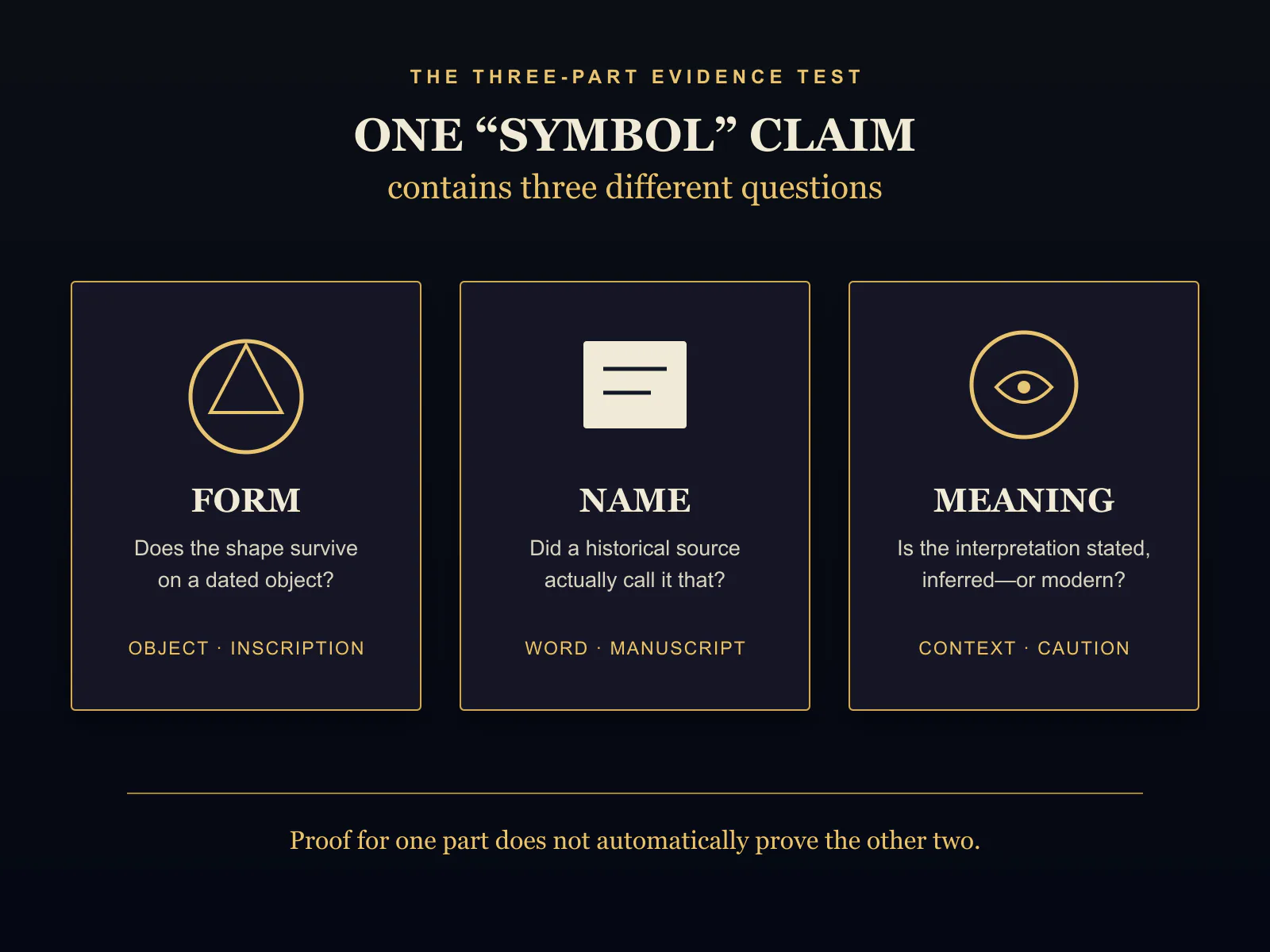
This evidence index separates those three questions. It asks when a form appears, what people actually called it, and how much of its meaning the surviving evidence can support.
The short answer: Mjölnir and Younger Futhark are among the clearest historically attested choices. The three-triangle design called the “Valknut” is old, but that name and its exact meaning are not. Vegvísir, the familiar Helm of Awe graphic, the Web of Wyrd and the Troll Cross should not be presented as Viking Age symbols.
Viking symbols at a glance
| Symbol or motif | Earliest secure context | Classification | What we can safely say |
|---|---|---|---|
| Mjölnir / Thor’s hammer | Viking Age amulets and hammer rings | Viking Age | Form and Thor association are secure; individual use can still vary |
| Younger Futhark | c. 725–1075 | Viking Age | The characteristic Viking Age runic writing system |
| Bindrunes | Runic inscriptions and objects | Historical, use varies | Combined rune forms are real; modern wish-sigils are a separate practice |
| Ships and ravens | Viking Age images and later texts | Viking Age, context-dependent | Historical motifs, not universal logos with one fixed meaning |
| Three interlaced triangles | Several seventh- to ninth-century objects | Historical form, lost meaning | The form is old; “Valknut” is a modern name and the original meaning is unknown |
| Interlocked-horn triskelion | Snoldelev stone, c. 700–800 | Historical form, disputed meaning | Perhaps three interlaced drinking horns; an Odin meaning is not established |
| Yggdrasil | Medieval Old Norse texts | Attested concept, no standard emblem | The world-tree is historical in the literature; modern tree logos are not one canonical Viking design |
| Ægishjálmr / Helm of Awe | Medieval name; later graphic staves | Medieval/post-Viking | The familiar radial graphic should not be dated to the Viking Age |
| Vegvísir | Icelandic manuscript, 1860 | Nineteenth century | A later Icelandic magical sign, not a Viking compass |
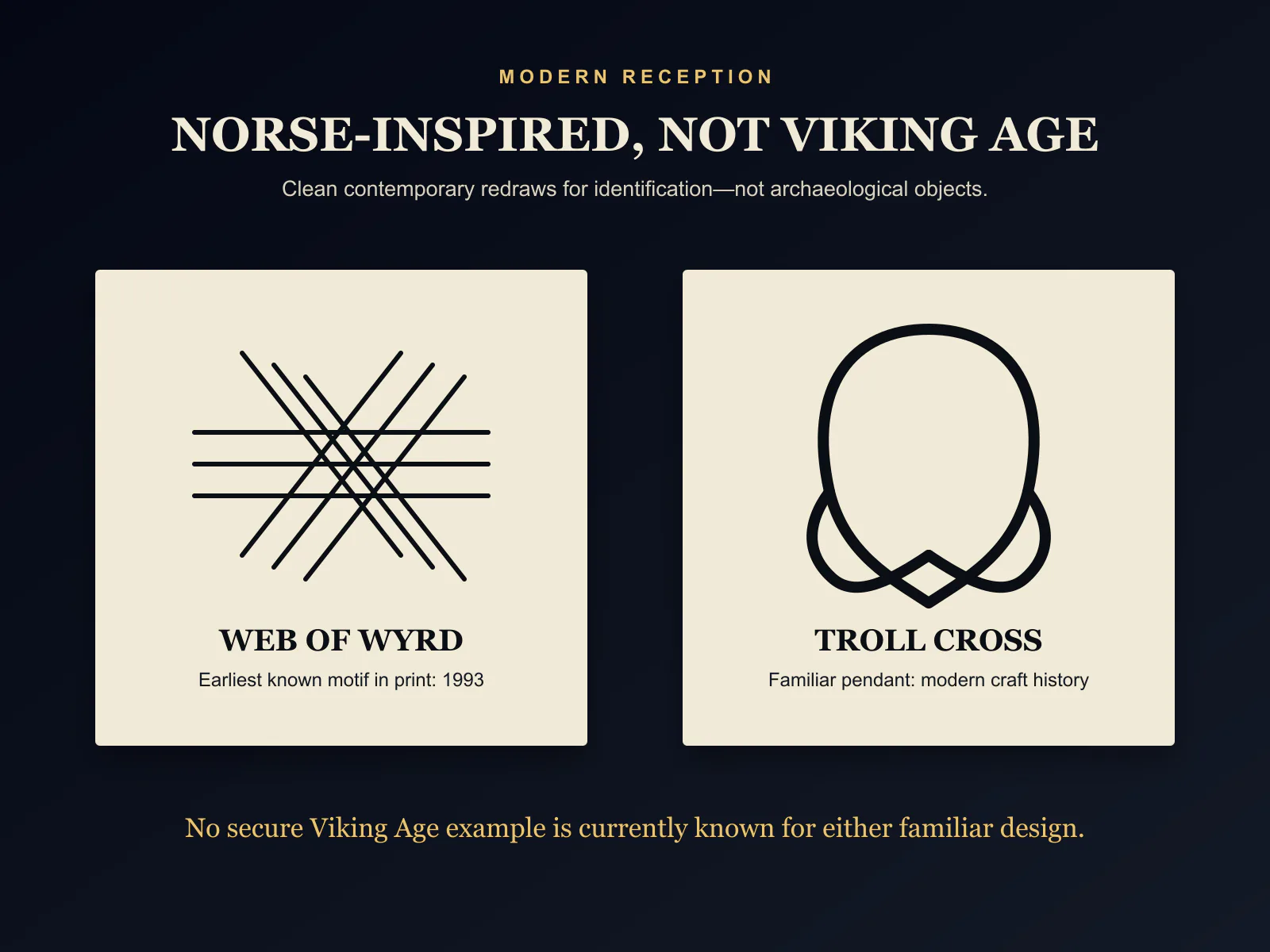
| Web of Wyrd | Earliest known form in print, 1993 | Modern | Modern graphic inspired by Northern themes; no secure Viking Age example is known |
| Troll Cross | Modern craft history | Modern | No known Viking Age archaeological precedent for the familiar pendant |
| Swastika | Ancient and Viking Age contexts | Historical form; modern warning | Old motif with no single recoverable Norse meaning; now highly charged by Nazi and white-supremacist use |
How to read the table: “Historical form” means that the shape occurs on an old object. It does not mean that its modern name, explanation or use has also survived from the Viking Age.
How do we test whether a “Viking symbol” is real?
Search results often treat symbols like vocabulary cards: one shape, one name, one meaning. The historical record is rarely that tidy.
This index ranks evidence in the following order:
- Dated objects and inscriptions. A museum record can establish that a form existed in a particular period and place.
- Contemporary or near-contemporary context. Where was the object found? What appears beside the motif? Was it jewellery, a memorial, a tool or a manuscript sign?
- Critical editions of texts. Medieval Old Norse literature can preserve names and stories, but it was written down through particular authors and manuscript traditions.
- Scholarly interpretation. Archaeologists, philologists and historians can compare sources, while still marking uncertainty.
- Modern reception. A modern meaning may be culturally important today without being evidence for Viking Age use.
Dates at the edges of the Viking Age vary by region and discipline. Rather than force every object into a single calendar box, the entries below give the date supplied by the relevant catalogue or specialist source.
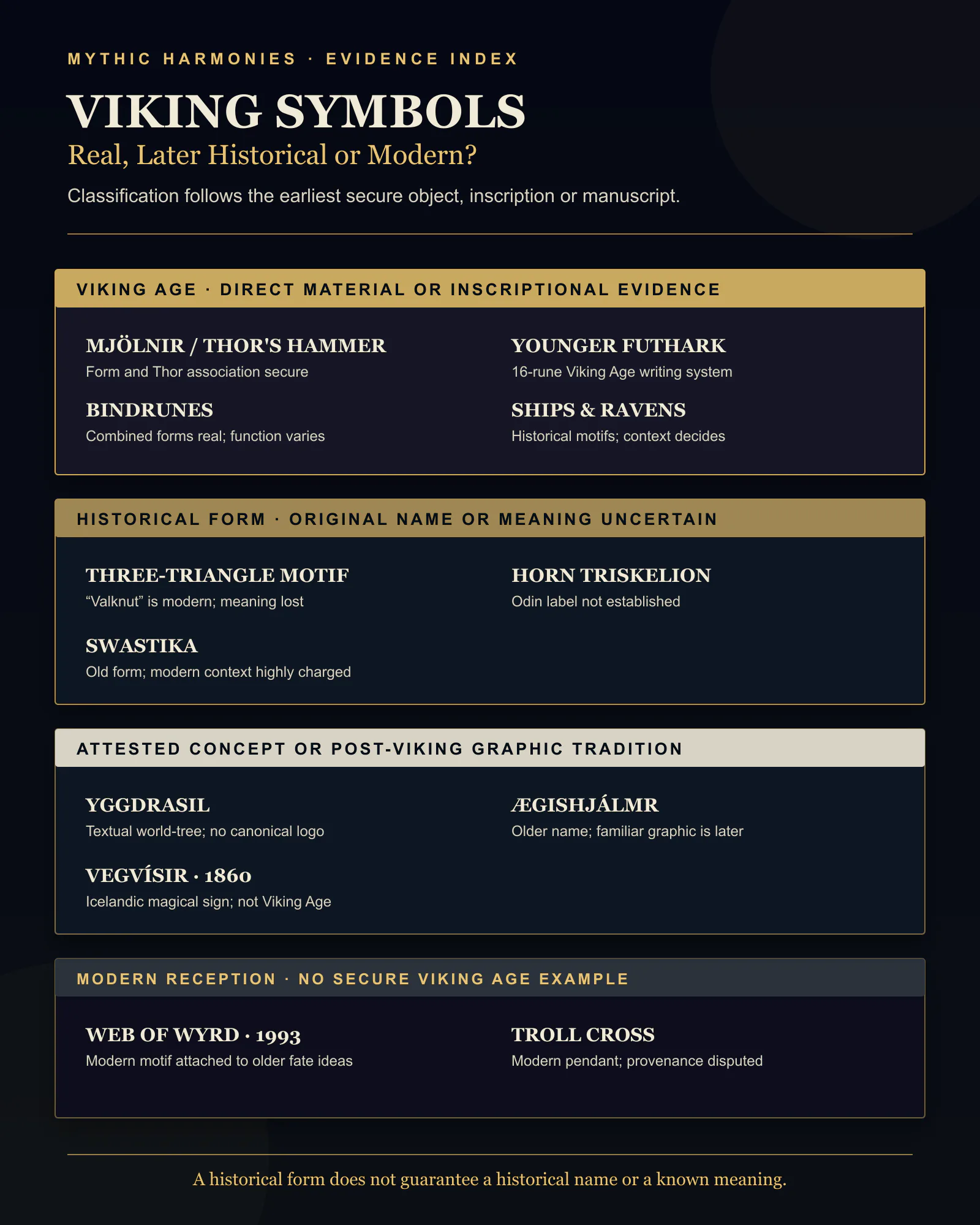
The most important rule is simple: form, name and meaning require separate proof.
Secure Viking Age evidence
Mjölnir: the clearest Viking Age emblem in this index
Hammer-shaped pendants and hammer rings are direct archaeological evidence. The Swedish History Museum’s catalogue and research summary records examples from Viking Age graves and settlements, including iron hammer rings from the Mälaren region and hammer pendants in iron, silver and amber. The museum identifies the hammer form with Thor’s weapon, Mjölnir.
That makes the central claim unusually strong:
- The form survives: yes.
- The Thor association is historical: yes.
- Every wearer’s personal intention is known: no.
Find context suggests religious, ritual and identity functions, but archaeologists do not recover a wearer’s private thoughts. Even the museum notes that the exact use of hammer rings is not known in every case. A hammer could participate in devotion, protection, communal identity, funerary practice or more than one of these at once.
This distinction matters. “Thor’s hammer was a Viking Age emblem” is supported. “Every hammer meant exactly protection” is too absolute.
For the full object history and the limits of interpretation, see the archaeological evidence for Mjölnir. Its mythic owner belongs in the separate guide to Thor in Norse mythology.
genuine Viking Age emblem; exact personal meaning varies by context.
Younger Futhark: authentic writing, not a symbol dictionary
Runes are letters. They can also occur in ritual, memorial or magical contexts, but their first evidential identity is a writing system.
The University of Copenhagen’s runology overview separates the principal chronological rows: the 24-character Elder Futhark, c. 150–650; the 16-character Younger Futhark, c. 725–1075; and expanded medieval runes, c. 1100–1400. The Swedish History Museum likewise explains that the older 24-character row had been reduced to 16 by the Viking Age.
This corrects two common internet shortcuts.
First, a page labelled “Viking runes” often displays the Elder Futhark. Those runes are historically Germanic and important, but the earlier 24-rune Elder Futhark largely predates the Viking Age. Younger Futhark is the characteristic Viking Age row.
Second, a rune name is not proof that everyone used the character as an isolated logo for one modern keyword. Inscriptions record names, ownership, memorial statements and language. Some objects may also carry magical or ritual uses, but those uses must be evaluated inscription by inscription.
Younger Futhark is securely Viking Age; a universal menu of one-word rune powers is not.
Bindrunes: combined forms are historical, designer sigils are modern
A bindrune combines two or more runic characters into one graphic form. Combined rune forms are not an internet invention. They occur in the historical runic corpus; the Kvinneby copper sheet in the Swedish History Museum, for example, includes bindrunes within an inscription whose reading and interpretation have been debated.
What does that evidence prove? It proves that runes could be graphically combined. It does not prove that a Viking routinely chose three modern keyword meanings—“strength,” “love,” “protection”—and merged their shapes into a personal manifestation sigil.
Historical bindrunes can serve orthographic, space-saving, decorative or inscription-specific purposes. Some occur in contexts interpreted as magical. Their function has to be argued from the actual inscription, not reverse-engineered from a modern chart.
If you are choosing a historically informed rune tattoo, label a newly designed bindrune honestly: it can be meaningful modern art using runic forms without being passed off as a recovered Viking formula.
historical combined rune forms are real; modern intention-based bindrunes are modern compositions.
Ships: unmistakably historical, never limited to one meaning
Ship imagery is among the least controversial entries as a form. Viking Age ships survive archaeologically, and ships also appear in contemporary visual sources. The Swedish History Museum’s Lillbjärs picture stone, object 45167_HST, shows a sailing ship beneath an upper scene with a mounted figure, a woman holding a drinking horn and geometric motifs.
The Viking Ship Museum’s guide to iconographic sources explains why such images matter: they can be compared with archaeological finds to study equipment, ships, power and religious ideas.
But a ship is not a one-definition icon. Depending on the object and scene, it may evoke travel, status, warfare, exchange, burial, narrative or movement between worlds. “The Viking ship symbolizes the journey to the afterlife” may fit one interpretation of one context; it is not a safe universal translation.
secure Viking Age motif; meaning is contextual.
Ravens: historical birds, contextual identifications
Ravens belong to both the ecology and the story-world of medieval Northern tradition. Huginn and Muninn are named as Odin’s ravens in Old Norse literature, and bird imagery appears on Viking Age objects. The Swedish History Museum’s Odin overview places the literary ravens beside objects such as the Tängelgårda picture stone.
The caution is iconographic. A bird on a worn object does not identify itself. Its species may be uncertain, and even a plausible raven does not automatically become Odin’s personal badge. Identification grows stronger when several contextual clues converge—an associated figure, scene, animal or literary parallel—but absolute certainty is often unavailable.
For the sources behind the names and their later interpretations, read Huginn and Muninn and Odin’s names and attributes.
raven imagery and Odin's ravens are historical; a lone raven is not automatically an Odin logo.
Historical forms whose original meanings are lost or disputed
Is the Valknut a real Viking symbol?
The most accurate answer is: the three-triangle form is historical, but “Valknut” is a modern label and its original meaning is unknown.
Pete Sandberg of Aarhus University surveys the evidence in “A ‘Valknut’ in the Capitol: Viking Age Symbol and Modern Myth”. He notes that the term does not occur in Old Norse and that no pre-modern written source names the design. A limited group of seventh- to ninth-century objects bears related three-triangle forms, including Gotland picture stones, a wooden lid from the Oseberg burial and a ring found in the River Nene.
The artefacts are real. The uncertainty is also real.
Modern descriptions often define the motif as “Odin’s knot,” “the knot of the slain,” or a symbol of death and Valhalla. Associations with Odin or death may be proposed from surrounding scenes, but the surviving makers left no caption that settles the question. On the Gotland stones, the motif may be meaningful, decorative or both; those modern categories may not even map neatly onto how the carvers understood it.
Use the popular word so readers know which design is being discussed, but do not let the label smuggle certainty into the evidence.
genuine early medieval motif; modern name; original meaning lost.
The “Triple Horn of Odin”: real motif, unproven label
The Snoldelev stone provides a valuable test case. The University of Copenhagen dates its inscription to approximately 700–800, at the transition into the early Viking Age. Alongside the runes are a swastika, a wheel cross and a triskelion that may represent three interlaced drinking horns.
That establishes the triskelion’s presence on this object. It does not establish the modern title “Triple Horn of Odin,” nor a fixed explanation involving Odin’s mead of poetry. The drinking-horn reading is itself described cautiously by the university source: “perhaps” a representation of interlaced horns.
The premium answer is therefore less dramatic and more useful: the design is old, its modern Odin label is unproven, and the object’s precise visual program remains open to interpretation.
historical early Viking Age motif; popular Odin name and meaning are not securely documented.
The swastika: historical evidence with a necessary modern warning
The swastika long predates the Viking Age and occurs across many cultures. It also appears in Northern European contexts, including the early Viking Age Snoldelev stone. Its presence there is evidence that the form was known; it is not a dictionary definition of what that carving meant locally.
Claims that every Norse example was specifically “Thor’s hammer,” a sun sign or a protection mark go beyond what an isolated form can establish. Object, date and visual company matter.
Modern context cannot be treated as a footnote. As the Anti-Defamation League’s contextual history explains, the sign is ancient and still has non-hateful religious uses, especially in Asian traditions, but Nazi adoption transformed its dominant meaning across much of Europe and North America. Historical discussion is legitimate; contemporary display without explicit educational context can harm, intimidate or communicate an ideology the wearer did not intend.
ancient and historically attested form; no single recoverable Norse meaning; exceptionally high modern-context risk.
Attested Norse concepts without one canonical Viking emblem
Yggdrasil is historical in the literature—not as one standard logo
Yggdrasill, the world-tree or world-ash, is securely present in medieval Old Norse literature. In the critical edition of Snorri Sturluson’s Edda edited by Anthony Faulkes, the world-ash and the Norns form part of Gylfaginning‘s cosmological account.
The source itself demands chronology. Snorri was a medieval Christian author writing after pre-Christian religion had changed; Faulkes’s introduction explicitly warns that his account remains indispensable but is shaped by that distance and by medieval learning.
Tree imagery on older objects can invite comparison with Yggdrasil, but not every tree is self-identifying. Nor does the textual concept produce one authorized circular “Yggdrasil symbol.” Most symmetrical tree-in-a-ring emblems sold today are modern visual syntheses.
This does not make them meaningless. It makes their status clear: modern designs representing an attested old concept.
historical mythic concept; no single standardized Viking Age emblem.
Mythological figures and objects are not automatically logos
The same distinction applies to wolves, ravens, eight-legged horses, spears and serpents. Fenrir, Huginn and Muninn, Sleipnir, Gungnir and Jörmungandr belong to surviving narratives. Images of animals and weapons also survive. Yet matching any modern silhouette to a named being requires evidence.
A spear is not automatically Gungnir. Two birds are not automatically Huginn and Muninn. A wolf is not automatically Fenrir. Sometimes an identification is persuasive because several attributes and contexts align; sometimes a label has been added by modern designers.
This is why an evidence index should ask more than “does the story exist?” It must ask whether this particular form, on this particular object, can be connected to that story.
Post-Viking and modern signs commonly called Viking
Ægishjálmr: an older name and a younger graphic have been fused
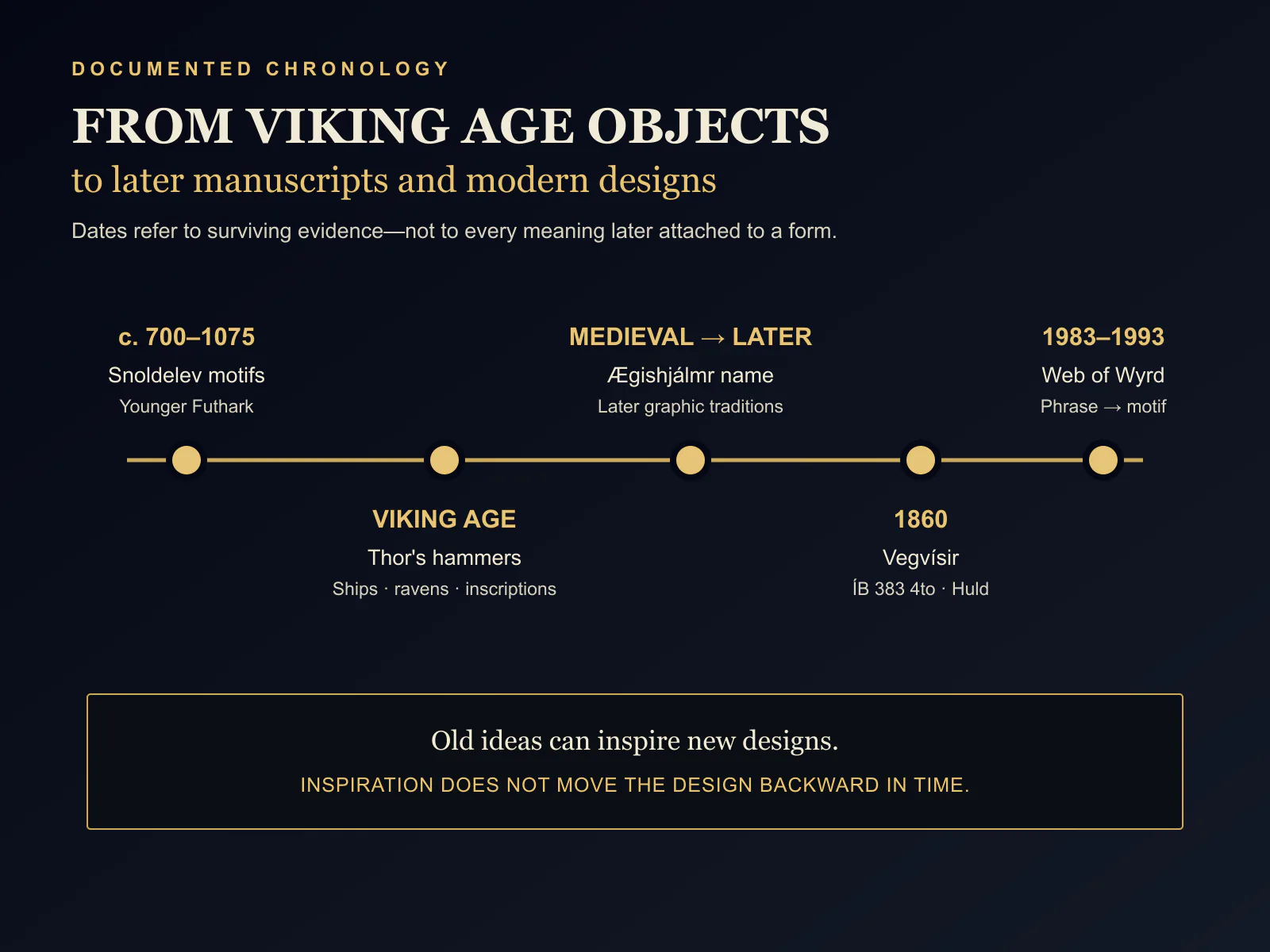
Ægishjálmr is usually translated “Helm of Awe” or “Helm of Terror.” The name or concept has medieval literary history, including the object associated with Fáfnir in Fáfnismál. The familiar eight-armed radial stave seen in tattoos and jewellery is a different evidential question.
Alessia Bauer and Alexandra Pesch examine Ægishjálmr, Vegvísir and related galdramyndir in a 2023 scholarly chapter. Their archaeological and philological conclusion is direct: the popular graphic signs are much younger than the Viking period, and modern interpretations go beyond their original contexts.
So two histories must not be compressed into one claim:
- the name/concept has medieval witnesses;
- the familiar radial graphic stave belongs to later Icelandic magical manuscript traditions.
medieval name or concept; familiar graphic is post-Viking.
Vegvísir: a nineteenth-century Icelandic sign, not a Viking compass
Vegvísir is historical—but not Viking Age. A key witness is the Icelandic manuscript ÍB 383 4to in the Handrit.is catalogue, commonly called Huld, compiled by Geir Vigfússon in 1860. The sign appears with a guidance formula in that later manuscript environment.
Calling it a “Viking compass” creates two false impressions: that the design is archaeologically Viking Age and that it was a navigational instrument used like a magnetic compass. Neither claim follows from the manuscript.
The more accurate description loses none of its interest: Vegvísir is a nineteenth-century Icelandic magical sign concerned with finding one’s way. It belongs to the long afterlife of Northern magical traditions, not to a Viking ship’s instrument panel.
documented Icelandic sign from 1860; not Viking Age.
Web of Wyrd: a modern design attached to older ideas about fate
The distinction between concept and motif is decisive here. Germanic and Old Norse sources contain rich language about fate, becoming and the Norns. That does not date the familiar nine-line emblem.
Joseph S. Hopkins and Lauren E. Fountain’s Kvasir Symbol Database entry traces the earliest known printed appearance of the motif to Jan Fries’s Helrunar in 1993, with a related geometric form appearing in later modern print. The phrase The Web of Wyrd is itself documented as the title of Brian Bates’s 1983 novel.
The right conclusion is not that the modern design is fraudulent. It is that the design and the ancient/medieval ideas have different histories. Our detailed guide explains what wyrd means in the sources and distinguishes that evidence from modern imagery; the Norns in the surviving texts deserve the same source-by-source treatment.
modern symbol; no secure Viking Age example is currently known.
Troll Cross: modern pendant with an uncertain origin story
The familiar Troll Cross is a bent-iron loop often sold as an ancient Scandinavian protection sign. No secure Viking Age archaeological corpus supports that presentation.
Its documented public history is modern and commonly connected with late twentieth-century Swedish craft. Paul Edward Montgomery’s University of York doctoral thesis, Branding Barbarians, records both the recent Swedish-maker account and the uncertainty surrounding its claimed family provenance. Until a primary craft record or securely dated publication is established, the exact origin should remain qualified.
That leaves a clear, honest label: a modern Scandinavian-style pendant, meaningful to many present-day wearers, but not a recovered Viking Age amulet.
modern; no known Viking Age archaeological precedent for the popular form.
What was the Viking symbol for protection?
There is no evidence for one universal “Viking protection symbol” equivalent to a modern safety icon.
Thor’s-hammer amulets are the strongest material candidate for a historically grounded protective association, but even their functions varied. Runes occur in inscriptions that can be interpreted as protective or magical, yet the formula, language and object—not an isolated modern keyword—carry the evidence. Later Icelandic magical staves may explicitly concern protection or guidance, but they should be dated to their own manuscript traditions.
Three popular answers therefore need correction:
- Algiz: an Elder Futhark rune, not a securely documented universal Viking protection badge.
- Vegvísir: a nineteenth-century Icelandic guidance sign, not a Viking compass.
- Ægishjálmr: a medieval name/concept whose familiar radial graphic is post-Viking.
If historical accuracy is the goal, begin with a dated object or an accurately translated Younger Futhark inscription. Do not begin with a social-media chart and work backward.
A five-minute test for any Norse symbol claim
Before accepting a product description, tattoo chart or viral infographic, ask five questions.
1. Is there a dated object or manuscript?
A museum number, excavation report or shelfmark is stronger than “Vikings believed.” If no example is provided, the claim has not yet cleared the first test.
2. Does the source show the same form?
A medieval word does not date a modern graphic. An ancient tree does not validate every circular Yggdrasil logo. Compare the actual shapes.
3. Is the popular name present in the historical source?
“Valknut” illustrates the danger: the form is old, but that name is not its documented Old Norse name.
4. Is the meaning stated, inferred or newly assigned?
An inscription may state a function. An archaeological scene may support an interpretation. A modern artist may assign a meaning. All three can be valuable, but they are different kinds of evidence.
5. Does the author admit uncertainty?
When scholars disagree or the evidence is silent, certainty is not a sign of quality. It is often a sign that the missing evidence has been replaced by a good story.
The evidence is more interesting than the myth of certainty
Real Viking Age visual culture was not a clean brand manual. It was material, local, reused, adapted and embedded in objects whose contexts only partly survive.
Mjölnir amulets and Younger Futhark give us firm ground. Ships, ravens and geometric motifs give us real forms with contextual meanings. The so-called Valknut gives us an old design whose voice has been lost. Yggdrasil gives us a literary concept without one authorized logo. Vegvísir, Ægishjálmr, the Web of Wyrd and the Troll Cross reveal how Northern traditions continued to be reshaped long after the Viking Age.
That chronology does not diminish modern symbols. It lets each one keep its real history.
Frequently Asked Questions
What are real Viking symbols?
The strongest examples include Thor's-hammer amulets, Younger Futhark inscriptions and Viking Age images of ships and animals. Some geometric motifs are also historical, including the three-triangle form now called the Valknut, but their original names and meanings may be unknown. A real old form is not proof of a modern explanation.
Is Vegvísir a Viking symbol?
No. Vegvísir is documented in a nineteenth-century Icelandic manuscript, Huld (ÍB 383 4to), compiled in 1860. It is a genuine part of later Icelandic magical tradition, but it is not a Viking Age archaeological symbol or a compass known to have been used by Viking sailors.
Is the Valknut a real Viking symbol?
The three-interlaced-triangle motif is historical and appears on a small number of late Iron Age and early medieval objects. However, “Valknut” is a modern name, not a documented Old Norse term for the design, and its original meaning is unknown. Fixed definitions such as “Odin's knot” remain interpretations.
What is the Viking symbol for protection?
There was no single universal Viking protection symbol. Thor's-hammer amulets provide strong material evidence for religious and possibly protective use, while particular runic inscriptions may have protective or magical functions. Algiz, Vegvísir and the familiar Helm of Awe graphic should not be presented as one proven Viking safety sign.
Did Vikings use Elder or Younger Futhark?
Younger Futhark is the characteristic Viking Age runic system, with 16 characters and a conventional date of roughly c. 725–1075. The 24-character Elder Futhark was used earlier, approximately c. 150–650, although period transitions vary and later knowledge or reuse cannot be reduced to a hard overnight change.
Is the Helm of Awe a Viking symbol?
The name Ægishjálmr has medieval literary history, but the familiar radial magical stave is younger than the Viking Age and belongs to later Icelandic manuscript traditions. Treating the medieval name and the later graphic as one unchanged Viking symbol collapses two different histories.
Are bindrunes historically authentic?
Combined rune forms are historically attested. Their uses depend on the inscription and may include orthographic, practical, decorative or possibly magical functions. Modern bindrunes built by combining fixed keyword meanings into a personal sigil are modern designs; the existence of historical ligatures does not date that method to the Viking Age.
Which Norse symbols should you avoid tattooing?
Avoid any design whose translation or origin you have not checked, and treat the swastika as exceptionally high risk because its dominant modern association in Europe and North America is Nazism and white supremacy. Other Norse imagery can also be appropriated by extremist groups, but context and combination matter; research the exact design rather than relying on a blanket list.
Sources and method
This article prioritises museum collections, university runology resources, critical editions and peer-reviewed or specialist scholarship. Commercial symbol lists were reviewed as search competitors, not used as historical authorities.
- Swedish History Museum, Thor’s hammer rings.
- Swedish History Museum, The first runes.
- Swedish History Museum, Lillbjärs picture stone, object 45167_HST.
- University of Copenhagen, Runology.
- Rikke Steenholt Olesen, University of Copenhagen, Salløv — carved in stone but surrounded with mysteries.
- Pete Sandberg, “A ‘Valknut’ in the Capitol: Viking Age Symbol and Modern Myth”, Aarhus University.
- Alessia Bauer and Alexandra Pesch, “Guidance from ancient symbols: Vegvísir, Ægishjálmur and other galdramyndir”, 2023.
- National and University Library of Iceland, ÍB 383 4to manuscript record, Huld, 1860.
- Snorri Sturluson, Edda: Prologue and Gylfaginning, ed. Anthony Faulkes, 2nd ed., 2005.
- Joseph S. Hopkins and Lauren E. Fountain, “Web of Wyrd”, updated 2025.
- Paul Edward Montgomery, Branding Barbarians, PhD thesis, University of York, 2019.
- Anti-Defamation League, “Swastika”, with explicit guidance to evaluate symbols in context.
Editorial principle: where the evidence ends, this article names the gap instead of filling it.
Music to read by
Each article has a soundtrack. Listen to Mythic Harmonies while you read.
Explore the music