
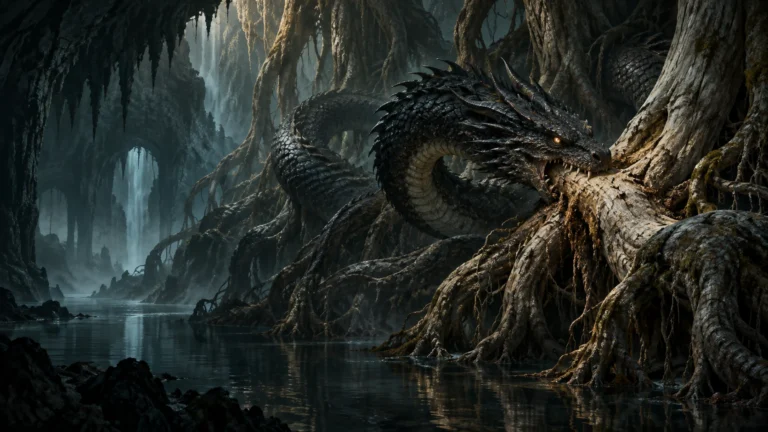
Nidhogg in Norse Mythology: The Dragon Beneath Yggdrasil
Nidhogg is the dragon or serpent beneath Yggdrasil, the World Tree in Norse mythology. The poem Grímnismál places him gnawing below the tree; Snorri Sturluson locates him at its root over Niflheim, beside Hvergelmir. In Völuspá, he feeds on the dead and appears in the final vision, flying with corpses in his wings. [1] [2] [3]
Those images make him unforgettable: a living world being eaten from below, then a dark shape crossing the sky after the earth has risen again. Yet the surviving texts give Nidhogg remarkably little biography. His presence matters more than his origins. Reading the passages together reveals a creature more unsettling than a straightforward monster waiting for a hero to kill him.
Is Nidhogg a dragon or a serpent?
Both descriptions have a basis in the poem. In its closing stanza, Völuspá calls the flying creature a dreki, a dragon, and a naðr, a serpent. These are two descriptions within the same scene, not competing accounts that force us to choose one creature over the other. [3] [6]
The scene also gives him an aerial form. Nidhogg flies from below, from Niðafjöll, carrying corpses. The Old Norse expression í fjöðrum can be rendered as “in his feathers” or “in his wings.” This striking detail belongs to the poem itself, although it does not supply a complete anatomical portrait. [3] [4] [6]
What does Nidhogg look like, and what powers does he have?
The poems give us actions and glimpses: he damages the tree from below, feeds on corpses and flies carrying the dead. The final stanza describes a dark dragon and a gleaming serpent, a combination of darkness and lustre rather than a precise scale colour. His size and number of legs are not specified in these passages. [1] [3]
Nor do these passages describe fire-breathing or an ability to change size. Artists can give these brief descriptions a detailed visual form, but choices such as horn shape, scale colour and precise wing anatomy belong to their designs. The myth’s most distinctive power is already there: Nidhogg can reach the foundations of the living world and the bodies of the dead.
What does the name Nidhogg mean?
“Malice-striker” is a useful short explanation of Níðhǫggr, but the etymology is not entirely settled. Edward Pettit discusses both a reading connected with malice and an alternative involving the waning or dark moon. His edition also uses forms with and without the long vowel in the first element. A single English translation therefore cannot capture every scholarly possibility. [4]
For clarity, this guide uses Nidhogg in its running text and retains Old Norse forms when discussing the language. Níðhöggr, Níðhǫggr and Nidhogg refer here to the same mythological creature.
How do you pronounce Nidhogg?
For the English name, Dictionary.com gives “NEED-hawg,” with the main stress on the first syllable. That is an American English pronunciation, not a reconstruction of the medieval name. [7]
The Old Norse spelling preserves distinctions hidden by the English form. In particular, ð represents the voiced “th” sound heard in English there, rather than an ordinary d. Cornell’s introductory language guide explains this letter and the ways translators simplify Norse names. [8]
Why does Nidhogg gnaw Yggdrasil?
In Grímnismál 35, the tree suffers in three directions: a deer bites above, decay attacks its side, and Nidhogg damages it from below. The stanza makes the ash vulnerable despite its immense place in the cosmos. Its suffering exceeds what people understand. [1]
The poem gives us the damage without explaining a personal motive. Nidhogg attacks the structure that sustains the world, making destruction part of the world’s everyday condition long before the final catastrophe.
Nor is he alone beneath the tree. The preceding stanza names several serpents there, including Góinn and Móinn, identified as sons of Grafvitnir. They should not be turned into Nidhogg’s children: the named father in the verse is someone else. [1, stanza 34]
Where does he live: Niflheim or Hvergelmir?
Snorri gives the clearest prose explanation. In Gylfaginning 15, one of Yggdrasil’s three roots extends over Niflheim. Beneath that root lies Hvergelmir, and Nidhogg gnaws from below. The following chapter places many other serpents with him in Hvergelmir. Niflheim is the larger setting in this account; Hvergelmir is the spring associated with the root and its serpents. [2]
The sources do not provide a single, perfectly consistent map. Grímnismál 31 associates the tree’s three roots with Hel, the frost giants and human beings. Snorri’s arrangement includes the Æsir, the frost giants and Niflheim. These descriptions overlap, but their differences matter when drawing the world. [1] [2]
Our guide to Yggdrasil and the Norse World Tree explores that wider cosmology. For Nidhogg, the stable image is simpler: he works below the ash, attacking what sustains it.
The tree is also being cared for
Snorri pairs damage with maintenance. In Gylfaginning 16, the Norns take water and mud from Urðr’s well and apply them to the ash so that its branches do not wither or decay. The same chapter contains both the creatures that injure the tree and the care that helps preserve it. [2]
This gives the scene its tension. Yggdrasil endures, but endurance involves continuing vulnerability and attention. As a literary reading, the contrast is more revealing than a simple countdown in which the dragon must eventually chew through the final root. Snorri does not describe such a final bite.
Is Nidhogg evil?
He is a destructive and frightening figure: he injures Yggdrasil and feeds on the dead. “Evil” captures that threatening role, but the texts give him little individual psychology. The corpse-feeding scene also places him among punishments associated with wrongdoing. These images invite moral interpretations without providing a complete account of his motives. [1] [2] [3]
Ratatoskr, Nidhogg and the eagle
The squirrel Ratatoskr connects the heights of the tree with its depths. Grímnismál 32 says that he carries the eagle’s words down to Nidhogg. Snorri’s prose makes the hostility explicit: the squirrel runs up and down the ash, carrying malicious words between them. [1] [2]
The distinction is small but useful. The poem gives the message route; the prose account describes the exchange as hostile. Neither passage quotes their insults or tells a complete origin story for the quarrel. Ratatoskr is not described here as making peace, and the sources cited do not show him inventing every message himself.
The eagle in Snorri’s account remains unnamed. Veðrfölnir is the hawk sitting between its eyes, a separate bird. Keeping those identities apart preserves the curious detail of the scene: an eagle, a smaller hawk, a travelling squirrel and the serpent below all share the living structure of the tree. [2, chapter 16]
Words can reach Nidhogg as well as roots. Reading the scene this way, hostility travels through the tree alongside physical damage. The squirrel’s small, repeated journeys give the vast cosmic setting a surprisingly intimate quarrel.
Nidhogg and the dead at Náströnd
The atmosphere changes in Völuspá. Around its Náströnd passage, the seeress describes a hall far from the sun, with north-facing doors, serpents and dripping venom. Nearby in the sequence, oath-breakers, murderers and a man who seduces another’s wife wade through oppressive currents. Nidhogg feeds on dead bodies, and a wolf tears at people. These are stanzas 38–39 in Bellows’s translation. [3]
The passage concerns particular wrongdoers and a place of suffering. It gives no rule that everyone who dies outside battle must have their blood drained by Nidhogg before reaching the underworld.
Snorri arranges the material differently. In Gylfaginning 52, he describes Náströnd’s terrible hall, then identifies Hvergelmir as worse, with Nidhogg tormenting the dead there. The poem and prose account should therefore retain their own wording and geography. [2]
These scenes make Nidhogg an especially disturbing presence because his violence crosses boundaries. The roots of the living world and the bodies of the dead are both exposed to him. Yet the texts stop short of making him the ruler or judge of the entire underworld.
Does Nidhogg survive Ragnarök?
His appearance after the poem’s scenes of renewal supports that reading, but the poem does not narrate how he survives. The closing vision shows him flying with corpses after the earth has risen from the sea and the future of the gods has been described. It gives us an image to interpret, rather than a continuous account of his journey through the catastrophe. [3]
This final appearance belongs to both principal manuscript versions of Völuspá. The numbering varies: Bellows prints the dragon stanza as 66; Pettit numbers it 63 in the Codex Regius version and 58 in the Hauksbók version. Those references point to the corresponding closing scene, not three separate flights. [3] [4]
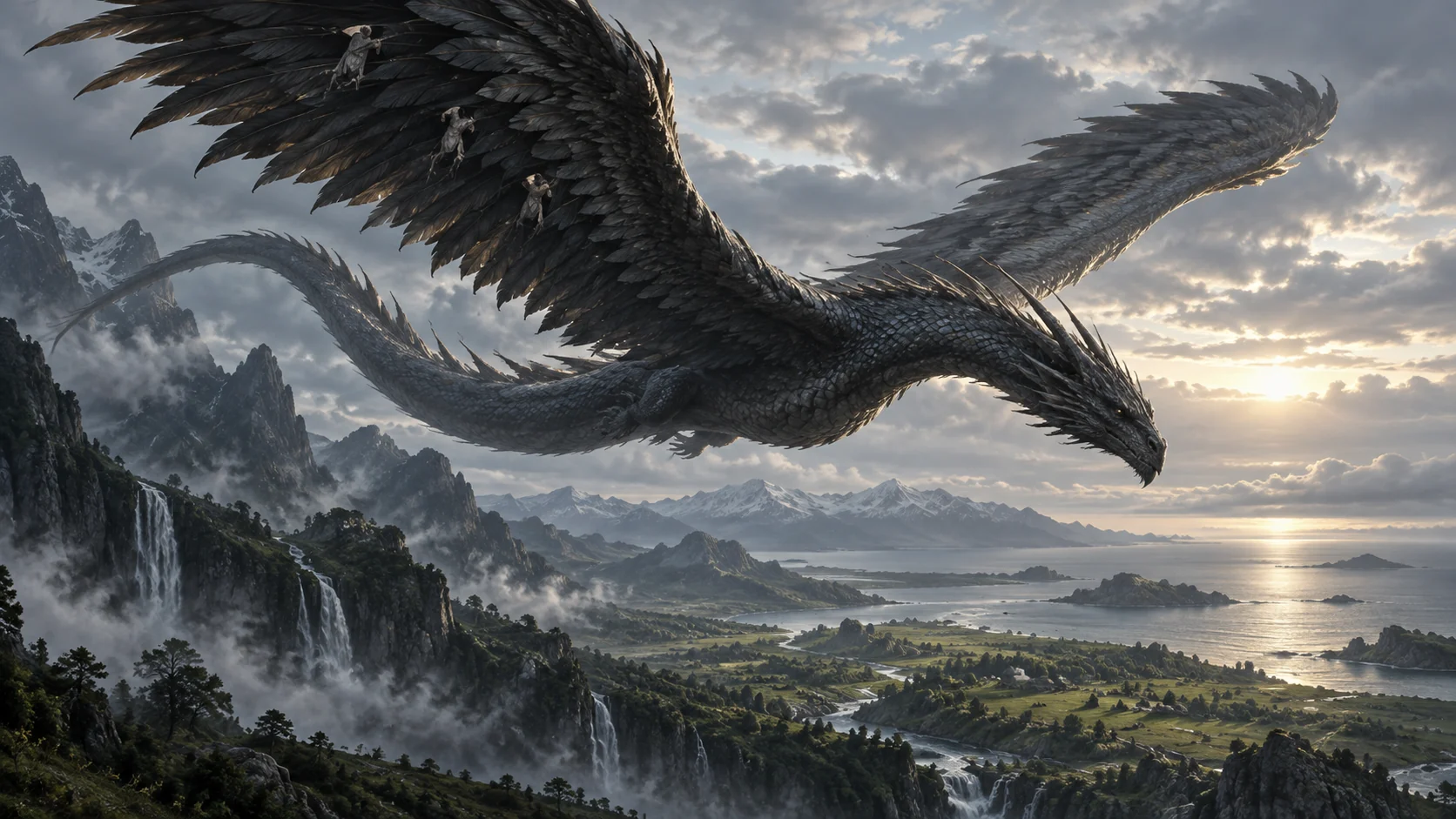
What actually happens in the final stanza?
Four details anchor the reading. A dark dragon flies. He comes from below, from Niðafjöll. He carries corpses in his wings or feathers. He passes over the field. The passage does not describe him swallowing the renewed earth or killing the gods who have returned. [3] [6]
Then the poem closes with a reference to “she.” That feminine subject is understood as the seeress. It should not be turned into a statement that the dragon sinks and dies. Exactly what the seeress’s sinking signifies remains open to interpretation. [4] [6]
The ending can feel like a threat intruding into a vision of renewal. That is a reasonable response to the contrast between the flourishing world and the corpse-bearing dragon. But the scene does not explain his destination, announce another apocalypse or provide a final battle. Its power partly comes from leaving that last movement unresolved.
For the wider sequence, see what happens at Ragnarök. Nidhogg’s brief final appearance belongs within that larger poem, where destruction, return and the limits of prophecy remain closely intertwined.
Nidhogg and Jörmungandr are different serpents
Jörmungandr is the World Serpent encircling the earth in the sea. Snorri identifies him as a child of Loki and Angrboða and describes his fatal encounter with Thor at Ragnarök. Nidhogg is associated with the roots, Hvergelmir and the dead; the passages discussed here give him no equivalent parentage or duel with Thor. [2, chapters 15–16, 34, 51–52]
| Question | Nidhogg | Jörmungandr |
|---|---|---|
| Where is he placed? | Beneath Yggdrasil; at Hvergelmir in Snorri | In the sea surrounding the earth |
| What is his defining action? | Gnawing below the tree and feeding on the dead | Encircling the earth and confronting Thor |
| What happens around Ragnarök? | Corpse-bearing flight closes Völuspá | Thor kills him, then dies from his venom |
Sources: Grímnismál 32–35, Völuspá’s closing stanza and Gylfaginning 34 and 51. [1] [2] [3]
The story of Jörmungandr, the World Serpent follows that separate relationship with Thor. Sharing a serpentine form does not give the two creatures the same story.
Another famous dragon, Fáfnir, belongs to Sigurd’s story. In the opening prose of Fáfnismál, Sigurd attacks him from a trench as he crawls from his gold towards water. Fáfnir’s treasure and encounter with a dragon-slayer distinguish him from the root-gnawing, corpse-bearing Nidhogg. [9]
How do we know about Nidhogg?
The evidence is literary and medieval. Grímnismál and Völuspá belong to the collection now called the Poetic Edda. An important manuscript witness, the Codex Regius, dates from around 1270. The Árni Magnússon Institute provides information about its digital edition, which includes manuscript images and transcriptions. The manuscript’s date is not automatically the composition date of every poem it preserves. [5]
Snorri’s Gylfaginning, part of the Prose Edda, presents mythological knowledge through questions and answers. It also quotes poetry, including verses about the suffering ash. Consequently, a detail repeated by Snorri and an Eddic poem is not necessarily two independent witnesses to a belief. Sometimes we can see the prose writer using the poem. [1] [2]
The following reading map keeps the evidence visible:
| Passage | What it contributes |
|---|---|
| Grímnismál 31–35 | The roots, Ratatoskr’s message route, other serpents and Nidhogg beneath the suffering ash |
| Gylfaginning 15–16 | Hvergelmir and Niflheim, hostile messages, the eagle and hawk, the Norns’ care of the tree |
| Völuspá 38–39, Bellows numbering | The Náströnd sequence and Nidhogg feeding on the dead |
| Gylfaginning 52 | Nidhogg tormenting the dead at Hvergelmir |
| Völuspá 66, Bellows numbering | The final flight with corpses; compare Pettit’s Regius 63 and Hauksbók 58 |
The surviving portrait is brief but distinctive. We know the tree he attacks, the messenger who reaches him and the bodies he carries. His origin and his destination remain out of view.
From the medieval image to modern music
The movement from hidden roots to open sky also offers a powerful starting point for contemporary art. Mythic Harmonies develops the creature into a modern musical narrative in its song Níðhöggr. The song page includes lyrics and listening links. Its dramatic inventions belong to the song; the medieval passages remain the evidence for the myth.
Reading and listening offer different ways into that image. The guide traces the surviving words. The music explores what it might feel like to stand in a world with something moving beneath its foundations.
Frequently asked questions
Is Nidhogg a god?
Is Nidhogg one of Loki’s children?
Nidhogg is not among the three children of Loki and Angrboða named in Gylfaginning 34: Fenrir, Jörmungandr and Hel. The core Nidhogg passages discussed here do not name his parents. [2]
Who kills Nidhogg?
Sources and further reading
References identify the text and the relevant passage. English descriptions above are original paraphrases. Short Old Norse expressions are identified in context. Bellows and Anderson are public-domain translations used as reading aids; their older editorial theories are not treated as settled modern scholarship.
[1] Grímnismál, especially stanzas 31–35. Henry Adams Bellows, The Poetic Edda (1923), “Grimnismol.” Read the translation. The source for the roots, squirrel and suffering ash. ↩ Back to text
[2] Snorri Sturluson, Gylfaginning, chapters 15–16, 34, 51–52. Anthony Faulkes, ed., Edda: Prologue and Gylfaginning, second edition (2005), especially printed pp. 17–19 and 53. Read the Old Norse edition and notes. An accessible older English version is Rasmus B. Anderson’s The Younger Edda (1880): sections 15–16 and 34 correspond directly; his sections 56–57 contain the final battle and post-catastrophe dwellings. Its section numbering differs from Faulkes in the later part. ↩ Back to text
[3] Völuspá, stanzas 38–39 and 59–66 in Henry Adams Bellows, The Poetic Edda (1923), “Voluspo.” Read the translation. Stanza numbers differ across editions; Bellows’s arrangement is not a diplomatic transcription of one manuscript. ↩ Back to text
[4] Edward Pettit, The Poetic Edda: A Dual-Language Edition (Open Book Publishers, 2023). Book and open-access formats. Relevant checks: Vǫluspá, Codex Regius, stanza 63, p. 53; notes 203 and 291–293, pp. 67 and 72. Vǫluspá, Hauksbók, stanza 58, p. 763. Grímnismál, notes 145–148, p. 200. These clarify the name, translations and manuscript comparison. ↩ Back to text
[5] Árni Magnússon Institute for Icelandic Studies, “New Electronic Edition of the Codex Regius of the Poetic Edda,” 13 November 2024. Read the institutional notice. Manuscript date and access to the digital edition. ↩ Back to text
[6] Völuspá, Old Norse text, closing stanza, conventionally numbered 66 in this presentation. Read the Old Norse alongside an English rendering. Used to display the words dreki, naðr and í fjöðrum; compare Pettit’s edition in reference 4. ↩ Back to text
[7] Dictionary.com, “Nidhogg,” American pronunciation entry. Read the entry. Used only for the English pronunciation, not to settle the Old Norse etymology. ↩ Back to text
[8] Oren Falk, Cornell University, “HIS 3200: The Viking Age, Old Norse,” introductory pronunciation and orthography guide. Read the guide. Used here for the letter ð and simplified forms in translation, not as a full reconstructed pronunciation of Níðhǫggr. ↩ Back to text
[9] Fáfnismál, opening narrative prose and stanzas 1–4. Henry Adams Bellows, The Poetic Edda (1923), “Fafnismol.” Read the text. Basis for the brief comparison with Fáfnir and Sigurd. ↩ Back to text
About the illustrations: the cover and the image within this guide were generated with AI for Mythic Harmonies. The cover draws on Nidhogg’s root-gnawing; the second image interprets the final flight in Völuspá. Their detailed anatomy, colours and landscapes are modern artistic choices, not surviving Viking Age depictions.
Music to read by
Each article has a soundtrack. Listen to Mythic Harmonies while you read.
Explore the music