
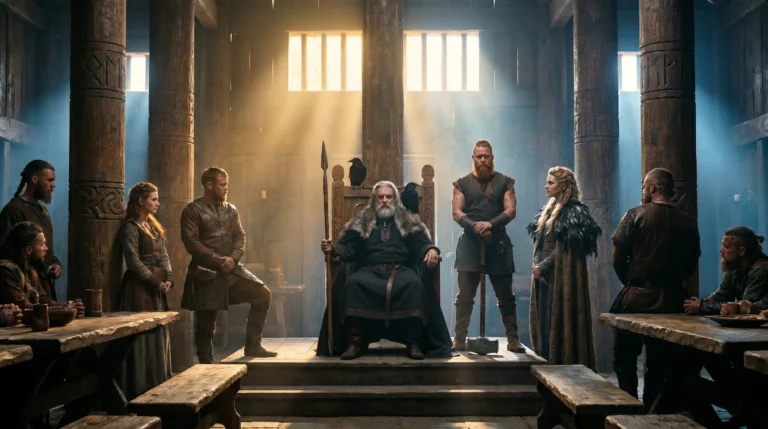
Norse Gods and Goddesses: The Complete Guide to Every Deity in the Eddas
Norse mythology does not preserve one canonical number or official list of gods. Snorri counts twelve Æsir in one passage of Gylfaginning—a count that excludes Odin and then adds Loki separately—but other poems and prose texts preserve further gods, goddesses, personified powers, and beings whose status is less clear. Any total depends on what the word “god” includes.
The best-attested major Norse gods and goddesses include Odin, Thor, Frigg, Baldr, Týr, Heimdall, Njörðr, Freyr, Freyja, and Iðunn. This guide also covers lesser-known Æsir and Ásynjur, the Vanir, Loki and Hel, and cosmic figures such as the Norns and Valkyries—while marking when a figure is not a god in the strict sense.
That distinction matters. The surviving record is not a modern rulebook: it combines medieval poems, Snorri Sturluson’s thirteenth-century synthesis, skaldic verse, archaeology, and place names. Some figures have entire narratives; others survive in a single line or name.
While you read, the atmospheric music of Mythic Harmonies offers a modern artistic response to the same mythology. It is not presented as a reconstruction of Viking Age performance.
Norse Gods and Goddesses List: Major Names at a Glance
This grouped list answers the searcher’s practical question without inventing a fixed pantheon. Spellings use normalized Old Norse where helpful, followed by familiar English forms throughout the guide.
| Group | Names covered in this guide | Evidence note |
|---|---|---|
| Æsir gods | Odin, Thor, Baldr, Týr, Heimdall, Bragi, Höðr, Víðarr, Váli, Forseti, Hœnir, Ullr, Hermóðr | Not one closed or consistent list across every source |
| Ásynjur and goddesses | Frigg, Iðunn, Sif, Skaði, Nanna, Sága, Eir, Gefjon, Fulla, Sjöfn, Lofn, Vár, Vör, Syn, Hlín, Snotra, Gná | Several are known chiefly from Snorri’s brief catalogue |
| Vanir and related figures | Njörðr, Freyr, Freyja, Kvasir, Nerthus, Gullveig | The last three have disputed or source-dependent classification |
| Liminal, primordial, or cosmic figures | Loki, Hel, Ymir, Búri, Borr, Sól, Máni, the Norns, the Valkyries | Central to the myths, but not all are gods |
The list is deliberately transparent about category. “Norse deity,” “Æsir,” “Vanir,” “jötunn,” and “personified power” are not interchangeable labels, even when the same figure marries into the gods or appears in divine company.
The Two Divine Groups: Æsir and Vanir
The Old Norse sources distinguish the Æsir from the Vanir. Ásynjur is the corresponding plural used for goddesses of the Æsir. Odin, Thor, Frigg, Týr, and Baldr belong with the Æsir; Njörðr, Freyr, and Freyja are the clearest Vanir.
Modern summaries often call the Æsir gods of war, rule, and order, and the Vanir gods of fertility, wealth, and natural abundance. That contrast is a useful orientation, not a law stated by the Eddas. Individual figures cross those boundaries, and the texts do not assign every deity one exclusive “domain.”
Völuspá remembers a conflict involving the gods, while later prose sources preserve different details about truce, hostage exchange, and Kvasir. These accounts should not be flattened into one perfectly consistent history. Njörðr and Freyr are explicitly hostages among the Æsir in Snorri; Freyja’s presence among them is clear, but she is not named as a hostage in every version.
The safest conclusion is that medieval authors remembered two divine groupings whose members became closely connected. Their relationship is essential to the mythology, but its religious meaning in Viking Age practice cannot be reduced to a simple opposition between “war gods” and “nature gods.”
The Principal Aesir Gods
Odin, the Allfather
Odin is presented as chief of the Æsir and is associated across the sources with wisdom, war, death, poetry, and magic. “God of” labels are useful summaries, but Odin’s surviving poetry and prose portray a contradictory figure rather than the ruler of one neat domain.
He is not a god of brute strength. He rules through knowledge, cunning, and sacrifice. He gave his eye at Mímir’s well for a single draught of wisdom. He hung himself on Yggdrasil for nine nights, pierced by his own spear, to discover the runes. He travels the Nine Worlds in disguise, gathering knowledge and preparing for a Ragnarök he knows he cannot survive.
Odin owns the spear Gungnir, the ring Draupnir—which produces eight rings of equal weight every ninth night—and the eight-legged horse Sleipnir. He is accompanied by his ravens Huginn and Muninn and his wolves Geri and Freki. At Ragnarök, he is destined to be devoured by the wolf Fenrir.
For the complete account of his myths, sacrifices, and meaning, see our dedicated article on Odin the Allfather.
Thor, God of Thunder
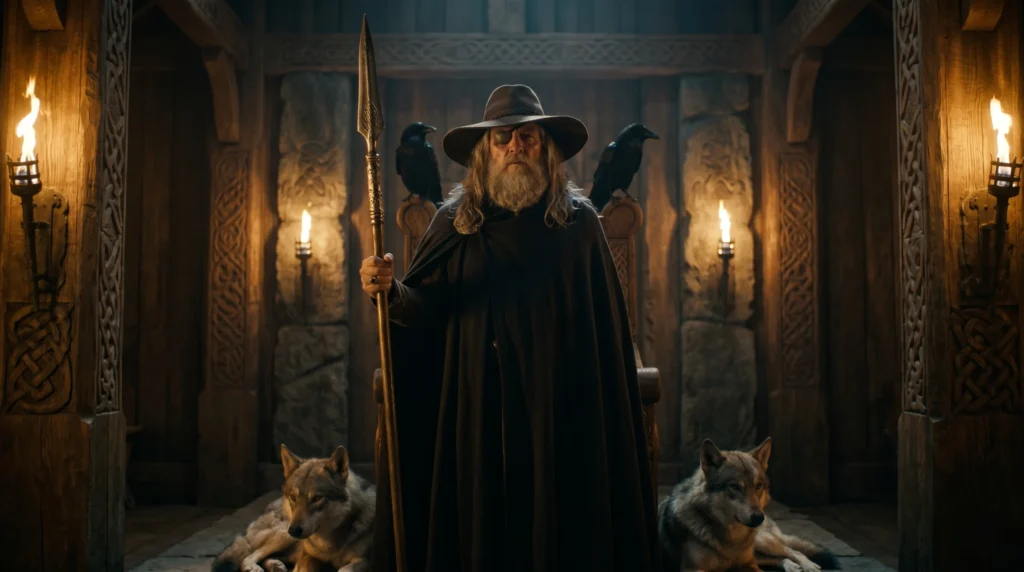
Thor is the son of Odin and one of the most strongly attested gods in myth, place names, and material culture. Snorri calls him the strongest of gods and humans, and his stories repeatedly cast him as a defender against giants. Evidence supports broad importance; it does not let us rank him as the single most worshipped god of every region or divide Viking society neatly between “Odin’s elite” and “Thor’s common people.”
Thor wields the hammer Mjölnir, wears the belt of strength Megingjörð, and rides a chariot pulled by two goats. His myths are full of journeys to Jötunheim and battles against giants. At Ragnarök, he will kill the World Serpent Jörmungandr and then die from its venom after taking nine steps.
For the full story, see our article on Thor, the god of thunder, and our dedicated piece on the true meaning of Mjölnir, Thor’s hammer.
Frigg, Queen of the Aesir
Frigg is Odin’s wife and the foremost Ásynja in Snorri’s account. Lokasenna says she knows the fates of all beings but does not speak them. Marriage, motherhood, and household protection are common modern summaries of her role, yet the surviving evidence is less systematic than a fixed list of domains suggests.
Her most famous and most tragic myth is the death of her son Baldr. Knowing he was in danger, she extracted oaths from every thing in the cosmos not to harm him, but she overlooked the mistletoe, judging it too small to matter. Loki exploited this single omission to engineer Baldr’s death. Frigg’s grief is one of the emotional centers of Norse mythology.
Frigg dwells in the hall Fensalir, and she is attended by a court of handmaiden goddesses, several of whom are deities in their own right, covered further down in the section on the Ásynjur.
Baldr, the Beautiful and Beloved God
Baldr is the son of Odin and Frigg. In Gylfaginning, Snorri calls him the best, brightest, and most praised of the gods, saying he is so fair that light shines from him. “God of light” is a popular modern title, but the medieval sources do not assign him a formal portfolio of light, joy, and purity.
His death is the pivotal tragedy of Norse mythology and the first sign that Ragnarök is approaching. Killed by a mistletoe dart thrown by his blind brother Höðr and guided by Loki, Baldr descends to the realm of Hel. The gods’ failed attempt to retrieve him, foiled by Loki in disguise, marks the point of no return for the cosmos. After Ragnarök, however, Baldr returns, reborn into the new world, becoming a symbol of hope and renewal.
Týr, the One-Handed God
Týr is closely associated with courage, battle, and the binding of Fenrir. Snorri says he is the bravest god and that invoking him benefits victory; later interpretation strongly connects him with law and justice. His name is cognate with older Indo-European words for “god,” which has led to the hypothesis that he once held a larger role. That is a scholarly reconstruction, not a fact narrated in the Norse myths.
His defining myth is the binding of the wolf Fenrir. When the gods needed to chain the monstrous wolf, Fenrir demanded that one god place a hand in his mouth as a pledge of good faith. Only Týr was willing. When the wolf realized he had been tricked and could not break free, he bit off Týr’s hand. Týr’s willing sacrifice for the good of the cosmos makes him the embodiment of justice that accepts personal cost.
Heimdall, the Watchman
Heimdall is the guardian of the Bifröst, the rainbow bridge connecting Asgard to the other realms. He possesses senses so acute he can hear grass growing and see for hundreds of miles. He needs less sleep than a bird.
His role is to watch for the coming of Ragnarök and to sound the Gjallarhorn when the giants approach. He is also, according to the Rígsþula, the divine ancestor of the three classes of human society. At Ragnarök, Heimdall and Loki are destined to kill each other, two boundary-crossers ending each other’s existence.
Bragi, God of Poetry
Bragi is associated with poetry, eloquence, and skaldic verse. Snorri describes him as renowned for wisdom and fluency, and he appears welcoming distinguished dead in Valhalla. He is married to Iðunn, keeper of the apples that preserve the gods’ youth.
Höðr, the Blind Brother of Baldr
In Snorri’s Gylfaginning, Höðr is Baldr’s blind brother and the unwitting instrument of his death: Loki guides him to throw the mistletoe that kills Baldr. Váli then avenges Baldr by killing Höðr. Völuspá later places Baldr and Höðr together after the world’s renewal, but it does not say that the brothers “rule” the new world.
Víðarr, the Silent God
Snorri calls Víðarr the silent god, a son of Odin, and nearly as strong as Thor. At Ragnarök he avenges Odin by killing the wolf. Gylfaginning explains his thick shoe through scraps cut from human footwear, while Völuspá describes the killing differently. Víðarr survives into the renewed world; the sources do not say that he repopulates it.
Váli, Avenger of Baldr
Völuspá presents Váli as a son of Odin who avenges Baldr while only one night old, before washing or combing his hair. Snorri likewise makes him Baldr’s avenger and says he survives Ragnarök. Reading Váli as a universal symbol of Norse morality goes beyond what these brief source passages establish.
Forseti, Judge at Glitnir
In Gylfaginning, Forseti is the son of Baldr and Nanna and dwells in the bright hall Glitnir. Snorri calls him the best judge and says that everyone who brings a dispute before him leaves reconciled. That passage supports an association with judgment and settlement; a detailed contrast between Forseti’s “justice” and Týr’s is a modern systematization.
Hœnir, the Enigmatic God
Hœnir appears in several texts, but they do not form one simple biography. Völuspá gives him a role in creating the first humans and later places him in the renewed world. Ynglinga saga, a separate prose account, makes him a handsome hostage who depends on Mímir’s advice. “The indecisive god” therefore describes one narrative, not his whole surviving tradition.
Ullr, God of the Hunt
Ullr is a somewhat mysterious god associated with archery, skiing, hunting, and single combat. Place-name evidence across Scandinavia suggests he was once a very important deity, perhaps more prominent than the surviving myths indicate. He is the stepson of Thor, dwelling in Ýdalir, the Yew Dales.
Hermóðr, the Messenger
Hermóðr is the brave messenger of the gods, often called a son of Odin. His great moment comes after Baldr’s death, when he volunteers to ride Sleipnir down the long dark road to the realm of Hel to plead for Baldr’s return. He negotiates the condition for Baldr’s release, that all things must weep, a condition Loki ultimately sabotages.
The Vanir Gods
Njörðr, God of the Sea
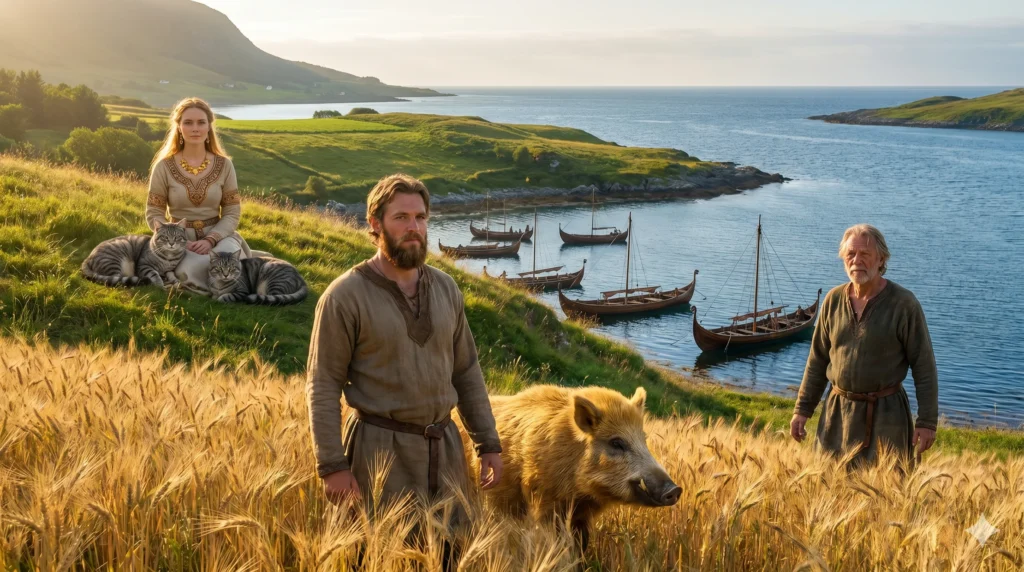
Njörðr is a Vanir hostage who lives among the Æsir. Gylfaginning associates him with wind, sea travel, fishing, and wealth, and says he may be invoked for voyages and prosperity. That literary description is firmer evidence than a universal claim about what every Viking sailor prayed.
His marriage to the giantess Skaði is one of the more memorable myths. The two could not agree on where to live. Njörðr could not bear the cold mountains where the wolves howled, and Skaði could not bear the seaside where the gulls cried. They eventually separated. Njörðr is the father of Freyr and Freyja.
Freyr, God of Fertility and Prosperity
Freyr is a prominent Vanir associated in the medieval sources with rain, sunshine, peace, prosperity, and the fruitfulness of the earth. Later written testimony and Scandinavian place names indicate a strong cult, especially in Sweden, but the evidence comes from different periods and should not be treated as a complete map of Viking Age worship.
He owns the ship Skíðblaðnir, which always has a favorable wind and folds up small enough to fit in a pouch, and the golden boar Gullinbursti. In one of the most poignant myths, Freyr gives away his magic sword to win the giantess Gerðr, a sacrifice that leaves him unarmed at Ragnarök, where he falls to the fire giant Surtr.
Freyja, Goddess of Love, War, and Magic
Freyja is one of the most prominent goddesses in the surviving mythology. The sources connect her with desire, wealth, seiðr, and the battle-dead, making any single label inadequate. Calling her merely a “Norse Aphrodite” erases much of that evidence.
Grímnismál says that Freyja chooses half of those slain in battle and Odin has the other half; Snorri places her hall Sessrúmnir in Fólkvangr. In Ynglinga saga, she introduces seiðr to the Æsir. These are claims from different texts, not proof of one ranked system of “the most powerful” magic. She also owns Brísingamen, travels with falcon plumage in Snorri’s account, and has a cat-drawn chariot.
For the full account of her domains, her magic, and her place in the afterlife, see our article on Freyja, the goddess of love, war, and magic.
Other Vanir
Several related figures resist easy classification. Tacitus describes the early Germanic goddess Nerthus; her name is linguistically related to Njörðr, but their precise historical relationship is debated. In Skáldskaparmál, Kvasir is made from the gods’ peace-spittle, while Ynglinga saga gives him a different role in the hostage exchange. Völuspá describes Gullveig’s repeated burning; identifying her with Freyja is a scholarly proposal, not an explicit statement in the poem.
The Goddesses: The Ásynjur
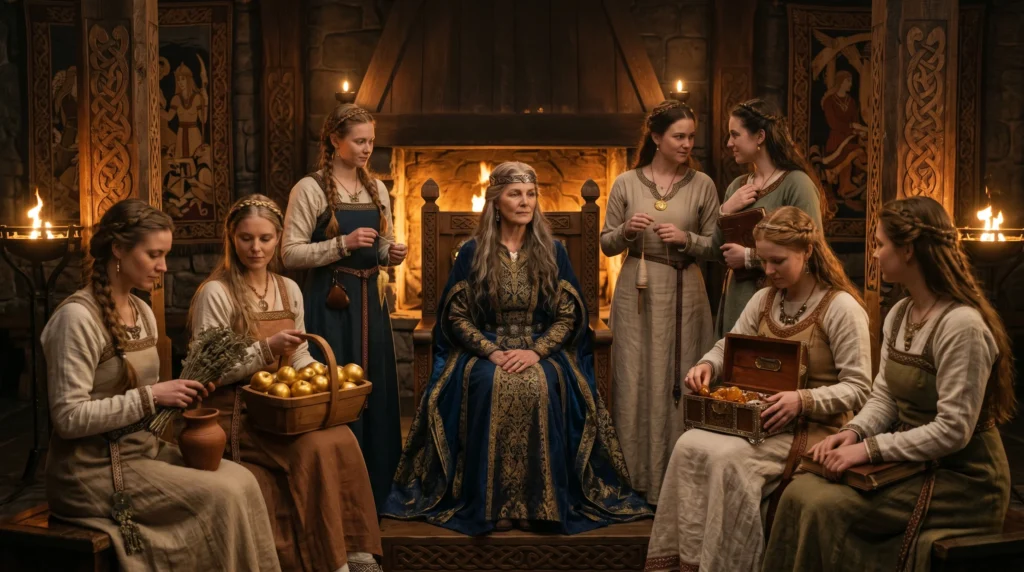
The female deities of the Aesir are called the Ásynjur, and they are among the most overlooked figures in popular treatments of the Norse gods and goddesses. Snorri Sturluson’s Prose Edda names a court of goddesses, many of whom appear only in brief descriptions. For several of them, this single mention is the only attestation in the surviving sources, yet their presence shows how rich the Norse conception of the feminine divine truly was.
Iðunn, Keeper of the Apples
Iðunn keeps the apples that preserve the gods’ youth; the sources do not call them apples of immortality. She is married to Bragi. In Skáldskaparmál, the giant Þjazi forces Loki to lure her away, and the gods grow old without her apples until Loki brings her back.
Sif, Thor’s Wife
Sif is Thor’s wife and is famous for the golden hair that Loki cuts off in Skáldskaparmál. Loki then obtains replacement hair made by dwarfs, alongside other divine treasures. Modern writers often interpret Sif’s hair as ripe grain and call her a harvest goddess, but no surviving Norse narrative explicitly assigns her that domain.
Skaði, the Huntress of the Mountains
Skaði is a jötunn who enters the company of the gods after demanding compensation for the death of her father Þjazi. The sources associate her with mountains, skiing, bow, and hunting; “goddess of winter” is a modern shorthand. Her marriage to Njörðr fails because each dislikes the other’s home.
Nanna, Wife of Baldr
Nanna is Baldr’s wife and the mother of Forseti in Snorri’s Edda. In Gylfaginning, she dies from grief during Baldr’s funeral and is placed on his pyre; Hermóðr later encounters her with Baldr in Hel. Other medieval versions handle Baldr’s family and death differently, so this is specifically Snorri’s narrative.
The Handmaidens of Frigg
Snorri names a sequence of Ásynjur in Gylfaginning, often with only an etymological gloss or one sentence of description. The list is valuable, but it does not prove that each figure had a separate, widely practiced cult or one exclusive “domain”:
Sága drinks with Odin at Sökkvabekkr, but calling her a goddess of “history” goes beyond the text. Eir is called the best physician. Gefjon receives those who die unmarried in Snorri’s account and appears in the story of land ploughed from Sweden. Fulla carries Frigg’s casket and knows her secrets. Sjöfn, Lofn, Vár, Vör, Syn, Hlín, Snotra, and Gná receive short explanations tied to love, permission, vows, inquiry, denial, protection, prudent conduct, and messenger work. These descriptions tell us what Snorri’s catalogue says; they do not reconstruct a complete Viking Age theology.
For several of these names, Snorri is our only substantial witness. Their presence shows how much material could survive as a name or poetic explanation even when story, cult, and local practice are no longer recoverable.
The Liminal Figures: Loki and His Kin
Loki, the Trickster
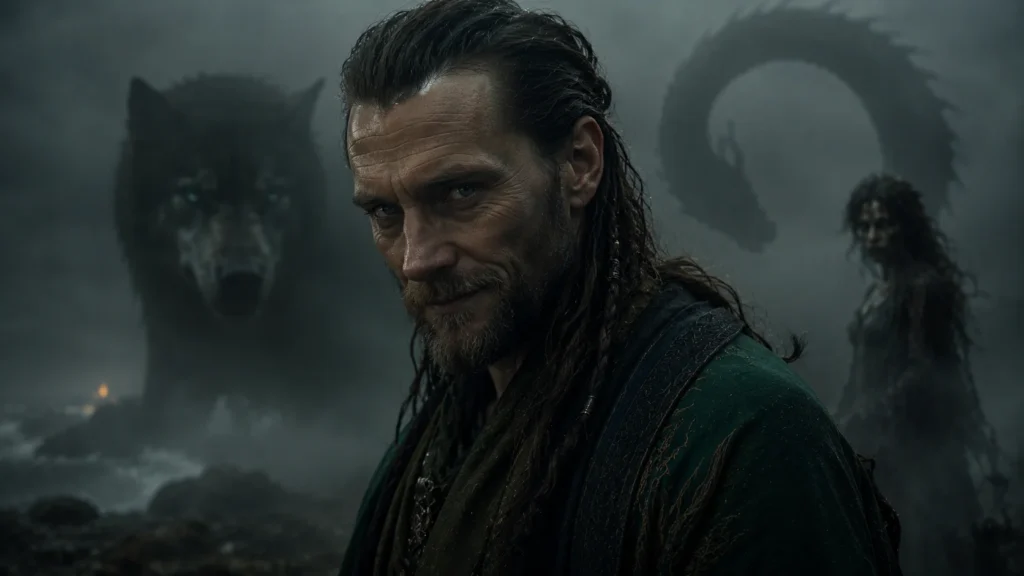
Loki is one of the most difficult figures to classify. Gylfaginning names Fárbauti as his father and Laufey or Nál as his mother, while Lokasenna stanza 9 has Loki remind Odin that they once mixed blood. The sources place Loki in the gods’ company without giving him a simple tribal identity or the modern title “sworn blood-brother.”
He is a shapeshifter and a trickster, responsible for both some of the gods’ greatest treasures and their greatest catastrophes. He engineers the death of Baldr. At Ragnarök, he turns fully against the gods, captaining the ship of the dead and dying in mutual combat with Heimdall.
For the full portrait of this contradictory figure, see our article on Loki, the god of chaos and trickery.
The Children of Loki
In Gylfaginning, Loki and Angrboða have three children who become central to Ragnarök: Fenrir, the wolf who will kill Odin; Jörmungandr, the World Serpent whom Thor kills before dying from its venom; and Hel, whom Odin appoints over many of the dead. These roles come from Snorri’s synthesis and should not be expanded into physical descriptions the source does not give.
Hel, Ruler of the Dead
Hel is Loki’s daughter and, in Snorri’s account, is appointed by Odin over those who die of sickness or old age. Snorri describes her as half flesh-coloured and half blue-black, with a grim appearance; “half beautiful woman, half corpse” is a later visual simplification. In the Baldr narrative, she agrees to release him only if all things weep for him.
The Primordial and Cosmic Beings
Beyond the two tribes, the Norse cosmos is populated by primordial beings who predate or stand outside the gods.
Ymir, the First Being
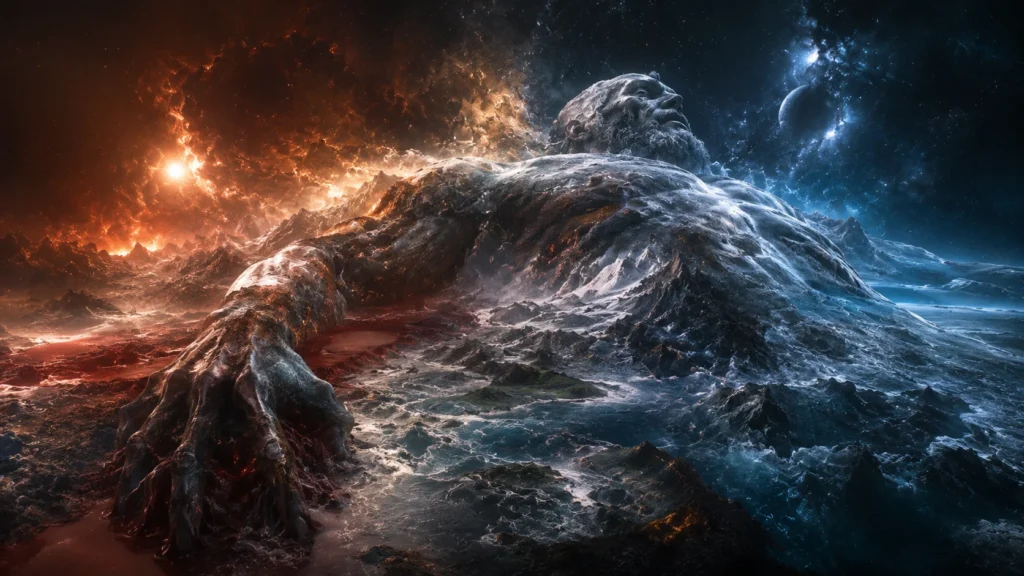
Ymir is the primordial giant from whose body the cosmos was made. Born from the meeting of fire and ice in the void of Ginnungagap, Ymir was slain by Odin and his brothers Vili and Vé. From his flesh they made the earth, from his blood the seas, from his bones the mountains, from his skull the sky, and from his brains the clouds. The entire physical world is, in the Norse imagination, the body of a murdered giant.
Búri and Borr, the First Gods
Búri is the first god, formed when the primordial cow Auðumbla licked the salty ice. His son Borr married the giantess Bestla, and their sons were Odin, Vili, and Vé, the gods who created the world. This lineage links the gods directly to the primordial origins of the cosmos.
Sól and Máni, Sun and Moon
Sól and Máni personify the sun and moon in Snorri’s account and travel across the sky while wolves pursue them. The surviving poems and Snorri do not agree perfectly on the wolves’ names, targets, or genealogy, so the familiar statement that Sköll and Hati are simply “Fenrir’s two sons” is more definite than the evidence allows.
The Norns, Shapers of Fate
The Norns are not gods in the ordinary sense. Völuspá names Urðr, Verðandi, and Skuld and says they establish laws and choose lives; Snorri places them by Urðarbrunnr beneath Yggdrasil. “Weaving fate” is familiar modern imagery, but the core Norse verbs concern shaping, allotting, choosing, and carving rather than one complete woven system. See our evidence-led guides to the Norns and wyrd and Old English fate.
The Valkyries
The Valkyries are female figures who choose which warriors die in battle and which are brought to Valhalla, Odin’s hall of the slain. They are not goddesses in the strict sense, but they serve Odin and operate within the cosmic structure of fate. Their true role is far more complex than the winged warrior maidens of popular imagination, as we explore in our article on the Valkyries and their true role.
Are the Norse Gods Immortal? What the Sources Actually Say
The Norse gods are extraordinarily powerful and long-lived, but the myths do not make them incapable of death. Baldr dies before Ragnarök, and the final battle kills Odin, Thor, Freyr, Heimdall, Loki, and other major figures. Iðunn’s apples preserve the gods’ youth in Skáldskaparmál; they are not called a guarantee that no god can ever be killed.
That does not make the Æsir merely “mortal like humans,” nor is mortality wholly unique among world mythologies. The accurate contrast is narrower: death and cosmic destruction are built into the surviving Norse narratives in a way that profoundly shapes them.
Völuspá prophesies the catastrophe, and Snorri says Odin gathers the battle-dead because the gods will need fighters when the wolf comes. This supports Odin’s preparation for Ragnarök. It does not prove that every god possesses the same knowledge or spends every myth consciously marching toward a known death.
Modern readers often find dignity in gods who resist disaster despite prophecy. That is a legitimate interpretation of the stories, but it should be labelled as interpretation rather than presented as “the highest virtue” of all historical Norse people.
For the sequence of sources behind creation, Baldr’s death, Ragnarök, and renewal, our complete Norse mythology timeline maps the events and identifies where the surviving accounts differ.
Norse God Names: Old Norse and English Spellings
The same deity may appear under an Old Norse spelling, a simplified English spelling, or a familiar anglicized form. These variants normally identify the same figure; they are not separate gods. This guide retains diacritics where they clarify the source form while using common English names where readers are most likely to recognize them.
| Normalized Old Norse | Common English form | Search variant |
|---|---|---|
| Óðinn | Odin | Odin |
| Þórr | Thor | Thor |
| Týr | Tyr | Tyr |
| Njörðr | Njord | Njord / Njörðr |
| Freyja | Freyja | Freya |
| Skaði | Skadi | Skadi |
| Heimdallr | Heimdall | Heimdall |
| Höðr | Hod | Hodr |
Older English books may also write Aesir for Æsir, Asynjur for Ásynjur, and Jotun for jötunn. Search spelling should never be used to manufacture a different identity or a false “original Viking name.”
The Sources: How We Know the Norse Gods
No single source gives us “the Norse pantheon.” The evidence is a layered record: eddic and skaldic poetry, Snorri’s medieval prose, other sagas and chronicles, runic inscriptions, images, objects, and place names. Each answers a different kind of question.
The Poetic Edda preserves mythological poems mainly through the thirteenth-century Codex Regius. Some poetic material is older than the manuscript, but individual poems cannot all be dated with the same confidence. Völuspá, Grímnismál, Lokasenna, and other poems sometimes preserve details that do not fit Snorri’s later synthesis perfectly.
Snorri Sturluson’s Gylfaginning offers the most extensive continuous medieval account and its clearest catalogue of gods and goddesses. His Skáldskaparmál preserves myths and divine names needed to understand poetic diction. Both are indispensable—and both are works by a Christian Icelandic author writing after conversion.
The Swedish History Museum emphasizes that written accounts were recorded after the Viking Age and must be read beside archaeology and place names. Thor’s-hammer amulets, mythological images, and names such as Torsåker or Odensala can support the historical importance of particular gods, but an object or place name rarely proves every story later told about that deity.
Divine elements also occur in personal names, but their interpretation requires linguistic care. A name containing Þór-, Freyr, or Ing- may preserve a divine association; it is not automatically a miniature myth or a literal statement about the person. Our guide to Viking names and their meanings separates attested forms from modern invention.
Primary editions and museum resources
- Snorri Sturluson, Edda: Prologue and Gylfaginning, ed. Anthony Faulkes, Viking Society for Northern Research
- Snorri Sturluson, Edda: Skáldskaparmál, ed. Anthony Faulkes, Viking Society for Northern Research
- Völuspá, normalized Old Norse text
- Swedish History Museum, “Sources for Norse mythology”
- National Museum of Denmark, “The old religion”
Frequently Asked Questions
How many Norse gods are there?
There is no canonical total. Gylfaginning counts twelve Æsir in one passage without including Odin, then treats Loki separately and gives another list of Ásynjur. Other poems and prose sources add further names. The answer changes depending on whether you count only named Æsir and Vanir or also goddesses, personified powers, jötnar allied with the gods, Norns, and Valkyries.
Who is the most powerful Norse god?
The sources do not provide one universal ranking. Odin is chief of the Æsir and excels in knowledge and magic, while Gylfaginning calls Thor the strongest of gods and humans. Týr, Freyja, Heimdall, and others possess different forms of power. “Most powerful” therefore depends on whether the question means authority, physical strength, knowledge, magic, or destiny.
What is the difference between the Aesir and the Vanir?
The Æsir and Vanir are two divine groupings in the Old Norse sources. Odin, Thor, Frigg, Týr, and Baldr belong with the Æsir; Njörðr, Freyr, and Freyja are the clearest Vanir. Modern summaries contrast Æsir order and warfare with Vanir fertility and wealth, but the sources do not make that a rigid rule. They also preserve differing details about conflict, truce, and hostage exchange.
Who are the main Norse goddesses?
The best-known Norse goddesses include Frigg, Freyja, Iðunn, Sif, Skaði, and Nanna. Snorri also lists Sága, Eir, Gefjon, Fulla, Sjöfn, Lofn, Vár, Vör, Syn, Hlín, Snotra, and Gná. Evidence is uneven: Frigg and Freyja appear across several texts, while some names survive mainly in one short catalogue.
Are the Norse gods immortal?
They are not incapable of death. Baldr dies before Ragnarök, and several major figures die in the final battle. Iðunn’s apples preserve the gods’ youth in Skáldskaparmál, but the source does not call them a guarantee of immortality. The gods are extraordinarily powerful and long-lived, yet the myths allow them to be killed.
Is Loki a god?
Loki’s status is difficult to reduce to one label. Gylfaginning gives him jötunn ancestry, while Lokasenna says that Loki and Odin once mixed blood. He travels and feasts with the gods and is sometimes counted in their company, but the sources do not give him a simple identity as either an Æsir god or an external enemy.
What happens to the Norse gods at Ragnarök?
Völuspá and Snorri describe the deaths of major figures: Odin is killed by the wolf, Thor kills the Midgard Serpent and then falls, Freyr fights Surtr, and Heimdall and Loki kill one another. The world is renewed afterward. Víðarr and Váli survive, Móði and Magni inherit Mjolnir, and Baldr and Höðr return.
What are the names of the main Norse gods and goddesses?
The major names include Odin, Thor, Frigg, Baldr, Týr, Heimdall, Njörðr, Freyr, Freyja, and Iðunn. Other important figures include Bragi, Höðr, Víðarr, Váli, Forseti, Hœnir, Ullr, Hermóðr, Sif, Skaði, Nanna, Loki, and Hel. No surviving source presents one final official roster.
The Norse Gods: What the Evidence Leaves Us
The surviving poems, prose narratives, names, and objects do not preserve one seamless Norse pantheon. They preserve powerful figures who can fail, grieve, betray, endure, and die—often in stories that differ from one source to another.
A modern reader may find dignity in gods who confront loss without a guaranteed victory. That is an interpretation, not a doctrine stated by every medieval text. The evidence is strongest when each story is attributed to its source and the gaps remain visible.
There is therefore no honest exact total of “all Norse gods.” The answer changes with the definition: named Æsir and Vanir, Ásynjur, jötnar who join the gods, personified powers, Norns, Valkyries, or every divine name preserved in poetry.
Our album GUÐS STRÍÐ (Gods of War), sung in Old Norse, is a modern artistic response to these myths—not a reconstruction of Viking Age performance. Listen alongside the sourced guide and explore the full catalog.
Music to read by
Each article has a soundtrack. Listen to Mythic Harmonies while you read.
Explore the music