
Surtr in Norse Mythology: Fire Giant, Sword and Ragnarök
Surtr in Norse mythology is the fire giant who fights Freyr and burns the world at Ragnarök in Snorri Sturluson’s account. His name means “the black one”. He comes from the south with a brilliant sword, but the medieval texts leave his origins, the name of his weapon and his eventual fate unresolved.
That combination makes him compelling: his part in the catastrophe is enormous, yet his surviving story is surprisingly spare. To understand Surtr, we need both the dramatic account of the last battle and the differences between the sources. This guide follows the story, then examines the sword, Sinmara, the Icelandic cave associated with him and the questions the Eddas cannot settle.
Surtr at a glance
- Names: Surtr in Old Norse; Surt in many English translations; Surtur in modern Icelandic and some adaptations.
- Usual description: a fire giant, associated with the enemies of the gods. The medieval classification is less uniform than modern character lists suggest.
- Realm: the frontier of Múspell or Múspellsheimr in Snorri’s cosmology.
- Weapon: a flaming, radiantly bright sword with no securely attested proper name.
- Opponent: Freyr. Snorri says Freyr falls in their encounter.
- Final act: burning the world. No clear death scene identifies Surtr’s killer.
Who is Surtr? His name, nature and appearance
What does Surtr mean?
The name is usually translated as “the black one” or “the swarthy one”. The edited Norwegian encyclopedia Store norske leksikon gives this meaning. Surt, Surtr and Surtur therefore need not indicate three different beings when you encounter them in books or searches. They reflect different linguistic forms and editorial conventions.
The meaning of a name is not a complete physical description. It does not establish a particular skin tone, a body made of lava or an appearance covered in soot. Those can be artistic interpretations, but the core passages concentrate on his fire, his sword and his approach to battle. They give no reliable height, detailed face, armour design or distinctive horned crown.
Is he a giant or a god of fire?
“Fire giant” is a practical description, with a basis in the wider medieval tradition. It should not be turned into a precisely defined species with a documented royal family. Anthony Faulkes’s scholarly index notes that Surtr is included among giants in Skáldskaparmál, while his nature is not specified in the relevant Gylfaginning narrative. Faulkes, Edda: Prologue and Gylfaginning, index, p. 176.
Calling him the Norse “god of fire” can mislead readers looking for a deity’s established place in the pantheon. His main narrative role is as an opponent of the gods at the world’s end. Nor should “giant” be treated as a measurement: a jötunn belongs to a mythological category, and the word does not supply a height in metres.
Muspell: where Surtr waits before Ragnarök
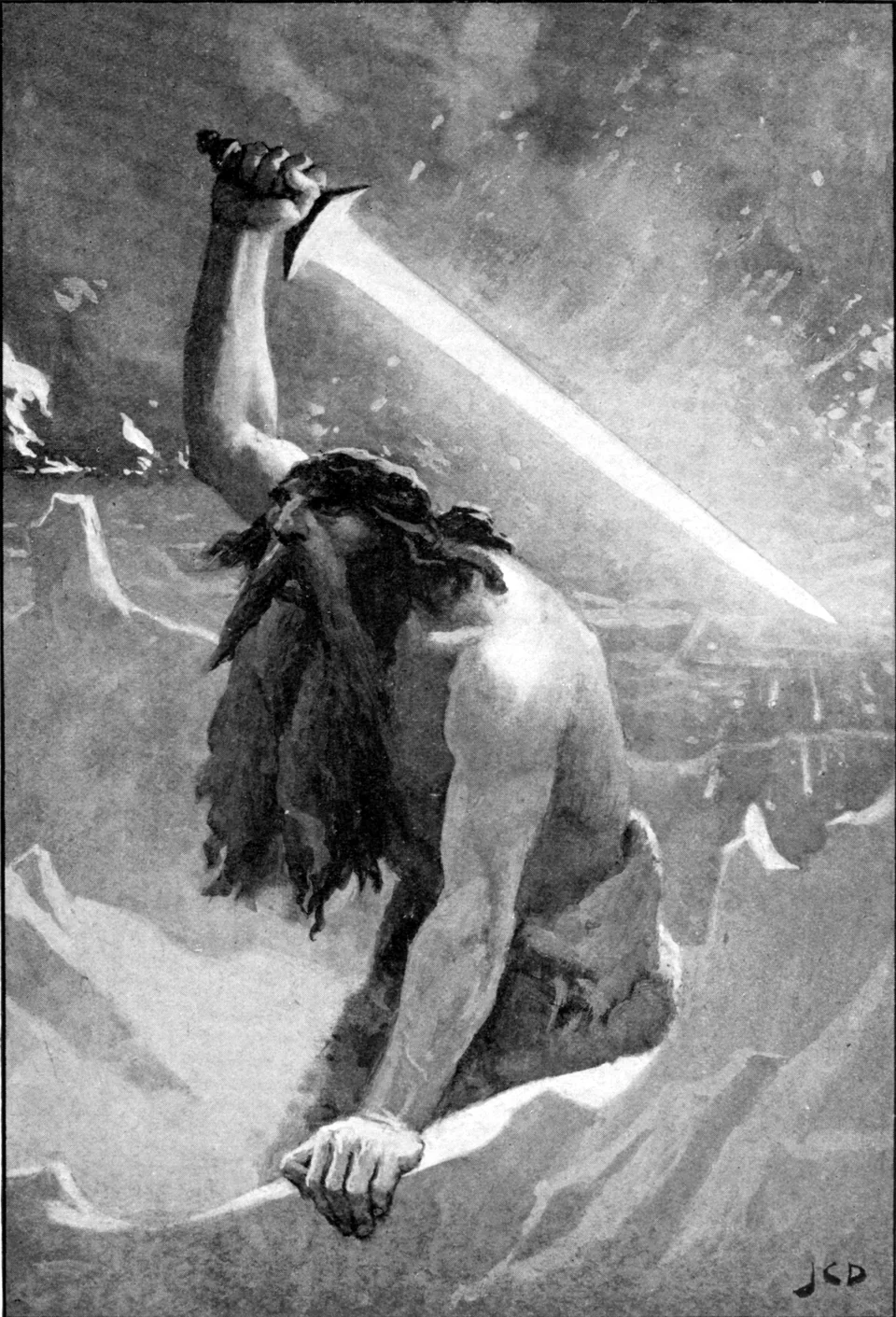
In Gylfaginning 4, Snorri describes a southern region of overwhelming heat and brightness called Múspell. Outsiders cannot enter it safely. Surtr occupies its boundary, defending it with a flaming sword. The account immediately looks ahead to the day when he will leave that position and bring destruction. His introduction therefore connects the earliest cosmology with the final catastrophe.
The next stage of Snorri’s creation story places heat from Múspellsheimr opposite the cold of Niflheim in Ginnungagap. Life emerges as the heat melts the rime. Later, sparks from the fiery region help furnish the lights of the heavens. Fire belongs to the making of the world as well as its destruction, although the text does not make Surtr personally responsible for every creative effect of that heat. Gylfaginning 4–8, translated by Arthur Gilchrist Brodeur.
This is why he is often called a primordial figure. Snorri introduces him within his account of the world before its familiar order is established. It is not a birth story. No passage here explains who created Surtr or makes him Ymir’s brother. An early position in a narrative cannot supply a missing genealogy.
“Ruler of Muspelheim” is not entirely a modern invention: the Uppsala manuscript explicitly makes him rule there. Other presentations emphasise his frontier guardianship. The distinction is worth retaining rather than expanding it into an unsupported kingdom of named fire giants. The Uppsala Edda, edited by Heimir Pálsson and translated by Anthony Faulkes, p. 15, preserves that wording. For the broader cosmology, see our guide to Yggdrasil and the Norse worlds.
Surtr at Ragnarök: the story in sequence
The clearest continuous narrative comes from Gylfaginning 51. The following sequence follows Snorri; it should not be mistaken for a single account reproduced identically in every Eddic poem.
1. The world’s defences fail
The crisis is already underway before Surtr arrives. Winters and human violence precede the loosening of bonds, the escape of Fenrir and the emergence of the Midgard serpent. The sky then splits, and the sons of Múspell ride out. Surtr leads them, with fire before and behind him and a sword whose radiance exceeds the sun’s.
When the host crosses Bifröst, the bridge breaks. This is not a private duel between Surtr and its guardian: the destruction of the crossing belongs to the advance of Múspell’s forces. Snorri had already anticipated the bridge’s failure in chapter 13, showing that even the gods’ workmanship cannot secure the world indefinitely.
2. Múspell’s host joins the battlefield
The forces gather on Vígríðr. Snorri distinguishes Múspell’s bright company from other enemies present there, rather than describing every opponent as one interchangeable army. Odin faces Fenrir; Thor is occupied with Jörmungandr; Freyr meets Surtr. This separation matters when modern summaries give Surtr the deeds of other combatants.
3. Freyr falls, then Surtr burns the world
Freyr and Surtr have a hard fight, and Freyr falls. Snorri connects that outcome to the absence of Freyr’s former sword. After recounting the other great confrontations, he describes Surtr casting fire over the earth. The disaster extends beyond a burning fortress or the destruction of Asgard alone: the prose account presents a world-consuming conflagration.
That is the central arc: the frontier guardian advances, the defences fail, Freyr falls, and the world burns. Snorri supplies no speech explaining Surtr’s motive and no detailed choreography of his duel. Those omissions leave room for modern storytelling, but they are not gaps a historical guide should fill with invented scenes. Gylfaginning 13 and 51. Our complete Ragnarök guide follows the wider catastrophe and its survivors.
Why does Freyr lose to Surtr?
The missing sword links Ragnarök to an earlier story about Freyr and Gerðr. In Gylfaginning 37, Freyr becomes consumed by his desire for her and sends his servant Skírnir to secure a meeting. Skírnir asks for Freyr’s remarkable sword as the condition of undertaking the errand. Freyr agrees. The weapon goes to the messenger; saying simply that Freyr gives it to Gerðr obscures the exchange described here.
The loss first becomes relevant when Freyr fights Beli. He kills that opponent with a stag’s antler, and the narrator explains that this was still a manageable encounter. The greater consequence will come when Múspell’s forces advance. Chapter 51 completes that connection by making the missing sword the reason for Freyr’s fall against Surtr.
The antler belongs securely to the Beli episode. Snorri does not explicitly state that Freyr carries it into the final fight with Surtr. Illustrations and retellings often carry the weapon over from one encounter to the other, but the source does not give us that detail. Nor does it say that Freyr kills Surtr before dying himself. Gylfaginning 37 and 51.
The name “Beli’s slayer” in Völuspá refers to Freyr, so readers need that earlier episode to recognise the combatant. Freyr is also distinct from his sister Freyja; their similar names can cause confusion in summaries. Our guide to the Norse gods and goddesses places them in the wider pantheon.
Surtr’s flaming sword: what is it called?
The relevant Eddic passages give Surtr’s sword no secure proper name. Its outstanding quality is brightness. In the familiar reading of Völuspá, solar light is associated with the sword as Surtr approaches from the south. Snorri makes the image especially clear: the sword shines more brightly than the sun. That description supports a brilliant weapon, not a catalogue of named powers.
Surtalogi describes fire, not a securely named blade
The word surtalogi appears in Vafþrúðnismál 50–51 in a question about what remains after the final fire subsides. It is commonly translated as Surtr’s flame. Kees Samplonius argues for a reading meaning dark flame instead, based on the compound’s form and comparative material. Whatever position one takes in that debate, the passage concerns the blaze and its aftermath; it does not introduce Surtalogi as the sword’s proper name. Samplonius, “The Background and Scope of Völuspá”, pp. 121–124.
Is it Freyr’s sword or Lævateinn?
The surviving narrative does not trace Freyr’s sword from Skírnir into Surtr’s possession. It also does not straightforwardly name Surtr’s weapon Lævateinn. These are questions of reconstruction, not settled identifications. Edward Pettit explores connections among solar imagery, Freyr and mythological weapons in The Waning Sword, chapter 9. Such arguments deserve to be read as scholarship proposing relationships, rather than as a lost scene recovered word for word.
For a reader who simply wants the myth, the distinction is straightforward: Freyr has lost his excellent sword; Surtr arrives with a brilliant one. The texts do not securely explain whether those facts conceal a further connection. Claims of certainty in either direction go beyond the evidence.
Does Surtr die, and what survives his fire?
No named killer of Surtr is supplied in the central battle accounts. Freyr’s death is stated in Snorri, but a matching death for Surtr is not. Silence does not establish that he is immortal, and the extinguishing of a fire does not automatically describe the death of the figure associated with it.
The destruction is not the end of everything the texts have to tell. Völuspá describes earth rising green from the sea and a renewed divine world. Vafþrúðnismál 50–51 names Víðarr and Váli among the gods who remain, and Móði and Magni as the inheritors of Thor’s hammer. These passages give the catastrophe an aftermath without explaining Surtr’s personal destination. Bellows’s Völuspá, the renewal passages; Vafþrúðnismál 50–51.
Snorri also tells of the human survivors Líf and Lífþrasir sheltering in Hoddmímis holt and of the earth becoming green again. This makes “Surtr kills absolutely everyone” an inaccurate summary. The narrative combines overwhelming destruction with survival and return. It never supplies the simple post-battle biography that a modern character profile might lead us to expect. Gylfaginning 53.
Sinmara and Surtr’s family: how much is known?
Sinmara is often presented as Surtr’s wife, sometimes with an elaborate story built around the relationship. The textual basis is much narrower. The difficult poem Fjölsvinnsmál associates the names, but its wording and the relationship are uncertain. In his commentary, Pettit considers Sinmara possibly Surtr’s wife or daughter. That is a range of scholarly possibilities, not a confirmed marriage. Pettit, Svipdagsmál, commentary on Fjölsvinnsmál, note 91.
The main Ragnarök accounts provide no secure parents or children for Surtr. They do not make him Loki’s son or Ymir’s half-brother. Being present on the same side of a final battle does not imply kinship. Similarly, the phrase “sons of Múspell” should not silently become “Surtr’s biological sons”: Snorri describes a company of beings and their leader, not a family register.
Surtshellir, Surtsey and the question of worship
What the cave evidence actually shows
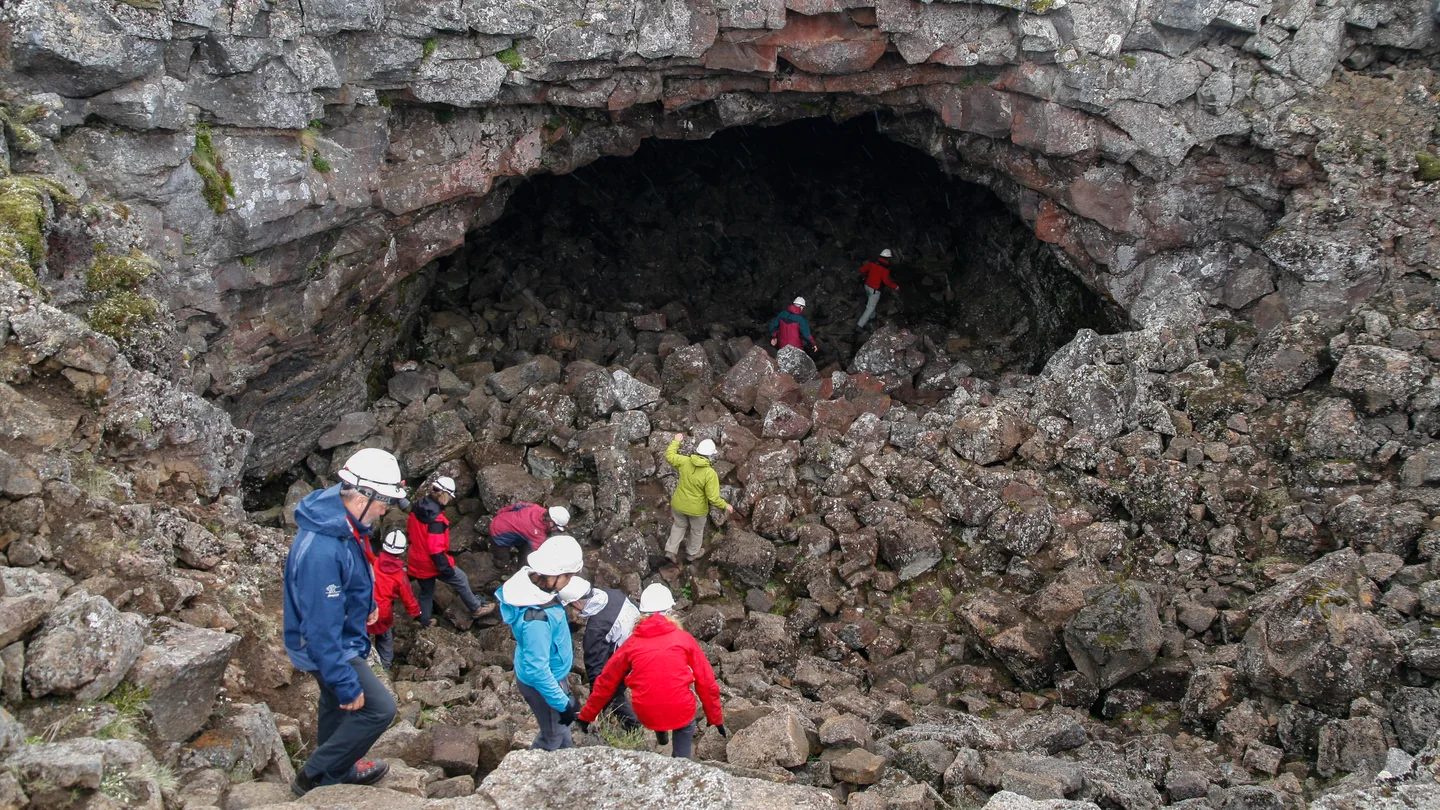
Surtshellir is an Icelandic lava cave with a substantial Viking Age archaeological site deep inside it. A 2021 study by Kevin P. Smith, Guðmundur Ólafsson and Albína Hulda Pálsdóttir combines radiocarbon dating, volcanic dating evidence and medieval texts. It identifies repeated deposits of domestic animal bones, including burning in a stone structure, over approximately 80–120 years. The activity ended shortly after Iceland’s conversion to Christianity.
The authors interpret the site through ritual responses to catastrophic volcanism and medieval associations with Surtr. This is stronger evidence than a suggestive place-name alone. It is still not a written record of participants explaining whom they addressed or exactly what each act meant. Ritual activity, an association with Surtr and proof of a widespread Surtr cult are three different claims. Smith, Ólafsson and Pálsdóttir, Journal of Archaeological Science 126 (2021), article 105316.
Did Iceland’s volcanoes create the myth?
The landscape offers a striking setting in which fire and the destruction of inhabited land could acquire mythological meaning. It does not, by itself, date the first story about Surtr or prove that one particular eruption generated it. Archaeology can document activity in a cave; a claim about the ultimate origin of a myth requires a different argument. The two questions should remain distinct.
A much later connection is explicit. Surtsey, the volcanic island that emerged off Iceland in 1963, was named after Surt. Iceland’s World Heritage nomination explains the name as Surt’s island. This is a documented modern act of naming, not evidence that the island was known to Viking Age people. Surtsey World Heritage nomination report (2007); Surtsey Research Society, eruption history.
Is Surtr evil? How interpretation differs from evidence
Within the last-battle story, Surtr is an adversary of the gods and an agent of destruction. Calling him a villain captures that narrative opposition, but it does not explain a personal moral philosophy: the passages do not give him a confession of hatred, a revenge story or a programme for ruling the next world. Conversely, declaring him wholly benevolent or morally neutral is also an interpretation.
The relationship between Norse world-fire and Christian apocalypse remains a scholarly question. Samplonius argues for significant Christian influence and relates Surtr to the language of dark fire. That argument should be identified as an argument, not used to announce that scholars have proved Surtr was simply borrowed from Christianity. Our evidence survives through medieval texts, and their cultural setting matters when reconstructing earlier beliefs. Samplonius, “The Background and Scope of Völuspá”.
For modern readers encountering Surtur through Marvel, or Surtr through a game, the safest comparison is to return to the documented core: southern fire, a brilliant sword, Freyr’s fall and the final conflagration. A screen character’s dialogue, appearance or family history needs its own source. An adaptation can be imaginative and effective without functioning as evidence for medieval religion.
Where to read about Surtr in the Eddas
The Eddas are not one continuous book with a single narrator. Poetry, prose explanation and later editorial decisions need to be distinguished. These passages provide a focused reading route:
- Völuspá: Surtr’s southern approach, the confrontation with Beli’s slayer, then cosmic destruction and renewal. Read the surrounding stanzas, not just the line mentioning his sword.
- Vafþrúðnismál 17–18: the battlefield Vígríðr; 50–51: the final fire and divine survivors. The immense dimensions belong to the field, not to Surtr’s body.
- Fáfnismál 14–15: Óskópnir is named in a comparable question about the gods’ final battle; the passage also mentions the breaking bridge. It should not be silently merged into a literal map of Vígríðr.
- Gylfaginning 4, 13, 37 and 51–53: Muspell, Bifröst, Freyr’s sword and the fullest continuous account of the catastrophe and its aftermath.
- Fjölsvinnsmál: the difficult evidence behind the association with Sinmara; consult editorial notes before constructing a family tree.
For the poems, Edward Pettit’s The Poetic Edda: A Dual-Language Edition (2023) provides Old Norse, translation and commentary together. A practical warning: Surtr’s arrival is stanza 51 in Pettit’s Codex Regius text, but stanza 52 in Bellows and other editions. A different number is not necessarily a different event. Bellows’s Fáfnismál also makes the Óskópnir passage readily accessible.
Frequently asked questions
Who is Surtr in Norse mythology?
Surtr is the fiery adversary who leads Múspell’s forces at Ragnarök. In Snorri’s account he fights Freyr, defeats him and sets the world ablaze.
What does the name Surtr mean?
The Old Norse name is generally translated as “the black one”. Surt is common in English translations; Surtur is the modern Icelandic form and appears in some adaptations.
Is Surtr a giant or a god?
Fire giant is a useful description, supported by his inclusion among giants in the wider tradition. The main story does not give him a uniform formal classification. Calling him the Norse god of fire can be misleading.
What is Surtr’s sword called?
The relevant Eddic passages do not give it a secure proper name. Surtalogi refers to a final fire, not a clearly named blade. Connections with Freyr’s sword or Lævateinn are debated reconstructions.
Who kills Surtr at Ragnarök?
The central accounts name no killer of Surtr. They describe Freyr’s fall and the burning of the world, but do not settle Surtr’s eventual fate.
Does Freyr fight Surtr with an antler?
Freyr explicitly kills Beli with an antler in Gylfaginning 37. The text does not explicitly give him that weapon in his later fight against Surtr.
Is Sinmara Surtr’s wife?
She is sometimes interpreted that way, but the difficult evidence in Fjölsvinnsmál does not establish a secure marriage. Pettit considers her possibly his wife or daughter.
Is Surtr related to Loki or Ymir?
The cited Eddic accounts do not establish Surtr as Loki’s son or Ymir’s brother. Shared opposition to the gods does not prove a family relationship.
Did Vikings worship Surtr?
Surtshellir provides archaeological evidence interpreted as ritual activity, alongside medieval associations with Surtr. That supports serious discussion of ritual responses to him, but does not establish a widespread cult or preserve participants’ exact beliefs.
Does Thor fight Surtr in the original myth?
In Snorri’s Ragnarök narrative, Freyr fights Surtr while Thor fights Jörmungandr. Modern adaptations may rearrange those encounters.
Sources and editorial notes
This guide was checked against medieval passages and scholarly editions on 27 September 2026. It distinguishes the story as told by Snorri from the shorter poetic attestations and from modern reconstruction. Chapter numbers for Gylfaginning follow the conventional arrangement used by Brodeur and Faulkes; the Uppsala manuscript has its own arrangement.
- Snorri Sturluson: Gylfaginning, Arthur Gilchrist Brodeur’s public-domain English translation (1916), cross-checked with Anthony Faulkes’s scholarly edition, Edda: Prologue and Gylfaginning (second edition, 2005).
- Heimir Pálsson, editor; Anthony Faulkes, translator: The Uppsala Edda (Viking Society for Northern Research, 2012). Used where its particular wording matters.
- Edward Pettit: The Poetic Edda: A Dual-Language Edition (Open Book Publishers, 2023), especially the notes on Surtr and Sinmara; The Waning Sword (2020), chapter 9, for a scholarly weapon hypothesis.
- Henry Adams Bellows: The Poetic Edda (1923), public-domain translations of the cited poems. Older notes are not treated as the last word in scholarship.
- Kevin P. Smith, Guðmundur Ólafsson and Albína Hulda Pálsdóttir: “Ritual responses to catastrophic volcanism in Viking Age Iceland” (2021), DOI 10.1016/j.jas.2020.105316.
- Kees Samplonius: “The Background and Scope of Völuspá”, in The Nordic Apocalypse (2013), pp. 113–145. Cited as an interpretation, not a settled consensus.
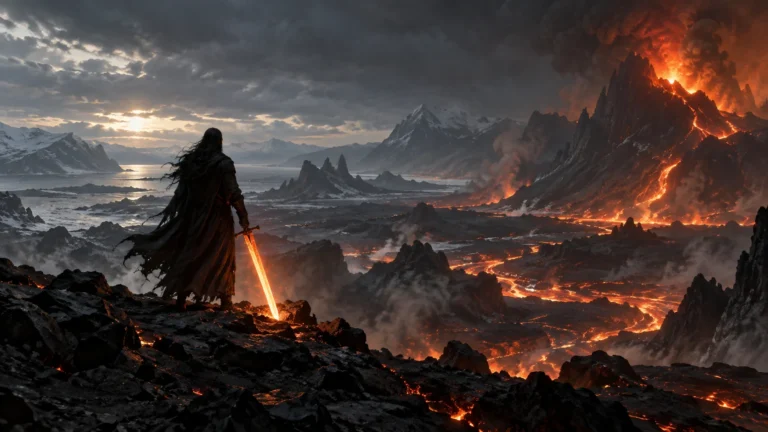
The featured image is contemporary artistic interpretation, not a reconstruction of a medieval portrait. Mythic Harmonies also explores the story through Surtr’s Flame: Fire of Ragnarök. The song and its imagery are creative works; the guide above explains the sources behind the myth.
Music to read by
Each article has a soundtrack. Listen to Mythic Harmonies while you read.
Explore the music