
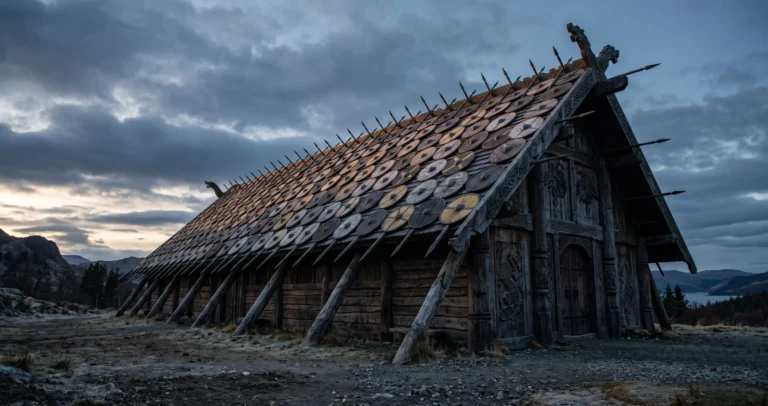
Valhalla: What It Actually Means in Norse Mythology
- Valhalla means “hall of the slain”, from the Old Norse valhǫll: valr, the war-dead, and hǫll, a hall. Some scholars have argued the second element was originally a word for rock, which would make the oldest Valhalla a place of stone rather than a building.
- It was never everyone’s afterlife. Half the battle-dead go to Freyja, not Odin. Everyone who dies of sickness or age goes to Hel. Valhalla is the exception, not the rule.
- “Til Valhalla” is modern. The phrase does not appear in any Old Norse source. It reached the American military from a Norwegian unit in Afghanistan, and it now carries a meaning of its own.
Valhalla means the hall of the slain.
That is the short answer, and every dictionary gives it. The Old Norse is valhǫll, built from valr, meaning those killed in battle, and hǫll, a hall. The same val- appears in valkyrja, the valkyrie: the one who chooses the slain.
In Norse mythology, Valhalla is Odin’s hall for warriors chosen from the battle-dead. The valkyries select them, and the warriors, called einherjar, train there for Ragnarök. Not every Viking who died in battle went there: half of the slain go to Freyja instead.
Now the longer answer, which is stranger.
The building described in the sources has a roof made of shields and rafters made of spears. Its benches are strewn with mail instead of straw. A wolf hangs before its western door and an eagle circles above it. It has five hundred and forty doors, and eight hundred men can walk through each one shoulder to shoulder. The dead inside it kill each other every single day and sit down to dinner together every single evening. They drink mead that runs from the udder of a goat standing on the roof, eating the leaves of a tree.
And the god who assembled them all knows exactly how it ends. He is building an army for a battle he has already seen himself lose.
This guide sets out what the sources actually say about Valhalla, where they contradict each other, which parts are late additions, and how a word that meant a heap of corpses became a phrase soldiers now say at funerals.
What the Name Actually Means
Valhǫll is a compound of two words, and the first is not in dispute. Valr means the slain, specifically the dead left on a battlefield. It is an old word, cognate with Old English wæl, slaughter, and it survives in valkyrja, valkyrie, literally the chooser of the slain.
The second element is where it gets interesting.
Read as hǫll, it means hall, and Valhalla is the hall of the slain. That is the standard translation, the one Britannica gives, and it fits every description we have from the thirteenth century.
But a line of scholarship going back to nineteenth century philology has proposed that the second element was originally hallr, a rock or a stone. On that reading, the oldest form of the idea was not a building at all. It was a rock of the slain: a stone, a cairn, a mountainside where the war-dead gathered. In that older picture the valkyries are not cup-bearers in a golden hall but something closer to carrion spirits, and the destination is a field rather than a feast.
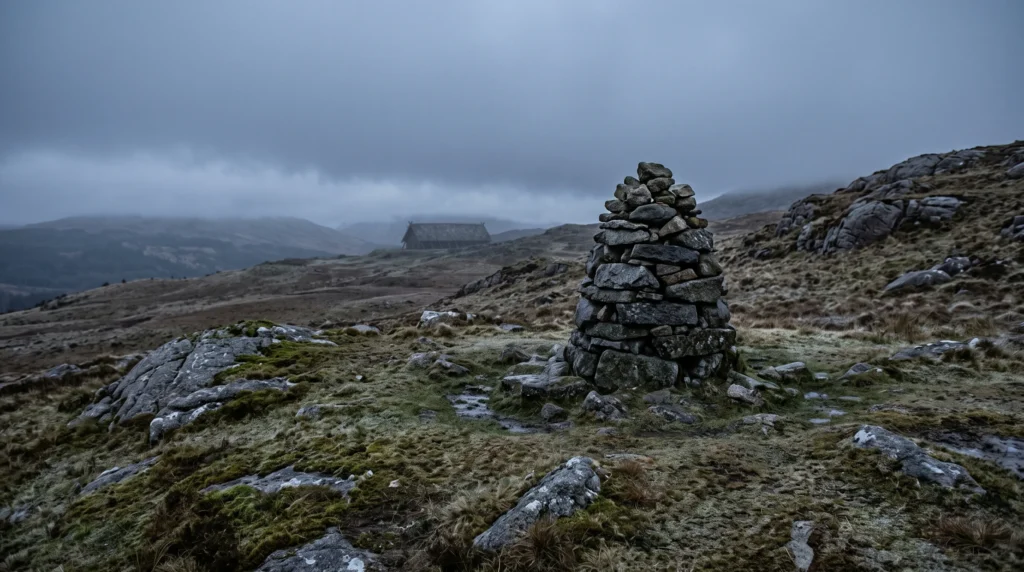
The evidence is not decisive either way, and most modern handbooks keep “hall of the slain”. But it is worth knowing that the most famous afterlife in Norse mythology may have started as a heap of stones, and that the golden hall we picture is the later, more comfortable version of something considerably bleaker.
The Hall Itself
Almost everything we know about the architecture of Valhalla comes from a single poem: Grímnismál, the Song of the Hooded One, in which Odin, disguised and bound between two fires, recites the layout of the cosmos to a boy who has shown him kindness. It survives in the Codex Regius and in a fragment known as AM 748 I 4to, and it was probably composed in the first half of the tenth century, which makes it one of the older pieces of eddic verse we have.
It is a strange source for a description. It is also the best one we have.
The hall stands in Asgard. It is gold-bright. The roof is thatched with shields, the rafters are spear-shafts, and mail-coats lie scattered across the benches where straw would normally be. A wolf hangs before the western door with an eagle above it.
Then the number that everyone remembers:
Five hundred doors and forty more, I think, there are in Valhalla.
Eight hundred fighters go through one door when they march out against the wolf.
Grímnismál, stanza 23, paraphrased
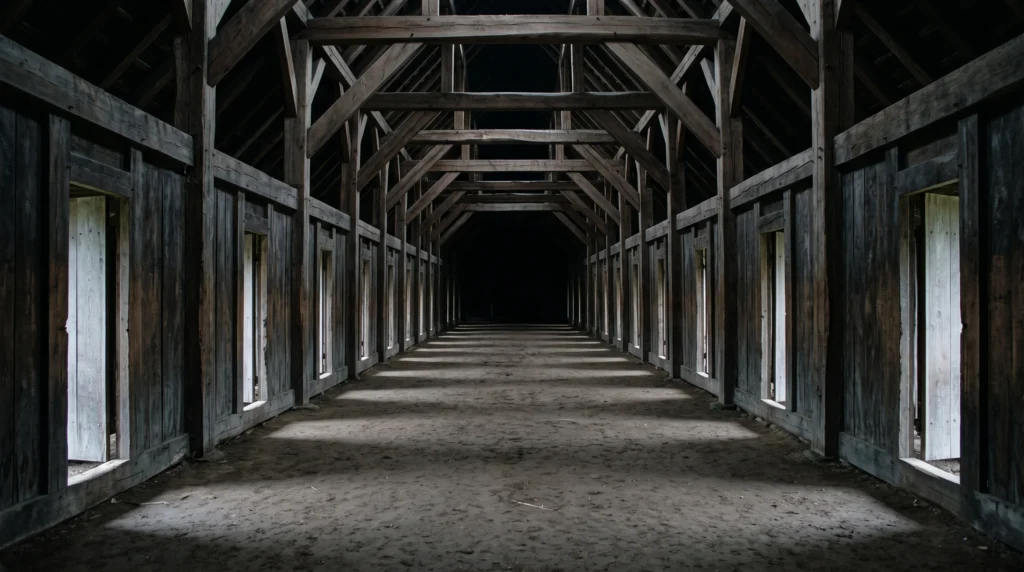
Multiply them and you get 432,000: the size of the army that marches out of Valhalla on the last day.
Nobody thinks that number is a census. It is the kind of figure that appears in cosmological poetry to mean beyond counting, and it has attracted a good deal of attention because 432,000 turns up in unrelated ancient traditions, including the length of a Hindu Kali Yuga cycle in years. Whether that is a shared inheritance, a coincidence, or a modern habit of pattern-hunting is not settled, and this guide is not going to settle it.
What the number does tell you is the scale of what Odin thinks he is preparing for.
The Einherjar
The dead of Valhalla have a name: the einherjar, usually translated as the lone fighters or those who fight alone, in the sense of fighting as one. The singular einheri appears once in the Poetic Edda, in Lokasenna, where Loki throws it at Thor as an insult.
Snorri Sturluson describes their day in Gylfaginning, chapter 41, and it is not a rest.
Every morning they arm themselves, ride out into the courtyard, and fight. They kill each other. Then, when it is time to eat, they get up, ride back to the hall, and sit down together. Whatever wounds they inflicted are gone.
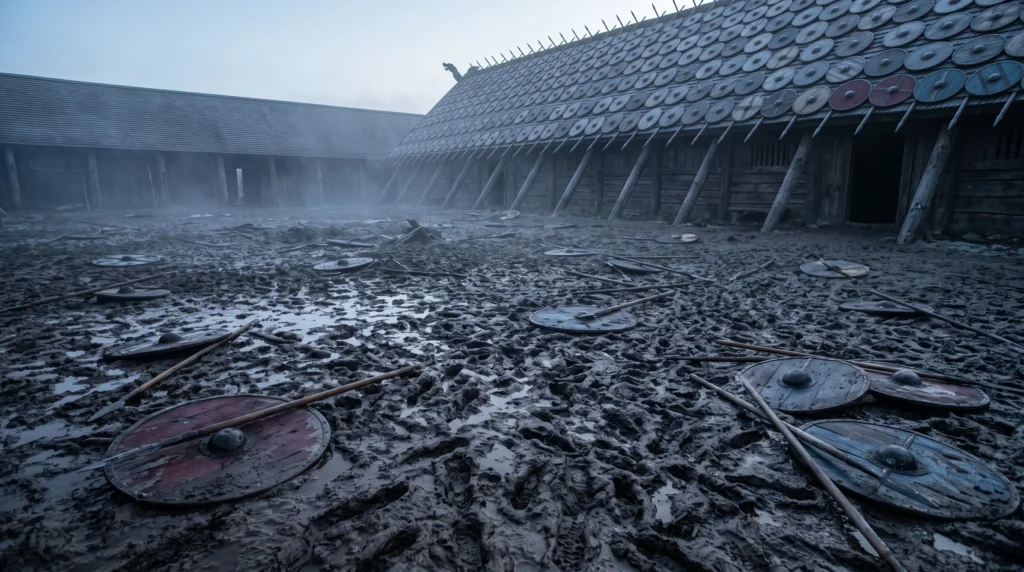
Read it once and it sounds like paradise for a certain kind of person. Read it twice and notice what it actually is: a garrison on permanent exercise, running the same drill every day forever, with the casualties reset overnight. Valhalla is not a reward. It is a barracks.
What They Eat and Drink
The catering of Valhalla is described with more care than almost anything else in Norse cosmology, and every detail of it is a solution to a logistical problem.
The meat. A creature named Sæhrímnir is cooked every day by a figure called Andhrímnir, in a cauldron named Eldhrímnir, and is whole again by the next meal. Three names sharing the same -hrímnir element, which is generally read as sooty: Eldhrímnir comes out as fire-sooty.
And here is a detail almost every retelling flattens. Grímnismál, stanza 18, does not say what Sæhrímnir is. It says only that Andhrímnir cooks it and that few know what the einherjar feed on. Whether the word means boar at all depends on which translator you are reading: Hollander puts a boar in the verse, Bellows and Faulkes do not. The identification as a boar is explicit only in Snorri, in Gylfaginning chapter 38.
The name itself resists it. Modern scholarship commonly reads Sæhrímnir as something closer to sooty sea-beast, which fits a cauldron better than it fits a pig, and which nobody has satisfactorily reconciled with Snorri’s boar. The most famous meal in Norse mythology may not be pork.
The drink. A goat named Heiðrún stands on the roof of the hall, grazing on the branches of a tree the poem calls Læraðr. From her udder runs mead, enough every day to fill a vat large enough for all of them. The next stanza puts a second animal on the same tree: a hart named Eikþyrnir, from whose antlers the drops fall that feed every river in the world.
Læraðr is usually identified with Yggdrasil, the World Tree, and that identification is reasonable but not stated in the poem. It is an inference, and it should be labelled as one.
And Odin eats nothing. Grímnismál is explicit: the food set before him goes to his two wolves, Geri and Freki, and Odin himself lives on wine alone.
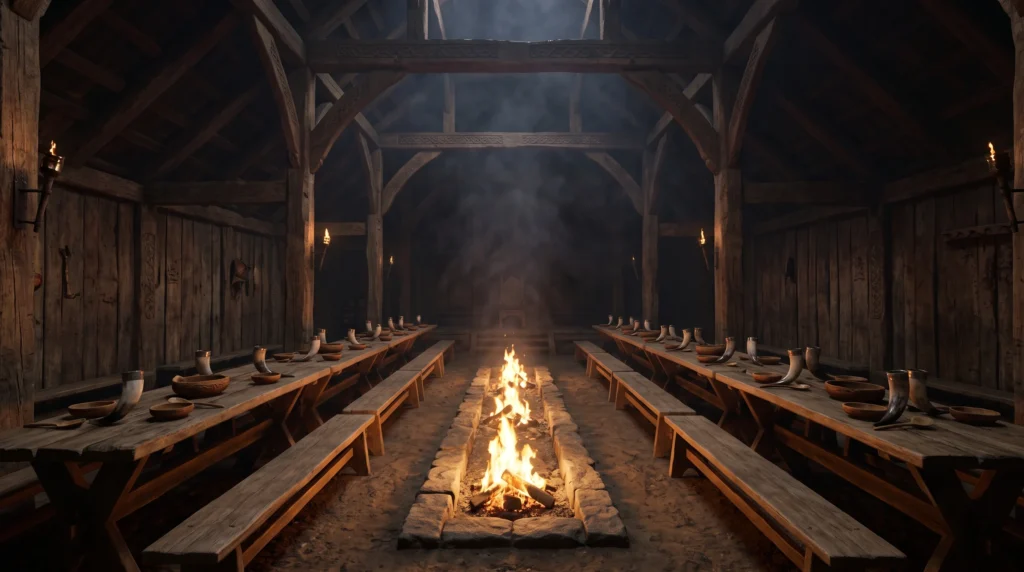
The god who runs an eternal feast does not attend it. That is worth sitting with for a moment. Whatever Odin is doing in Valhalla, enjoying himself is not the main part of it.
Who Actually Gets In
This is where most retellings go wrong, and where the sources are clearer than their reputation suggests.
The valkyries choose. They ride over the battlefield and select. The word says so: valkyrja, chooser of the slain. In Gylfaginning they also serve the ale in the hall, which has led to a soft, cup-bearing image that the older poetry does not support. In skaldic verse they are far closer to birds of prey.
Odin does not get all of them. This is the single most-omitted fact about Valhalla, and it is stated plainly in Grímnismál, stanza 14: Freyja rules Fólkvangr, and every day she chooses half of the slain, while Odin takes the other half. Not a footnote, not a variant. Half. We took the division apart in the guide to Valhalla and Fólkvangr.
And the sword in the hand is not in the sources. You will read everywhere that a Norse warrior had to die with a weapon in his hand to be admitted, and that a sword was pressed into the fingers of the dying for that reason. It is a vivid image. It is not in the Poetic Edda, it is not in Snorri, and it appears to be a modern accretion built on a real thing nearby: the sagas do treat strádauðr, straw death, dying in bed, as an unenviable end for a fighting man. Contempt for a quiet death is attested. The sword in the hand as an entry requirement is not.
Why Odin Is Collecting an Army
Every element above serves one purpose, and Snorri states it directly: Odin gathers the greatest warriors because Ragnarök is coming and he wants the strongest possible army when it does.
That is the whole logic of the hall. The endless boar and the endless mead are not luxuries, they are supply. The daily slaughter in the courtyard is not entertainment, it is training. The 540 doors are wide enough for a mass deployment. Valhalla is a mobilisation.
And then the part that makes it Norse rather than triumphal.
Odin knows how it ends. He is consistently portrayed as the god who has purchased foreknowledge at enormous cost, an eye at Mímir’s well, nine nights hanging on the tree for the runes. What that knowledge bought him is the certainty that the wolf Fenrir will kill him, that the gods will fall, and that the world will burn. He builds the army anyway. The einherjar train every day for a battle their commander has already watched himself lose.
That fatalism is the actual centre of the Valhalla idea, and it is the part that gets stripped out when the hall is turned into a warriors’ heaven. It was never a promise that you would win. It was a promise that you would be there. We set out the sequence of that last day in the guide to Ragnarök, and the god at the centre of it in the guide to Odin.
Valhalla Was Not Everyone’s Afterlife
If you take the sources as they stand, the great majority of Norse people never expected to see Valhalla, and had no particular reason to want to.
Hel receives those who die of sickness and old age, which is almost everybody. Snorri describes the realm without much relish and without much horror either. It is not punishment. It is where you go.
Fólkvangr takes half the battle-dead, as above.
Rán takes the drowned into her net, which in a seafaring culture is not a small category.
And underneath all of it runs something less tidy and probably older: a persistent sense in the sagas that the dead stay near their burial mound, sit in their howes, and remain part of the landscape. That belief shows up in how people were actually buried, which we set out in the guide to Viking funeral rites.
There is a broader caution to add here, and it is the honest state of the field. Almost everything above was written down in Iceland in the thirteenth century, two centuries after the conversion, by Christians recording a religion that had ended. Snorri’s Valhalla is coherent, systematic and detailed, and some of that coherence may be his. Parts are independently supported by older poetry. Parts are not. The safest reading is that he preserved genuine older material and gave it a tidier structure than it ever had in life.
Valhalla as a settled national belief held by every Norse farmer is not something the evidence supports. Valhalla as an aristocratic, martial, poetic ideal, sung by skalds for the kind of men who paid skalds, is much easier to defend.
Til Valhalla: The Modern Life of an Old Word
The phrase “Til Valhalla” appears nowhere in Old Norse literature. No saga ends with it, no skald wrote it, no runestone carries it. It is modern, and its history is short and well documented.
In 2010 the Norwegian newspaper Dagbladet published a video filmed in Afghanistan. In it, Rune Wenneberg, commander of Mechanized Company 4 of the Telemark Battalion, addresses his soldiers before an operation: you are the hunters, you are the predators, the Taliban is now the prey. To Valhalla. The men answer with a shout, Til Valhall, and the footage travelled.
It is worth adding what usually gets left out. In Norway the video did not read as inspiring. It set off a national argument about Viking rhetoric and symbolism among Norwegian troops, running alongside a separate controversy over soldiers painting a comic-book skull on Afghan property. The phrase that American veterans would later adopt as a tribute was, at home, a subject of public unease.
From there it changed. Among American veterans it stopped being a battle cry and became a farewell. It is said at funerals and written on memorial plaques. It has been taken up in particular by organisations working on veteran suicide, where it carries a specific meaning: that the person is not disqualified, not forgotten, and will be met again.
It is worth being precise about this rather than dismissive, because the two things are often confused.
Historically, the phrase is not Norse. And in its modern use it has been detached from the mythology it borrowed from, since the sources are explicit that the einherjar are selected by valkyries from the battlefield dead, which is not what most modern usage means by it.
But a phrase does not have to be ancient to mean something, and this one clearly does. It has been carried by people burying their friends. What it means now was made by them, not by Snorri, and that is a real answer to the question of what it means: it means the promise not to forget, spoken in borrowed words.
What We Still Do Not Know
Whether hǫll or hallr stands behind the second half of the name, and therefore whether the oldest Valhalla was a hall or a rock, is not resolved.
How widely the idea was actually believed, as opposed to sung about, is beyond recovery. No Norse farmer left us a statement of faith.
How much of Snorri’s tidy system, the daily combat, the regenerating boar, the numbered doors, was inherited and how much was organised by him, is argued case by case and will stay that way.
Whether the 432,000 means anything beyond uncountably many is a question people keep answering with more confidence than the evidence allows.
And what any of it sounded like, whether anything was sung for a man his companions believed had just been chosen, is gone entirely. Nothing survives. That absence is the one this project works in, and naming it is more honest than filling it.
Before you close this tab
The hall that calls
Mythic Harmonies writes in Old Norse from the same sources you have just read: the Poetic Edda, the Prose Edda, the archaeological record, using only the instruments the evidence supports. Valhöll Kallar takes its name and its subject from this hall, and its lyrics are published line by line with their translation.
Not a reconstruction of what was sung in Valhalla, because nobody can reconstruct that. An honest reach toward it.
Frequently Asked Questions
What does Valhalla mean?
Valhalla means “hall of the slain”. It comes from the Old Norse valhǫll, formed from valr, the war-dead, and hǫll, a hall. The same valr appears in valkyrja, valkyrie, which means chooser of the slain. Some scholars have argued that the second element was originally a word for rock rather than hall, which would make the earliest form of the idea a stone place for the battle-dead rather than a building.
Who goes to Valhalla?
Warriors chosen by the valkyries from among those killed in battle. Not all of them: Grímnismál states that Freyja takes half the slain to her own field, Fólkvangr, and Odin takes the other half. Those who die of sickness or old age go to Hel, and the drowned belong to Rán. Valhalla is the exception rather than the general Norse afterlife.
Is Valhalla the same as heaven?
No. Valhalla is not a reward and not a rest. The einherjar arm themselves every morning, fight and kill each other in the courtyard, are restored by evening, and feast. It is a permanent military exercise, assembled by Odin because he knows Ragnarök is coming. The comparison to heaven is a modern one and it misses the point of the place.
What do they eat and drink in Valhalla?
Sæhrímnir, identified as a boar by Snorri Sturluson though not named as one in the poem, is cooked every day by Andhrímnir in the cauldron Eldhrímnir, and is whole again by the next meal. For drink, mead running from the udder of the goat Heiðrún, who stands on the roof of the hall grazing on the branches of a tree. Odin himself eats nothing: Grímnismál says the food before him goes to his wolves Geri and Freki, and that he lives on wine alone.
How many doors does Valhalla have?
Five hundred and forty, according to Grímnismál, each wide enough for eight hundred warriors to march through abreast. That gives an army of 432,000 marching out at Ragnarök. The figure is almost certainly poetic rather than literal, a way of saying beyond counting.
Did Vikings have to die with a sword in their hand to enter Valhalla?
There is no source for it. Neither the Poetic Edda nor Snorri Sturluson makes holding a weapon a condition of entry, and the claim appears to be a modern addition. What is attested is nearby but different: the sagas treat strádauðr, straw death, meaning death in bed, as an unenviable end for a fighting man.
What does “Til Valhalla” mean, and is it Old Norse?
It means “until Valhalla”, in the sense of until we meet again there. It is not Old Norse and appears in no medieval source. It reached the American military in the late 2000s from a Norwegian unit in Afghanistan whose pre-operation shout was filmed and widely circulated, and it is now used at funerals and by organisations working on veteran suicide. The phrase is modern, and what it means today was made by the people who use it.
Is Valhalla real?
Valhalla is a place in Norse mythology, described mainly in the poem Grímnismál and in Snorri Sturluson’s Prose Edda. There is no archaeological site and no physical evidence, and both of those sources were written down in Christian Iceland two centuries after the conversion. How widely the idea was believed during the Viking Age, as opposed to sung about by poets working for warrior aristocrats, is genuinely uncertain.
The Poetic Edda, above all Grímnismál: stanzas 8 to 10 for the shields, spears and the wolf and eagle at the western door; stanza 14 for Freyja’s half of the slain at Fólkvangr; stanza 18 for Andhrímnir, Sæhrímnir and the cauldron Eldhrímnir; stanza 19 for Geri, Freki and Odin living on wine; stanza 23 for the 540 doors and the 800 fighters; stanza 25 for the goat Heiðrún and the tree Læraðr, and stanza 26 for the hart Eikþyrnir on the same branches. Also Lokasenna for the singular form einheri.
Snorri Sturluson, Prose Edda, Gylfaginning, c. 1220: chapter 20 for Odin as god of the slain, chapter 36 for the architecture of the hall, chapters 38 and 39 for the boar and the goat, and chapter 41 for the daily routine of the einherjar. The identification of Sæhrímnir as a boar is explicit in chapter 38 and is not stated in the poem.
On the name and its disputed second element, and on the older conception of the warrior dead, the standard reference points are Hilda Ellis Davidson, The Road to Hel: A Study of the Conception of the Dead in Old Norse Literature (1943), and Rudolf Simek, Dictionary of Northern Mythology. The caution regarding how much of the system is Snorri’s own organisation, and how much is inherited, reflects the mainstream position in current scholarship rather than any single author.
On the modern phrase: the video of Rune Wenneberg, commander of Mechanized Company 4 of the Telemark Battalion, was published by Dagbladet in 2010 and was followed by a Norwegian public debate on military symbolism the same year. The phrase was subsequently adopted in the United States, particularly by veterans’ organisations working on suicide awareness.
Music to read by
Each article has a soundtrack. Listen to Mythic Harmonies while you read.
Explore the music