
Baldur (Baldr) in Norse Mythology: Death, Mistletoe and the Sources
On this page 7 sections
Nothing the gods throw can hurt him. Weapons strike, stones fly, and Baldur remains standing. What began as an attempt to protect a beloved son has become a game, a public demonstration that disaster has been defeated. Then Loki arrives with the one thing that never promised to leave him unharmed: mistletoe. [2]
Baldur, called Baldr in Old Norse, is a god in Norse mythology, a son of Odin and Frigg, the husband of Nanna and the father of Forseti. Snorri Sturluson’s Prose Edda describes his extraordinary beauty and radiance, then tells how the blind god Hödr kills him with mistletoe under Loki’s guidance. An attempt to bring him back from Hel fails. Yet his story does not end with that failure: both Snorri and the poem Völuspá place him in the world renewed after Ragnarök. [1–4, 6]
That movement, from apparent invulnerability to death and finally to return, gives Baldur’s story its particular force. The tragedy is not that nobody tries to save him. It is that almost everyone does.
- Names: Baldr in Old Norse; Baldur and Balder are familiar modern forms. [1, 7]
- Family: Son of Odin and Frigg; husband of Nanna and father of Forseti. [1, 6] In Snorri’s account, Thor is his half-brother: both are sons of Odin, but Thor’s mother is Jörd. [9]
- Home: Breidablik, a heavenly dwelling described as free from impurity. [1]
- Best-known story: His death through mistletoe, followed by the unsuccessful effort to recover him from Hel. [2]
- Killer in Snorri’s account: Hödr delivers the fatal shot; Loki supplies the mistletoe and guides him. [2]
- Future: Baldur and Hödr are present together after the world’s destruction and renewal. [3–4]
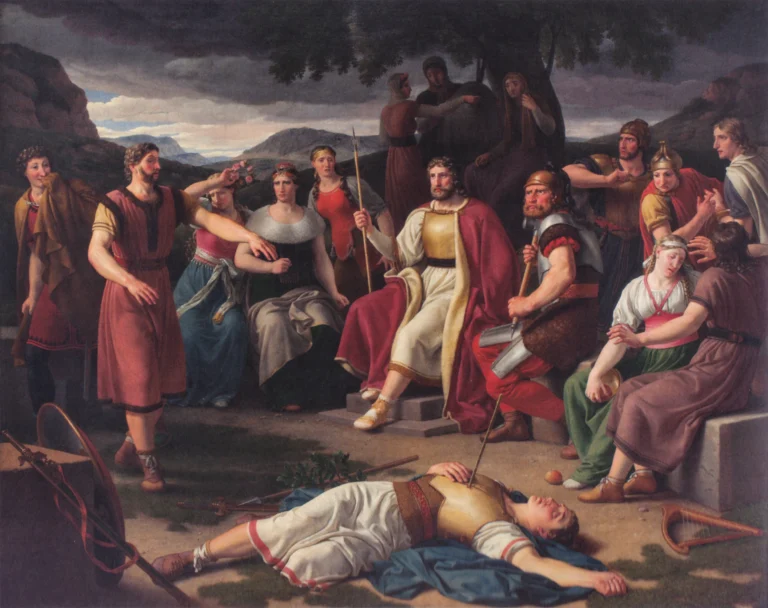
The main story below follows Snorri’s Gylfaginning. Where a poem or Saxo tells the story differently, it is identified separately. The paintings and illustrations are later interpretations, not Viking Age evidence.
Baldr, Baldur or Balder? And is he the god of light?
The spellings can make one figure look like several. This article uses Baldur for readability and Baldr when naming Old Norse texts or discussing their language. The older English translations cited below generally use Baldr, while Saxo’s translated account uses Balder and Hother. The names overlap, but the narratives should not be treated as interchangeable. [1, 7]
Calling Baldur the “god of light” captures something real about his literary image, but needs a little care. In Gylfaginning 22, Snorri describes him as so bright that light shines from him. His appearance is compared with a remarkably white plant, and his beauty accompanies wisdom and gracious speech. That is strong evidence for radiance as part of his portrait. It is not the same thing as a formal statement that he governs sunlight. [1]
What powers does Baldur have in the myths?
In Snorri’s account, Baldur’s radiance and his protection from injury are different things. Light shines from him in the description of his appearance; later, weapons fail to hurt him because Frigg has obtained protective oaths. Mistletoe has given no oath, so that protection does not cover it. These passages do not describe light-based attacks or a power to control the sun. [1–2]
The story of Baldur’s death
1. The dreams that disturb the gods
The trouble begins before the fatal game. Baldur has frightening dreams concerning his life, and the gods gather to discuss what can be done. Snorri does not open with a battle or an enemy army. He opens with a warning that enters the household through sleep. Protection becomes a collective concern. [2]
The poem Baldrs draumar, “Baldr’s Dreams,” gives that anxiety another shape. Odin, Baldur’s father, saddles Sleipnir and rides towards the realm of the dead. There he awakens a buried seeress and questions her under an assumed name. He wants knowledge of what is coming, but the scene gives him no comforting answer. [5, stanzas 1–6]
The hall below is already being prepared for Baldur. The seeress identifies Hödr as his future killer and foretells revenge by Váli, Odin’s son with Rind. Odin’s knowledge makes the scene darker: he can discover the shape of the catastrophe, but the prophecy gives him no way to prevent it. [5, stanzas 7–11]
2. Frigg asks the world to keep him safe
In Snorri’s account, Frigg responds through oaths. Fire and water, metals and stones, earth and trees, diseases and animals are brought into the effort to spare Baldur. This is much wider than a promise from “every living thing.” The protection extends across the materials and forces through which harm might reach him. [2]
There is one exception. Mistletoe grows west of Valhalla, and Frigg considers it too young to require an oath. She does not simply forget it. Her decision rests on an assessment of what is worth asking, and that apparently negligible exception becomes the opening Loki needs. [2]
3. Protection becomes a game
Confident that Baldur cannot be injured, the gods begin testing the protection. They shoot at him, strike him and throw stones. He remains unharmed. Snorri presents this as a pastime at the assembly, and the repeated failure of the weapons makes his safety seem visible and undeniable. [2]
Loki is displeased that Baldur cannot be hurt. Snorri describes his reaction without explaining a deeper motive; jealousy is an interpretation, not the passage’s explicit explanation. Taking the appearance of a woman, he visits Frigg and asks whether everything has sworn to spare Baldur. She tells him about the mistletoe. He then obtains the plant and returns to the gathering, carrying knowledge that the others do not possess. [2]
Hödr stands apart because he is blind and has no weapon. Loki encourages him to join in and honour Baldur as the others are doing. He provides the mistletoe and directs his aim. Hödr shoots; the missile passes through Baldur, who falls dead. The act is Hödr’s, but the arrangement and guidance are Loki’s. [2]
The gathering changes instantly. The gods cannot find words, and their grief breaks into weeping. They cannot immediately take vengeance because the place is a sanctuary. Odin understands especially keenly how great a loss Baldur’s death represents. The passage moves from communal confidence to communal helplessness in a few sentences. [2]
4. A funeral on Hringhorni
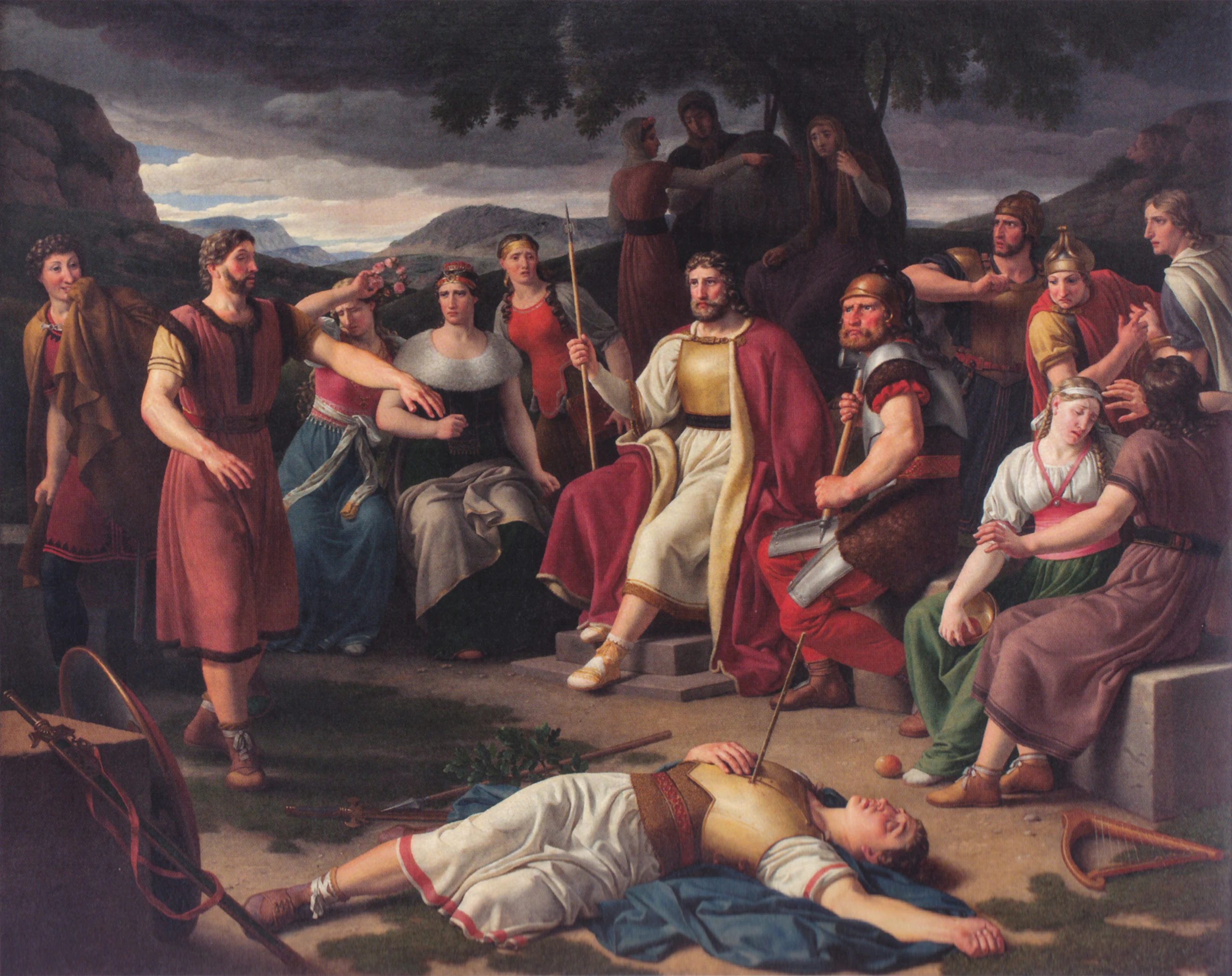
Baldur’s body is brought to the sea and to his ship, Hringhorni. The gods intend to use it for his funeral, but cannot launch it. They summon the giantess Hyrrokkin, who arrives riding a wolf with a serpent for a bridle. Her first push moves the ship with such force that fire bursts from the rollers and the land shakes. [2]
Nanna dies of grief when she sees her husband’s body carried aboard, and she is placed on the pyre with him. Thor consecrates it with his hammer. Odin contributes Draupnir, the gold ring that produces further rings, while gods and giants assemble for the burning. Baldur’s death draws together a much larger company than his immediate family. [2]
The funeral is not a quiet interlude. Its physical difficulty, its extraordinary visitors and its gifts make the loss monumental. Yet the story has not abandoned the possibility of recovering him. While the funeral unfolds, a messenger is already travelling elsewhere. [2]
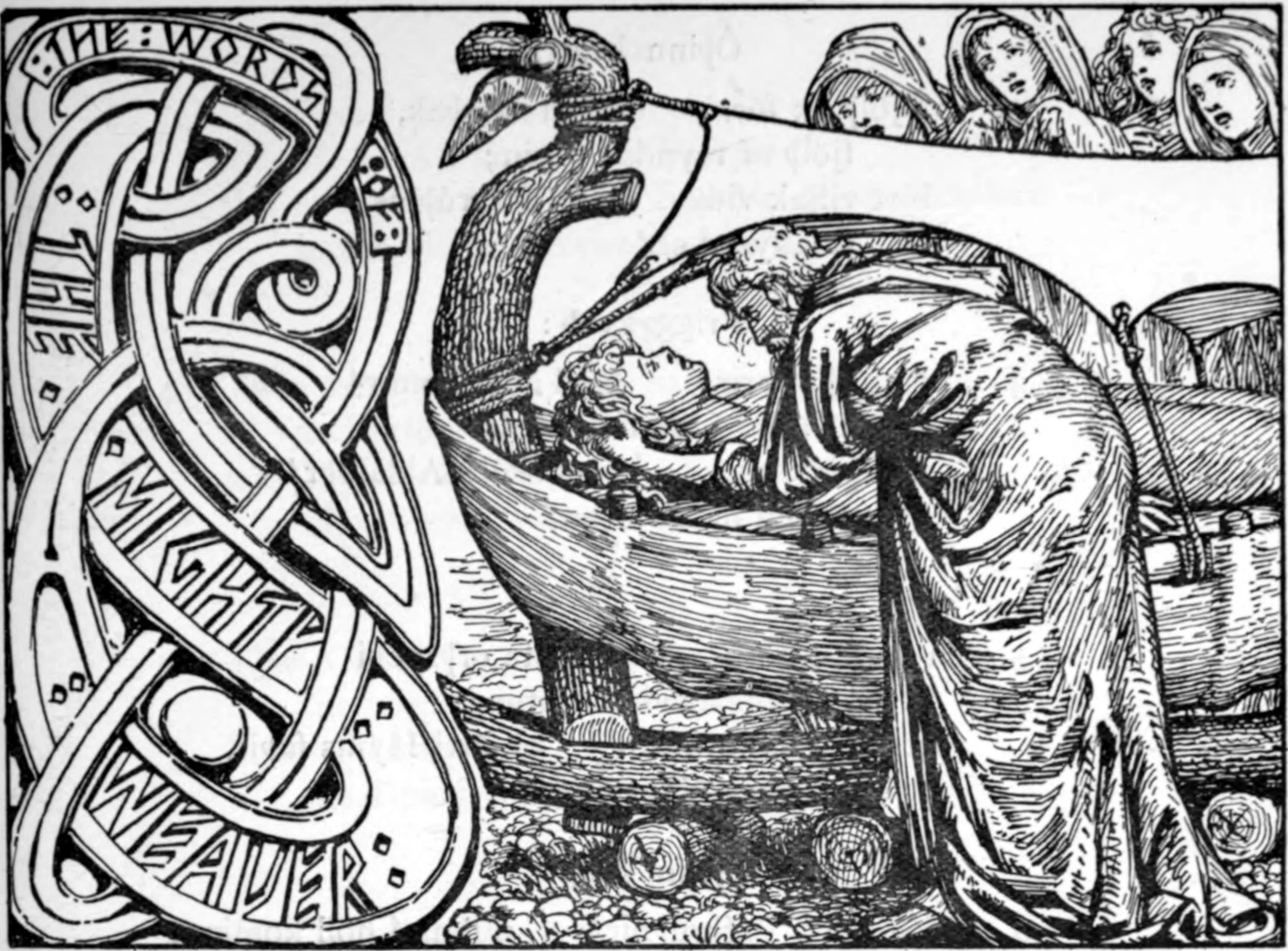
Vafþrúðnismál 54–55 raises the question of what Odin said to his son before the funeral pyre. The poem does not reveal the words. Collingwood imagines the scene, not an answer. [8]
For the historical evidence beyond this mythic funeral, see our guide to Viking funeral rites. A literary scene and a documented burial practice are not automatically the same thing.
5. Hermódr reaches Hel
Frigg asks who will ride to Hel and seek Baldur’s release. Hermódr volunteers and takes Sleipnir. His journey lasts nine nights through darkness before he reaches the bridge over Gjöll and speaks with its guardian. He continues to Hel’s gate, which Sleipnir clears in a leap. [2]
Inside the hall, Hermódr finds Baldur seated in a place of honour. The next morning he asks Hel to allow Baldur to return, explaining the grief among the gods. Hel proposes a test: everything in the world, living and dead, must weep for him. If anything refuses, he must remain. [2]
Before Hermódr leaves, Baldur sends Draupnir back to Odin. Nanna also sends gifts, including gifts for Frigg and Fulla. These exchanges make the episode more intimate than a simple negotiation with death. The dead still remember the living, even though the boundary between them has not opened. [2]
6. The one refusal
Messengers ask the world to mourn, and the response appears universal. People and creatures weep, but so do earth, stones, trees and metals. Snorri links this remarkable image to the moisture that appears when cold objects enter warmth, giving cosmic grief a familiar physical likeness. [2]
Then the messengers encounter a giantess who calls herself Thökk. She refuses to weep, and the condition fails. Snorri reports that people believed this figure was Loki in disguise. That wording is worth preserving: the narrative identifies the suspicion rather than staging an explicit unmasking. [2]
The structure echoes Frigg’s earlier protection. Once again, everything depends on universality. Once again, one exception is enough. This is one of the story’s sharpest patterns: a world almost completely united cannot reverse the loss.
Does Baldur return after Ragnarök?
Yes, but not through the failed mission to Hel. In Gylfaginning 53, the earth rises green from the sea after the destruction at Ragnarök. Several gods survive or return, including Vidar, Váli, Modi and Magni. Baldur and Hödr come from Hel and join the gathering. The gods speak together about the earlier world and its great events. [3]
Völuspá also places Baldur’s return amid renewal. Its vision includes fields bearing crops without sowing and Baldur dwelling with Hödr. The presence of the slain god beside his killer is striking, but the texts do not spell out their conversation or describe a formal act of forgiveness. Reading their shared future as reconciliation is a reasonable interpretation, not a narrated ceremony. [4, stanza 62]
Nor do these passages say that Baldur becomes the ruler of the new world, alone or alongside Hödr. What they give us is simpler and perhaps more affecting: both are there. A relationship defined by catastrophe in one world is not excluded from the next. [3–4]
Why the sources do not tell exactly the same story
Snorri supplies the most continuous version used in this article, but the poems often work through compressed references. They expect names, images and brief exchanges to carry a larger story. Reading them separately reveals what each actually contributes. [2, 4–6]
In Völuspá, mistletoe, Hödr’s fatal projectile, the avenger and Frigg’s grief appear in a short sequence. Bound Loki appears nearby, but the poem does not narrate him handing mistletoe to Hödr. Baldrs draumar identifies the killer and avenger through prophecy. It mentions Loki’s eventual release at its close, without explicitly making him the organiser of the killing. [4, stanzas 32–35; 5, stanzas 9–14]
Lokasenna supplies a different piece of evidence. During an exchange of insults, Frigg invokes Baldur, and Loki claims responsibility for his no longer returning to the hall. This supports a connection between Loki and Baldur’s loss, but it still does not reproduce Snorri’s full sequence of disguise, discovery and guided shot. [6, stanzas 27–29]
Saxo’s Balder and the warrior Hother
Saxo Grammaticus offers a substantially different narrative in Book III of Gesta Danorum. His Hother is a capable human warrior and musician, not a blind participant deceived at a divine gathering. Nanna loves Hother, while Balder, a semidivine son of Odin, becomes his rival for her. Their conflict involves armies, changing fortunes and a contest over marriage. [7]
Balder cannot be wounded by ordinary steel, but Hother learns of an exceptional sword held by Miming. Later, Hother strikes Balder in the side, and Balder dies after three days. Loki does not arrange this killing. Saxo’s Book III narrative does not name the sword “Mistletoe”; the weapon should not be confused with the plant in Snorri’s account. [7]
These differences should remain visible. Saxo’s story is not a missing chapter that can simply be inserted into Snorri’s. It gives familiar names a different arrangement of character, motive and action. Setting the versions alongside each other makes the surviving tradition richer, not less readable.
Explore Gods of War by Mythic Harmonies, a modern musical interpretation of the Ragnarök cycle. The music offers another way into this world; the medieval sources below remain the evidence for the story.
What makes Baldur’s myth endure?
One way to read the story is as a tragedy about the limits of protection. Frigg’s actions are loving and extensive, but they cannot make the world perfectly safe. The gods’ game mistakes repeated success for certainty. Later, their collective grief comes close to recovering what has been lost, yet closeness is not enough.
Another reading begins with the ending. Baldur’s return does not cancel the funeral, the failed journey or the pain of those who mourned him. Renewal arrives beyond them. The myth can therefore hold two ideas together: loss matters, and loss is not the only possible final horizon. These are interpretations offered by this article, not an attempt to assign one compulsory meaning to the medieval texts.
Frequently asked questions about Baldur
Who actually killed Baldur: Loki or Hödr?
In Snorri’s account, Hödr delivers the fatal shot, while Loki obtains the mistletoe, gives it to him and guides him. Saying only “Loki killed Baldur” hides the mechanism; saying only “Hödr killed Baldur” hides the manipulation. Lokasenna separately gives Loki a claim of responsibility for Baldur’s absence. [2, 6]
Why could mistletoe hurt him?
Because it had not sworn Frigg’s protective oath. She judged it too young to be asked. The decisive quality is the missing promise, not a special poison or a botanical power explained by the story. Mistletoe exposes the exception within a protection that everyone else has accepted. [2]
Did Frigg bring Baldur back from the dead?
Not in the attempted recovery told by Snorri. Hermódr reaches Hel on her behalf, but Thökk’s refusal to weep defeats the condition for release. Baldur’s later return belongs to the renewed world after Ragnarök, not to an immediate resurrection following his funeral. [2–4]
Is Baldur a peaceful god in every version?
No single description fits all the sources. Snorri stresses his beauty, wisdom and gracious character. In Lokasenna, Frigg imagines a son like Baldur confronting Loki. Saxo’s Balder is a military rival pursuing Nanna. These portraits make a universal label such as “the harmless god of peace” too restrictive. [1, 6–7]
Sources and further reading
The article follows Snorri for its main narrative and identifies comparisons with other sources. The freely accessible English translations below are older public-domain editions; their notes sometimes contain interpretations or dating claims that should not be mistaken for the medieval text itself.
- [1] Snorri Sturluson, Gylfaginning, chapters 22 and 32. Baldur’s description, Breidablik and Forseti. Translated by Arthur Gilchrist Brodeur. Read the source.
- [2] Snorri Sturluson, Gylfaginning, chapters 49–50. The dreams, oaths, killing, funeral, journey to Hel and Loki’s punishment. Brodeur translation. Read the source.
- [3] Snorri Sturluson, Gylfaginning, chapter 53. The renewed world and the return of Baldur and Hödr. Brodeur translation. Read the source.
- [4] Völuspá, especially stanzas 32–35 and 62 in Henry Adams Bellows’s numbering. Death, grief and return. Numbering varies between editions. Read the source.
- [5] Baldrs draumar, stanzas 1–14. Odin’s journey and the seeress’s prophecy. Bellows translation. Read the source.
- [6] Lokasenna, stanzas 27–29. Frigg and Loki’s exchange concerning Baldur. Bellows translation. Read the source.
- [7] Saxo Grammaticus, Gesta Danorum, Book III. Balder, Hother and Nanna. Translated by Oliver Elton as The Danish History. Read the source.
- [8] Vafþrúðnismál, stanzas 54–55. Odin’s unanswered question about the words spoken to Baldr. Henry Adams Bellows translation (1923). Read the source.
- [9] Snorri Sturluson, Skáldskaparmál, chapters IV–V. The parentage of Thor and Baldur. Brodeur translation. Read the source.
- Modern annotated edition: Edward Pettit, The Poetic Edda: A Dual-Language Edition, Open Book Publishers, 2023. Further reading alongside the public-domain translations cited above.


All five albums and every single: 86 songs in WAV and MP3, yours to keep.