

Jörmungandr: The World Serpent in Norse Mythology
Jörmungandr—the World Serpent or Midgard Serpent—is the immense sea serpent born to Loki and Angrboða in Norse myth. In Snorri Sturluson’s Gylfaginning, Odin throws him into the ocean around the inhabited world; there he grows until he encircles the land and bites his own tail. At Ragnarök, Thor kills him and then dies after nine steps from the serpent’s venom.
The story survives in several kinds of evidence: Eddic poems, Snorri’s thirteenth-century prose, earlier skaldic verses and Viking Age or medieval stone images commonly identified with Thor’s fishing expedition. These witnesses overlap, but they do not always tell the episode in the same way.
Evidence boundary: no surviving Norse text says that Jörmungandr’s tail-bite literally “holds the world together,” or that releasing his tail starts Ragnarök. The sources say that he encircles the land, bites his tail, comes ashore amid the world’s destruction and dies fighting Thor. Boundary, containment and cyclical-time readings are interpretations, and this guide labels them as such.
| At a glance | Evidence-led answer |
|---|---|
| Old Norse names | Jǫrmungandr; Miðgarðsormr (“Midgard Serpent”) |
| Family | Child of Loki and Angrboða; sibling of Fenrir and Hel in Gylfaginning |
| Best-attested episodes | The serpent-cat illusion, Thor’s fishing expedition and the final fight at Ragnarök |
| Historical image evidence | Altuna U 1161, the Hørdum stone and the Gosforth fishing stone are commonly connected with Thor’s fishing |
| Not securely attested | A special “Jörmungandr rune,” or a medieval doctrine that his tail-bite symbolizes infinity or physically seals the cosmos |
Who Is the World Serpent?
The World Serpent is Jörmungandr (Old Norse Jǫrmungandr), also called Miðgarðsormr, the Midgard Serpent. The first element of his name conveys enormous scale; translations such as “mighty monster” or “huge supernatural being” are useful glosses, not a perfectly certain one-word equivalence.
Snorri’s Gylfaginning gives the clearest prose definition: Jörmungandr lies in the ocean around all lands, encircles the earth and bites his own tail. He is the child of Loki and Angrboða, and the sibling of Fenrir and Hel.
His narrative role is clearer than his symbolism. He is Thor’s great opponent in the fishing story and at Ragnarök. Calling him a “boundary of the world” is a reasonable interpretation of his encircling position and of land-related kennings, but the medieval texts do not provide a single authoritative explanation of what his tail-biting means.
The Birth of the World Serpent
Jörmungandr’s family is introduced in Gylfaginning. Loki and the giantess Angrboða—whose name is often glossed as “grief-bringer”—have three children: Fenrir, Jörmungandr and Hel. Snorri says that prophecies foretold great harm from them, so the gods had the children brought to Odin.
Snorri assigns a different fate to each sibling. Hel is sent to Niflheim and given authority over those who die of sickness or old age; Fenrir is eventually bound; Jörmungandr is thrown into the deep sea surrounding all lands. The text does not explicitly call this an execution or say that Odin expected the serpent to drown.
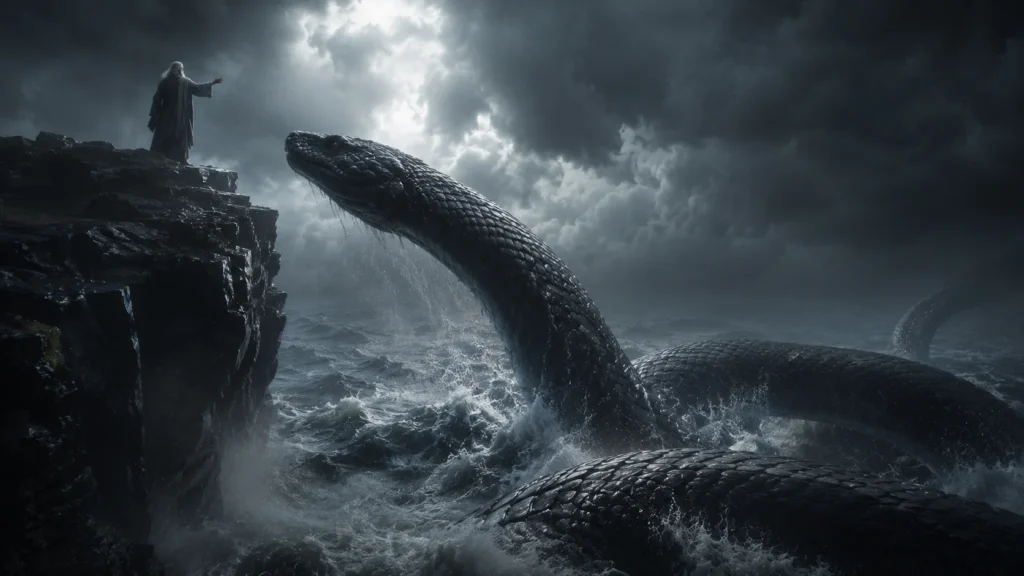
In the ocean, the serpent grows until he lies around the land and bites his own tail. That concise statement is the secure textual core. The larger idea that Odin accidentally created a cosmic wall is a modern interpretive development, not something Snorri states.
For the wider family tradition, see the source-led guide to the children of Loki.
Why Does Jörmungandr Encircle the World?
The surviving texts first make a statement about scale and location: Jörmungandr lies in the ocean around the inhabited lands. Snorri adds that he bites his own tail. This is why “World Serpent” and “Midgard Serpent” are not merely modern nicknames; they summarize the creature’s place around the human world.
Skaldic poetry also describes him through land- and sea-based kennings. Húsdrápa by Úlfr Uggason and Ragnarsdrápa by Bragi Boddason preserve early poetic witnesses to Thor’s encounter with the serpent. Because kennings are compact and their translations vary by edition, phrases such as “necklace of the earth” or “fish of the land’s border” should be treated as scholarly renderings, not as a prose doctrine about how the cosmos works.
It is therefore fair to read Jörmungandr as an image of an encircling limit. It is not fair to present “the serpent physically holds the world together” as a sentence preserved in an Edda. The distinction makes the image more historically useful, not less powerful.
Is Jörmungandr an Ouroboros?
Visually, Jörmungandr resembles an ouroboros because Snorri describes a serpent encircling the land and biting its own tail. The comparison is useful as a description of shape. It becomes misleading when the later symbolic meanings of the ouroboros are automatically assigned to the Norse figure.
No surviving Norse source explains the tail-bite as “infinity,” eternal recurrence, death and rebirth, or a magical seal that keeps chaos outside. Those readings may work in modern art, spirituality or comparative mythology, but they should be labelled as later interpretation.
The evidence-led formulation is simpler: Jörmungandr’s immense body surrounds the lands, and his mouth reaches his tail. At Ragnarök, the sources describe the serpent writhing in giant-fury, driving the waves, coming onto land and poisoning air and sea. They do not explicitly say that he first releases his tail or that this action triggers the end.
Thor and Jörmungandr: A Rivalry in Three Acts
The surviving tradition brings Thor and Jörmungandr together in three famous scenes: the disguised serpent-cat, the fishing expedition and the final fight at Ragnarök. Snorri narrates all three in Gylfaginning; Eddic and skaldic poems preserve the fishing and Ragnarök material independently. Treating them as a deliberate “three-act rivalry” is a useful modern arrangement, not a structure announced by the sources.
For the full story of the thunder god himself, see our article on Thor, the god of thunder.
Act One: The Cat That Was Not a Cat
The first encounter is a deception, and neither Thor nor the reader knows the truth until afterward.
Thor, along with Loki and the servant Þjálfi, travels to the hall of the giant king Útgarða-Loki, who challenges his guests to a series of contests. Thor is given what seems like a trivial task: lift a large grey cat off the floor.
He tries. He strains with all his divine strength. And he manages only to raise a single paw of the cat from the ground.
Only when the visitors leave does Útgarða-Loki reveal that the cat was the Midgard Serpent disguised by illusion. He says the onlookers were terrified when Thor lifted one paw because the feat was astonishing against a creature that encircles the earth. The text does not say Thor nearly “unmade the cosmos”; that is a modern dramatic expansion.
This first encounter establishes the scale of what Jörmungandr is. Even disguised, even reduced to the form of a housecat, the serpent is nearly too vast for the strongest god to move.
Act Two: The Fishing Trip
The fishing expedition is the best-attested encounter, appearing in Eddic and skaldic poetry as well as Snorri’s prose. Its versions share the hook, ox-head bait and confrontation, but they differ in important details.
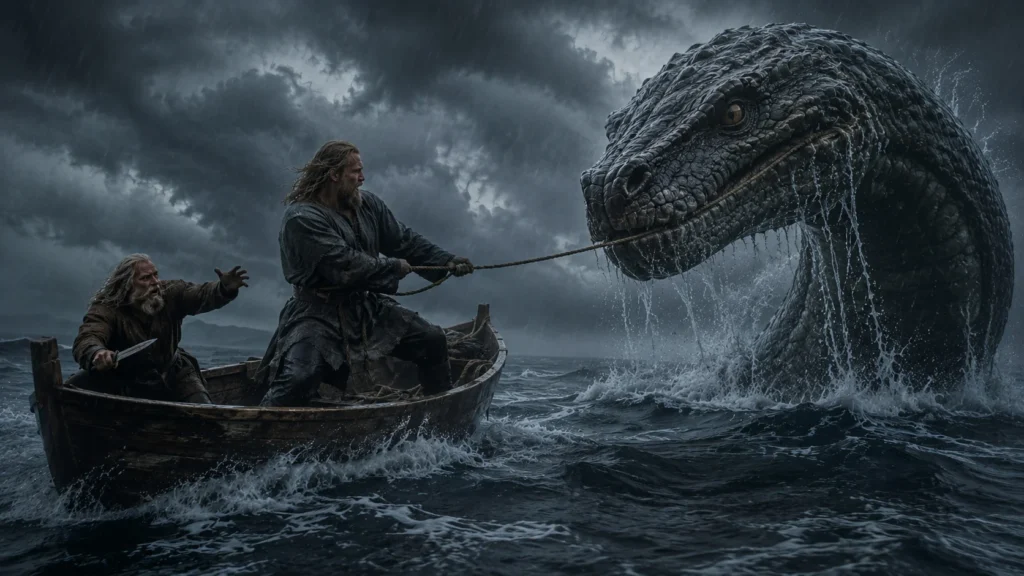
Thor, in the guise of a young man, goes out to sea with the giant Hymir on a fishing expedition. Thor insists on rowing far out, past the point where Hymir is comfortable, into the deep waters at the edge of the world. He baits an enormous hook with the head of an ox and casts it into the depths.
Jörmungandr takes the bait.
What follows is one of the great set pieces of Norse mythology. Thor hauls on the line with such force that his feet break through the bottom of the boat and brace against the seabed. He pulls the World Serpent up from the depths, hand over hand, until the monstrous head breaks the surface, venom dripping from its jaws. Thor raises Mjölnir, his hammer, to deliver the killing blow that would end the serpent then and there.
In Snorri’s version, Hymir panics and cuts the line.
Snorri says the serpent sinks back into the sea and adds variant reports about Thor’s thrown hammer. He does not say Hymir understood a threat to the structure of the cosmos. In Hymiskviða, the episode is told differently and the poem does not end with Hymir cutting the line.
Modern readers sometimes interpret the fishing trip as an attempt to avert Ragnarök. The medieval accounts do not give Thor that explicit motive. What they do establish is the enmity that culminates in the pair’s mutual destruction.
Act Three: The Final Duel at Ragnarök
The third encounter is the last, and it is the one the entire mythology has been building toward.
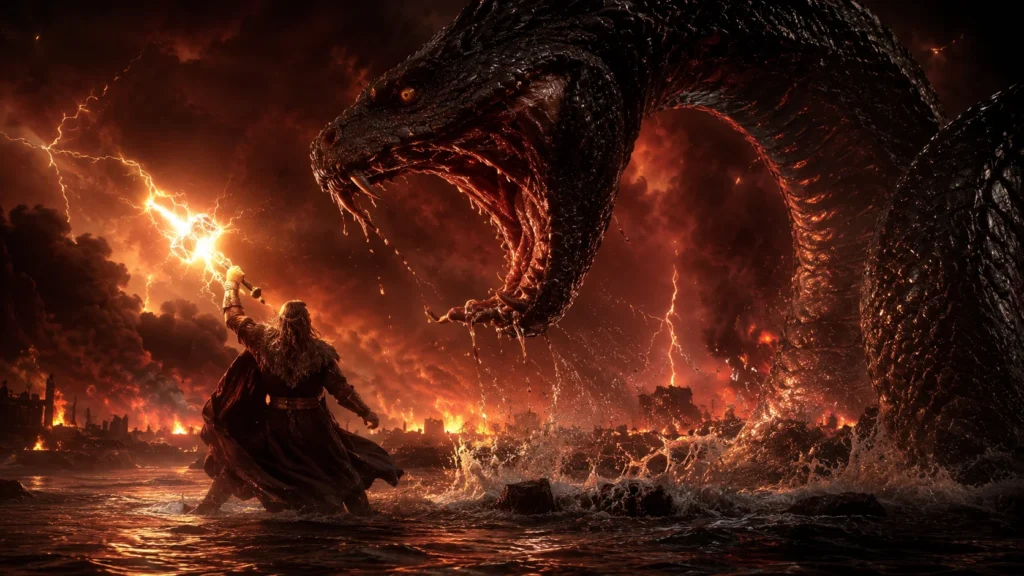
At Ragnarök, Völuspá describes Jörmungandr writhing in giant-fury and beating the waves. Snorri says the sea surges over the land as the serpent comes ashore and that its venom fills air and sea. Neither passage explicitly narrates him releasing his tail as the trigger.
And there, at last, Thor meets him.
The two destined enemies fight their final battle. Thor swings Mjölnir and lands the killing blow, slaying the World Serpent he first encountered disguised as a cat, the serpent he nearly hauled from the sea on Hymir’s boat. The prophecy is fulfilled. The serpent dies.
But Jörmungandr has the last word. In the course of the fight, his venom has flooded into Thor’s body. Having killed the serpent, Thor staggers back from the dying coils. He manages exactly nine steps. On the ninth, the venom takes him, and the god of thunder falls dead beside the serpent he killed.
Their mutual destruction is the perfect end to a rivalry that defined them both. The protector of the world and the boundary of the world, locked together in death. Neither survives the other. The thunder and the serpent fall together.
What Does Jörmungandr Represent?
The honest answer has two layers. The sources attest a gigantic serpent around the lands, Thor’s opponent in the fishing episode and the creature whose venom kills Thor at Ragnarök. They do not preserve a single medieval explanation of what Jörmungandr “represents.”
A boundary reading is nevertheless plausible. His body is imagined at the world’s outer sea, and several poetic kennings connect him with land’s edge or encirclement. On that basis, modern readers can interpret him as a figure of limits: the meeting point between inhabited space and the dangerous sea beyond.
Other readings—cyclical time, ecological balance, suppressed chaos, inevitable fate—belong to reception history rather than recoverable Viking Age belief. They can be meaningful, but evidence-led writing should name the interpretive step instead of putting it into the mouths of unnamed “Norse people.”
This distinction also changes the Thor comparison. Thor protects gods and humans; Jörmungandr encircles the human world and later fights him. Describing the pair as “protector versus boundary” is a modern analytical frame, not an explicit formula in the poems.
Jörmungandr in the Primary Sources
No single text contains the whole modern biography. The picture is assembled from witnesses of different dates and genres. Snorri is the fullest narrator, but he wrote in thirteenth-century Iceland and repeatedly quotes older poetry.
| Evidence | Where to look | What it supports |
|---|---|---|
| Family, ocean and tail-bite | Prose Edda, Gylfaginning 34 | Loki and Angrboða as parents; Odin casts the serpent into the sea; it grows around the lands and bites its tail |
| Serpent-cat illusion | Gylfaginning 46–47 | Thor lifts one paw of a cat that is revealed as the Midgard Serpent |
| Fishing expedition | Hymiskviða 20–24; Gylfaginning 48; Húsdrápa; Ragnarsdrápa | Thor hooks and confronts the serpent; details differ between poetic and prose accounts |
| Ragnarök | Völuspá; Vafþrúðnismál 53; Gylfaginning 51 | The serpent drives the waves and fights Thor; Thor dies after nine steps |
| Historical images | Altuna U 1161; Hørdum stone; Gosforth fishing stone | Scenes widely identified as Thor’s fishing expedition |
The fishing episode is a good example of source variation. In Snorri’s prose, the frightened Hymir cuts Thor’s line. In Hymiskviða, the poem moves differently and does not give that same line-cutting resolution. A premium retelling should not silently fuse the versions.
Editions and scholarly reference works
- Anthony Faulkes, ed., Snorri Sturluson: Edda. Prologue and Gylfaginning, 2nd ed., Viking Society for Northern Research, 2005.
- Skaldic Poetry of the Scandinavian Middle Ages, the scholarly database for skaldic editions and commentary.
- John Lindow, Norse Mythology: A Guide to the Gods, Heroes, Rituals, and Beliefs, Oxford University Press, 2001.
- Rudolf Simek, A Dictionary of Northern Mythology, trans. Angela Hall, D. S. Brewer, 1993.
Jörmungandr in Archaeology
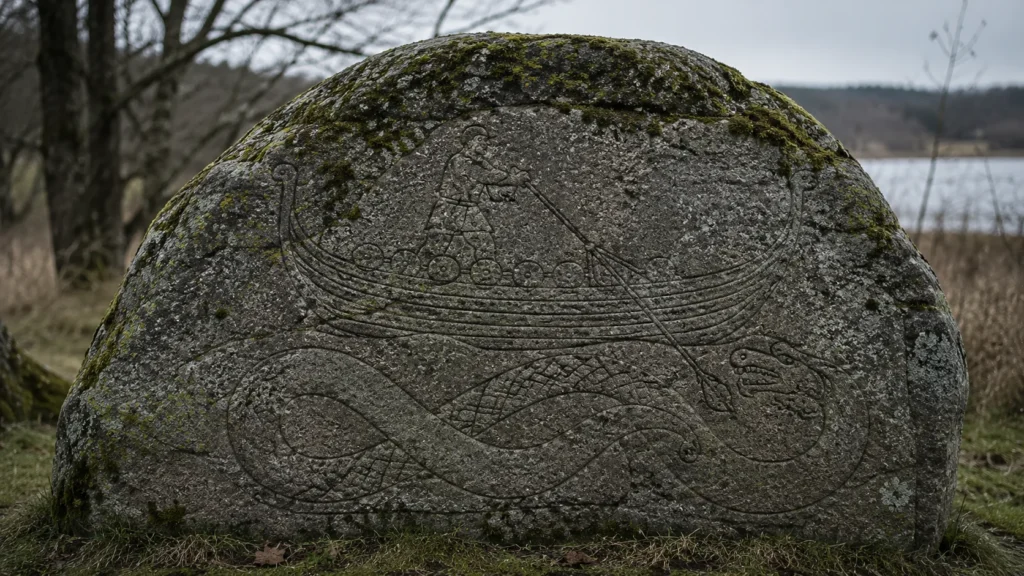
Several carved images are commonly identified with Thor’s fishing expedition. They do not carry captions naming Jörmungandr, so the identifications rest on the combination of boat, line, serpent, hammer or ox-head details and comparison with the literary accounts.
The eleventh-century Altuna runestone U 1161 in Uppland, Sweden, shows a figure in a boat whose foot appears to break through the hull while a line descends toward a serpent. That unusual foot-through-boat detail closely matches Snorri’s version and makes the identification especially persuasive.
The Hørdum stone in Denmark and the Gosforth fishing stone in Cumbria are also widely read as versions of the same mythic episode. Together, the objects show that the fishing motif circulated across different parts of the Norse cultural world. They do not, by themselves, prove one universal symbolic interpretation or tell us how every viewer understood the scene.
Frequently Asked Questions
Who are Jörmungandr’s parents?
Jörmungandr is the child of the trickster god Loki and the giantess Angrboða. This makes him the brother of the wolf Fenrir and of Hel, the ruler of the underworld. All three siblings are destined to play major roles in Ragnarök, the end of the world.
Why does Jörmungandr bite his own tail?
Snorri says Jörmungandr grew until he encircled all lands and bit his own tail, but he does not explain why. Boundary or containment readings are modern interpretations; no surviving Norse source says the bite literally holds the cosmos together.
Is Jörmungandr an ouroboros?
Jörmungandr has an ouroboros-like shape in Snorri’s prose, but medieval Norse sources do not call him an ouroboros or assign him later infinity or death-and-rebirth meanings. The resemblance is visual; a specific symbolic equivalence is not securely attested.
How does Jörmungandr die?
Jörmungandr dies at Ragnarök in his final battle with Thor. The thunder god kills the serpent with his hammer Mjölnir, but the serpent’s venom has already entered Thor’s body. After killing Jörmungandr, Thor takes nine steps and then falls dead from the venom. The two destined enemies kill each other.
What is the Midgard Serpent’s role in Ragnarök?
At Ragnarök, Völuspá and Snorri describe Jörmungandr driving the waves, coming onto land and spreading venom before fighting Thor. Thor kills the serpent and then dies from its poison. No surviving passage explicitly says that releasing his tail begins Ragnarök.
What does the name Jörmungandr mean?
The name Jörmungandr (Old Norse Jǫrmungandr) is generally interpreted as meaning “huge monster” or “great beast.” He is also commonly called the Midgard Serpent, after Midgard, the world of humans that his body encircles, and the World Serpent.
Did Thor try to kill Jörmungandr before Ragnarök?
Yes. Thor hooks and confronts Jörmungandr during the fishing expedition. In Snorri’s prose, Hymir cuts the line; Hymiskviða gives the episode a different resolution. The idea that Thor was deliberately trying to prevent Ragnarök is a modern interpretation, not an explicit motive in the surviving accounts.
Is Jörmungandr a dragon or a serpent?
Jörmungandr is a serpent, not a dragon. The Old Norse sources consistently call him ormr, meaning serpent or worm, and describe him without wings, legs, or fire. The figure closest to a dragon in Norse mythology is Níðhöggr, the corpse-eating creature that gnaws the roots of Yggdrasil.
Why does Jörmungandr hate Thor?
The sources never describe a personal hatred or explain Jörmungandr’s emotions. They repeatedly place Thor and the serpent in conflict: first in Snorri’s serpent-cat illusion, then in the fishing story, and finally at Ragnarök, where they kill one another.
Is there a Jörmungandr rune?
No. No rune in the Elder or Younger Futhark represents Jörmungandr. The serpent circles sold as “Jörmungandr runes” in modern jewelry and tattoo designs are contemporary creations, sometimes combining runic letters with an ouroboros shape. Historical runestones depict the serpent in carved scenes, not as a runic character.
The World Serpent: What the Evidence Leaves Us
The medieval evidence leaves three durable images: a serpent vast enough to surround the lands, Thor hauling that serpent toward the surface, and the two enemies killing one another at Ragnarök. Those images come from texts and objects that do not always agree in detail.
Reading Jörmungandr as the world’s boundary is a powerful modern interpretation grounded in his location and in the language of encirclement. Reading him as a literal seal that keeps the cosmos intact goes further than the surviving sources allow. Where the evidence stops, the article should say so.
That uncertainty does not empty the myth of meaning. It gives the reader the same fragments scholars work with: a tail in a mouth, a line cast into deep water, a hammer raised over the waves and nine final steps.
Our Old Norse song Jörmungandr Ris (The Serpent Rises) is a clearly labelled artistic response to those sources—not evidence for the medieval myth. The video is placed here, after the documented account, so the interpretation follows the evidence.
Music to read by
Each article has a soundtrack. Listen to Mythic Harmonies while you read.
Explore the music