
Hel: The Norse Goddess of Death Who Ruled Where Almost Everyone Went
On this page 13 sections
- Who Is Hel? A Quick Introduction
- The Myth-Buster: Marvel’s Hela Is Not the Real Hel
- The Birth and Banishment of Hel
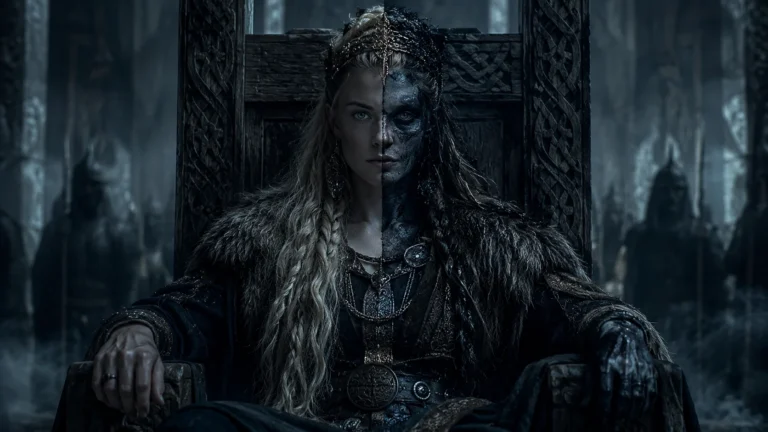
- Half Alive, Half Dead: The Appearance of Hel
- The Realm of Hel: What the Sources Actually Describe
- Who Actually Went to Hel? Almost Everyone
- Hel’s Greatest Moment: The Death of Baldr
- Hel at Ragnarök
- Is Hel Evil? The Deeper Reading
- Hel in the Primary Sources
- The Legacy: How Hel Became “Hell”
- Frequently Asked Questions
- The Hidden Queen
A rider descends through darkness. For nine nights he has followed the road down and north, through valleys so deep that no light reaches them, on a horse with eight legs borrowed from the king of the gods. He crosses a river spanned by a golden bridge, where a maiden tells him that five battalions of dead men crossed the day before. He rides until he reaches a wall no living being should pass, and leaps it.
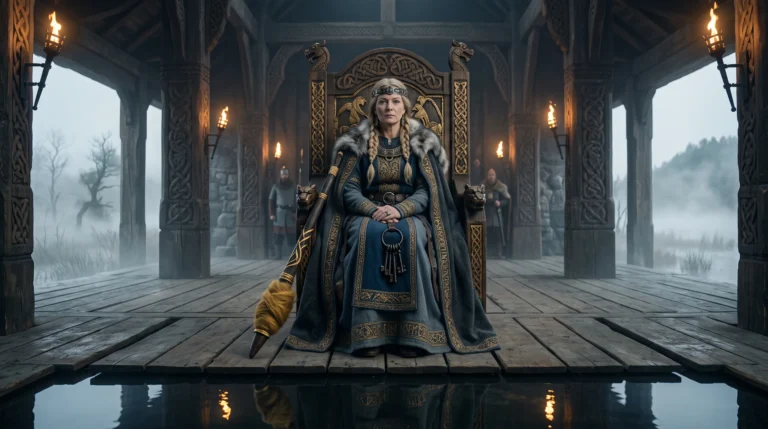
Beyond it stands a hall. And in that hall, on a throne, sits a being unlike any other in the Nine Worlds: a woman who is half alive and half dead, her body divided between living flesh and the blue-black of a corpse. Her expression is grim, downcast, and utterly unmoved.
The rider is Hermóðr, son of Odin, and he has come to beg for the return of the god Baldr. The being on the throne is Hel, the Norse goddess of death. And what happens next reveals something remarkable: she does not bow to the gods. She sets her own terms. And when those terms are not met, she keeps what is hers, and there is nothing Odin or any power in the cosmos can do about it.
This is Hel. Daughter of Loki, sister of monsters, exiled queen of the dead. Popular culture has turned her into a villain, a horned Marvel antagonist, a final boss. The sources tell a different and far more interesting story: the story of the being who ruled the destination where almost every Norse man, woman, and child expected to end up. Not Valhalla. Hel.
This article tells her full story, drawn directly from the primary sources: the Poetic Edda, the Prose Edda of Snorri Sturluson, and the scholarly record. By the end, you will understand who Hel actually was, what her realm actually looked like, and why the quietest of Loki’s children may have been the most powerful of them all.
While you read, the atmospheric music of Mythic Harmonies on YouTube draws from the same Old Norse tradition that gave us the story of Hel.
Who Is Hel? A Quick Introduction
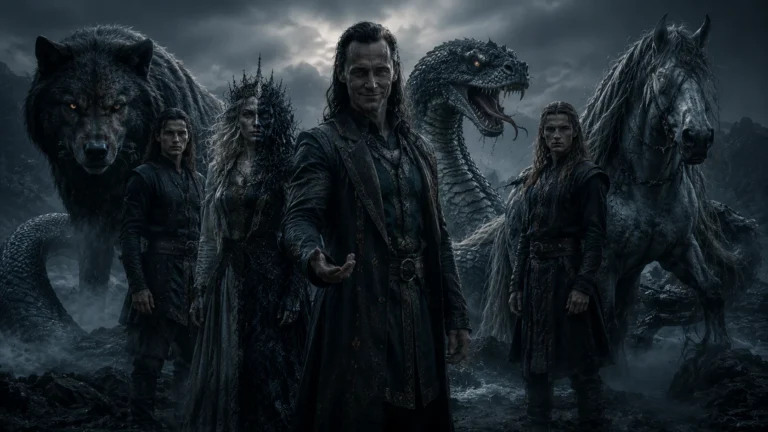
Hel is the being who presides over the realm of the dead in Norse mythology, a realm that bears her own name. She is the daughter of the trickster god Loki and the giantess Angrboða, and the sister of two monsters: the great wolf Fenrir and the World Serpent Jörmungandr.
Her name in Old Norse means “hidden” or “concealed,” from the same root that gives us the modern English word “hell.” Her appearance is described in the Prose Edda as half flesh-colored and half blue-black, half living woman and half corpse, with a gloomy and fierce expression.
She was appointed by Odin himself to rule over the dead in Niflheim, the world of mist and cold. Her subjects are those who die of sickness, old age, and accident, which is to say, almost everyone. The warriors who fall in battle go to Valhalla or Fólkvangr. Everyone else, the vast majority of humanity, goes to Hel.
That single fact changes how you should see her. She is not a marginal figure of horror. She is the ruler of the ordinary afterlife, the hostess of nearly all the dead, and one of the most quietly powerful beings in the entire Norse cosmos.
The Myth-Buster: Marvel’s Hela Is Not the Real Hel
Before going further, one correction that matters, because it has shaped how millions of people picture this goddess.
In Marvel’s Thor: Ragnarok, Hela is Odin’s firstborn daughter, the goddess of death, Thor’s older sister, an ambitious conqueror imprisoned by her father and returning for vengeance. It is a striking character. It is also almost entirely invented.
In the Norse sources, Hel is not Odin’s daughter. She is Loki’s daughter. She is not Thor’s sister; her siblings are a wolf and a serpent. She never sought to conquer Asgard. She was never Odin’s executioner or the leader of his armies. And she does not wield weapons or fight at all. Her power is of an entirely different kind: she rules, she keeps, and she does not release.
The real Hel never wanted a throne in Asgard. She was thrown out of it as a child, cast down into the world of mist, and given dominion over the dead. And instead of raging against that exile, she built something in the dark: a realm so absolute in its authority that even the gods could not take back what entered it.
The invented Hela conquers. The real Hel simply keeps. Of the two, the real one is more frightening.
The Birth and Banishment of Hel
Hel’s story begins in Jötunheim, the land of giants, where Loki fathered three children with the giantess Angrboða, whose name means “She Who Brings Grief.” The gods learned through prophecy that these three children would bring great misfortune upon them. Their response shaped the geography of the entire cosmos.
Odin had the three children brought to Asgard. The serpent Jörmungandr he cast into the great ocean surrounding the world of humans. The wolf Fenrir the gods kept close and eventually bound with an unbreakable chain. And Hel, the third child, Odin cast down into Niflheim, the primordial world of ice and mist, the deepest and coldest of the Nine Worlds.
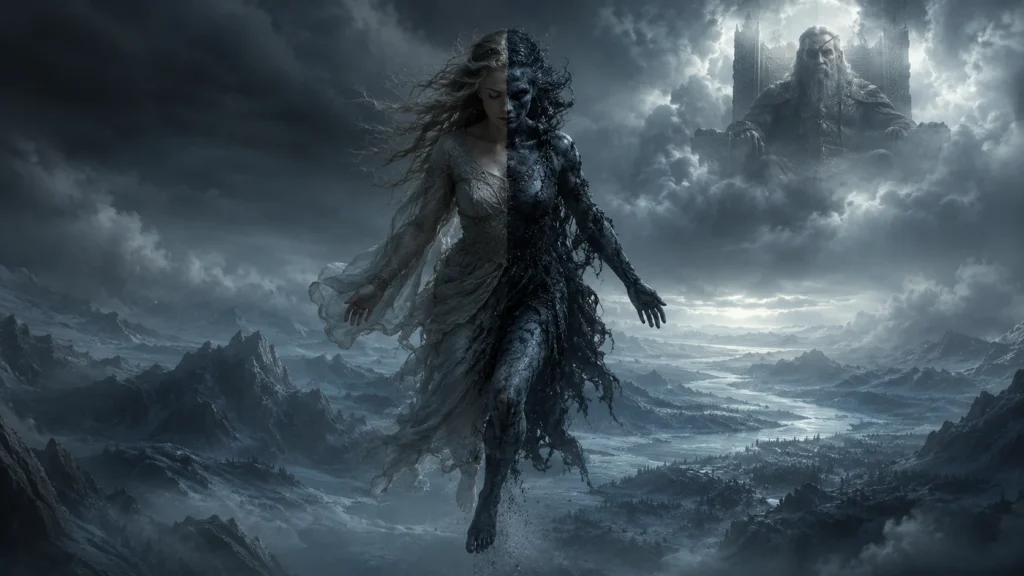
But her exile came with something neither of her brothers received: authority. The Prose Edda states that Odin gave her power over nine worlds, with the charge that she must “administer board and lodging to those sent to her, and that is those who die of sickness or old age.”
Pause on that. The gods bound Fenrir in fear. They drowned Jörmungandr in the sea. But Hel they made a queen. Whether Odin intended it as a punishment, a containment, or a grim necessity, the result was the same: the child the gods threw away became the ruler of the largest population in the cosmos, the dead.
There is a bitter irony woven into this arrangement, and the Norse storytellers surely saw it. Odin, who knew the future, handed the keys of the underworld to the daughter of the being who would one day orchestrate the death of his own son. When Baldr died, the god Odin loved most fell directly into the power of the family he had feared and exiled. The trap was built by the very god who fell into it.
Half Alive, Half Dead: The Appearance of Hel
The Prose Edda gives Hel one of the most striking physical descriptions in all of Norse mythology. She is half flesh-colored and half blue-black: one side of her body is that of a living woman, the other bears the color of a corpse. Snorri adds that this makes her instantly recognizable, and that she is “rather downcast and fierce-looking.”
The description is not decorative. It is a theology written on a body. Hel stands exactly on the boundary between life and death, belonging fully to neither. She can receive the dead because she is half dead herself. She can rule them because she is half alive. She is the border between the two states, made flesh.
The Norse imagination did this deliberately. Just as her brother Jörmungandr physically embodies the boundary of the world, encircling it in the sea, Hel physically embodies the boundary of life. The children of Loki are not random monsters. Each one is a living frontier: the wolf who ends the age, the serpent who edges the world, and the woman who divides the living from the dead.
The Realm of Hel: What the Sources Actually Describe
Hel’s realm, which shares her name, lies downward and northward, beneath one of the three roots of Yggdrasil, in the cold world of Niflheim. To “go to Hel” was, in Old Norse, simply the way of saying “to die.”
The road there is called the Helvegr, the Hel-road, and the sources describe it in detail through the journey of Hermóðr: nine nights of riding through valleys so dark and deep that nothing can be seen, then the river Gjöll and its bridge Gjallarbrú, roofed with glowing gold and guarded by the maiden Móðguðr, who questions all who cross. Beyond the bridge, the road runs downward and northward until it reaches the high gates of Hel, the Helgrind, the corpse-gates that no living being is meant to pass.
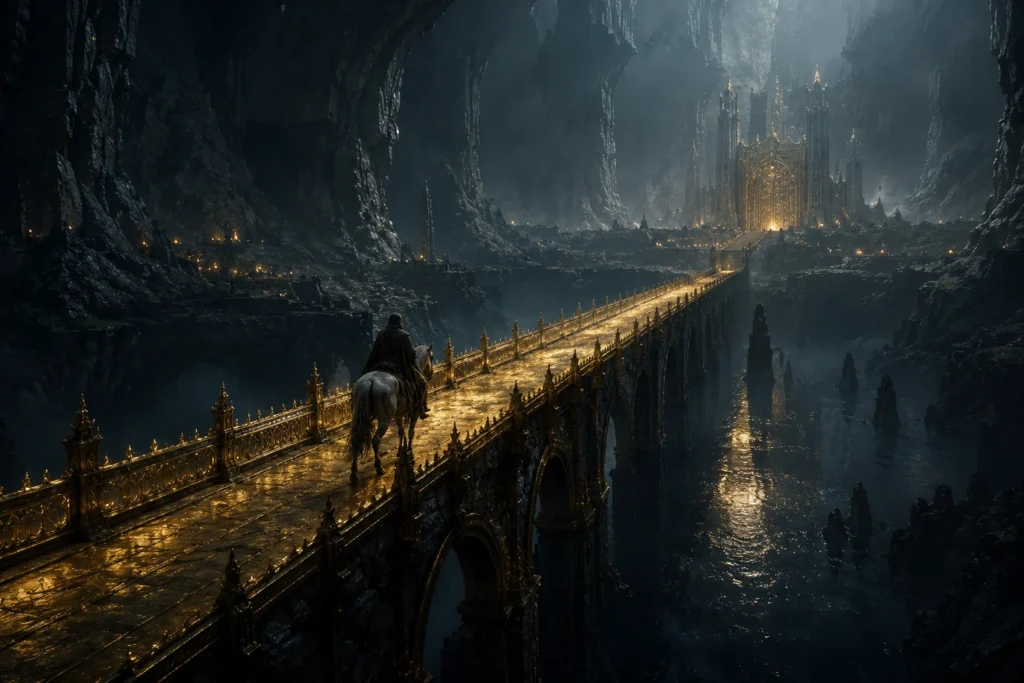
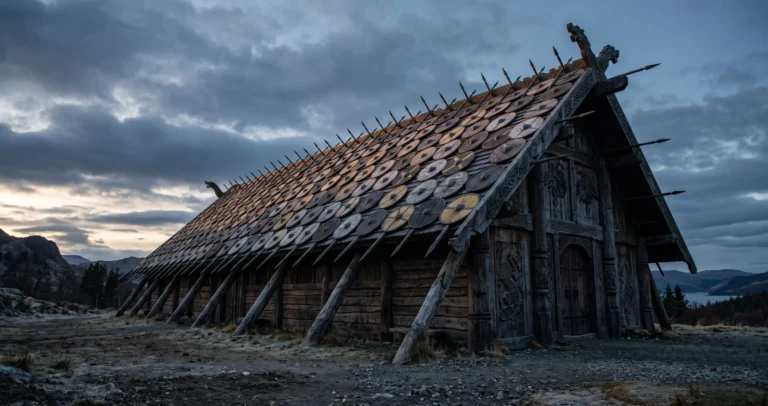
Within stands Hel’s own hall, Éljúðnir, a name meaning “sprayed with snowstorms” or “damp with sleet.” And here the Prose Edda gives us an inventory unlike anything else in mythology. Every object in Hel’s household bears a name, and every name is a quiet sentence about mortality:
Her dish is called Hungr, Hunger. Her knife is called Sultr, Famine. Her servant is Ganglati, “the slow-walking one,” and her serving-maid Ganglöt, the same name in female form. The threshold of her hall is called Fallandaforað, Stumbling-block. Her bed is named Kör, Sick-bed. And the curtains around it are called Blíkjandaböl, Gleaming-bale, the shining misfortune.
Read that list again slowly. It is a portrait of dying of illness or old age, told entirely through furniture: the hunger that will not be satisfied, the slowness that overtakes the body, the stumble, the sick-bed, the pale gleam of the end. No other passage in Norse literature compresses so much meaning into the naming of household objects. Hel’s hall is not a torture chamber. It is the anatomy of an ordinary death, rendered in architecture.
One important clarification, because popular retellings often get this wrong: the realm of Hel is not a place of punishment. It is cold, grey, and quiet, but it is not the Christian hell. The Norse sources reserve real torment for a separate place, Náströnd, the Shore of Corpses, where oath-breakers, murderers, and betrayers wade in venom while the dragon Níðhöggr feeds on them. For everyone else, the realm of Hel is simply a continuation: dim, uneventful, and endless. The dead receive board and lodging. Nothing more, and nothing worse.
Who Actually Went to Hel? Almost Everyone
Here is the perspective shift that changes everything about how you should understand this goddess.
Popular imagination is dominated by Valhalla: the golden hall, the feasting warriors, the glorious dead. But Valhalla was never the destination of the many. It received only chosen warriors who fell in battle, selected by the Valkyries, and even those were split with the goddess Freyja, who took half of the battle-dead into her own field, as we explore in our article on Valhalla versus Fólkvangr.
Everyone else, the farmer who died of fever, the mother lost in childbirth, the elder who faded in winter, the child taken by sickness, the fisherman who drowned, went to Hel. In a world without modern medicine, that meant the overwhelming majority of every generation. The Vikings even had a term for dying outside of battle: the “straw death,” dying in one’s bed on a straw mattress, and it was the fate of most.
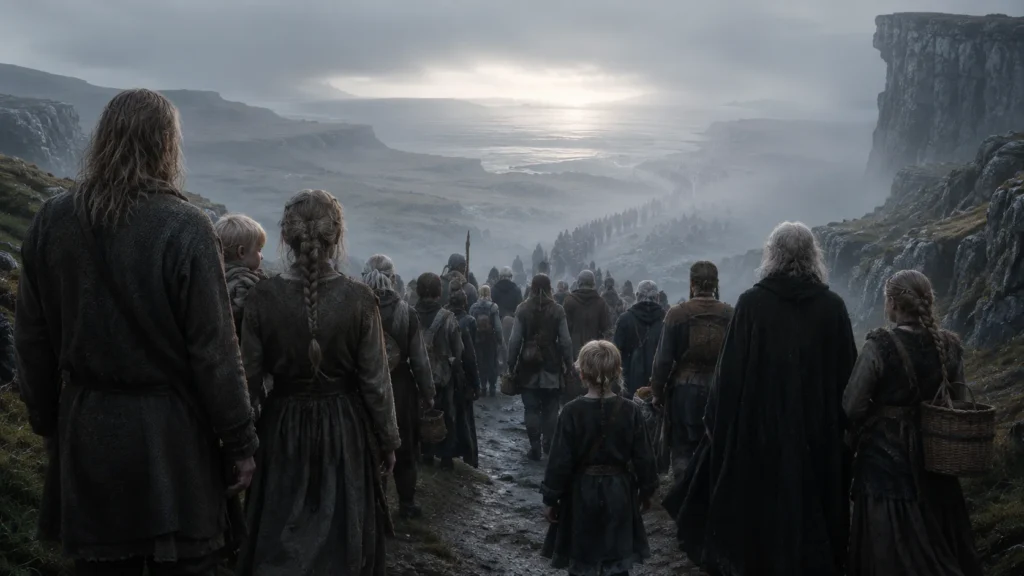
This means Hel was not a fringe figure of the Norse afterlife. She was the Norse afterlife, for nearly everyone. When a Viking Age family thought about where their dead parents were, where their lost children had gone, where they themselves would most likely end up, the honest answer was not Valhalla. It was the quiet grey halls of Hel.
Seen this way, her half-dead face takes on a different character. She is not the monster at the edge of the story. She is the hostess of humanity, the keeper of nearly everyone who ever lived. And the sources never describe her mistreating the ordinary dead in her care. She administers. She keeps. She is, in the most literal sense, the last authority almost everyone would ever answer to.
Hel’s Greatest Moment: The Death of Baldr
If you want to understand Hel’s true power, look at the one story where she takes center stage. It is the pivotal tragedy of Norse mythology, and she decides how it ends.
Baldr, son of Odin and Frigg, the most beloved of all the gods, is killed through the scheming of Loki, who guides a dart of mistletoe into the hands of the blind god Höðr. Baldr does not die in battle. And so, by the very rules the gods themselves established, he does not go to Valhalla. He goes down the Hel-road, into the realm of his enemies’ daughter.
The gods are devastated. Frigg asks who among them will ride to Hel to ransom Baldr back. Hermóðr volunteers, borrows Odin’s eight-legged horse Sleipnir, and makes the nine-night descent. He finds Baldr seated in the hall of the dead, honored, in the high seat. And he begs Hel to release him, telling her of the weeping of the gods and the grief of all the worlds.
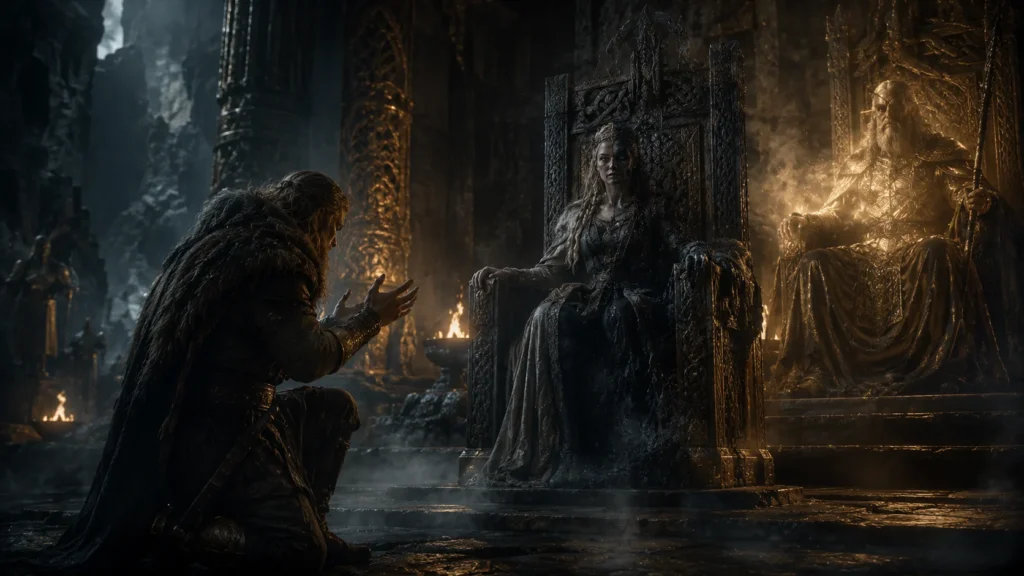
Hel’s answer is one of the most extraordinary moments in the sources. She does not refuse. She does not surrender. She sets a condition: if everything in the cosmos, living and dead, weeps for Baldr, she will release him. If even one thing refuses, he stays.
Consider what this scene actually shows. The entire pantheon of Asgard, Odin included, wants Baldr back. And they cannot take him. They cannot command Hel, cannot threaten her, cannot trade with her. The gods who bound her brother with chains and drowned her other brother in the sea can do nothing here but plead, and accept her terms. In her own realm, the exiled daughter of Loki outranks the king of the gods.
The gods send messengers across all the worlds, and everything weeps: people, animals, stones, metals. But in a cave sits a giantess named Þökk who refuses, saying Hel should keep what she holds. The giantess, the sources strongly imply, is Loki in disguise. One voice withholds its tears, and the condition fails.
And Hel keeps Baldr. The most beloved god in the cosmos remains in the grey halls until after Ragnarök, because the queen of the dead said so, and no power existed that could overrule her.
She is the only being in Norse mythology who defeats the entire pantheon without lifting a weapon.
Hel at Ragnarök
Hel’s role in the final battle is quieter than that of her brothers, and the sources are more fragmentary about it, but her contribution may be the largest of all.
At Ragnarök, her father Loki breaks free of his bonds and sails against the gods aboard Naglfar, the ship built from the untrimmed nails of the dead. The armies he leads include the hosts of the dead from Hel’s realm, the uncounted generations who died the ordinary deaths of sickness and age, now marching against Asgard.
Her brothers take the great duels: Fenrir devours Odin, and Jörmungandr kills Thor at the cost of his own life. Hel herself is not described fighting. Her fate in the battle is never recorded. But think about what she supplies: the numbers. Valhalla’s Einherjar were gathered warrior by chosen warrior across the ages precisely for this day. Hel’s population is everyone else. The dead of the whole of human history sail with Loki, and they sail from her kingdom.
Even here, at the end of the world, she remains what she always was: not a fighter, but a keeper of multitudes. The gods spent eternity recruiting an elite. Hel simply received everyone, and in the end, everyone came back.
Is Hel Evil? The Deeper Reading
The instinct to cast Hel as a villain is modern, and the sources resist it at every turn.
Look at what she actually does across the entire mythology. She accepts the exile imposed on her as a child, without rebellion. She administers the realm she was given, exactly as charged. She houses the ordinary dead, and nothing in the sources describes her tormenting them; the genuinely wicked are punished elsewhere, at Náströnd, and the texts do not even clearly place that punishment in her hands. When the gods come begging for Baldr, she does not gloat or refuse. She names a fair, cosmic-scale condition, and abides by its outcome. Even her participation in Ragnarök is, in the sources, more her father’s doing than her own ambition.
What emerges is not a devil. It is something the Norse understood far better than we do: an impartial power. Hel does not hate the dead or love them. She keeps them. She is the personification of the one fact no god, hero, or king in the Norse world could bargain away: that death receives everyone, plays no favorites, and does not give back.
The Norse placed the warrior’s death under Odin and Freyja, wrapped in glory and selection. But the common death, the one waiting for nearly everyone, they placed under Hel. Grim, yes. Fierce-looking, yes. But never cruel, never deceitful, and never once, in any surviving source, unjust.
Her name means “the hidden one.” That may be the deepest truth about her. Death, for the Norse, was not a monster that hunted you. It was a quiet, half-lit queen in a hall below the world, keeping what came to her, hidden until the day you made the journey yourself.
Hel in the Primary Sources
For readers who want to go directly to the medieval texts, here is where Hel appears.
The Prose Edda, written around 1220 CE by the Icelandic scholar Snorri Sturluson, contains the fullest account. The Gylfaginning section describes her parentage, her casting into Niflheim, her authority over those who die of sickness and old age, her half-dead appearance, and the remarkable inventory of her hall Éljúðnir. It also preserves the complete story of Baldr’s death and Hermóðr’s ride to Hel.
The Poetic Edda refers to Hel and her realm across several poems. The Völuspá describes the road to Hel and the events of Ragnarök. Grímnismál places her dwelling beneath one of the three roots of Yggdrasil. The phrase “to go to Hel” appears throughout Old Norse literature simply meaning to die.
Beyond the Eddas, Hel appears in Heimskringla and in skaldic poetry from as early as the 9th and 10th centuries, where dying is described as “going into Hel’s embrace.” The 12th-century Latin history Gesta Danorum by Saxo Grammaticus includes a figure generally understood to be Hel, appearing in a dream to the hero Balderus as the herald of his coming death.
One scholarly debate is worth knowing about. Some researchers have argued that Hel began as a place, the hidden realm of the grave, and only later became personified as a goddess; others see in her a genuinely ancient underworld deity with parallels across Indo-European mythology. The sources we have were written down by Christians centuries after the conversion, so certainty is impossible. What is certain is that by the time the Eddas were compiled, the Norse imagined death itself with a face: half living, half gone.
The Legacy: How Hel Became “Hell”
Hel left a mark on the modern world that few Norse figures can match: her name is in your vocabulary.
The Old Norse Hel comes from a Proto-Germanic root meaning “to hide” or “to conceal,” the same root that produced the Old English hell. When Christianity spread through the Germanic world, missionaries needed a word for the place of the damned, and they reached for the one the converts already knew: the name of the hidden realm of the dead. The word survived. The meaning transformed.
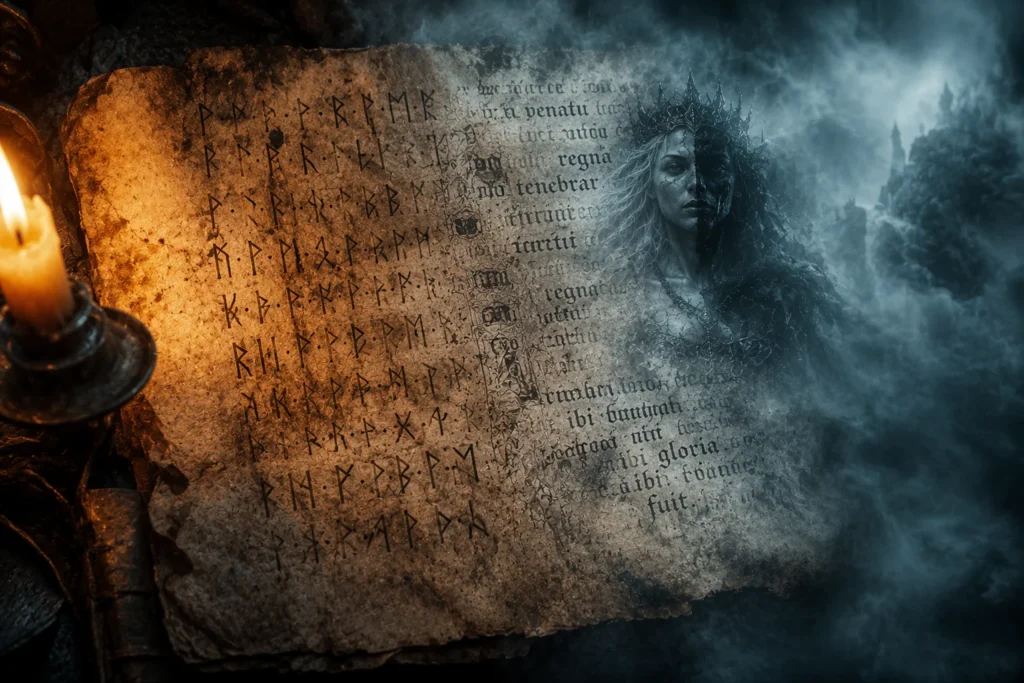
And the transformation is the point. The Christian hell is hot, punitive, and moral: you are sent there for what you did. The Norse Hel is cold, neutral, and universal: you go there simply because you died. In borrowing her name, the new faith inverted almost everything about her realm except the descent. Every time the word “hell” is spoken in English, it carries the ghost of a half-dead Norse queen whose kingdom punished no one.
She also endures in the modern imagination, from Marvel’s Hela to video games and fantasy literature, almost always transformed into an active villain. The real figure, the impartial keeper of the ordinary dead, remains largely untold. Her story, like her name, stayed hidden. For the full chronological picture of where she fits, from the birth of Loki’s children to the last battle, our complete Norse mythology timeline maps every major event of the cosmos.
Frequently Asked Questions
Who is Hel in Norse mythology?
Hel is the being who rules the realm of the dead in Norse mythology, a realm that shares her name. She is the daughter of Loki and the giantess Angrboða, and the sister of the wolf Fenrir and the serpent Jörmungandr. Odin appointed her to rule over those who die of sickness and old age, which made her the ruler of the vast majority of the dead.
Is Hel the daughter of Odin or Loki?
Hel is the daughter of Loki, not Odin. The idea that she is Odin’s firstborn daughter comes from Marvel’s Thor: Ragnarok and has no basis in the Norse sources. In the Poetic Edda, Prose Edda, and Heimskringla, she is consistently identified as Loki’s daughter by the giantess Angrboða.
What does Hel look like?
The Prose Edda describes Hel as half flesh-colored and half blue-black: one half of her body appears as a living woman, the other as a corpse. Snorri Sturluson adds that she is easily recognized by this, and that her expression is downcast and fierce. Her appearance embodies her position on the boundary between life and death.
Is Hel’s realm the same as the Christian hell?
No, though the Christian word “hell” derives directly from her name. The realm of Hel is cold, grey, and quiet, but it is not a place of punishment. Ordinary people who died of sickness or old age simply continued a dim existence there. Real torment was reserved for a separate place called Náströnd, where oath-breakers and murderers were punished.
Who goes to Hel instead of Valhalla?
Everyone who does not die in battle: those who die of sickness, old age, or accident. Since battle-death was the exception rather than the rule, the vast majority of people in the Norse world expected to go to Hel. Valhalla and Fólkvangr received only chosen warriors who fell in combat.
What is Hel’s role in the death of Baldr?
When the god Baldr died outside of battle, he came under Hel’s authority. When the gods sent Hermóðr to beg for his return, Hel set a condition: everything in the cosmos must weep for Baldr. One giantess, believed to be Loki in disguise, refused, and Hel kept Baldr in her realm until after Ragnarök. Not even Odin could overrule her decision.
Is Hel evil in Norse mythology?
No. The sources never portray Hel as cruel, deceitful, or unjust. She accepts the role Odin assigned her, administers her realm exactly as charged, and deals fairly even with the gods during the Baldr episode. She is best understood as an impartial power: the personification of death itself, which receives everyone and plays no favorites.
What happens to Hel at Ragnarök?
The sources describe the hosts of the dead from her realm sailing with Loki aboard the ship Naglfar to fight the gods, but Hel’s own fate in the final battle is never recorded. Unlike her brothers Fenrir and Jörmungandr, who die fighting Odin and Thor, Hel has no recorded duel and no recorded death.
What is Helheim like?
Helheim is cold, grey, and quiet, but not a place of torment. Hel’s hall Éljúðnir gives the mood through its furnishings: her dish is named Hunger, her knife Famine, her bed Sick-bed. The ordinary dead simply continue a dim existence there, receiving board and lodging under an impartial queen.
The Hidden Queen
Somewhere below the world, down nine nights of darkness and across a river of the dead, a hall stands in the mist. The dish on its table is called Hunger. The bed is called Sick-bed. And on the throne sits a queen with a living face on one side and a dead one on the other, keeping what has come to her since the beginning of the world.
The gods feared her brothers, and her brothers died at Ragnarök. Fenrir was bound and fell to Odin’s avenger. Jörmungandr was cast into the sea and fell to Thor’s hammer. Hel was thrown into the dark, and she alone was given a crown. She never fought the gods, and she never lost to them. When they came to her hall to beg, she named her terms, and the terms held.
Of all the children of Loki, the quietest one won.
Her name means the hidden one, and she has kept that name’s promise for a thousand years, hidden behind the golden noise of Valhalla, hidden behind a Marvel villain wearing her crown, hidden in plain sight inside the most common word for the underworld in the English language. But she was never gone. She is the answer to the question the Norse asked more honestly than most cultures ever have: not “how do heroes die,” but “where do the rest of us go.”
To the hidden one. To the keeper. To Hel.
And if you want to stand at her gates, our track Heljar Dyr (The Doors of Hel), sung in Old Norse, is the sound of the Helgrind opening.





All five albums and every single: 86 songs in WAV and MP3, yours to keep.