

Norns in Norse Mythology: The Goddesses of Fate Who Even Odin Cannot Defy
On this page 13 sections
- Who Are the Norns? A Quick Introduction
- Where the Norns Came From
- What the Norns Do
- The Difference Between Urd, Verdandi, and Skuld
- The Norns and Wyrd: The Norse Concept of Fate
- The Norns and Yggdrasil
- The Norns and the Gods
- The Norns at Ragnarök
- Beyond the Three: Other Norns in the Eddas
- Norns vs the Greek Fates: The Crucial Differences
- The Norns in Modern Imagination
- Frequently Asked Questions
- The Norns in Text and Modern Imagination
The Norns are female beings associated with fate in Old Norse literature. The best-known three—Urðr, Verðandi, and Skuld—appear in Völuspá, while Snorri’s Gylfaginning also describes many norns who shape the lives of people at birth.
The sources do not show the three spinning, measuring, and cutting one thread of life each. That familiar loom belongs primarily to the Greek Moirai and to later art. Völuspá instead says the three carved on wood, established laws, and chose lives; Snorri places them beside Urðarbrunnr at Yggdrasil.
Their names invite temporal translations such as “what happened,” “what is becoming,” and “what shall or must be.” Turning those etymologies into a complete past–present–future job description, however, is a modern synthesis rather than an explanation given by the poem.
This guide follows the Poetic Edda and the Faulkes edition of Snorri’s Edda source by source, naming what they say and what later retellings add.
While you read, the atmospheric music of Mythic Harmonies draws from the same Old Norse literary world.
Who Are the Norns? A Quick Introduction
Who are the Norns? In Völuspá stanza 20, three “deeply knowing” maidens come from the hall beside the tree. They are named Urðr, Verðandi, and Skuld; they carve on wood, establish laws, and choose lives for human beings.
- Urðr: a name related to what has happened and to the Old Norse noun for fate.
- Verðandi: a participial form related to becoming or happening.
- Skuld: related to what shall or must be, with senses also connected to obligation or debt.
These translations explain the names; the poem does not explicitly assign “the past” to Urðr, “the present” to Verðandi, and “the future” to Skuld as three separate cosmic departments.
Where the Norns Came From
The surviving sources do not provide a genealogy for Urðr, Verðandi, and Skuld. Völuspá introduces them as coming from a hall beside the tree; it does not say that they existed before every god or that they created time.
Snorri preserves a broader and partly different picture. In Gylfaginning, the three named maidens live by Urðarbrunnr, but there are also many norns of different origins who come to newborn children and shape their lives. The absence of one complete origin story should remain an absence, not become a hidden cosmological doctrine.
What the Norns Do
The texts give the Norns several related roles, but not one standardized ritual system. Völuspá says the three carve on wood, establish laws, and choose lives. Snorri says norns come to people at birth and describes the three by Urðarbrunnr tending Yggdrasil with water and clay from the well.
Neither source gives Urðr, Verðandi, and Skuld a loom. The spinning and cut thread belong to Greek and later comparative imagery. This is why the visual below is labelled as modern editorial art rather than evidence.

1. They Shape or Choose Lives
This is the strongest common ground between the poem and Snorri: the Norns are connected with the course or fortune of lives. The texts do not specify one thread’s length, color, and pattern for every being, nor do they explain a universal mechanism that removes all choice.
2. They Tend Yggdrasil in Snorri’s Account
Gylfaginning says the norns living beside Urðarbrunnr take water and clay from the well and pour it over the ash so that its branches do not decay. This is a specific statement in Snorri’s thirteenth-century prose account, not a ritual described uniformly across every Old Norse source.
3. Did the Norns Carve Runes?
Völuspá says they carved on wood; it does not call the marks runes, identify the surface as Yggdrasil, or connect them with the Elder Futhark. Reading the passage beside Odin’s runic ordeal in Hávamál can inspire a modern interpretation, but no source says Odin copied a primordial runic system created by the Norns.
For the broader test separating historical forms from later symbolic systems, consult the evidence index of Viking, medieval, and modern symbols.
The Difference Between Urd, Verdandi, and Skuld
The names are distinct and etymologically meaningful. What is not securely attested is the familiar chart that assigns one full temporal office—past, present, or future—to each Norn.

This is a modern editorial visualization. The Eddas do not assign each figure a separate loom-based office for past, present, and future.
Urðr — Fate and What Has Happened
Urðr is related to a past participle of verða, “to become/happen,” and is also an Old Norse word for fate. Translating the name with reference to what has happened is linguistically defensible; depicting her as the eldest archivist who alone controls the past is later elaboration.
Verðandi — Becoming or Happening
Verðandi is a present participial form related to becoming or happening. That supports the translation; it does not prove a separate Eddic role in which she alone weaves every present instant.
Skuld — What Shall or Must Be
Skuld is related to skulu, “shall/must,” and to obligation or debt. She is also named among valkyries in Völuspá. The sources do not explicitly make her the sole cutter of future lives; that role is often imported from the Greek third Fate.
The safest conclusion is precise: the names have temporal grammar, while the complete three-stage model is an influential modern interpretation.
The Norns and Wyrd: The Norse Concept of Fate
Wyrd is Old English, not Old Norse. Its semantic range includes what happens, event, fortune, lot, and fate. Old Norse texts use related but non-identical words such as urðr and örlög.
The surviving material does not define one closed “Norse fate system” in which ancestral actions become threads and the three Norns administer cause and effect. Poems and prose offer separate images—carving, allotment, laws, birth, cords, and in another poem battle-weaving by valkyries. Modern retellings often combine them.
That does not make the synthesis useless; it makes it a synthesis. Our detailed guide to wyrd meaning separates Old English evidence, Old Norse parallels, and the modern Web of Wyrd motif.
The Norns and Yggdrasil
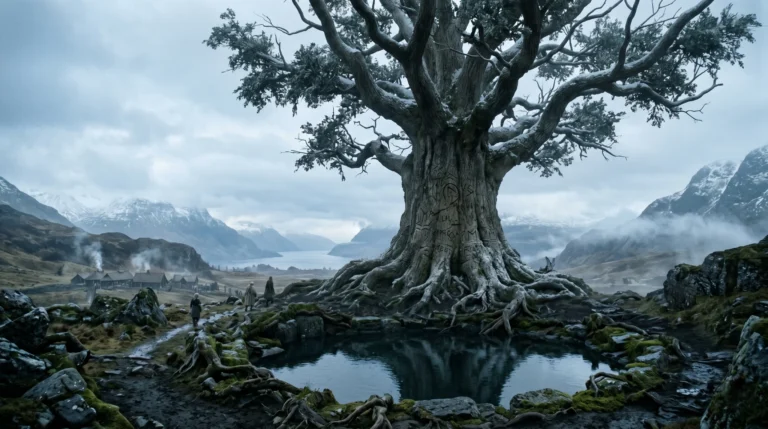
Snorri places the three named maidens in a hall beside Urðarbrunnr beneath the ash Yggdrasil. In Gylfaginning, they take water and clay from the well and pour it over the tree so that its branches do not decay.
This is strong evidence for their relationship with the World Tree in Snorri’s account. Claims that the well is literally the source of fate, that the Norns pour fate into reality, or that the cosmos would immediately collapse without a daily ceremony are interpretations not stated by the passage.

The Norns and the Gods
Are the Norns more powerful than Odin? The sources do not provide a formal ranking. They give norns authority over lives and fortune, and Norse poems repeatedly show that gods as well as humans face foretold deaths and limits.
Odin learns about Ragnarök and prepares for it, but no surviving passage says that Urðr, Verðandi, and Skuld personally wove the thread of his death or that he attempts and fails to rewrite it. “More powerful than Odin” is therefore a modern philosophical summary, not a quotation or rule from the Eddas.
The evidence supports a narrower and stronger statement: the mythological world contains fate-shaping powers that are not simply identical with Odin’s will.
The Norns at Ragnarök
The surviving Eddic accounts do not tell us whether the Norns survive Ragnarök. Völuspá describes the destruction and renewed world, and Gylfaginning retells that sequence, but neither explicitly places the three beside the well after the catastrophe.
Yggdrasil’s trembling does not by itself prove the later fate of every being associated with it. Saying that the same Norns weave the renewed world is a modern continuation of the story, not a preserved medieval detail.

Modern editorial interpretation; the survival of the Norns is not narrated in the Eddas.
Beyond the Three: Other Norns in the Eddas
Snorri’s Gylfaginning does not limit norns to the famous three. It says norns come to every newborn to shape the person’s life and distinguishes norns of different origins, including those associated with the Æsir, elves, and dwarfs.
Snorri also explains unequal fortunes through good and bad norns. This is his thirteenth-century prose presentation; it should not be turned into a claim that a fixed hierarchy of “minor norns” handles individuals while the principal three control the universe.
Later Scandinavian birth customs sometimes associated with norns belong to post-conversion folklore and need their own dating rather than being projected automatically into the Viking Age.
Norns vs the Greek Fates: The Crucial Differences
The Norns and the Greek Moirai are comparable because both traditions connect female figures with fate. The comparison becomes misleading when the Greek division—spinning, measuring, and cutting one life-thread—is presented as if it were stated in the Eddas.
The Old Norse evidence instead emphasizes carving and law in Völuspá, birth-fortune and care for Yggdrasil in Snorri, and many norns rather than only one trio. A shared Indo-European origin is a scholarly hypothesis, not something the medieval sources explain.
Shakespeare’s “weird” ultimately descends from Old English wyrd, but the Weird Sisters are not a direct documented survival of the three named Norns. The linguistic history and the mythological identification should be kept separate.
The Norns in Modern Imagination
Modern novels, games, tattoos, and art often present the Norns as three weavers of past, present, and future. That image is memorable and can be used creatively when it is labelled as modern reception.
The older textual record is less symmetrical and more interesting: three named figures in one poem, many norns in Snorri, carving rather than a loom, and no complete manual of fate or free will. Preserving those differences makes the tradition richer rather than weaker.
The Norse mythology timeline places the relevant poems and Snorri’s later prose account in their literary context.
Frequently Asked Questions
Who are the Norns in Norse mythology?
The Norns are female beings associated with fate in Old Norse literature. Völuspá names Urðr, Verðandi, and Skuld and says they carve on wood, establish laws, and choose lives. Snorri also describes many norns who come to people at birth. The Eddas do not give the famous trio a loom.
Are the Norns more powerful than Odin?
The sources do not rank the Norns against Odin in a simple power scale. Norns shape lives and fortune, while gods also face prophecy and death. Saying that the three personally wove Odin’s death or are categorically more powerful than him is a modern interpretation.
What is the difference between the Norns and the Greek Fates?
Both traditions connect female figures with fate, but spinning, measuring, and cutting a life-thread belong to the Greek Moirai. Völuspá describes the Norns carving and establishing laws; Snorri describes birth-fortune, many norns, and care for Yggdrasil.
What is the Well of Urd?
Urðarbrunnr is the well beside Yggdrasil where Snorri places the three named Norns. Gylfaginning says they take water and clay from it and pour the mixture over the ash so its branches do not decay. The text does not call the water a literal source of fate.
Do the Norns survive Ragnarök?
The surviving Eddic accounts do not say whether the Norns survive Ragnarök. They describe the catastrophe and renewed world but do not explicitly place Urðr, Verðandi, and Skuld beside the well afterward.
What does the name Urd mean?
Urðr is related both to what has happened and to an Old Norse noun for fate. This supports temporal translations of the name, but the Eddas do not explicitly appoint her as a separate ruler of the past.
Can humans change their fate in Norse mythology?
The surviving sources do not provide one systematic Norse answer to fate versus free will. They combine prophecy, allotted fortune, choices, and foretold outcomes in different narratives. A single thread-based theory of constrained choice is a modern synthesis.
What does the word Norn mean?
The etymology of “norn” is disputed, and no single literal translation is securely established. Proposed connections should be presented as proposals rather than used to prove that the Norns were originally weavers.
The Norns in Text and Modern Imagination
The image of three patient weavers beneath Yggdrasil is modern, but its creative power is easy to understand. It gathers separate Old Norse motifs—fate, carving, birth, law, the World Tree—and turns them into one memorable scene.
The medieval sources leave us something less tidy: three named figures in Völuspá, many norns in Snorri, carving rather than a loom, care for Yggdrasil in one prose account, and no statement that the same three survive Ragnarök. Naming those limits does not empty the myth; it lets readers see where the evidence ends and modern art begins.
Our song Call of the Norns deliberately belongs to that modern creative reception: it gives the weavers a voice without presenting the loom as an archaeological or Eddic fact.





All five albums and every single: 86 songs in WAV and MP3, yours to keep.