
The Children of Loki: All 6 of Them, Including the One He Gave Birth To
On this page 12 sections
- How Many Children Does Loki Have?
- The Mother of Monsters: Angrboða
- Fenrir: The Wolf Who Devours Odin
- Jörmungandr: The Serpent Who Kills Thor
- Hel: The Daughter Who Rules the Dead
- Sleipnir: The Child Loki Gave Birth To
- Narfi and Váli: The Sons Who Paid for Their Father
- The Two Váli Problem (And the Nari Confusion)
- One Family, One Apocalypse
- The Children of Loki in the Primary Sources
- Frequently Asked Questions
- The Household at the End of the World
One of his sons will devour the king of the gods. Another will kill the god of thunder. His daughter will rule over nearly all the dead. Another son will be torn apart by his own brother, and his entrails will bind his father to a rock until the end of the world. And one of his children, the strangest case of all, was not fathered by Loki.
Loki gave birth to that one himself.
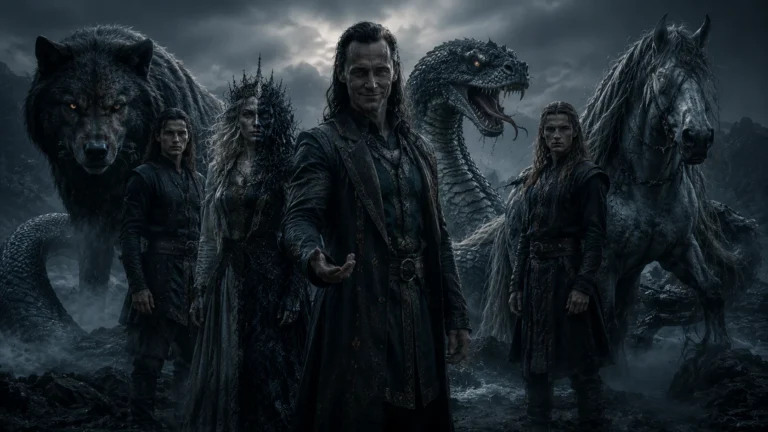
The family of Loki is unlike anything else in world mythology. It is not a family in any ordinary sense. It is a collection of living instruments of fate: a wolf, a serpent, a half-dead queen, an eight-legged horse, and two doomed brothers, all orbiting the most ambiguous figure in the Norse pantheon. Between them, the children of Loki bring about the death of Odin, the death of Thor, the imprisonment of their own father, and the unmaking of the world itself.
This article covers all six of them, drawn directly from the primary sources: the Poetic Edda and the Prose Edda of Snorri Sturluson. Who they were, who their mothers were, what the gods did to each of them, and why the Norse storytellers built an entire apocalypse out of a single family tree. Along the way, we will untangle two confusions that trip up almost every popular retelling: the two different gods named Váli, and the puzzle of Nari versus Narfi.
While you read, the atmospheric music of Mythic Harmonies on YouTube draws from the same Old Norse tradition that preserved the story of this family.
How Many Children Does Loki Have?
Loki has six children in the Norse sources. With the giantess Angrboða he fathered three: the wolf Fenrir, the World Serpent Jörmungandr, and Hel, ruler of the dead. With his wife, the goddess Sigyn, he fathered two sons: Narfi and Váli. And in the form of a mare, Loki himself gave birth to a sixth child: Sleipnir, the eight-legged horse that became Odin’s steed.
Some later folk traditions add other names, such as two daughters with a fire-giantess called Glut, but these do not appear in the Eddas and are generally considered late inventions rather than genuine Norse mythology. The Lokasenna also hints that Loki bore other children in female form, but no surviving myth explains the reference. The six above are the children the medieval sources actually attest.
Three monsters, two doomed brothers, and one horse. Here is each of them.
The Mother of Monsters: Angrboða
The three most famous children of Loki were born in Jötunheim, the land of giants, to the giantess Angrboða, whose name means “She Who Brings Grief” or “Herald of Sorrow.” The sources tell us little about her beyond her name and her offspring, but the name alone is a prophecy: everything she brought into the world became a grief for the gods.
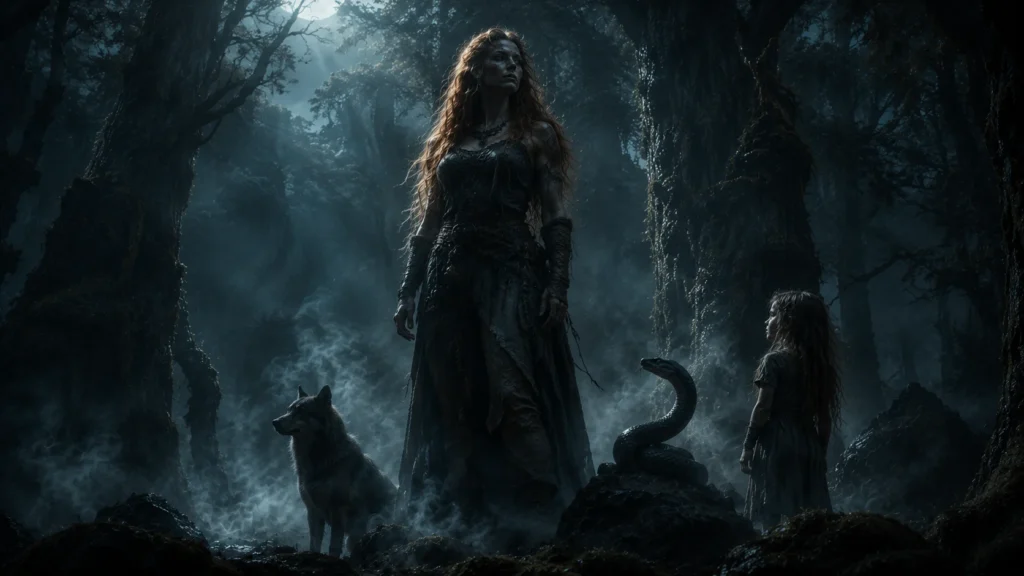
When the Aesir learned through prophecy that great misfortune would come from these three children, Odin had them seized and brought to Asgard. What the gods did next to each child shaped the entire future of the cosmos, and, as we will see, may have created the very dooms they were trying to prevent.
Fenrir: The Wolf Who Devours Odin
The first of the three is Fenrir, the great wolf. The gods chose to raise him in Asgard, where only the god Týr dared feed him. But the wolf grew at a terrifying pace, and the gods resolved to bind him. Two chains he shattered. The third, the dwarf-forged ribbon Gleipnir, held him, but only after Fenrir demanded a pledge of good faith: a god’s hand in his mouth. Týr paid that price, and the wolf took his hand.
Fenrir remains bound on a desolate island, a sword wedged in his jaws, until Ragnarök. When his chains finally break, he will fulfill the prophecy the gods tried to prevent: he will devour Odin himself, king of the gods, before being killed in turn by Odin’s son Víðarr.
His full story, from the three chains to the final duel, is told in our complete article on Fenrir, the wolf who will kill Odin.
Jörmungandr: The Serpent Who Kills Thor
The second child is Jörmungandr, the World Serpent. Odin cast him into the great ocean surrounding the human world, expecting the deep to dispose of him. Instead, the serpent grew until his body encircled the entire world of Midgard, gripping his own tail in his jaws. The execution became an enthronement: the discarded child became the living boundary of the cosmos itself.
Jörmungandr is the destined enemy of Thor. The two meet three times in the sources: once with the serpent disguised as a cat, once on a fishing trip that nearly ended the prophecy early, and finally at Ragnarök, where Thor kills the serpent and then falls dead from its venom after nine steps.
The full story of the serpent, including why calling him an ouroboros misreads the Norse sources, is in our complete article on Jörmungandr, the World Serpent.
Hel: The Daughter Who Rules the Dead
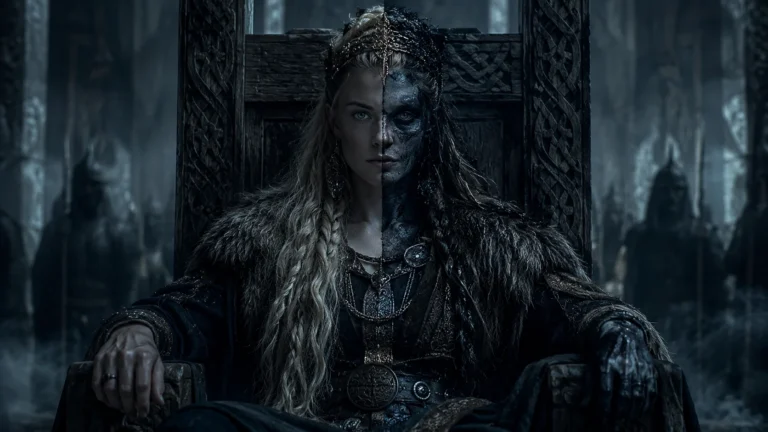
The third child is Hel, the only daughter. Half her body is that of a living woman, half bears the blue-black of a corpse. Odin cast her down into Niflheim, the world of mist, but her exile came with something her brothers never received: a crown. She was given authority over all who die of sickness and old age, which in the Norse world meant nearly everyone.
Of the three siblings, Hel is the quiet one, and arguably the most powerful. She never fights the gods, yet when Baldr, the most beloved god in the cosmos, dies and comes to her realm, the entire pantheon can do nothing but plead with her. She sets her terms. The terms are not met. She keeps Baldr, and not even Odin can overrule her.
Her full story, from the strange inventory of her hall to the word “hell” itself, is in our complete article on Hel, the Norse goddess of death.
Sleipnir: The Child Loki Gave Birth To
Now for the strangest story in the family, and one of the strangest in any mythology.
Early in the history of the gods, a builder arrived in Asgard and offered to raise an impenetrable wall around it in three seasons. His price was staggering: the goddess Freyja as his bride, plus the sun and the moon. On Loki’s advice, the gods accepted, but with conditions designed to make success impossible: one winter only, and no help from any man.
The builder asked for one concession: the use of his stallion, Svaðilfari. The gods, again on Loki’s counsel, agreed. It was a catastrophic mistake. The stallion hauled stones of such size, and at such speed, that as winter neared its end the wall was almost complete. The gods faced the unthinkable: handing over Freyja, the sun, and the moon, on a bargain Loki had talked them into.
So they turned on Loki and made the problem his, on pain of death. And Loki solved it the way only Loki could. That evening, as the builder drove Svaðilfari toward the stones, a beautiful mare trotted out of the forest and whinnied at the stallion. Svaðilfari snapped his tackle and chased her all night, and the builder’s work collapsed behind schedule. The enraged builder revealed himself to be a giant, and Thor ended the negotiation with Mjölnir.
But the mare did not return that night, or for many nights after. The mare was Loki in shifted form, and the chase had ended the way such chases do. Some time later, Loki came back to Asgard leading a grey foal with eight legs. He had carried the child himself, and given birth to him.
That foal was Sleipnir, “the sliding one,” and he grew into the greatest of all horses: the eight-legged steed of Odin, able to outrun anything alive and to travel between the worlds, even down the long dark road to the realm of the dead. When Hermóðr rode to Hel to plead for Baldr’s return, the horse that carried him was Sleipnir. Read that again with the family tree in mind: the gods sent one child of Loki to bargain with another.
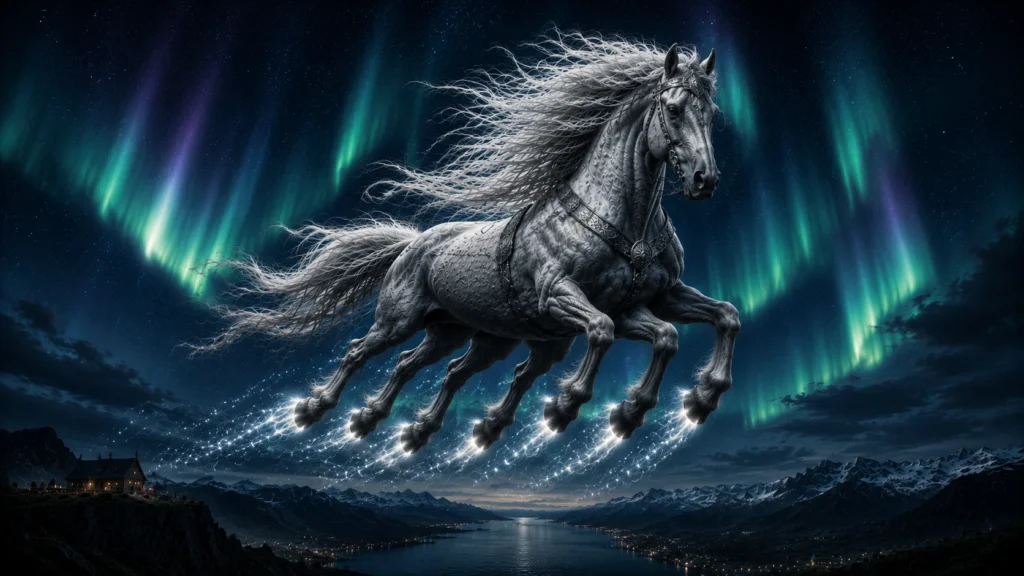
There is no embarrassment about any of this in the sources. Snorri reports it plainly, and the eight-legged horse became one of the most beloved images in Norse art, appearing on the picture stones of Gotland more than a thousand years ago. The Norse found it fitting, perhaps, that the best horse in the cosmos was born of the cleverest being in it, and that Odin’s most trusted companion was, by blood, a child of Loki.
There is even a linguistic wink hidden in Loki’s own name. Norse naming was patronymic: children carried their father’s name, Eiríksson, Þorvaldsdóttir. Yet the sources call Loki “Laufeyjarson”, son of his mother Laufey, one of mythology’s rare matronymics. The god who broke the naming rules would go on to become a mother himself. How those naming rules actually worked, from -son to -dóttir, is explored in our guide to Viking naming customs.
Narfi and Váli: The Sons Who Paid for Their Father
The last two children are the family’s tragedy, and the sources give them almost no life of their own. They exist in the myths for a single terrible scene.
With his wife Sigyn, a goddess of the Aesir, Loki had two sons: Narfi and Váli. Unlike their monstrous half-siblings, nothing suggests they were feared, prophesied about, or anything other than ordinary. That is precisely what makes their fate so dark.
After Loki engineered the death of Baldr and then insulted every god at Ægir’s feast, the Aesir finally hunted him down. They caught him in a river in salmon form, and they brought his two sons to the cave where he would be punished. There, the gods transformed Váli into a wolf. In his animal madness, Váli tore his brother Narfi apart. The gods then took Narfi’s entrails and used them to bind Loki to three stones, and the bonds turned to iron. A serpent was fixed above his face, dripping venom, and there Loki lies until Ragnarök.
Sigyn stayed. She stands beside her bound husband with a bowl, catching the venom before it strikes his face. But when the bowl fills, she must turn away to empty it, and in those moments the venom lands, and Loki convulses so violently that the earth itself shakes. The Norse used this image to explain earthquakes: every tremor is Loki writhing while a faithful wife empties a bowl.
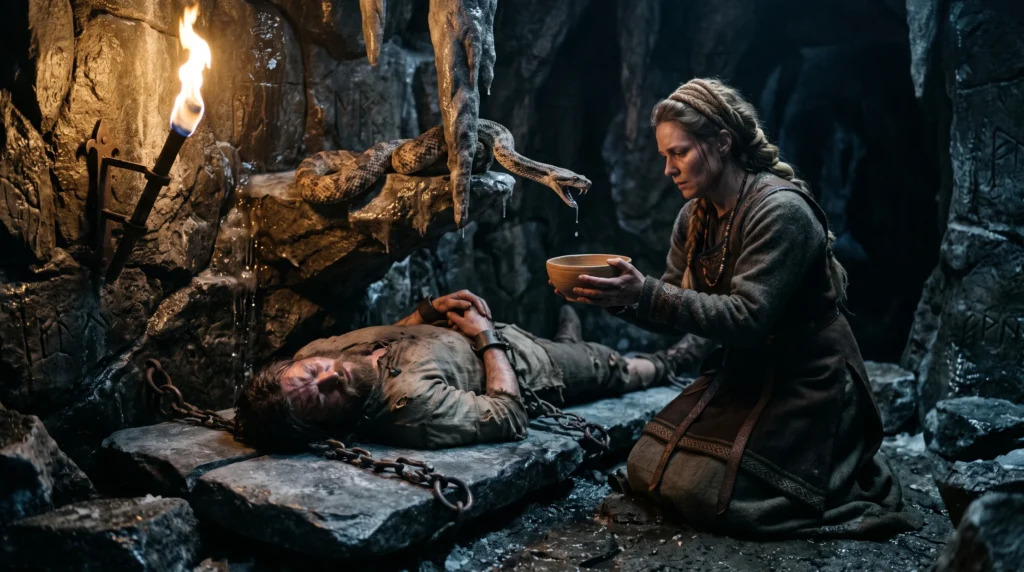
Neither brother did anything in the sources to deserve any of it. Their death and desecration exist purely as punishment aimed at their father, an eye-for-an-eye answer to the death of Odin’s son. If the monstrous children show how the gods treated what they feared, Narfi and Váli show how far the gods would go when they grieved.
The Two Váli Problem (And the Nari Confusion)
Two genuine confusions run through popular retellings of this family, and untangling them is worth a moment, because even careful readers get caught.
There are two different figures named Váli in Norse mythology. One is the son of Loki and Sigyn, transformed into a wolf to kill his brother. The other is a son of Odin, born specifically to avenge Baldr by killing the blind god Höðr, and destined to survive Ragnarök. They are not the same being. Many websites and even some books merge them into one, which produces the nonsensical image of a son of Odin being turned into a wolf to murder a son of Loki. The sources keep them distinct: Váli Lokason dies in the cave; Váli Odinson walks into the new world after the old one burns.
The name of the other brother is also unstable. Snorri’s Prose Edda calls him Nari or Narfi, treating the names as one person. The prose ending of the Eddic poem Lokasenna instead treats Nari and Narfi as two separate sons, with Narfi becoming the wolf. The manuscripts simply disagree, and honest scholarship says so rather than papering over it. What every version agrees on is the outcome: one son of Sigyn dies at the jaws of the other, and his entrails bind their father.
These inconsistencies are not flaws to hide. They are what a real oral tradition looks like when it is written down centuries later by different hands. The family of Loki comes to us in fragments, and the fragments do not always fit. That, too, is part of the story.
One Family, One Apocalypse
Step back and look at what this family accomplishes across the whole of Norse mythology, and a pattern emerges that no single article about any one child can show.
Fenrir kills Odin. Jörmungandr kills Thor. Hel keeps Baldr, which forecloses the gods’ one hope of undoing their greatest loss, and her realm supplies the armies of the dead that sail against Asgard. Narfi’s body binds Loki, which turns the trickster from an ambiguous insider into a committed enemy nursing his vengeance for an age. And Sleipnir, the one child the gods embraced, carries Odin faithfully until the end, a daily reminder in Asgard’s own stables that the line between the gods’ best friend and their doom runs through a single father.
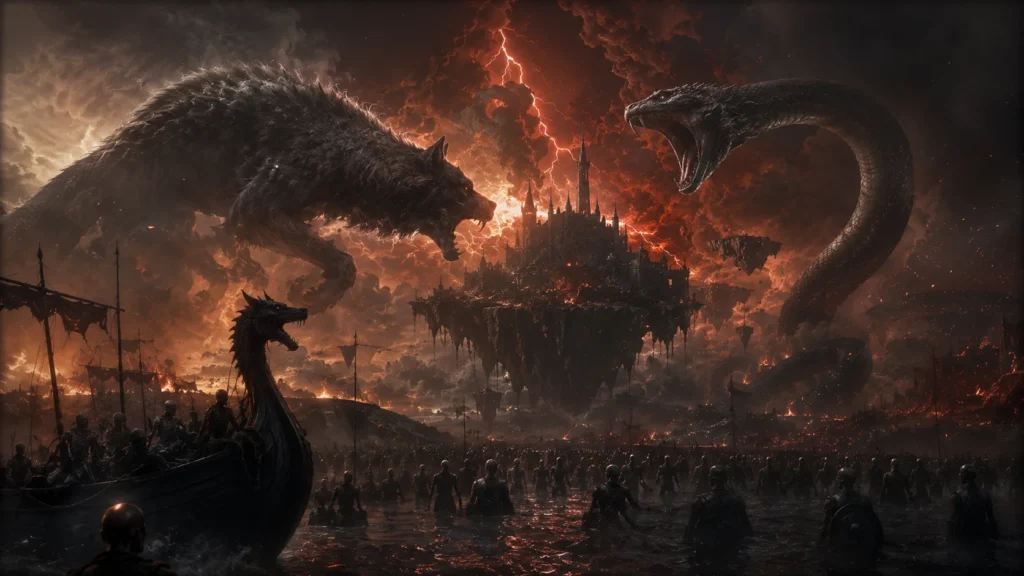
Here is the harder question the myths quietly ask: how much of this did the gods bring on themselves? The prophecy said Loki’s children would be their ruin, so the gods bound the wolf who had done nothing, drowned the serpent who had done nothing, exiled the girl who had done nothing, and butchered two sons who had done nothing. Every one of those acts either created an enemy or armed one. The wolf they chained learned hatred in his chains. The serpent they threw away grew into the sea itself. The daughter they banished became the power even they had to beg before. This is the same self-fulfilling logic that runs through the binding of Fenrir, and it may be the deepest idea in all of Norse myth: the fate the Norns weave is not imposed from outside. It is woven out of the choices of those who fear it.
The children of Loki are not villains who invade the story of the gods. They are the story of the gods, reflected back. Where the full pantheon of Aesir and Vanir represents order, the family of Loki is the account of everything order casts out, and of the price of casting it out. You can meet the whole divine cast in our complete guide to the Norse gods and goddesses, but you cannot understand why their world ends without understanding this one household.
The Children of Loki in the Primary Sources
For readers who want the medieval texts themselves, here is where the family appears.
The Prose Edda of Snorri Sturluson, written around 1220 CE, contains the fullest accounts: the Gylfaginning tells of the three children of Angrboða and the gods’ response to them, the building of Asgard’s wall and the birth of Sleipnir, and the binding of Loki with Narfi’s entrails. The Skáldskaparmál lists Loki’s kennings, naming him “father of Vánargandr” (Fenrir), “father of Jörmungandr and of Hel,” and “relative of Sleipnir.”
In the Poetic Edda, the Völuspá prophesies the roles of Fenrir and Jörmungandr at Ragnarök and shows Sigyn sitting beside her bound husband. The Lokasenna preserves the insult-match that seals Loki’s fate, along with its prose ending describing the punishment, and the poem’s taunts include references to Loki having borne children in female form. The Hyndluljóð names Angrboða as Fenrir’s mother.
As always with Norse mythology, these sources were written down by Christians centuries after the living tradition ended, and they occasionally contradict one another, as the Nari and Narfi problem shows. What we have are fragments of something once much larger. The wonder is how much of the family’s shape still comes through.
Frequently Asked Questions
How many children does Loki have in Norse mythology?
Loki has six children in the Norse sources. With the giantess Angrboða: the wolf Fenrir, the serpent Jörmungandr, and Hel, ruler of the dead. With his wife Sigyn: the sons Narfi and Váli. And as a mare, Loki himself gave birth to Sleipnir, the eight-legged horse of Odin.
Did Loki really give birth to Sleipnir?
Yes. In the Prose Edda, Loki shape-shifts into a mare to lure away the stallion Svaðilfari and sabotage the builder of Asgard’s wall. As a result of that encounter, Loki became pregnant and later gave birth to Sleipnir, the eight-legged foal who grew into Odin’s steed, the greatest of all horses.
Who is the mother of Fenrir, Jörmungandr, and Hel?
Their mother is Angrboða, a giantess of Jötunheim whose name means “She Who Brings Grief.” The Aesir learned through prophecy that her three children with Loki would bring great misfortune upon the gods, and Odin had all three seized and dealt with: Fenrir bound, Jörmungandr cast into the sea, and Hel sent to rule the dead in Niflheim.
Are Váli son of Loki and Váli son of Odin the same person?
No, and this is one of the most common confusions in Norse mythology. Váli son of Loki was transformed into a wolf by the gods and killed his brother Narfi as part of Loki’s punishment. Váli son of Odin is a completely different figure, born to avenge Baldr by killing Höðr, who survives Ragnarök. The sources keep the two distinct.
What happened to Narfi and Váli, the sons of Sigyn?
After Loki orchestrated the death of Baldr, the gods captured him and brought his two sons to his place of punishment. They transformed Váli into a wolf, and in his madness he tore his brother Narfi apart. The gods then used Narfi’s entrails to bind Loki to three stones until Ragnarök.
Which of Loki’s children kill gods at Ragnarök?
Two of them. Fenrir devours Odin, king of the gods, before being killed by Odin’s son Víðarr. Jörmungandr and Thor kill each other: Thor slays the serpent with Mjölnir, then dies from its venom after taking nine steps. Hel does not fight, but the hosts of the dead from her realm sail against the gods with Loki.
Who is Sigyn in Norse mythology?
Sigyn is a goddess of the Aesir and the faithful wife of Loki, mother of his sons Narfi and Váli. After Loki was bound, she chose to remain at his side, holding a bowl to catch the venom dripping onto his face from the serpent above him. Her name has become a byword for loyalty in the face of unbearable circumstances.
Why did the gods fear the children of Loki?
Because of prophecy. The gods learned that great harm would come to them from the children of Loki and Angrboða, so they acted preemptively: binding Fenrir, casting Jörmungandr into the sea, and exiling Hel to the world of the dead. The deep irony of the myth is that these preemptive strikes may have created the very enemies the prophecy foretold.
The Household at the End of the World
Every mythology has its monsters. What makes the Norse tradition different is that it gave its monsters a family, a father with a name and a smile, mothers, a loyal stepmother, brothers, and a childhood in the halls of the very gods they would one day destroy.
The children of Loki are the Norse answer to a question most traditions never dare ask: what does the end of the world look like from the inside of one family? A bound wolf remembering the hand he took. A serpent holding the sea shut around the world. A half-dead queen keeping the gods’ most beloved son. A horse in Odin’s stable, faithful to the end. A brother’s entrails hardened to iron in a cave where a wife empties a bowl, drop by drop, for centuries.
When Ragnarök finally comes, it does not come from outside the story. It comes home. The wolf, the serpent, and the hosts of the dead arrive at Asgard led by their father, and the gods fall to the family they made, feared, bound, and broke.
Six children. One apocalypse. And at the center of it all, the being who was clever enough to build the gods their wall, their hammer’s match, and their doom, and who carried one of those children himself, on four legs, through a long dark forest, at the beginning of the world.



All five albums and every single: 86 songs in WAV and MP3, yours to keep.
Mythic Harmonies has also turned this theme into a song: Loka Svǫik, on the album Shadows over Midgard.