
Wyrd Meaning: The Old English Fate Behind “Weird” (And What Norse Sources Actually Say)
Wyrd meaning, in one sentence: wyrd is an Old English word for what happens—an event, a turn of fortune, a person’s lot, or fate. It is the ancestor of modern English weird. It is not, strictly speaking, an Old Norse word, and the familiar nine-line “Web of Wyrd” is not known from any Viking Age object.
Those facts answer the basic question. They also prevent three common mistakes: treating wyrd as a single supernatural doctrine, calling it “the Viking word for fate,” and presenting a modern emblem as ancient archaeology.
The surviving evidence is more interesting than any of those shortcuts. In Old English poetry, wyrd can name fate, but it can also mean an event, an outcome, or the condition that has befallen someone. In Beowulf, it stands beside courage and divine judgment rather than erasing them. In Old Norse sources, related ideas appear through Urðr, örlög, the Norns, carving, allotment, cords, and weaving—but never as one complete system explained from beginning to end.
Wyrd at a glance
- Language: Old English, not Old Norse.
- Core meanings: what happens, event, fate, fortune, lot, or condition.
- Related Old Norse word: urðr, “fate,” also the name Urðr.
- Another Norse fate term: örlög or normalized ǫrlǫg, a plural noun associated with fate, doom, and “primal law” in the dictionary tradition.
- Famous literary use: Beowulf, especially lines 572–573.
- Modern descendant: English weird.
- Web of Wyrd symbol: modern, with its earliest documented form in a 1993 book.
Wyrd Meaning in Old English: Fate, Event, or What Happens?
The Bosworth–Toller Anglo-Saxon Dictionary begins with a deliberately broad definition: “what happens, fate, fortune, chance.” Its examples then extend across event, lot, condition, death, personified Fate, and the classical Fates used as a Latin gloss.
That range is the key to translating the word responsibly. Fate is often right, but it is not automatically right in every sentence. A translator may need event, outcome, circumstance, fortune, lot, or what came to pass instead.
This is why the best short definition is not a mystical formula:
Wyrd means fate, fortune, an event, or what comes to pass in Old English; context decides how fixed or supernatural it sounds.
The noun is grammatically feminine. That fact can support personification in some passages, but grammatical gender does not turn every occurrence into a goddess. Old English writers could speak of wyrd as an active force, use its plural for events, or place it inside a Christian account of providence.
Is wyrd a goddess or a force?
Sometimes it is personified; often it is not. Bosworth–Toller records uses comparable to the classical Fates, as well as lines where wyrd acts dramatically. The same entry also records ordinary senses such as an event, a hidden circumstance, a person’s lot, or a series of happenings.
Calling Wyrd “the Anglo-Saxon goddess of fate” therefore turns one possible literary use into a universal rule. It is safer to say that wyrd can be personified as Fate, while the word itself has a much wider semantic range.
Wyrd, “Becoming,” and the Origin of Weird
Wyrd belongs to a Germanic word family concerned with becoming and coming to pass. It is related to Old English weorðan, “to become” or “to happen,” and to Old Norse verða. The historical idea inside the word is not simply a script stored in the future; it is also the event that has become real.
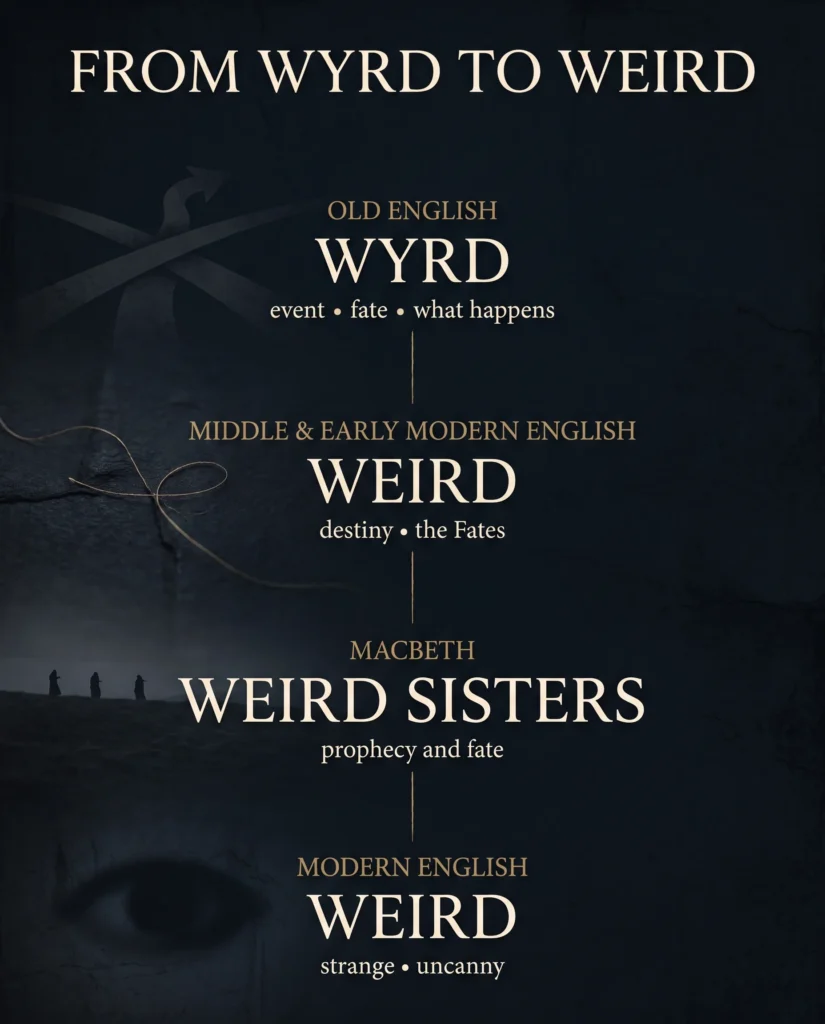
Modern English weird descends from this older noun. The semantic path did not jump directly from “fate” to “strange.” In late medieval and early modern English, weird could still refer to destiny or to beings with power over it.
Shakespeare’s “Weird Sisters” preserve that intermediate world. The three figures in Macbeth are strange, but their defining function is prophecy. The Folger Shakespeare Library’s text of Macbeth lets readers check the phrase in the play, while the Folger’s historical discussion of the sisters follows their changing life on stage.
The everyday adjective meaning odd or uncanny became dominant much later. The older sense survives whenever the witches are called the Weird Sisters—even if a modern audience hears “strange” first and “fateful” only after explanation.
How do you pronounce wyrd?
Modern English speakers commonly say it like weird. That is a practical reading, not an exact reconstruction of Old English pronunciation. The Old English vowel represented by y was a rounded front vowel, closer to French u or German ü than to the vowel most English speakers use today. For a general English article, “like weird, approximately” is honest; pretending that modern pronunciation is identical is not.
Wyrd in Beowulf: More Than One Kind of Fate
Beowulf is the best-known place to watch the word change with its context. The poem survives in a Christian manuscript and tells stories set in a pre-Christian heroic past. Its language can place inherited vocabulary of fate beside the Creator, God’s judgment, personal courage, and the consequences of human decisions.
That mixture is not a flaw to be solved. It is the evidence.
“Wyrd goes as it must” — line 455
Before fighting Grendel, Beowulf says that the outcome will go as it must: Gæð a wyrd swa hio scel. The line is often rendered as “Fate goes ever as it must.” Yet in the surrounding speech, Beowulf also leaves judgment to God.
The passage does not offer a clean opposition between pagan fate and Christian providence. It shows that the poet can use both vocabularies in one dramatic situation. What will happen is beyond Beowulf’s control, but choosing to fight is not.
“Wyrd often saves the undoomed man” — lines 572–573
During the story of his swimming contest, Beowulf says:
Wyrd oft nereð unfægne eorl, þonne his ellen dēah.
A close translation is: “Wyrd often saves an undoomed man when his courage holds.” The Old English line and its context can be checked in Benjamin Slade’s annotated Beowulf, lines 572–573.
The sentence matters because it refuses simple fatalism. The man is unfægne—not doomed to die—but his ellen, his courage or heroic strength, still has to be effective. Wyrd and action occupy the same line.
This does not prove that every Anglo-Saxon believed in free will according to one formal doctrine. It proves something narrower and more secure: the poem does not make human courage meaningless merely because it speaks of wyrd.
Wyrd can destroy, deny, or simply describe events
Elsewhere in the poem, wyrd behaves differently. It sweeps men into Grendel’s terror; it is associated with Hygelac’s death; it denies Beowulf victory in the final dragon fight. In another passage, the plural wyrda belongs with worda—events and words—showing that a cosmic translation would be excessive there.
The complete Rutgers Old English Poetry Project edition of Beowulf is useful precisely because readers can compare each occurrence with the whole poem rather than isolate one slogan.
| Passage | Narrative setting | What wyrd contributes |
|---|---|---|
| Line 455 | Beowulf accepts the unknown outcome before Grendel | Necessity or the course events must take |
| Lines 572–573 | Beowulf recalls surviving the sea | Fate and courage working in the same sentence |
| Line 1205 | The death of Hygelac is remembered | A destructive or personified force |
| Line 2574 | Beowulf’s last battle turns against him | Fate denying the victory he once expected |
| Line 3030 | A messenger recounts events and words | “Events” rather than a supernatural being |
The lesson is methodological: the meaning of wyrd must be read locally before it is turned into a philosophy.
The Wanderer and the Problem with “Inexorable Fate”
Another famous half-line appears near the beginning of The Wanderer: wyrd bið ful aræd. It is traditionally translated along the lines of “Fate is wholly inexorable.” That translation has become so familiar that it is often presented as a direct window into a fatalistic Anglo-Saxon worldview.
The wording is less secure than the slogan suggests. Ophelia Eryn Hostetter’s Rutgers Old English Poetry Project commentary explains the grammatical and interpretive problems and argues for reading wyrd as the course of events or “way of the world,” not automatically as a divine Fate.
The point is not that the traditional translation must be banned. The point is that it is an interpretation. A premium historical article should show readers where scholars disagree instead of presenting the most dramatic English wording as the only possible meaning.
Wyrd, God, and Christian Providence
Old English literature was copied and often composed in a Christian intellectual world. That matters whenever modern writers try to extract a pure pre-Christian “religion of wyrd” from surviving poems.
The Old English adaptation of Boethius provides a particularly clear warning. In material cited by Bosworth–Toller, providence is associated with God’s forethought, while wyrd can describe the way that divine ordering unfolds in created events. Here the word is not a rival pagan deity fighting the Christian God. It has been incorporated into Christian philosophy.
Beowulf is not simply the Old English Boethius, and its layers remain debated. Still, the comparison proves that the same noun could operate inside more than one intellectual framework. Richard North’s Cambridge chapter “Wyrd: ‘Event’ or ‘Fate’, Norn or Fortune” surveys that range and the history of interpreting it.
There is no responsible route from one poetic line to a complete, uniform Anglo-Saxon theology.
Is Wyrd Norse or Viking?
No. Wyrd is Old English. The peoples who spoke Old English and Old Norse inherited related Germanic vocabulary, but related languages are not interchangeable.
The closest Old Norse cognate is urðr. The Cleasby–Vigfusson dictionary entry for urðr defines it as fate and records it as the name of one of the three famous Norns. It also notes that the common noun was obsolete in prose, an important complication that disappears from many modern summaries.
Old Norse also uses örlög—normalized more strictly as ǫrlǫg—a neuter plural noun. Cleasby–Vigfusson’s ör-lög entry gives “primal law, fate, weird, doom” and cites Völuspá, Hávamál, sagas, and compounds involving the threads of fate.
| Term | Language | Secure minimum | Claim to avoid |
|---|---|---|---|
| wyrd | Old English | Event, outcome, fate, fortune, lot, what happens | “The Viking word for fate” |
| urðr | Old Norse | Fate; also Urðr, one of the Norns | A complete doctrine proved by the word alone |
| örlög / ǫrlǫg | Old Norse, plural | Fate, doom, allotted or primal law | A precise system of ancestral karma described in the Eddas |
The terms overlap, but they do not provide interchangeable labels for one lost textbook of Germanic destiny.
What Do the Norse Sources Actually Say?
The Old Norse evidence becomes clearest when each source is allowed to say only what its words support.
Völuspá: carving, laws, lives, and örlög
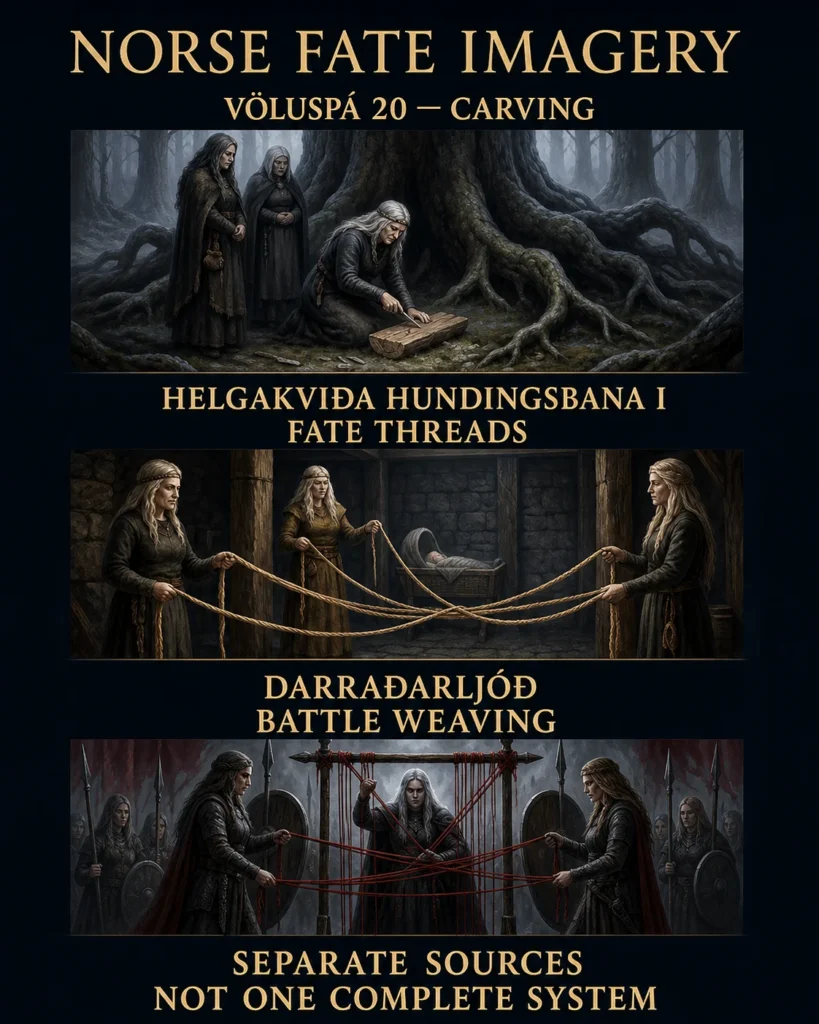
In stanza 20 of Völuspá, three powerful maidens—Urðr, Verðandi, and Skuld—come from the hall beneath the tree. They carve on wood, establish laws, choose lives for human beings, and speak or set örlög.
The verbs matter. This stanza supports inscription, law, allotment, and fate. It does not mention a nine-line diagram. It does not formally label the three women “Past, Present, and Future.” It does not explain that each ancestral choice adds a strand to a personal cosmic web.
Readers wanting the beings rather than the word can continue with the Norns in Norse mythology. The wider setting is explained in the guide to Yggdrasil and the Nine Realms.
Snorri: many Norns, appointed lives, and the Well of Urðr
In Gylfaginning, Snorri Sturluson names Urðr, Verðandi, and Skuld at the well and says that they determine the span of people’s lives. He also describes many other Norns who come to children at birth to appoint their lives. The Norns at the well draw water and clay and apply them to Yggdrasil so that its branches do not wither or rot.
The Viking Society for Northern Research provides Anthony Faulkes’s scholarly edition of Edda: Prologue and Gylfaginning. It is a stronger reference than an anonymous retelling because readers can verify the source, edition, and chapter.
Snorri gives a structured account, but he wrote in thirteenth-century Iceland, after conversion. His testimony is indispensable, not transparent access to Viking Age belief without mediation.
Did the Norns Weave Fate?
Yes, textile imagery connected with supernatural women and fate is attested—but not in the exact form modern art usually presents.
Völuspá stanza 20 gives the three named Norns carving, not sitting at a loom. Snorri describes appointed lives and the care of Yggdrasil. Elsewhere, however, the corpus does contain cords, spinning, and weaving:
- In Helgakviða Hundingsbana I, Norns arrive at Helgi’s birth and powerfully twist or spin örlögþættir, threads of fate. The Old Norse text of stanzas 2–4 preserves the vocabulary directly.
- In Darraðarljóð, preserved in Njáls saga, valkyries weave the outcome of battle on a terrible loom made from human bodies and weapons.
- In Völundarkviða, valkyrie-like maidens spin linen, adding another textile image to this wider complex of supernatural women.
What the Eddas do not provide is the standard Greek division reproduced in modern illustrations: one woman spins, one measures, and one cuts. That belongs to the Moirai in later classical tradition, not to a direct Norse passage assigning those three jobs to Urðr, Verðandi, and Skuld.
The accurate conclusion is therefore balanced: Norse fate-thread and weaving imagery is real; the familiar three-woman loom system is a modern synthesis.
Is the Web of Wyrd an Authentic Viking Symbol?
The underlying imagery has old roots. The nine-line emblem is modern.
The design now called the “Web of Wyrd” or “Skuld’s Net” usually contains three sets of three intersecting lines. It is widely said to include every rune and to represent the past, present, and future.
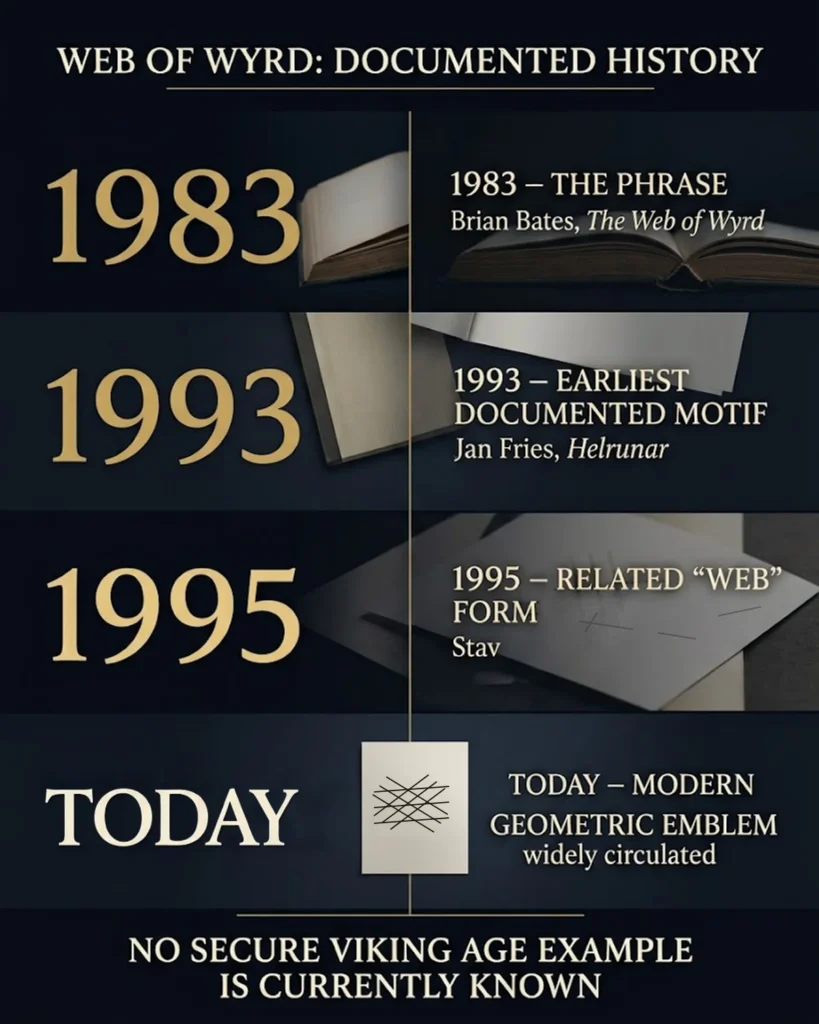
Joseph S. Hopkins and Lauren E. Fountain traced the design in the scholarship-focused Kvasir Symbol Database entry “Web of Wyrd”. Their earliest documented example is the twig-like form in Jan Fries’s 1993 occult book Helrunar. Fries displays it but does not explain it. A 1995 book on the modern system called Stav describes a related form as “the web.” The simplified geometric version appears to have developed later.
That history supports a careful claim: no Viking Age carving, manuscript, weapon, brooch, or runestone is currently known to carry this nine-line emblem under the name Web of Wyrd. It does not prove that nobody drew an intersecting pattern before 1993; absence claims should never be stronger than the searched evidence. It proves that the modern symbol’s documented history begins in late twentieth-century print, not in a securely identified Viking artifact.
The phrase has a separate history. Hopkins and Fountain identify a prominent early use in Brian Bates’s 1983 novel The Web of Wyrd. The phrase is a compelling modern English description, but it is not a direct quotation from an Old Norse source.
For the same form–date–name test applied side by side to Mjölnir, picture-stone motifs, later Icelandic staves, and modern emblems, use our evidence index of real, later, and modern Viking symbols.
Is the Web of Wyrd a rune?
No. A rune is a character in a runic writing system. The Web of Wyrd is a modern compound emblem. Claims that “all the runes are hidden inside it” belong to its modern interpretation, not to a Viking Age rune row.
For the attested alphabets, use the complete Elder Futhark guide. Anyone considering the emblem as body art should also read the historical cautions in Viking rune tattoos and their meanings.
Calling the symbol modern is not an insult. Modern religious and artistic symbols can carry real meaning. Historical honesty simply requires separating present-day significance from ancient provenance.
Does Wyrd Mean Everything Is Predetermined?
The sources do not preserve one systematic answer.
Some lines make events sound unavoidable. Norns appoint lives; örlög can be hidden or fixed; a hero knows death cannot always be escaped. Other passages make courage, loyalty, judgment, reputation, and deliberate choices morally decisive. Beowulf can place wyrd and courage together and can move between wyrd and God’s rule without pausing to explain a philosophical system.
A popular modern formula says that the past forms a web that constrains the future while each new choice adds another thread. It is coherent and may be spiritually meaningful. It is not a definition supplied by Beowulf, Völuspá, or Snorri.
The evidence supports a more restrained conclusion: early English and Norse texts are deeply concerned with what is allotted, what has happened, and how a person acts when outcomes cannot be controlled. They do not make meaningful action disappear.
What We Know—and Where the Evidence Stops
We know that wyrd is Old English and that its meanings include event, fate, fortune, lot, and what happens. We know it is related to Old Norse urðr. We know Old Norse sources use örlög, describe Norns appointing lives, and sometimes connect supernatural women with fate-threads and weaving. We know modern English weird descends from this historical vocabulary.
We do not have an ancient Web of Wyrd diagram. We do not have a medieval source defining wyrd as a nine-part law of cosmic cause and effect. We do not have an Eddic passage formally presenting Urðr, Verðandi, and Skuld as three abstract time zones with one assigned to past, one to present, and one to future.
The gaps are part of the answer. Wyrd is not valuable because it offers a perfectly preserved doctrine. It is valuable because one small word opens several worlds at once: an event becoming real, courage meeting uncertainty, a life being allotted, laws carved into wood, threads stretched at a child’s birth, and an old word for fate slowly becoming a modern word for the strange.
Frequently Asked Questions
What does wyrd mean in simple terms?
Wyrd means fate, fortune, an event, or what comes to pass in Old English. The best translation depends on context; it is not always a supernatural force or a fixed destiny.
Is wyrd a Norse or Viking word?
No. Wyrd is Old English. Its closest Old Norse cognate is urðr, meaning fate and also serving as the name of the Norn Urðr. Old Norse also uses örlög for fate or doom.
What does wyrd mean in Beowulf?
In Beowulf, wyrd can mean fate, an appointed outcome, or the course of events. Its meaning changes by passage, and the poem places it beside courage and God’s judgment rather than presenting one simple fatalistic doctrine.
How do you pronounce wyrd?
Modern readers commonly pronounce wyrd like “weird.” That is a useful approximation. The reconstructed Old English vowel was a rounded front vowel, so the historical pronunciation was not identical to modern English.
Is the Web of Wyrd historically Viking?
No securely dated Viking Age source contains the modern nine-line Web of Wyrd emblem. Its earliest documented form appears in Jan Fries’s 1993 book Helrunar. It is a modern symbol inspired by older Germanic fate imagery.
Are wyrd and örlög the same thing?
They overlap semantically but are not the same word. Wyrd is Old English; örlög is an Old Norse plural noun. Both can concern fate, but neither should be used as an automatic translation for the other in every context.
Did the Norns represent past, present, and future?
Their names invite that interpretation, especially Urðr as what has happened, Verðandi as becoming, and Skuld as obligation or what should be. Medieval sources name the three and describe their actions, but do not formally label them “Past, Present, and Future.”
Sources and Further Reading
- Bosworth–Toller Anglo-Saxon Dictionary, “wyrd”.
- Benjamin Slade, Beowulf in Old English with notes.
- Old English Poetry Project, Rutgers University, Beowulf.
- Ophelia Eryn Hostetter, “Wyrd bið ful aræd,” Rutgers Old English Poetry Project.
- Richard North, “Wyrd: ‘Event’ or ‘Fate’, Norn or Fortune,” Cambridge University Press.
- Cleasby–Vigfusson Old Norse Dictionary, “urðr”.
- Cleasby–Vigfusson Old Norse Dictionary, “ör-lög”.
- Anthony Faulkes, ed., Edda: Prologue and Gylfaginning, Viking Society for Northern Research.
- Helgakviða Hundingsbana I, Old Norse text.
- Joseph S. Hopkins and Lauren E. Fountain, “Web of Wyrd,” Kvasir Symbol Database.
- Folger Shakespeare Library, Macbeth.
Music to read by
Each article has a soundtrack. Listen to Mythic Harmonies while you read.
Explore the music