

Viking Music: The Complete Guide to Norse and Nordic Sounds (By Mood and Use)
On this page 9 sections
- What Is Viking Music, Really?
- The Artists Shaping Viking Music Today
- Viking Music for Workouts and Strength Training
- Viking Music for Gaming and Tabletop RPGs
- Viking Music for Rituals, Funerals, and Remembrance
- Viking Music for Relaxation and Reflection
- How to Start Listening
- Frequently Asked Questions
- Let the Saga Unfold
Something is happening to music. More and more people are reaching past the usual playlists toward something older, deeper, and stranger: the sound of the Viking world. Slow frame drums that feel like a heartbeat. Low male chants that seem to rise from the earth. Bone flutes, horns, and voices singing in a language that has not been spoken as a mother tongue for a thousand years.
This is Viking music, and if you have found your way here, you already feel the pull of it.
But Viking music is not one thing. It ranges from thunderous war chants that make your pulse climb to quiet ritual drones that slow your breathing to almost nothing. The trick is not just finding it. The trick is finding the right piece for the right moment: the track that carries you through a hard workout, the one that holds a room while you work, the one that belongs at a funeral, the one that turns a tabletop game into something you remember for years.
This guide is built for exactly that. It covers what Viking music actually is, the artists shaping it today, and then, section by section, the right sound for every mood and every use. Throughout, you will find tracks from Mythic Harmonies, original compositions rooted in Old Norse and drawn from the same tradition these sounds come from. Press play on anything that speaks to you. The saga is meant to be heard.
What Is Viking Music, Really?
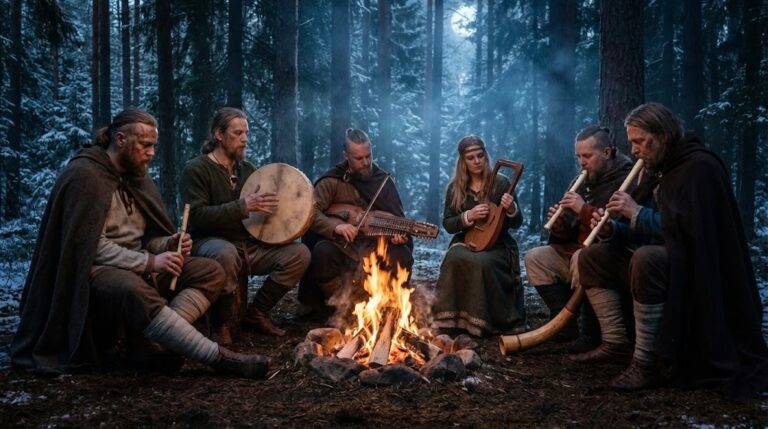
Here is the honest answer that most guides skip: nobody knows exactly what the Vikings sounded like. Almost no notation survived. What we have are fragments. Descriptions in the sagas of chanting and horns. Archaeological finds of instruments like the tagelharpa, a bowed lyre strung with horsehair, and animal-horn lurs. References to the skaldic tradition, in which poets performed elaborate verse for kings and warriors, a practice that sat somewhere between poetry, music, and magic.

So modern Viking music is not a reconstruction. It is an evocation. It takes the instruments, the language, the imagery, and above all the atmosphere of the Norse world, and builds something that feels ancient rather than something that claims to be authentic. The best of it is grounded in real scholarship, the Poetic Edda, the Prose Edda, the archaeological record, while accepting that it is creating an emotional bridge to the past, not a museum piece.
The result is a sound defined by a few core elements: deep frame drums and ritual percussion, low throat-style and chest vocals, male and female choirs, drones and ambient layers, and often lyrics in Old Norse. Whether it leans toward the meditative or the ferocious, that palette is what makes a piece recognizably Viking.
The Artists Shaping Viking Music Today
The modern Nordic sound has a handful of defining names, and knowing them helps you navigate the whole genre.
Wardruna is the reference point for most listeners. Founded by Einar Selvik, who researched and rebuilt ancient Norse instruments, Wardruna reached a wide audience through its work on the History Channel series Vikings. Its music is ceremonial, deeply researched, and patient.
Heilung describes its own work as “amplified history” from the Iron Age and Viking Age. Its live performances are closer to ritual than concert, combining ancient texts, bone and skin instruments, and a visual world that feels genuinely otherworldly.
Danheim, the project of Danish composer Mike Olsen, leans more rhythmic and cinematic, and has become a favorite for gaming and video content thanks to its driving, atmospheric production.
Mythic Harmonies belongs to this new generation of Nordic creators. Rather than the aggression of Viking metal, the focus is atmospheric and narrative: each composition begins with a story or image from the Norse world, a funeral crossing dark water, a ritual in a firelit longhouse, a night in a forest where warriors believed spirits moved between realms. The tracks use traditional drums, low chants, ritual tempos, and ambient drones, with lyrics drawn from Old Norse. If you are building a collection of modern Viking music, it sits naturally alongside the names above.
If you want the fuller landscape of heavier Nordic sounds as well, our guide to the best Viking metal bands covers everything from folk to fury.
Now to the heart of this guide: the right Viking music for every moment.
Viking Music for Focus and Deep Work
This is one of the most popular uses of Viking music, and for good reason. The genre’s slow drones, steady low percussion, and wordless or Old Norse vocals give your mind something to hold onto without the distraction of lyrics you understand. It fills the silence without demanding attention, which is exactly what deep work needs.
For focused, sustained concentration, reach for the more atmospheric and ritual pieces rather than the war chants. A track like Lyfjaberg (Healing Mountain) builds a calm, enveloping space that holds for the length of a work session. Echoes of the Fjord and Raddir Forna (Voices of the Ancients) work the same way, offering steady ancestral atmosphere that keeps you anchored without pulling your focus.
The key for focus is consistency of mood. You want a piece that stays in one emotional register rather than building to dramatic peaks. Let it loop, and let your attention settle into the work while the sound holds the room.
Viking Music for Workouts and Strength Training
This is where Viking music comes alive as fuel. The heavy stomp rhythm, the rising chants, the sense of marching toward battle: it is built for the moment under a loaded barbell or on the last hard interval.

For heavy compound lifts, deadlifts and squats and the grind that demands everything, you want the war chants with a driving pulse. Blóð ok Eldr (Blood and Fire) and Blóð ok Heiðr (Blood and Honor) are made for exactly this, with a steady stomp that builds a feeling of invincible strength. Berserkir Ris (Berserker Rising) and Úlfheðnar (Wolf Warriors of Odin) draw directly on Norse warrior traditions, while Rise of the Storm carries the momentum of a charge.
For a full session with a building arc, open with something driving like Spears in the Storm, push through the hard middle with Thrumr Thors (Thunder of Thor), and let the intensity peak with Valhalla Rising. The music does what a good training playlist should: it takes the decision out of your hands and simply carries you forward.
There is a reason so many strength athletes have found this genre. The Norse warrior ethos, meeting hardship without flinching, is written into the music itself.
Viking Music for Gaming and Tabletop RPGs
For gamers and especially for tabletop role-playing, Viking music is one of the most powerful atmosphere tools available. The right track transforms a session. A Dungeons and Dragons or Pathfinder table lit by the sound of Norse war drums plays differently than one in silence.

For combat encounters and boss fights, the battle hymns deliver. Valkyrjur (The Valkyries) and Rise of the Valkyries bring an epic charge to any fight scene. Skjaldborg til Vallhollu (Shieldwall to Valhalla) and Skjoldr ok Sal (Shield and Soul) are built for the shield wall closing in.
For the somber story beats, the death of a major character, a funeral scene, a moment of loss, few things land harder than a Viking funeral piece. Voices of Valhalla was made for exactly this kind of moment, and many listeners already use it to score the fall of a beloved character.
For exploration and travel through cold and ancient lands, the atmospheric tracks set the scene: Echoes of the Fjord, Draugr á Hafinu (Ghost Ship) for something haunted, or Hafróst (Sea’s Call) for a voyage across dark water.
Whether you are the game master scoring a campaign or a solo player deep in an open-world Norse adventure, matching the track to the scene is what turns a game into a memory.
Viking Music for Rituals, Funerals, and Remembrance
This is the most emotionally powerful use of Viking music, and one of the oldest in spirit. In the Norse world, a funeral was not only grief. It was a ritual to guide the soul onward and to fix the memory of the dead, because a person lived on as long as they were remembered in song. “Songs remain when men are dead,” as the tradition holds.

For memorial and remembrance, the funeral pieces carry a weight that ordinary music cannot reach. Voices of Valhalla imagines the fallen being welcomed by the voices of those who died before them, a promise of reunion. Undir Ösku Yggdrasils (Under the Ash of Yggdrasil), Tár Hrafn (Raven’s Tear), and Valhöll Kallar (Valhalla Calls) each hold that solemn, spacious grief, with slow funeral percussion like a single drum at a burial and layered choirs that feel like a whole clan singing at once.
Many listeners use these tracks to honor lost loved ones, finding comfort in the Norse view of death not as an ending but as a crossing to a hall of friends and ancestors. Viking Funeral at Sea and Call of Valhalla hold that same farewell atmosphere. This is music for the heaviest moments, and it meets them with dignity rather than sentimentality.
Viking Music for Relaxation and Reflection
Not all Viking music is thunder and war. A significant part of the genre is quiet, spacious, and meditative, ideal for winding down, for reflection, or simply for filling a room with something ancient and calm.

For these moments, reach for the gentler and more atmospheric pieces. Dagr ok Nótt (Day and Night), a Viking love song, carries a tenderness rare in the genre. Vikingr Hjarta (Viking Heart), Draumar við Fjǫrðinn (Dreams by the Fjord), and Echoes of the Fjord settle into a reflective, enveloping calm. Blót við Tungl (Moon Ritual) moves at the pace of a slow ceremony, perfect for the end of a long day.
This is the side of Viking music that surprises newcomers. Beneath the warrior imagery lies a deep strand of stillness, the silence of winter landscapes, the vastness of the northern sky, the quiet of a forest where the old people believed spirits moved between worlds.
How to Start Listening
If you are new to all of this, the easiest way in is simply to pick the section above that matches your moment and press play. There is no wrong entry point. Follow the mood you are in.
From there, the genre opens up quickly. You will start to notice the recurring elements, the frame drums, the Old Norse refrains, the interplay of male and female voices, and you will develop a feel for which artists and which tracks speak to you. The best way to explore the full Mythic Harmonies catalog is on YouTube and on Spotify, where the whole saga is gathered in one place, from the war chants to the funeral laments to the quiet ritual pieces.
Press play, and let the North find you.
Frequently Asked Questions
What is Viking music?
Viking music is a modern genre that evokes the sound and atmosphere of the Norse and Viking Age world. Since almost no actual Viking-era music survived, contemporary artists build an evocation using traditional instruments like frame drums and the tagelharpa, low chanting vocals, choirs, ambient drones, and lyrics often written in Old Norse. It ranges from ferocious war chants to quiet ritual and funeral pieces.
What instruments are used in Viking music?
Common instruments include frame drums and ritual percussion, the tagelharpa (a bowed lyre strung with horsehair), animal-horn lurs, bone flutes, and above all the human voice, used in throat-style and chest singing and in male and female choirs. Modern productions often layer these with ambient drones and field recordings.
Is Viking music historically accurate?
Not exactly, and the best artists are honest about this. Almost no Viking-era music was preserved, so modern Viking music is an evocation rather than a reconstruction. It draws on real instruments, the Old Norse language, and primary sources like the Poetic Edda and Prose Edda to create an emotional bridge to the past, without claiming to be an exact recreation of what Vikings actually heard.
What is the best Viking music for working out?
For strength training, the driving war chants work best: pieces with a heavy stomp rhythm and rising chants that build momentum. Tracks like Blóð ok Eldr, Berserkir Ris, and Valhalla Rising are built for heavy lifts and hard intervals. The warrior ethos of the music makes it natural fuel for training.
What is the best Viking music for studying or focus?
For focus and deep work, the calmer atmospheric and ritual pieces work better than the war chants, because they hold a steady mood without lyrics in a language you understand pulling your attention. Tracks like Lyfjaberg (Healing Mountain) and Echoes of the Fjord fill the silence without demanding your focus.
Who are the best Viking music artists?
The most defining artists in the modern Nordic sound include Wardruna, known for its deeply researched ceremonial music and its work on the series Vikings; Heilung, known for its ritual “amplified history” performances; and Danheim, known for rhythmic cinematic production. Mythic Harmonies belongs to this new generation, with an atmospheric, narrative approach rooted in Old Norse.
Where can I listen to Viking music?
Viking music is available on all major streaming platforms. The full Mythic Harmonies catalog, spanning war chants, funeral laments, and quiet ritual pieces, is on YouTube and Spotify, where the complete collection can be explored in one place.
Let the Saga Unfold
Viking music endures for the same reason the myths behind it endure. It speaks to something old in us: the pull of winter landscapes, the weight of fate, the beauty of facing hard things without flinching, the comfort of believing that those we lose have only crossed to a hall of friends.
Whatever brought you here, the workout that needs fuel, the game that needs atmosphere, the loss that needs a song, the quiet evening that needs filling, there is a piece of this ancient-feeling music waiting for it. Find the moment, find the sound, and press play.
The songs remain. Let them find you.





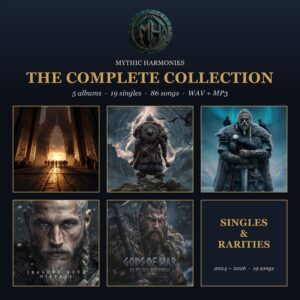
All five albums and every single: 86 songs in WAV and MP3, yours to keep.