

Did Vikings Wear Horned Helmets? Real Helmets & Shields
On this page 7 sections
- Vikings never wore horned helmets: the horns were invented for Wagner’s opera costumes in 1876. Not one horned helmet exists in any Viking Age find.
- Only ONE nearly complete Viking helmet has ever been found: the Gjermundbu helmet from Norway, a plain iron cap with a spectacle guard, now in Oslo. Most warriors fought in leather, padding, or nothing at all.
- The real Viking icon was the shield: a light, painted, 90-centimeter round shield only 7 millimeters thick at the rim, built for the skjaldborg, the shield wall that decided every major battle.
Here is a number that should end the debate before it starts: after two centuries of excavating thousands of Viking Age graves across Scandinavia, Britain, Ireland and Russia, archaeologists have found exactly one nearly complete Viking helmet. One. And it has no horns.
Meanwhile, every costume shop, sports logo and birthday card on the planet insists that horns were standard Norse headgear. This is one of history’s most successful lies, and this article does two things about it: it traces exactly where the horns came from (spoiler: an opera), and then it rebuilds what Viking warriors actually carried into battle, the plain iron helmet almost none of them could afford, and the painted round shield that every single one of them could.
The Horned Helmet Myth: Blame Wagner
The horns have a birth certificate, and it is dated 1876.
That summer, Richard Wagner’s opera cycle Der Ring des Nibelungen premiered at Bayreuth, and the costume designer Carl Emil Doepler dressed the Germanic heroes in winged and horned helmets to make them look suitably ancient and barbaric. The image was theatrical, memorable, and completely invented. Romantic painters of the same era, hungry for a wild pagan North, spread it further, and by the early twentieth century the horned Viking was locked into the world’s imagination: advertising, comic strips, Halloween, a certain American football team, and every “Viking” party hat ever sold.
The irony is that horned helmets DID exist in Scandinavia, just not anywhere near the Vikings. The magnificent horned bronze helmets found at Veksø in Denmark date to the Nordic Bronze Age, around 900 BC, nearly two thousand years before the first longship raid. And Viking Age art does show a few horned figures, like the dancing warriors on the Oseberg tapestry, but these are ritual images, likely cult dancers connected to Odin, captured in ceremony rather than combat.
The practical case against horns is even simpler, and any fighter understands it instantly: horns on a battle helmet are handles for your enemy’s axe. They catch blows that a smooth dome would deflect, they add weight, and they snag on everything. No culture that fought as often as the Norse would have worn them into a shield wall. Which brings us to what they actually wore.
Gjermundbu: The One Real Viking Helmet Ever Found
In 1943, in the middle of the German occupation, a farmer’s son digging on the Gjermundbu farm in Ringerike, Norway, uncovered a rich tenth-century burial mound. Inside, along with weapons and a mail shirt of roughly 25,000 rings, lay a helmet in nine iron fragments, since painstakingly restored and displayed at the Museum of Cultural History in Oslo. It remains, to this day, the only nearly complete helmet from the entire Viking Age, and recent re-examinations of the find suggest its owner may have been a warrior who served rulers along the eastern routes, which would explain why he owned armor almost no one else in Scandinavia was buried with.
The Gjermundbu helmet is everything the myth is not. It is a rounded cap built from four iron plates riveted to a frame, topped with a small spike, and fitted with a spectacle guard: a mask-like piece protecting the eyes and nose, shaped like a pair of goggles. No horns, no wings, no decoration beyond the fittings. It is a purely functional object, built by someone who expected it to stop a sword.
It is not entirely alone. A handful of fragments fill out the picture: a partial helmet from Tjele in Denmark, a fragment from Lokrume on Gotland, pieces from Kyiv. And in 2020, a helmet that had been sitting in a museum drawer in northern England since the 1950s was formally identified: the Yarm helmet, now recognized as a probable tenth-century Anglo-Scandinavian piece, and possibly the second most complete “Viking” helmet in existence. The picture all these finds paint is consistent: simple iron caps, sometimes with spectacle guards or nose guards, always hornless.
One helmet from an entire age: how? Three reasons. Iron was expensive, so helmets were elite gear from the start. They were repaired and inherited rather than buried, since a dead man’s helmet was worth a month of a smith’s labor. And when a helmet finally wore out, its iron was recycled into tools and nails. Archaeology finds what people threw away or buried with their dead; the Vikings did neither with their helmets. Absence of horns, however, is not an accident of preservation: thousands of graves, picture stones and carvings agree.

What Viking Helmets Actually Looked Like
Put the finds together with picture stones and written sources, and the real types of Viking helmets emerge as a hierarchy, and it is a hierarchy of wealth.
At the top: the iron helmet. A Gjermundbu-style riveted cap, perhaps with a spectacle or nose guard, worn over a padded cap or hood to absorb impact. Iron was expensive and helmets were labor-intensive, so this was elite equipment: the jarl, the professional retainer, the wealthy farmer who had raided well. Helmets were valuable enough to be repaired for generations and handed down, which is one more reason so few ended up in the ground.
In the middle: leather and padding. Many warriors likely fought in hardened leather caps or thickly padded wool hoods, none of which survive archaeologically. This is informed reconstruction rather than certainty, and honest articles say so, but it fits the economics: a man who could barely afford a spear did not own four kilograms of shaped iron.
And for many: nothing at all. The sagas are full of men fighting bareheaded. Hair, courage and a good shield were the armor of the poor.
One more distinction matters, because search engines and museum gift shops blur it constantly: the spectacular ornate helmets with bronze eyebrows and full face masks, like the famous finds from Vendel and Valsgärde in Sweden or the Sutton Hoo helmet in England, are NOT Viking helmets. They belong to the Vendel period, the century or two before the Viking Age, and they were ceremonial treasures of an earlier aristocracy. Beautiful, Norse-adjacent, and chronologically off by two hundred years: the Viking Age fighter wore the plain cap, not the masked crown.
The Viking Shield: Build and Colors
If the helmet was the rare luxury, the round shield was the universal standard, and thanks to one ship burial, we know it in extraordinary detail.
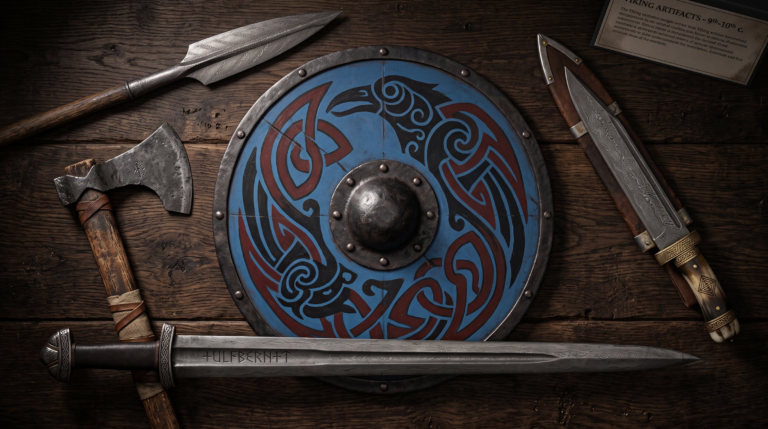
The Gokstad ship, excavated in Norway in 1880, carried 64 shields hung along its rails: round, roughly 90 centimeters across, made of thin planks of spruce, fir or pine butted edge to edge. And here is the detail that surprises everyone: the boards are only about 7 millimeters thick near the rim. A Viking shield was not a heavy wall to hide behind. It was light, fast, and semi-disposable, a weapon of active defense used to deflect, bind and punch, expected to take damage and be replaced.
The anatomy was simple and brilliant. In the center, a domed iron boss protected the hand, because the grip ran horizontally behind it: the shield was held in a fist, not strapped to the forearm, so it could be angled, rotated and extended. The rim was typically bound in rawhide, which shrank tight as it dried and held the boards together; the faces were often covered in linen or thin leather, gluing the whole construction into a composite that resisted splitting far better than bare wood.
And they were painted. The Gokstad shields alternated yellow and black along the ship’s rail; fragments and images elsewhere show reds, blues, and simple bold patterns, spirals, quarters, crosses. The sagas add a layer of shield language on top: a red shield hoisted meant war, a white shield meant peace or truce. Like everything else the Norse wore, as our guide to Viking clothing shows in full, the shield was loud, colorful and communicative, the exact opposite of the mud-toned props on television.

The Shield Wall: Where Everything Above Was Tested
The shield existed for one formation above all: the skjaldborg, the shield wall, the fortress of shields.
The mechanics were brutally simple. Warriors formed a line, shoulder to shoulder, each shield overlapping its neighbor’s edge, creating a continuous wall of painted wood with spear points bristling over the rims. The front rank held; the ranks behind pushed, threw, and stepped into gaps. Battles between Norse armies, and against Saxons and Franks who fought the same way, were shield wall against shield wall: a grinding, shoving, stabbing contest where the first line to break usually died. This is where the seax earned its keep, because in the crush of two walls pressed together there was no room to swing a sword, and a short stabbing blade like the seax worked where nothing else could.
The wall was as much psychology as engineering. Holding your place while an enemy line slams into your shield takes more discipline than courage, and the man who stepped back doomed his neighbors. That is why the war horn mattered: signals had to cut through the roar, the same role the Gjallarhorn plays in myth, the horn that calls every warrior to the final battle line. The shield wall is where Norse warfare stopped being individual heroics and became a single organism of wood, iron and nerve.
You can stand inside that wall. Our track Skjaldborg til Valhǫllu (Shield Wall to Valhalla), sung in Old Norse, is the sound of the line holding: the rhythm, the push, the oath between neighbors.
Helmets in Pop Culture vs Reality
The horns refuse to die, and it is worth being precise about who wears them and who finally stopped.
The Minnesota Vikings logo, Hägar the Horrible, Asterix’s Norman visitors, half the metal album covers ever printed, and every plastic party helmet: full horns, full myth. Skyrim splits the difference with horned “ancient Nord” armor. But the tide has visibly turned in serious productions: the Vikings TV series and The Northman dropped horns entirely, and the video game Assassin’s Creed Valhalla buried them, though most screen Vikings still commit the other costume sins, the black leather and the missing color, that our clothing myths guide takes apart.

Why does the myth survive its own debunking? Because it works as a symbol. Horns read as wild, pagan, untamed, everything the nineteenth century wanted its Vikings to be, and everything a football team wants its defense to be. The horned helmet is not a historical claim anymore; it is a logo. There is no harm in enjoying it, as long as you know what it is: a costume designed in 1876, worn by an opera tenor, and never once by a Norseman with a ship to catch.
How to spot a fake in five seconds: horns or wings, instant fantasy. Ornate full face mask with bronze eyebrows, beautiful but Vendel period, pre-Viking by two centuries. Plain rounded iron cap, riveted plates, maybe a spectacle or nose guard: now you are looking at the real thing, and there is exactly one of those in the world, resting in Oslo.
The Gjermundbu find (1943), Museum of Cultural History, University of Oslo; the Yarm helmet identification (Preston Park Museum / Royal Armouries analysis, 2020); the Gokstad ship burial shields, Viking Ship Museum, Oslo; the Tjele fragment, National Museum of Denmark; the Veksø Bronze Age horned helmets, National Museum of Denmark; Carl Emil Doepler’s costume designs for Der Ring des Nibelungen (Bayreuth, 1876); the Oseberg tapestry fragments; Kim Hjardar & Vegard Vike, Vikings at War (Casemate, 2016).
Frequently Asked Questions
Did Vikings really wear horned helmets?
No. Not a single horned helmet has been found in any Viking Age context. The image was invented by costume designer Carl Emil Doepler for Wagner’s opera cycle in 1876 and spread by Romantic painters. Real Viking helmets were plain rounded iron caps, sometimes with a spectacle or nose guard.
Why do people think Vikings had horns?
Because of nineteenth-century art. Wagner’s 1876 opera costumes and Romantic painters dressed Norsemen in horned helmets to look wild and pagan, and advertising, comics and sports logos cemented the image. Genuine horned helmets from Scandinavia exist, but they are Bronze Age ritual objects nearly two thousand years older than the Vikings.
What is a shield wall?
The shield wall (skjaldborg) was the core Viking battle formation: warriors standing shoulder to shoulder with round shields overlapping, spears projecting over the rims. Battles were decided by two walls grinding against each other until one line broke. It demanded discipline above individual heroics.
Did Viking shields have metal?
Only at the center. The domed iron boss protected the hand, since the grip ran horizontally behind it. The rest was thin spruce or fir planks, about 7 millimeters at the rim, faced with linen or leather and edged with rawhide. Full metal shields are fantasy; real ones were light, painted, and semi-disposable.
How many Viking helmets have been found?
Only one nearly complete helmet: the Gjermundbu helmet from Norway, found in 1943. A handful of fragments exist from Denmark, Gotland and Kyiv, and the Yarm helmet identified in England in 2020 is likely a second near-complete Anglo-Scandinavian example. Helmets were expensive, inherited, and recycled, which is why so few survive.
What color were Viking shields?
Loudly painted. The 64 shields of the Gokstad ship alternated yellow and black; other finds and images show red, blue and bold simple patterns. In saga tradition, hoisting a red shield signaled war and a white shield signaled peace. Bare wooden shields are a screen invention.
How big was a Viking shield?
Around 80 to 95 centimeters in diameter, based on the Gokstad ship finds, and surprisingly light: the wooden boards thin to about 7 millimeters at the rim. A Viking shield weighed far less than fantasy versions suggest, because it was built for active deflection and quick handling, not for hiding behind.







All five albums and every single: 86 songs in WAV and MP3, yours to keep.