
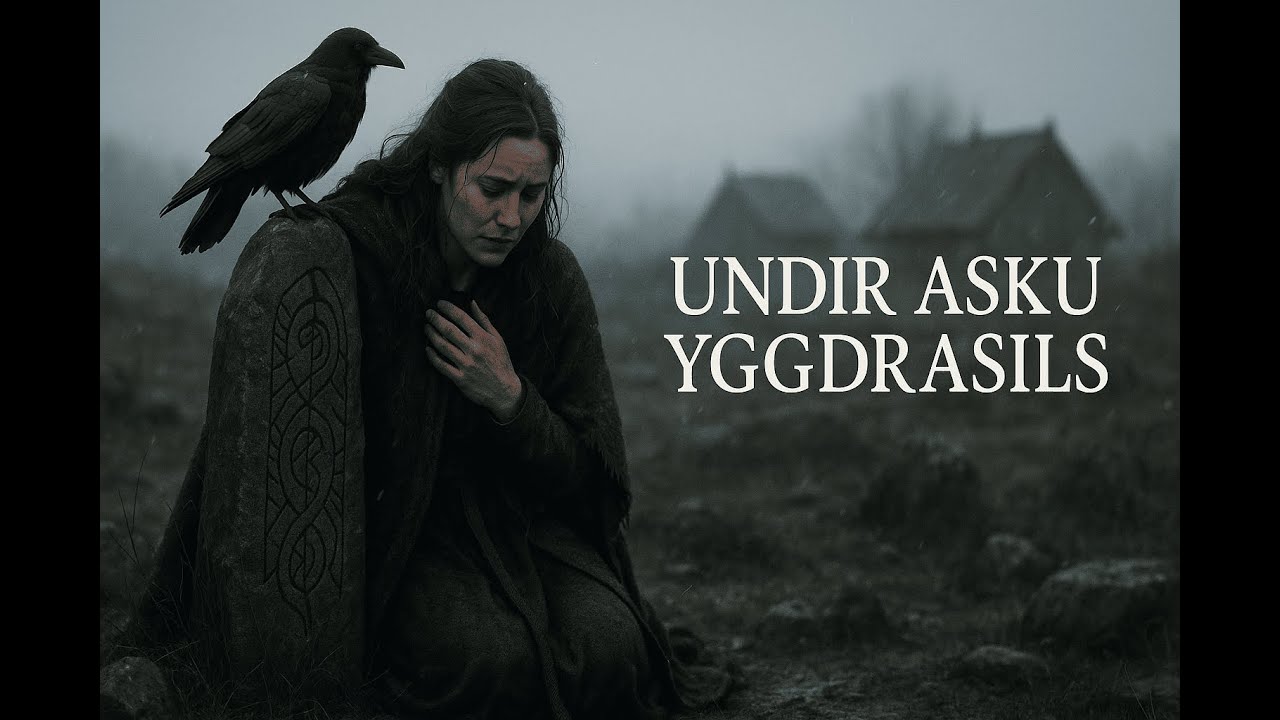
Undir Asku Yggdrasils (“Beneath the Ash of Yggdrasil”) is a 3:22 Mythic Harmonies lament sung by a solitary female voice. She walks at night beneath the world-tree, addresses a fallen warrior, hears him in dreams and entrusts his memory to the roots before the song closes with a broken phrase toward Valhalla.
Play the complete master above. The exact 3:22 release is also available on Spotify and Apple Music. This is a modern funeral-themed composition in Old Norse-styled language: Yggdrasil and Valhalla come from medieval Norse sources, while the grieving narrator, memory-bearing roots and melody belong to the song.
Undir Asku Yggdrasils at a Glance
| Artist | Mythic Harmonies |
|---|---|
| Song | Undir Asku Yggdrasils |
| English title | Beneath the Ash of Yggdrasil |
| Duration | 3:22 on YouTube, Spotify and Apple Music |
| Voice | Female solo lament |
| Language | Old Norse-styled text with English artistic translation |
| Status | Original modern composition, not a surviving funeral chant |
What Is the Song About?
The first stanza establishes absence: a lone walker, night, wind and a name that can no longer answer. The refrain addresses “my fallen hero” and lets roots hold his memory. A second verse widens the silence to gods, ravens, tears and green earth, yet keeps one line of hope. The refrain returns unchanged, then the voice fragments into “under the ash,” “I sing” and “to Valhalla.”
The recording is therefore less a description of a funeral ceremony than a private act of remembrance. Its progression is solitary walk → dream-hearing → memory in the roots → grief with surviving hope → farewell. The words never identify the singer as a shieldmaiden, mother, seeress or wife, so the fiche does not assign her a role the song leaves open.
What Does “Undir Asku Yggdrasils” Mean?
Undir means “under” or “beneath,” asku is a form of askr, “ash tree,” and Yggdrasils is the genitive “of Yggdrasil.” The intended title is therefore Beneath the Ash of Yggdrasil. It places the lament under the tree rather than claiming the speaker is literally within an attested burial site.
The title is understandable, but it should be treated as the name of this composition. No cited Eddic stanza preserves this phrase as the title of a lament, prayer or funeral rite.
Yggdrasil in the Sources—and in This Song
Grímnismál calls Yggdrasil an ash, gives it roots extending in different directions and describes creatures that feed on or wear away the tree. It is immense and vulnerable at once. Snorri’s Gylfaginning develops the world-ash, its roots, wells and the gods’ assembly in a more systematic prose account. Both can be read in reliable open editions from Open Book Publishers and the Viking Society for Northern Research.
The song adds a different function: “the roots hold your memory.” That is a powerful image of grief, but the cited sources do not designate Yggdrasil’s roots as an archive for each dead person or a home where a soul is buried. The tree supplies the mythic setting; personal memory is the composition’s invention.
Is This a Viking Funeral Ritual?
No ceremony is actually performed in the text. There is no pyre, ship, grave mound, offering or named ritual specialist. The female voice sings to someone fallen and imagines Valhalla, which makes “funeral song” an accurate description of genre and mood—not proof that Viking Age mourners used these words beneath a sacred tree.
Archaeology shows varied burial settings rather than one universal Norse funeral. The National Museum of Denmark notes that many dead were buried near settlements, while other sites differ and interpretations based on water or myth do not fit every burial. Its pages on burial places near Viking homes and commemorative rune stones support a careful, plural picture of remembrance.
Ravens, Valhalla and the Limits of the Scene
Ravens fly above the earth in the second verse, but the song does not name Huginn or Muninn. They can remain part of the visual field without becoming an automatic message from Odin. The final “Til Valhǫll” expresses the mourner’s desired destination for the fallen; it is not evidence that every warrior, every mourner or every funeral followed one route after death.
That distinction keeps the fiche centered on the recording. Mythic references explain what the voice imagines, while uncertainty is left visible wherever the medieval evidence does not confirm the song’s personal theology.
Old Norse Language Note
The original-language block is reproduced exactly as released. It contains clear Old Norse vocabulary alongside modern forms and grammatical compression. Regular first-person prose would use ek geng rather than third-person gengr ek; “I hear you” expects an object such as þik, not genitive þín; minning would take an accusative form in “the roots hold your memory”; and the preposition til normally governs a genitive, so “to Valhalla” would be til Valhallar.
Other phrases, including hrafnar fljúga yfir sǫnn and þó allt sé varð, resist the exact meanings given by the English. The translation below is thus an artistic adaptation, not a normalized philological edition. Michael Barnes’s A New Introduction to Old Norse provides the grammatical baseline used for this note.
Where This Fiche Fits
This page owns the exact search intent for the 3:22 Undir Asku Yggdrasils recording: its female lament, title, dream-hearing, memory-bearing roots, complete text and verified platforms. Tears of Yggdrasil is a separate song centered on the world-tree’s sorrow. Viking Funeral at Sea owns the distinct seaborne farewell. Explore the full funeral and ritual catalogue from the Music page.
Undir Asku Yggdrasils Lyrics & Translation
The published Old Norse-styled text and English artistic translation are reproduced below without silent correction.
Original Old Norse-Styled Text
Undir asku Yggdrasils, Gengr ek ein í nótt Vindr kallar nafn þitt Ok hjarta mitt blæðir hótt
Þú ert fallinn, hetja mín Í draumum ek heyri þín Rætur halda minning þína Undir asku, heima sína
Goðin þegja í sinni bǫn Hrafnar fljúga yfir sǫnn Tár mín falla á grǫn jarð En von lifir, þó allt sé varð
Þú ert fallinn, hetja mín Í draumum ek heyri þín Rætur halda minning þína Undir asku, heima sína
Undir ask… Ek syng… Til Valhǫll…
English Artistic Translation
Under the ash of Yggdrasil, I walk alone in the night The wind calls your name And my heart bleeds quietly
You have fallen, my warrior In dreams, I still hear you The roots hold your memory Beneath the ash, your sacred home
The gods are silent in their prayers Ravens circle over truth My tears fall upon green earth Yet hope lives, though all seems lost
You have fallen, my warrior In dreams, I still hear you The roots hold your memory Beneath the ash, your sacred home
Under the ash… I sing… To Valhalla…
Listen on Spotify and Apple Music
The exact 3:22 release is available as Undir Asku Yggdrasils on Spotify and Undir Asku Yggdrasils on Apple Music. Browse the complete lyric catalogue in the Songbook of the North.
Sources and Editorial Method
- Edward Pettit, The Poetic Edda: A Dual-Language Edition, especially Grímnismál 29–35.
- Anthony Faulkes (ed.), Snorri Sturluson: Edda. Prologue and Gylfaginning.
- National Museum of Denmark, evidence pages on burial locations near Viking settlements and runic commemoration.
- Michael Barnes, A New Introduction to Old Norse, Part I: Grammar.
Editorial note: sources establish the world-tree, grammatical baseline and variety of commemoration. The narrator, words, melody and personal memory beneath the roots are modern creative choices.
Frequently Asked Questions
What does Undir Asku Yggdrasils mean?
The intended English title is “Beneath the Ash of Yggdrasil.” It places the narrator under the world-tree and is the title of this modern song, not a preserved medieval lament.
What is Undir Asku Yggdrasils about?
A solitary female voice mourns a fallen warrior, hears him in dreams and asks Yggdrasil’s roots to hold his memory before singing a final farewell toward Valhalla.
Is this an authentic Viking funeral song?
No. It is an original Mythic Harmonies composition. Yggdrasil and Valhalla are medieval Norse references, but the melody, narrator, exact words and memory-bearing roots are modern.
Are the lyrics written in Old Norse?
They use recognizable Old Norse vocabulary but also contain modern and non-standard grammar. This fiche labels them Old Norse-styled lyrics and the English as an artistic translation.
Where can I listen to Undir Asku Yggdrasils?
The 3:22 YouTube master is embedded at the top. The same 3:22 release is linked directly on Spotify and Apple Music below the lyrics.
More from Funeral & Ritual
March with the War-Band
New Old Norse chants every month. Join the listeners who never miss a release.