
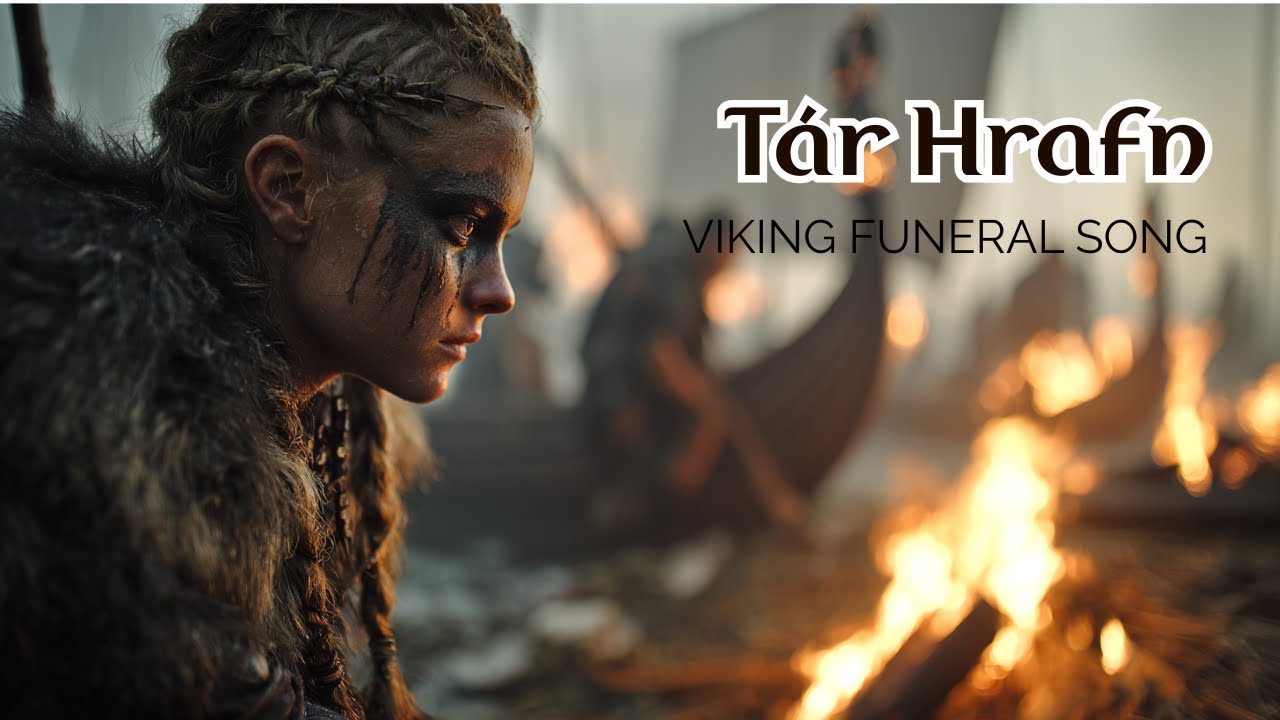
What Is Tár Hrafn?
Tár Hrafn (“The Raven’s Tear”) is a 5:58 Mythic Harmonies funeral lament led by a female voice. The speaker addresses a dead brother directly: his sword rests, she stands alone, and the wind carries his name after the final note. The exact official recording is embedded above.
- Artist: Mythic Harmonies
- Recording: 5:58 on YouTube, Spotify and Apple Music
- Language: stylized Old Norse-inspired lyrics with a published English rendering
- Point of view: a bereaved sister or female mourner speaking to “my dear brother”
- Central images: dew on stone, a resting sword, moonlight, burial fires, earth, memory and wind
- Historical status: an original modern song, not a surviving Viking Age funeral chant
The fiche stays with that recording and its grief narrative. Norse sources and archaeology are used only where they clarify a lyric—or prevent a modern image from being presented as universal history.
What Does Tár Hrafn Mean?
The intended English title is “The Raven’s Tear.” Tár means “tear,” and hrafn means “raven.” A normalized possessive construction would ordinarily mark “raven” in the genitive, as in hrafns tár. Tár Hrafn is therefore best treated as the song’s compact, modern poetic title rather than as a model prose phrase.
The title does not appear as a line in the lyric and no raven is explicitly named in the verses. Instead, it frames the mourner’s tears through an Odin-associated bird already present in the track’s artistic identity. That is a deliberate title-image, not evidence for an ancient symbol called “the raven’s tear.”
The Song’s Story: A Sister Speaks to the Dead
The first verse establishes the private address. Dew falls on wounded stone, grief sings with the wind, and the speaker names the dead man “bróðr minn kær”—“my dear brother.” The English rendering sends him toward Valhalla, but the emotional centre is the voice that remains behind.
The second and third verses move through still objects: a resting sword, a sleeping heart, moonlight, fire on burial mounds and shadows around memory. The speaker remembers having walked the roads of war beside him. Now the plural journey has collapsed into one repeated fact: “ek stendr ein”, “I stand alone.”
The refrain gives grief a newly coined physical image, sorgblóð, “sorrow-blood.” It flows while the brother sleeps in the earth and the wind bears remembrance through the fading night. The final verse changes what survival means: the brother becomes story and song, then the coda leaves his name dwelling in the wind. The song does not resolve grief; it gives grief a form that can be sung.
Ravens, Odin and the Limits of the Image
Ravens are strongly associated with Odin in medieval Norse literature. Grímnismál names Huginn and Muninn flying over the world, while Snorri repeats their daily flight and return. Battle poetry can also place ravens near the slain. Those traditions explain why a raven can carry emotional weight in a modern Norse-inspired lament.
They do not securely establish the raven as a universal Norse psychopomp who guides every soul between worlds. The old version of this fiche made that leap. In this song, “The Raven’s Tear” remains an artistic title: Odin’s bird is drawn into human mourning, but the lyric never describes it conducting the brother to an afterlife.
Burial Mounds, Fire and Valhalla
The lyric combines a sleeper in the earth, burial mounds and burning fires. Viking Age treatment of the dead was much more varied than one standard scene: archaeology records cremation and inhumation, mounds and flat graves, boat graves, chamber burials and changing grave assemblages across regions and centuries. The song assembles a visual funeral setting; it does not document one compulsory rite.
Valhalla is likewise the mourner’s destination for her brother, not an automatic outcome for every Norse warrior. Grímnismál 14 divides the battle-slain between Freyja and Odin, and the surviving evidence preserves other destinations as well. The broader history belongs to the guides on Viking funeral rites and Valhalla and Fólkvangr; this fiche keeps the camera on the sister’s hope.
How Tár Hrafn Differs from the Other Laments
Tár Hrafn owns the long 5:58 female solo, the direct address to a brother, the sorgblóð refrain and the final name in the wind. Undir Væng Hrafnsins follows a collective escort beneath the raven’s wing and a ship by the fjord. Viking Funeral at Sea centres the burning ship and mourners on shore. The Weeping Shieldmaiden keeps its English-language first-person warrior lament. These are related moods, not interchangeable masters.
Language Note: Preserved, Not Normalized
The complete sung text below is preserved exactly as published. It contains recognizable Old Norse words and inflections, but it is a modern stylized lyric rather than a normalized medieval text. Forms such as meðr vindr, í draumr, sál mín bær, Blot gefin, tǫrr, í jǫrð, Til dauðr, konur syngja mjúk and Þú varðr show case, agreement, spelling or number problems.
The English block therefore records the intended poetic meaning; it should not be cited as a literal philological translation. No wording has been silently corrected inside the copyrighted song text.
Tár Hrafn Lyrics and English Translation
Published Old Norse-inspired lyrics:
Dǫgg fellr á sárum steini, Ein harmr syngr meðr vindr í heimi. Ek grætr í draumr, sál mín bær, Til Valhǫll flýgr þú, bróðr minn kær.
Sverð þitt hvílir, hjarta þitt sefr, Undir mánans ljós, sorg mín legr. Blot gefin, orð mín bær, Til goða ek syng, með tǫrr ok sær.
Eldar loga á haugum hljóðr, Skuggar dansa, minningin glóðr. Ek gekk með þér um stríðs vegir, Nú ek stendr ein, meðr sorg sem segir.
Sorgblóð rennr, í jǫrð þú sefr, Vindr ber minning á nótt sem legr. Sál mín rifnar, ek stendr ein, Til dauðr ok dýrð, vér syngjum seinn.
Börn gráta, konur syngja mjúk, Blotr ok ljós, í myrkri súk. Þú varðr saga, þú varðr ljóð, Í hjarta Norðrs þú býr með bróð.
Sorgblóð rennr, í jǫrð þú sefr, Vindr ber minning á nótt sem legr. Sál mín rifnar, ek stendr ein, Til dauðr ok dýrð, vér syngjum seinn.
Sefr í mold… lifir í ljóma… Nafn þitt kallar… í vindinum dvelr.
Published English rendering:
Dew falls on wounded stone, A lone grief sings with the wind in the world. I weep in dreams, my soul bears pain, To Valhalla you fly, my dear brother.
Your sword rests, your heart sleeps, Under the light of the moon, my sorrow lies. A sacrifice given, my words I carry, To the gods I sing, with tears and salt.
Fires burn on silent burial mounds, Shadows dance, memory glowing. I walked with you through the roads of war, Now I stand alone, with grief that speaks.
Sorrow-blood flows, in earth you sleep, The wind carries memory through night that fades. My soul tears open, I stand alone, Toward death and glory, we sing too late.
Children cry, women sing softly, Sacrifice and light, in darkness sinking. You became a story, you became a song, In the heart of the North you live with your brother.
Sorrow-blood flows, in earth you sleep, The wind carries memory through night that fades. My soul tears open, I stand alone, Toward death and glory, we sing too late.
Sleeping in soil… living in light… Your name calls… it dwells in the wind.
Listen on YouTube, Spotify and Apple Music
The official Tár Hrafn video on YouTube runs 5:58. The same-title Mythic Harmonies master also runs 5:58 on Spotify and Apple Music; title, artist and duration all match exactly.
Sources and Further Reading
- Edward Pettit (trans.), The Poetic Edda, especially Grímnismál for Odin’s ravens and the division of the battle-slain.
- Anthony Faulkes (ed.), Snorri Sturluson: Edda. Prologue and Gylfaginning, for Huginn, Muninn and Odin’s hall.
- Viking Ship Museum, Roskilde, “Dead and buried”, for the diversity of burial evidence and ship graves.
What does Tár Hrafn mean?
The song’s intended English title is “The Raven’s Tear.” The compact form is a modern poetic title; a normalized possessive Old Norse phrase would ordinarily mark “raven” in the genitive.
What is Tár Hrafn about?
A female mourner addresses her dead brother. She remembers walking beside him, watches his sword rest, repeats that she stands alone and finally preserves his name as story, song and a voice in the wind.
Is Tár Hrafn an authentic Viking funeral song?
No. It is an original modern Mythic Harmonies lament in stylized Old Norse-inspired language. Its burial, raven and Valhalla images draw on Norse material, but the words and music are not a surviving Viking Age composition.
Is the raven a Norse guide for every dead soul?
The medieval sources strongly associate ravens with Odin and battle, especially Huginn and Muninn, but they do not securely define the raven as a universal psychopomp for every Norse dead person. In this song it is an artistic title-image.
Where can I listen to the exact Tár Hrafn recording?
The same-title Mythic Harmonies master runs 5:58 on YouTube, Spotify and Apple Music. All three exact links are provided on this fiche.
More from Funeral & Ritual
March with the War-Band
New Old Norse chants every month. Join the listeners who never miss a release.