
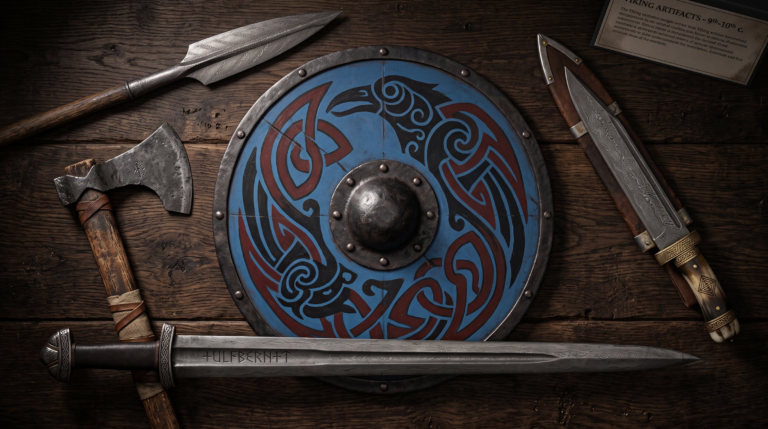
Viking Weapons and Armor: What They Actually Used
- The spear, not the axe, was the Viking weapon number one: cheap in iron, deadly in the shield wall, required by law for every free man, and sacred to Odin himself.
- Swords were luxury objects: worth several cows, named like people in the sagas, and crowned by the mysterious Ulfberht blades, the first luxury brand in European history, counterfeits included.
- Viking armor myths die here: mail was real but rare aristocrat gear, padded protection is probable but unproven, and the studded leather armor of television has never been found in a single Viking Age grave.
Ask anyone to name the Viking weapon, and they will say the axe, or maybe the sword. Both answers are wrong, and the Vikings themselves would have told you so with a smile: the weapon that actually won their battles, the one nearly every warrior carried and the law itself required, was the humble spear.
That gap between image and reality runs through the entire Norse arsenal. The sword of the movies was, in real life, so expensive that owning one meant roughly what owning a sports car means today. The leather armor of every TV series has never been found in a single Viking grave. And the weapon a man carried said less about how he fought than about what he was worth, because in the Viking Age, your weapons were your bank account, your legal status and your identity, hanging within reach above your bed.
This guide rebuilds the real Norse armory piece by piece, from the spear that ruled the battlefield to the mail shirt almost nobody could afford, using what the graves, the laws and the sagas actually say.
The Spear: The Real Viking Weapon N°1
The spear was everywhere, and the reasons stack up beautifully.
Economics first. A spearhead needed a fraction of the iron a sword demanded, and iron was brutally expensive: Scandinavian smiths pulled it laboriously from bog ore, smelted in small charcoal furnaces. A farmer who could never dream of a sword could arm himself with a spear, and the law expected him to. The Norwegian Gulaþing law required every free man to own basic weapons, the folkvápn, for the common defense: typically an axe or sword, a spear, and a shield. The spear was not the poor man’s compromise; it was the legal backbone of Norse society under arms.
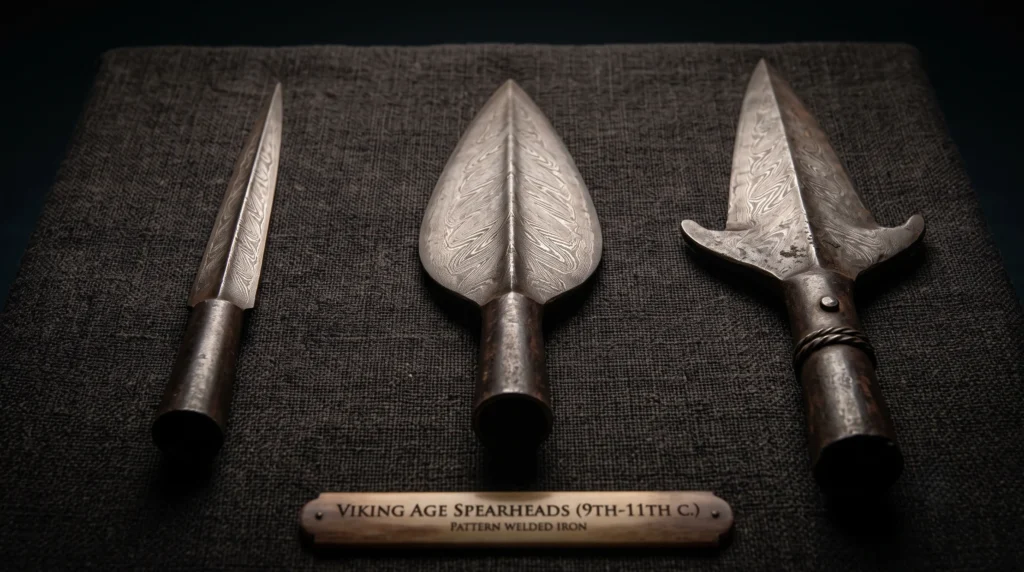
Then effectiveness. A two-to-three-meter ash shaft topped with an iron head kept your enemy at a distance his axe could not cross, and in the crush of the shield wall, thrusting over the rims was how most killing actually happened. Heads ranged from slim, armor-piercing spikes to broad leaf blades, some with “wings” below the head to stop a run-through enemy from sliding down the shaft, and many were pattern-welded and decorated, because even the common weapon carried pride.
And finally, religion. Throwing a spear over an enemy army was a ritual act, an imitation of Odin casting his spear Gungnir over the Vanir in the first war of the gods. The cast came with a dedication: the enemy host was being given to Odin, every one of them. The spear was the weapon of farmers, kings and the Allfather himself, and that range is exactly why it ruled.
The Viking Axe: From Farm Tool to Dane Axe
The axe earned its iconic status honestly, but not the way the movies tell it. The history of the Viking axe is really the history of a promotion: from the humblest tool on the farm to the most feared weapon on the battlefield.
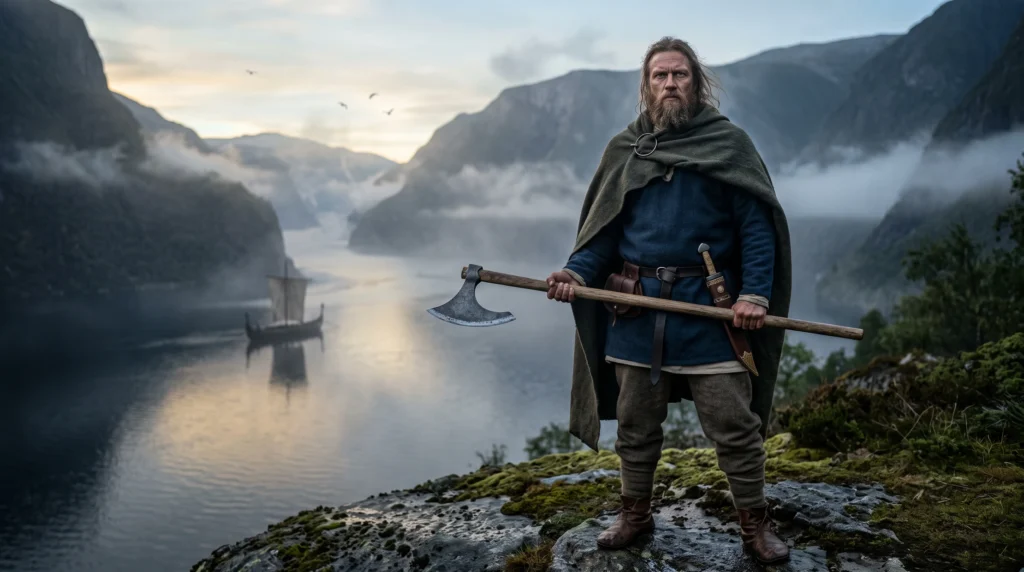
Every Norse farm ran on axes: felling, splitting, building, butchering. That is precisely why the axe became the second great weapon of the age: every man already owned one and knew how to swing it. Early battle axes were simply working axes carried to war, plain iron on a meter of wood, and for a poor man, the axe hanging by the door WAS his war gear, the same logic that made the seax the universal blade of daily life.
Over the Viking Age, the weapon specialized. Blades broadened, beards lengthened (the “bearded axe” whose lower edge could hook a shield rim and yank it down), and by the late period the evolution peaked in the Dane axe: a wide, thin, wickedly light crescent on a shaft as tall as a man, swung with both hands, its wielder trusting speed, reach and his neighbors’ shields to protect him, since his own hands were full. Thin is the key word the replicas get wrong: real battle axe heads were shaved down to the minimum, built for speed, not for the five-kilo fantasy chopping of video games. The best-preserved examples, like the decorated Mammen axe with its silver inlay, are objects of art as much as war.
Swords: Rare, Expensive, and Named Like People
Here is the number that reframes everything: a good sword represented the value of several cows, months of a specialist smith’s labor, more wealth than most families saw in a year. Owning one was owning a sports car; inheriting one was inheriting a title. This is why swords in the sagas have names and biographies: Skofnung, cut from a king’s barrow and never to be drawn in the presence of women; Gram, the blade that slew the dragon Fafnir. A named sword was a character, passed down, fought over, buried and sometimes dug back up.
The blades themselves were double-edged, around 90 centimeters, and, contrary to every “heavy broadsword” cliché, light: 1 to 1.5 kilograms, balanced for one hand while the other held the shield. Early blades were pattern-welded, twisted rods of iron and steel forged into serpentine patterns; later blades increasingly used better homogeneous steel. The types of Viking swords are so distinct that archaeologists still classify them by Jan Petersen’s 1919 typology, over two dozen hilt families that let a specialist date a blade by its pommel alone.
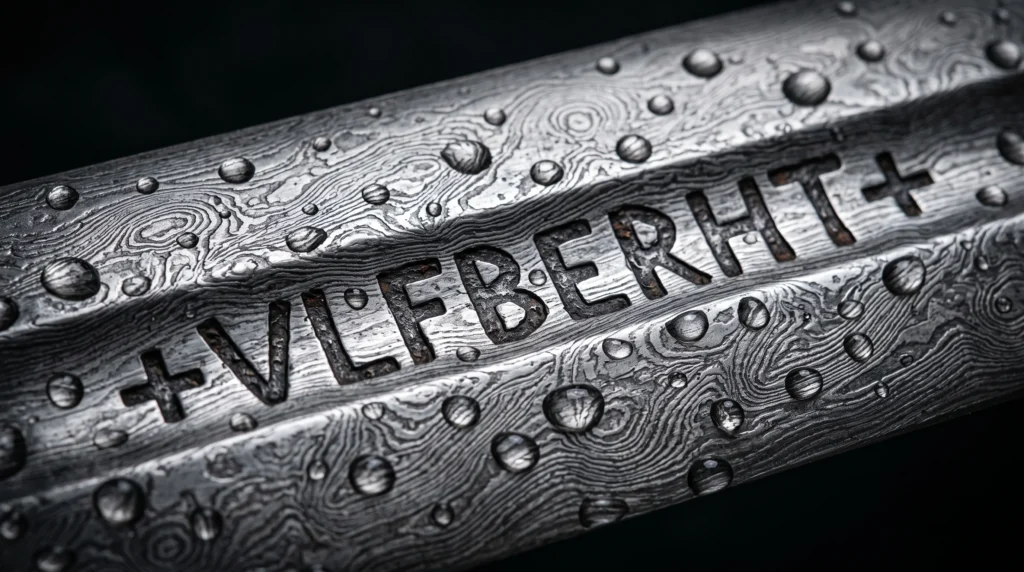
And then there are the Ulfberht swords, the mystery of the age. About 170 blades scattered across the Norse world carry the same inlaid signature, +VLFBERH+T, and the finest of them are made of crucible steel so clean that European furnaces supposedly could not produce it for another several centuries, pointing to imported ingots from the east or a lost forging tradition. Ulfberht was, functionally, the first luxury brand in European history, complete with what archaeologists believe are period counterfeits carrying misspelled versions of the name. A fake designer sword, a thousand years before designer anything.
Named blades run through the myths as well as the sagas. Odin casts the spear Gungnir to claim the first war; Sigurd slays the dragon Fafnir with the reforged Gram; Freyr gives away the sword that fights by itself, and pays for it at the end of the world. And looming over Ragnarök is the fire giant Surtr, whose flaming sword, “brighter than the sun”, will burn the Nine Realms at the final battle. When a culture prices a sword at a year of a family’s wealth, its gods carry legendary ones. The arsenal of the myths is the arsenal of the age, gilded.
The Seax: The Blade Everyone Carried
Between the knife and the sword lived the seax, the single-edged blade that free Norse men and women wore horizontally at the belt, from the everyday utility knife to the sword-length langseax. It deserves, and has, its own complete story: our full guide to the seax, history and types covers the broken-back blade, the famous Thorfast comb-carving versatility, and why it thrived exactly where swords failed, in the crush where no one had room to swing. For this article’s purposes, one sentence carries the essential: the seax was the most democratic weapon of the age, the one piece of the arsenal that cut across every level of wealth.
Bows and Ranged Weapons: The Opening Move
Norse battles did not begin with a charge. They began with a hiss.
Bows of yew or elm, drawing arrows tipped for war, opened engagements from behind the shield lines and from the decks of ships closing for a fight, volley after volley until the distance closed. The bow was also the everyday hunting tool, which kept the skill universal, though its status was complicated: killing at distance sat awkwardly with an honor culture built on facing your enemy, and the sagas mostly give the bow to specific famous archers rather than to heroes in general. Alongside arrows flew thrown spears and, at close quarters before the walls met, throwing axes, though the dedicated “franciska-style” throwing axe was more a Frankish habit than a Norse one. The opening barrage softened the enemy line; the shield walls decided the rest, as our guide to real Viking helmets and shields shows in detail.
Armor Truth: Mail Was Rare, Leather Bracers Are Hollywood
Now for the section every costume department should be forced to read.
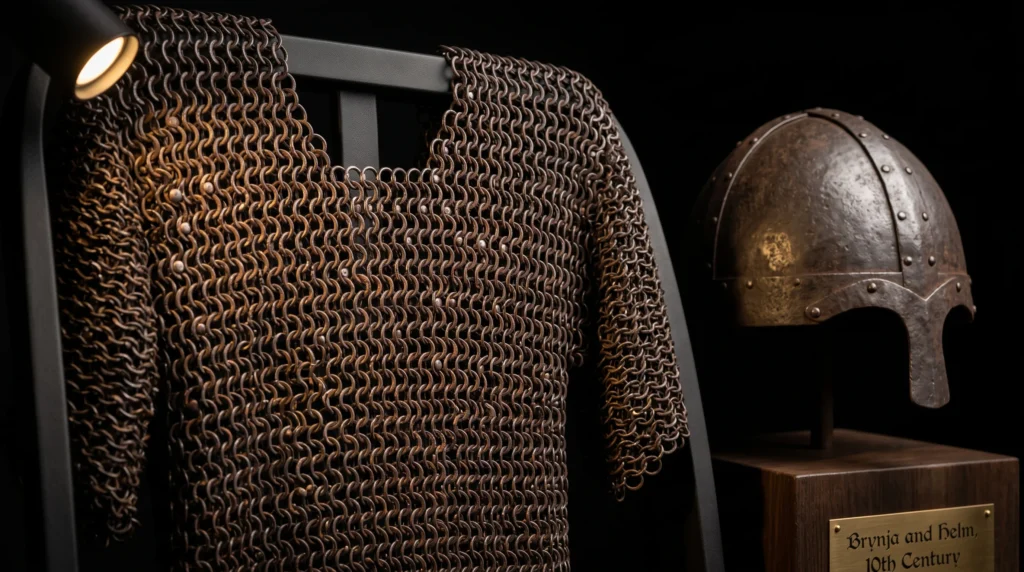
Mail was real, and mostly out of reach. The mail shirt (brynja) was the supreme protection of the age: thousands of hand-riveted iron rings, months of labor, aristocrat money. The Gjermundbu grave that produced the only nearly complete Viking helmet also held a mail shirt of roughly 25,000 rings, and that pairing is the point: the man rich enough for one was rich enough for both, and he was one man in a region. Most warriors fought in wool and courage.
Padding is probable, not proven. Thick wool garments or padded layers under mail (or instead of it) make practical sense and fit the later evidence, but Viking Age finds are essentially absent, so honest historians say “likely” and stop there.
The leather armor of television is fiction. No studded leather vest, no molded leather cuirass, no leather bracers have been found in a Viking Age context. Leather served for belts, sheaths, shoes and shield facings; the armored-biker look is a modern costume language for “tough guy”, not archaeology. The same goes for the all-black warrior aesthetic, as our Viking clothing myths guide explains: real Norse dress was tailored, colorful wool.
And the one genuine oddity: lamellar. Around thirty small iron plates from Birka suggest lamellar armor, the laced-plate style of the eastern steppes, was at least present there, probably imported or worn by a traveler on the eastern routes. One site, a few plates, honest uncertainty: that is the entire dossier, whatever the replica shops claim.
Weapons in Graves: What the Archaeology Actually Shows
Almost everything above rests on burials, and burials speak in patterns.
Weapon graves follow the wealth ladder faithfully: spearheads and axes are common companions of the dead, swords far rarer, mail and helmets nearly absent, exactly the pyramid the economics predict. A full aristocratic panoply, sword, spear, axe, shield, mail, helmet, marks the resting place of power, and its pieces were often ritually bent or broken before burial, killed like their owner.
But the graves also complicate the picture in two important ways. First, a weapon burial marks status, not necessarily a warrior: weapons were legal identity and inherited wealth, so a spear beside a farmer says “free man of standing” as much as “fighter”. Second, not all weapon graves belong to men. The most famous, grave Bj581 at Birka, a richly equipped warrior burial with sword, axe, spears, arrows and two horses, was confirmed by DNA analysis in 2017 to be a woman. What that means, and what it does not, is one of the liveliest debates in Viking archaeology, and it deserves its own full article rather than a paragraph, but for anyone searching for historically accurate female Viking armor, the honest answer is: when women were buried with war gear, it was the same gear as the men’s. There was no separate “female armor”, whatever the games say. The finds from across the Norse world are cataloged by institutions like the National Museum of Denmark, whose galleries of Viking weapons and armour anchor much of what this article describes.
Arm a Viking by Budget
The whole arsenal in one table, the way a Norse father would have explained it:
| If you were… | You carried | Modern equivalent |
|---|---|---|
| A poor free man | The farm axe, a spear, a round shield | A used car and a legal ID |
| A solid farmer | Spear, shield, a good axe or seax, maybe a bow | A family car and some savings |
| A prosperous man | All the above, plus a sword | A sports car in the driveway |
| An aristocrat or king’s man | Sword, spear, axe, shield, mail shirt, iron helmet | The estate, the yacht, the jet |
One rule held the ladder together: the shield. Rich or poor, everyone carried one, everyone painted it, and every battle came down to the moment two walls of them met.
Steel had a sound, and the skalds sang it. Our track Sverd ok Eldr (Sword and Fire), sung in Old Norse, is the clash of the arsenal above: the spear’s hiss, the axe’s weight, the sword’s price paid in full.
The weapons collections of the National Museum of Denmark; the Gjermundbu find (helmet and mail shirt), Museum of Cultural History, Oslo; Jan Petersen, De Norske Vikingesverd (1919), the standard typology of Viking swords and axes; Anne Stalsberg’s studies of the Ulfberht blades; Alan Williams, metallurgical analyses of Ulfberht crucible steel; the Gulaþing law provisions on folkvápn; grave Bj581 at Birka (Hedenstierna-Jonson et al., 2017); the Mammen axe, National Museum of Denmark; the Poetic Edda (Völuspá, Hávamál) and the Prose Edda of Snorri Sturluson, for Gungnir, Gram and Surtr.
Frequently Asked Questions
What was the most common Viking weapon?
The spear. It required far less iron than a sword, making it affordable for every free man, and Norwegian law codes like the Gulaþing required free men to own one as part of their folkvápn. In the shield wall, where most Viking Age fighting happened, the spear did most of the killing.
Did Vikings dual wield?
No evidence supports routine dual wielding. The standard kit was one weapon plus a shield, because the shield was half the fighting system. Sagas occasionally describe exceptional feats with a weapon in each hand, but these are presented as extraordinary, which is exactly why they were worth telling.
How heavy was a Viking sword?
Between 1 and 1.5 kilograms, far lighter than the fantasy broadsword image. Viking swords were balanced one-handed weapons, around 90 centimeters long, built for speed alongside a shield. The heavy, slow “barbarian sword” is a modern invention.
Did Vikings wear leather armor?
No leather armor has ever been found in a Viking Age context. Leather served for belts, shoes, sheaths and shield facings. Real protection was the mail shirt for the wealthy few and probably thick wool padding for others, though even padding is inferred rather than proven.
What weapons did Vikings use?
The complete arsenal: spears (the most common), axes from farm tools to two-handed Dane axes, single-edged seax knives, expensive double-edged swords for the wealthy, bows for the opening barrage, and round painted shields for everyone. What a man carried depended on his wealth, not his taste.
Did Viking women use weapons and armor?
Some weapon graves belong to women, most famously grave Bj581 at Birka, confirmed female by DNA in 2017 and buried with a full warrior kit. When women were buried with war gear, it was the same gear as men’s: there was no separate female armor. How common women warriors actually were remains one of the field’s liveliest debates.
Music to read by
Each article has a soundtrack. Listen to Mythic Harmonies while you read.
Explore the music