
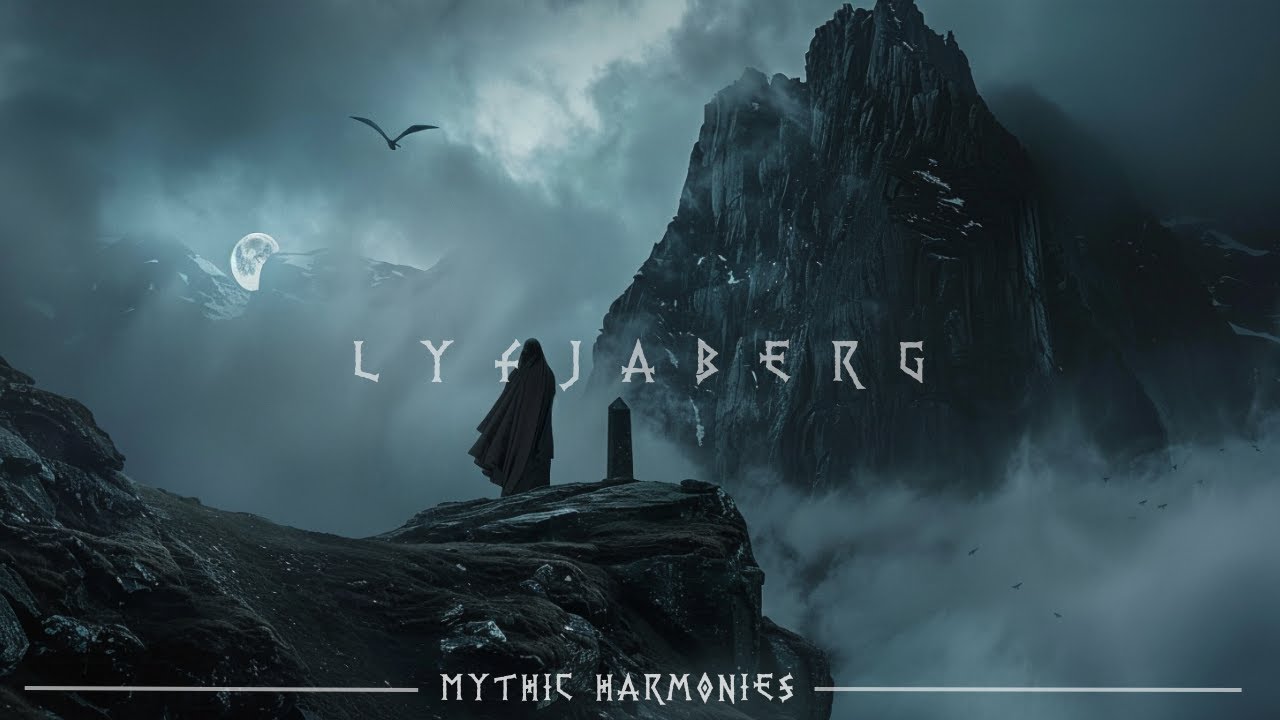
Lyfjaberg is an original Mythic Harmonies song inspired by the healing mountain named in Fjölsvinnsmál. The track turns a compact medieval image—a height associated with comfort for the sick and wounded—into a modern, meditative ritual piece. Its words and music are contemporary; the place, Menglöð and the maiden Eir come from the surviving Norse text.
This page brings together the official video, complete vocal text, English translation and an evidence-led explanation of what the sources actually say. It also marks the limits clearly: the Eddic poem does not describe glowing runes, a blood-healing rite or a historical ceremony performed to this song.
What Does Lyfjaberg Mean?
Lyfjaberg combines lyf, a word connected with medicine, remedy or healing substances, and berg, a mountain or rocky height. “Healing Mountain,” “Mountain of Healing” and “Mountain of Remedies” are all useful English renderings. The song uses Healing Mountain because it communicates the image directly without pretending that one translation exhausts the Old Norse name.
The name occurs in Fjölsvinnsmál, where the mountain is described as a long-standing source of comfort or benefit for the sick and wounded. A woman who climbs it is said to become whole even when afflicted by a grave illness. That is the poem’s extraordinary claim; it is a mythic statement inside a medieval narrative, not historical medical advice.
Track Facts
| Artist | Mythic Harmonies |
|---|---|
| Title | Lyfjaberg |
| English subtitle | Healing Mountain |
| Category | Funeral & Ritual |
| Official video | Watch on YouTube |
| Source inspiration | Fjölsvinnsmál and Snorri’s Gylfaginning |
| Historical status | Modern original composition, not a surviving Viking Age chant |
Lyfjaberg in Fjölsvinnsmál
The central evidence appears in Fjölsvinnsmál. Svipdag, calling himself Vindkaldr, questions the watchman Fjölsviðr outside an enclosed hall. He asks the name of the mountain where he can see a renowned woman resting. The answer is Lyfjaberg.
The woman at the center of the scene is Menglöð, not Eir. Menglöð waits for Svipdag and sits with nine maidens. When the poem names them, Eir appears among the group. The sequence matters: Lyfjaberg belongs to Menglöð’s setting, while Eir is one of the attendants associated with it. The poem does not say that Eir owns the mountain, rules there alone or conducts a healing ceremony on its summit.
In many modern editions Fjölsvinnsmál is printed with Eddic poetry, often together with Grógaldr under the editorial title Svipdagsmál. Unlike the principal poems of the Codex Regius, however, it survives in later paper manuscripts and presents difficult textual questions. Calling it “an Eddic poem” is sound; implying a simple, perfectly preserved Viking Age text would go beyond the evidence.
The Nine Maidens and the Offering Passage
After naming the women at Menglöð’s knees, the poem asks whether they protect people who make offerings to them. The answer says that they wisely help those who honor them at a sacred place and can rescue a person from great danger. This is one reason the Lyfjaberg episode feels ritual as well as medicinal.
Yet the passage does not identify a particular substance, chant, instrument or treatment. It does not say that Eir alone receives the offering, and it does not mention blood. The modern song’s line “with blood and seiðr” therefore belongs to the composition’s imagery, not to a hidden instruction preserved in the poem. Even the relation between the nine named maidens and other divine figures remains open to interpretation because the text supplies names and actions, not full identities.
Who Is Eir in the Norse Sources?
Snorri Sturluson lists Eir among the Ásynjur in Gylfaginning, chapter 35, and calls her the best physician. Fjölsvinnsmál independently includes a maiden named Eir beside Menglöð. These brief notices explain why Eir is widely connected with healing, but they do not supply a biography, cult manual or body of myths comparable to those of Odin, Thor or Freyja.
Some modern summaries call Eir a valkyrie and then contrast her with figures who “choose the dead.” Names can recur in Old Norse lists, and the surviving material is too sparse to build a secure doctrine from that contrast. The central sources do not say that Eir chooses who lives, carries wounded warriors from battle or presides over a copper flower. Those are later interpretations or inventions, not details the song page should repeat as fact.
The safest conclusion is modest: Eir’s name is connected with help or mercy; Snorri calls her an excellent physician; and a figure of that name sits among Menglöð’s nine maidens at Lyfjaberg. The song gives this small body of evidence an imaginative voice while keeping the source boundary visible.
What Is Modern Imagery in the Song?
The vocal text mentions blood, seiðr, ravens, fire and runes carved on the mountain. None of those elements is part of the Lyfjaberg passage in Fjölsvinnsmál. They create a dark ritual atmosphere for this composition; they should not be read as a reconstruction of a documented Norse healing rite.
Seiðr is a broad and difficult category of magic in Old Norse literature. The sources associate it with divination, altered states, harmful acts and other practices, but they do not give one universal “Viking shamanism” system. No surviving text says that patients at Lyfjaberg were treated through blood and seiðr. Likewise, there is evidence for practical care, herbs and wound treatment in medieval Scandinavia, but that does not authenticate every modern claim about magical medicine.
This distinction strengthens the song rather than diminishing it. The mountain and its promise of relief are documented. The ritual scenery is a modern artistic response to that promise. Mythic Harmonies names both layers so a listener can enter the atmosphere without confusing imagination with primary evidence.
Lyfjaberg by Mythic Harmonies
This recording is a Mythic Harmonies original. It is not a cover, translation or remix of Wardruna’s song of the same name. Both works draw independently on the shared medieval place-name and its healing associations. When searching on streaming services, verify the artist as well as the title; no exact Mythic Harmonies release under Lyfjaberg was confirmed on Spotify or Apple Music during this page’s latest review, so the platform buttons retain the general artist catalogues.
Musically, the piece favors repetition, space and gradual ascent over battle energy. Low vocal layers and restrained percussion frame the title as a destination approached slowly. The refrain does not claim to cure a listener. Its role is expressive: it turns the idea of climbing toward relief into a calm, cyclical listening experience suited to reflection, reading or a quiet transition after more forceful tracks.
Listen for the distinction between the narrative verses and the recurring invocation of the mountain. The verses introduce Eir, prayer, storm, runes and the imagined ritual landscape; the refrain reduces the idea to ascent, voices and renewed life. That alternation gives the piece its retention curve without requiring a dramatic tempo change: each return feels familiar, while the surrounding images keep widening the scene.
For another restorative piece, continue with Undir Asku Yggdrasils. To place the sound in the wider catalogue, use our guide to Viking and Nordic-inspired music or browse the complete Songbook of the North.
Lyfjaberg Lyrics & English Translation
The words below are an original modern composition in stylized Old Norse, not verses copied from Fjölsvinnsmál. The English version gives the intended poetic meaning rather than a critical, word-for-word edition.
Original Vocal Text
Lyfjaberg rís, í myrkri bjart,
heilagr staðr, meðr krafta hart.
Eir kallar, viðr sár ok mein,
fjǫll bera, læknis grein.Lyfjaberg! heilagr hlíð,
meðr blóð ok seiðr, gefr oss líf.
Lyfjaberg! rǫddir syng,
heilun kemr, viðr fjǫr ok hring.Stormar þrumu, foldin hrær,
menn biðja, engi stærr.
Í loga hljóð, í hrafna kveð,
Eir hlýðir, líf hon gef.Fjallit glóir, meðr runum skráð,
heilagr staðr, af goðum varð.
Sár grǫr, ok meinit hverf,
kraftr lifir, er fjǫllin gefr.Lyfjaberg! heilagr hlíð,
meðr blóð ok seiðr, gefr oss líf.
Lyfjaberg! rǫddir syng,
heilun kemr, viðr fjǫr ok hring.Lyfjaberg… eilífr…
kraftr goða… lifir.
English Translation
Lyfjaberg rises, bright in the dark,
A holy place, with powers stark.
Eir calls forth, to wounds and pain,
The mountains bear her healing grain.Lyfjaberg! sacred hill,
With blood and seiðr, new life instill.
Lyfjaberg! voices sing,
Healing comes, with life’s bright ring.Storms are roaring, the earth is stirred,
Men are praying, none unheard.
In fire’s hum, through ravens’ breath,
Eir is listening, she conquers death.The mountain glows, with runes engraved,
A sacred place the gods once saved.
The wounds are sealed, the pain departs,
The mountain’s strength revives all hearts.Lyfjaberg! sacred hill,
With blood and seiðr, new life instill.
Lyfjaberg! voices sing,
Healing comes, with life’s bright ring.Lyfjaberg… eternal…
The gods’ power… lives on.
What does Lyfjaberg mean?
Lyfjaberg can be translated as Healing Mountain, Mountain of Healing or Mountain of Remedies. In Fjölsvinnsmál it is a mythic height associated with comfort or benefit for the sick and wounded.
Where does Lyfjaberg appear in Norse mythology?
Lyfjaberg appears in Fjölsvinnsmál, an Eddic poem preserved in later paper manuscripts. Menglöð is seen there with nine maidens, including Eir, while Svipdag questions the watchman Fjölsviðr outside the enclosure.
Is Lyfjaberg the home of the goddess Eir?
The poem places Menglöð at Lyfjaberg and names Eir among her nine maidens. It does not say that Eir owns or rules the mountain. Snorri separately lists Eir among the Ásynjur and calls her the best physician.
Is this an authentic Viking healing chant?
No. Lyfjaberg is an original modern Mythic Harmonies song in stylized Old Norse. The mountain and mythic names come from medieval sources, but the words, melody, ritual imagery and performance are contemporary.
Can Lyfjaberg be used as medical treatment?
No. The song may accompany personal reflection or relaxation, but it is an artistic work and makes no medical claim. The healing promised by Lyfjaberg belongs to a mythic poem, not evidence-based healthcare.
More from Funeral & Ritual
March with the War-Band
New Old Norse chants every month. Join the listeners who never miss a release.