
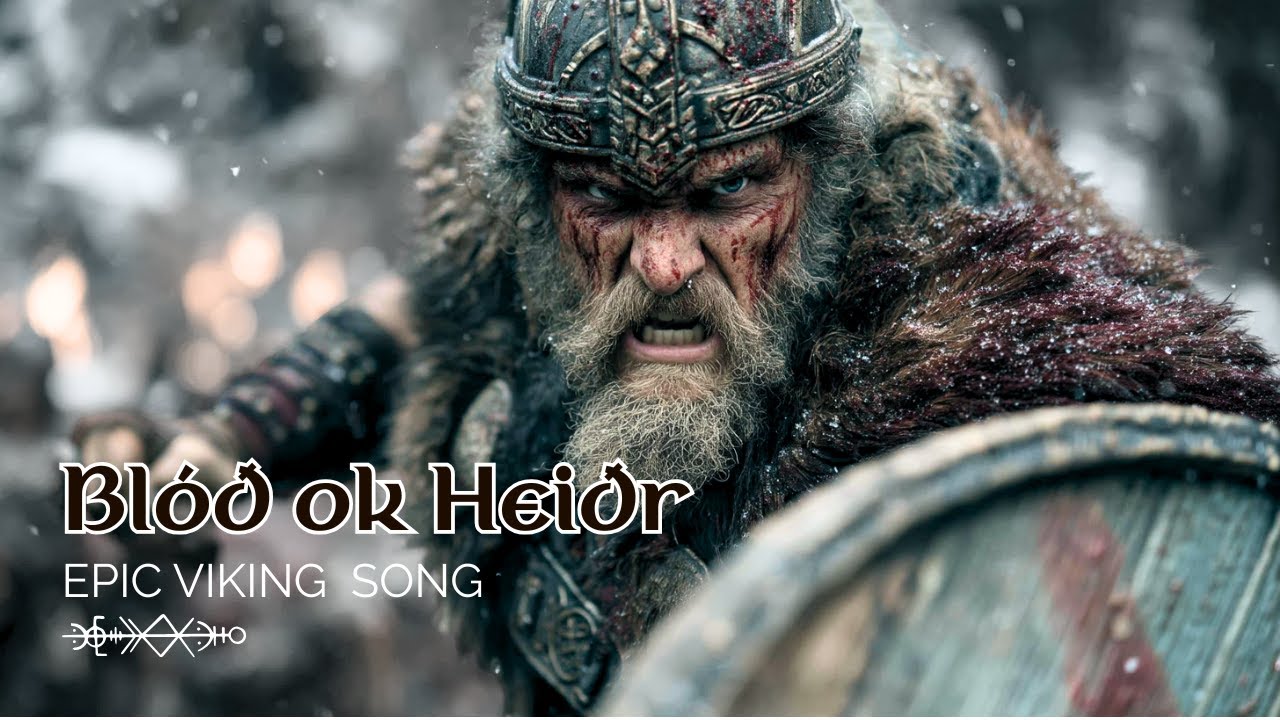
Blóð ok Heiðr (“Blood and Honor”) is an original Mythic Harmonies battle song built around a public promise: carry blood, guard honor and do not yield. Its Norse-language verses move through a red battlefield, wolves and ravens, a sworn oath, the endurance of the speaker’s kin and a final appeal to Odin and Thor.
This page gives the complete Blóð ok Heiðr lyrics and English translation, explains what the title means and separates the song’s modern imagery from what medieval Norse sources can actually support. It is a guide to this specific track—not a claim that the words preserve an ancient Viking war chant or a universal “Viking code.”
Blóð ok Heiðr at a Glance
- Track: Blóð ok Heiðr
- English title: Blood and Honor
- Artist: Mythic Harmonies
- Official video: 4 minutes
- Streaming master: 3 minutes 59 seconds
- Language: stylized Norse-language text with an artistic English translation
- Core theme: honor maintained through collective resolve, oath and remembered lineage
What Is Blóð ok Heiðr About?
The song begins in motion: blood falls, a sword catches the sun and shields are held on the field. The second stanza fills the landscape with wolves, ravens, mountains and storm. Against that unrest, the refrain gives the singers one repeated answer—“blood and honor” are what they carry forward and what remains with them even in death.
The later verses make the theme personal. The speaker hears a call from Ásgarðr, swears an oath “raised with blood,” names Odin and Thor, and returns to the line Ætt mín lifir, aldri endr: “My kin lives and never ends.” The song is therefore not simply about winning a battle. Its center is continuity—how a group imagines that its name, promise and memory can outlast the person speaking.
What Does “Blóð ok Heiðr” Mean?
Blóð means “blood”, ok means “and”, and heiðr can carry senses including “honor,” “esteem” and public standing. “Blood and Honor” is therefore the intended and natural artistic translation of the title.
That compact translation should not be expanded into a single moral system shared unchanged by every Viking Age community. Medieval Norse literature repeatedly cares about reputation, family standing, insult and response, but the evidence comes from different genres, places and dates. The Dictionary of Old Norse Prose and the Cleasby–Vigfusson Old Norse dictionary are useful starting points for vocabulary; they do not turn the song title into the name of a documented historical doctrine.
A Modern Norse-Inspired Song, Not an Ancient Chant
Blóð ok Heiðr is a modern original composition. No known medieval manuscript records this refrain, these stanzas or this melody as a Viking Age song. Its wolves, ravens, weapons, gods and oath deliberately evoke the literary North, but the complete work belongs to the present.
The released Norse-language text also uses poetic and stylized forms rather than a consistently normalized scholarly Old Norse grammar. The transcription below is preserved as performed instead of being silently rewritten. The English version is the official artistic translation: it conveys the intended scene and rhythm rather than functioning as a word-for-word philological edition.
Blood, Kin and the Line That Continues
In the title, “blood” first belongs to the battlefield. Within the refrain, however, it gains a second possible resonance through ætt, the speaker’s kin or lineage. The repeated claim that the kin “never ends” makes remembrance as important as survival. The individual may die; the name and group are imagined as continuing.
This is a reading of the song’s own sequence, not proof that all Norse people understood blood through one fixed warrior creed. Kinship and reputation mattered deeply in saga narratives, yet those narratives are literary works preserved in medieval manuscripts rather than transparent recordings of every Viking Age belief. The distinction matters because it lets the lyric remain powerful without disguising a modern interpretation as a historical fact.
The Song’s Personal Oath
The fifth stanza says Ek sverja eið, meðr blóði reist, translated here as “I swear an oath, carved in blood.” That oath is real inside the song’s narrative: it is the point where collective language becomes the speaker’s declared commitment. The line does not specify an arm ring, weapon, legal formula or known historical ceremony, so none should be supplied as though the lyric had named it.
Old Norse sources certainly contain oaths and treat reputation as consequential, but their settings and formulas vary. Here, blood is poetic intensification—a promise made costly and bodily. Listeners looking for a separate composition devoted to sworn brotherhood should continue to The Blood Oath. Keeping that broader oath intent on its own page prevents the two tracks from competing for the same search.
Odin, Thor and Ásgarðr in the Song
The text names three mythic anchors. Ásgarðr supplies the distant call; Odin watches; and Thor strikes. These roles fit recognizable parts of the medieval literary tradition—Odin is closely connected with war and the slain, while Thor is the forceful enemy of giants—but the exact scene is the song’s invention.
The line should not be presented as a recovered pre-battle prayer. It compresses complex gods into a few seconds of action so the refrain can return quickly. For readers who want the source tradition rather than this track’s dramatic shorthand, the linked guides treat each god separately and identify where later interpretation begins.
How the Song Builds Its Battle-Chant Effect
The text uses short four-line stanzas, repeated elemental images and a chorus whose title returns at the beginning of consecutive lines. That structure makes the central words easy to recognize even for a listener who is reading the translation for the first time. The movement is cumulative: battlefield, landscape, refrain, divine call, personal oath, then refrain again.
The official video runs 4:00, while the verified Spotify and Apple Music releases run 3:59. That one-second platform difference falls within the catalogue’s matching rule and identifies the same Mythic Harmonies recording. The track works naturally for training, gaming and dramatic scenes, but those are modern listening contexts rather than evidence about Viking Age performance.
Blóð ok Heiðr, Blóð ok Eldr and The Blood Oath
These three songs share battle language, so their meanings need clear borders. Blóð ok Heiðr owns “Blood and Honor”, the exact lyrics on this page and the tension between public standing, oath and lineage. Blóð ok Eldr owns “Blood and Fire” and the image of a shield-line refusing to fall. The Blood Oath owns sworn brotherhood and the bond between companions.
For a wider comparison, the Mythic Harmonies Songbook gathers every released transcription and translation. This page remains intentionally focused on one song instead of trying to rank for every general “Viking honor” or “Viking oath” query.
Blóð ok Heiðr Lyrics & English Translation
Below is the released transcription as it appears with the song. The Norse-language wording is preserved as written; the English section is the official artistic translation rather than a normalized academic edition.
Original Norse-Language Text
Blóðr fellr á vígvǫllr rauðr,
Heiðr lifir í hjarta glaðr.
Sverðr í sól, skjǫldr í brand,
Í nafni goða, vér stendr á land.Úlfar grenja, hrafnar fljúga,
Fjǫll skelfa, stormar búa.
Í loga stríðs, vér reisum ham,
Blóð ok heiðr, vér berum fram.Blóð ok heiðr, vér deyjum með,
Í sigr goða, vér finnum leið.
Blóð ok heiðr, í eldr stendr,
Ætt mín lifir, aldri endr.Horn gjalla, eldrar loga,
Mennir falla, draumar stóðu.
Ek heyri kall frá Ásgarðr ham,
Blóð ok heiðr, vér sigr nám.Ek sverja eið, meðr blóði reist,
Ek stendr í stríð, þar heiðr er meist.
Óðinn horfir, Þórr mun berja,
Blóð ok heiðr, vér aldri verja.Blóð ok heiðr, vér deyjum með,
Í sigr goða, vér finnum leið.
Blóð ok heiðr, í eldr stendr,
Ætt mín lifir, aldri endr.Blóð… ok heiðr… í dreyra lifum.
English Translation
Blood falls on the red battlefield,
Honor lives in the gladdened heart.
Sword in the sun, shield in hand,
In the name of the gods, we stand our ground.Wolves howl, ravens fly,
Mountains tremble, storms prepare.
In war’s blaze we rise in might,
Blood and honor, we carry forth.Blood and honor, with them we die,
In the gods’ victory, we find the way.
Blood and honor, in fire we stand,
My kin lives and never ends.Horns resound, the flames arise,
Men fall, and dreams stood still.
I hear the call from halls of Ásgarðr,
Blood and honor, the triumph’s ours.I swear an oath, carved in blood,
I stand in war, where honor’s greatest.
Odin watches, Thor will strike,
Blood and honor, we never yield.Blood and honor, with them we die,
In the gods’ victory, we find the way.
Blood and honor, in fire we stand,
My kin lives and never ends.Blood… and honor… in blood we live.
Listen to Blóð ok Heiðr
Watch the official 4:00 video above. The exact Mythic Harmonies release is also available as “Blood and Honor” on Spotify and Apple Music at 3:59, matching the video within one second.
Listen to Blood and Honor on Spotify · Listen to Blood and Honor on Apple Music
Sources and Further Reading
- Dictionary of Old Norse Prose, University of Copenhagen, for medieval vocabulary and attested forms.
- Cleasby–Vigfusson Old Norse–English Dictionary, for the lexical range of blóð, eiðr, heiðr and related words.
- Marta Rey-Radlińska, “Friendship and Man’s Reputation”, in Social Norms in Medieval Scandinavia, for reputation in a specific medieval Icelandic literary context.
- Snorri Sturluson, Edda: Prologue and Gylfaginning, ed. Anthony Faulkes, Viking Society for Northern Research, for the medieval mythographic presentation of Odin, Thor and Ásgarðr.
- Margaret Clunies Ross, The Cambridge Introduction to the Old Norse-Icelandic Saga, excerpt, for the literary and social context of saga evidence.
What does Blóð ok Heiðr mean?
Blóð ok Heiðr means “Blood and Honor.” Blóð means blood, ok means and, and heiðr can carry senses including honor, esteem and public standing. It is the title of this modern Mythic Harmonies song, not the name of a documented Viking Age doctrine.
Is Blóð ok Heiðr an authentic Viking Age song?
No. Blóð ok Heiðr is an original modern Mythic Harmonies composition inspired by Norse vocabulary and literary imagery. No known medieval manuscript records these lyrics, this refrain or this melody as an ancient war chant.
Is Blóð ok Heiðr sung in Old Norse?
The song uses a stylized Norse-language text with recognizable Old Norse vocabulary, but its forms are not uniformly normalized like a scholarly medieval edition. The released transcription is preserved as performed, and the English text is an artistic translation.
How is Blóð ok Heiðr different from Blóð ok Eldr and The Blood Oath?
Blóð ok Heiðr centers Blood and Honor, lineage and one personal oath. Blóð ok Eldr centers Blood and Fire and a battle line that refuses to fall. The Blood Oath is the separate track devoted to sworn brotherhood and the bond between companions.
Where can I listen to Blóð ok Heiðr?
The official 4:00 video is on the Mythic Harmonies YouTube channel. The verified release appears as Blood and Honor by Mythic Harmonies on Spotify and Apple Music at 3:59, matching the video within one second.
More from Epic War Battle
March with the War-Band
New Old Norse chants every month. Join the listeners who never miss a release.