
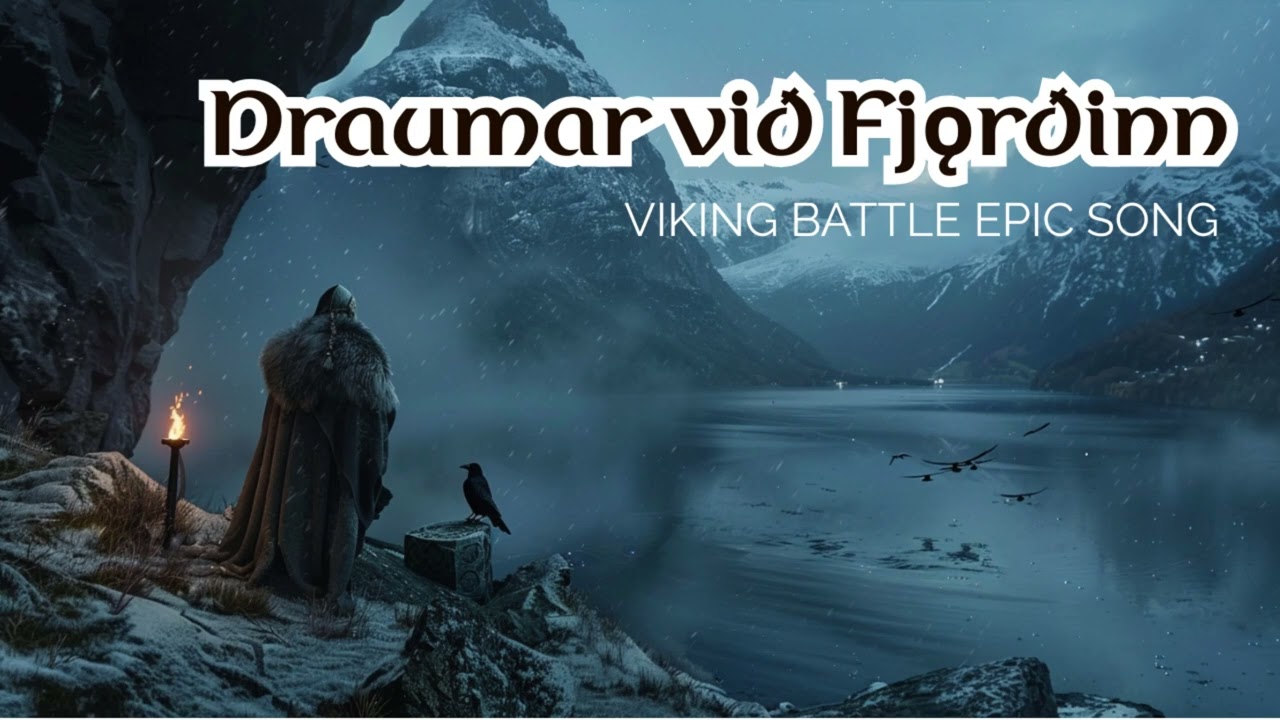
Draumar við Fjǫrðinn (“Dreams by the Fjord”) is a 3:44 original Mythic Harmonies song in stylized Old Norse. A sleeping fjord, reflected stars, wind, ancestral voices, ravens and recurring dreams create a quiet journey through memory rather than a battle narrative.
This page preserves the complete Draumar við Fjǫrðinn lyrics and English translation exactly as released. It distinguishes the track’s modern spiritual imagery from medieval evidence: the water is not documented here as a portal, the “Spirit of the North” is not an attested Norse being, and the ravens are not automatically Huginn and Muninn.
Draumar við Fjǫrðinn at a Glance
- Site and video title: Draumar við Fjǫrðinn
- Streaming title: Dreams by the Fjord
- Artist: Mythic Harmonies
- Language: stylized Old Norse with an artistic English translation
- Duration: 3 minutes 44 seconds
- Core theme: dreams, memory and stillness beside a fjord
- Historical status: modern original composition
What Is Draumar við Fjǫrðinn About?
The opening gives the landscape the action: the fjord sleeps, spirit breathes and dreams awaken. Light and stars then appear as reflections in deep water. Wind carries a soul toward ancient kin, while voices sound in the cold morning. These first images place the narrator between night and waking, presence and memory.
The refrain turns that threshold inward. The soul flies, memory lives in the “fire of night,” and silence settles in the heart. A later verse adds ravens on high peaks and dreams travelling toward “blue gods.” The final stanza returns to water and wind before the soul departs into a dream of the North. The movement is circular and contemplative, not a literal map of a rite.
What Does Draumar við Fjǫrðinn Mean?
Draumar is the plural “dreams,” while fjǫrðinn is the definite form “the fjord.” The released English title Dreams by the Fjord expresses the intended scene. The preposition við has a wider range than one fixed English equivalent, so the subtitle is best treated as an artistic title rather than a claim that every word has only one possible gloss.
The spelling also varies within the published text: the title uses Fjǫrðinn, while the opening begins Fjörðr. Both are reproduced as performed. This page does not silently regularize orthography to create a false impression of a manuscript poem.
The Fjord as Landscape, Not a Proven Portal
A fjord is a long, deep sea inlet between steep sides formed through glaciation. UNESCO describes the West Norwegian fjords as deep rock basins with cliffs, waterfalls, rivers, glaciers and active geological processes. That physical combination makes reflection, shadow, echo and enclosure powerful materials for a modern song.
The line about light reflected in deep water does not itself identify a gateway between a material world and a spirit world. The UNESCO account of Geirangerfjord and Nærøyfjord supports the real landscape behind the imagery; it does not establish the metaphysical portal previously claimed on this page.
Dreams in Medieval Norse Literature
Dreams and portents do matter in medieval Icelandic narrative. They can foreshadow death, conflict or political change, and dream figures may speak verse. A Cambridge edition of women’s dream-verse notes scattered dream-poetry and portents in family and kings’ sagas and a denser use in the thirteenth-century Sturlunga saga.
That is evidence for a literary motif, not a rule that Norse people treated every dream as a message from gods or ancestors. The sources differ in date, genre and purpose, and most surviving saga manuscripts belong to Christian medieval Iceland. Draumar við Fjǫrðinn uses the motif freely as a modern inward journey.
Soul Flight and the “Blue Gods”
The refrain says sál mín flýgr, translated “my soul takes flight.” The line can be heard as imagination, dream or spiritual departure. It does not on its own document ecstatic soul travel, seiðr practice or communication with a named ancestor.
The later guða blá is rendered “the blue gods.” No deity is identified, and the phrase should not be converted into an established divine group. On the page it remains striking color imagery in a non-standard modern text. The same restraint applies to “Spirit of the North”: the phrase is the song’s personification, not the Old Norse name of a god or land-spirit.
What Do the Ravens Mean?
Two ravens watch from lofty peaks, but the lyric never calls them Huginn and Muninn. Odin’s named birds travel over the world and report what they see and hear in Grímnismál and Snorri’s prose. Watching ravens can recall that tradition, yet ordinary birds and broader poetic witnesses remain possible.
For the complete source comparison, use the site’s guide to Huginn and Muninn. This fiche does not assign the ravens an unspoken role as guides, psychopomps or carriers of the narrator’s soul.
Language and Translation Notes
The performed text combines recognizable vocabulary with modern or uncertain constructions and inconsistent normalization. Sequences such as ætti(r) forn, minning lífr, Andi Norðrsins leiðir þitt and eilífr hljóð should not be passed off as an edited medieval stanza without grammatical review.
The English version is therefore labelled an artistic translation. It clarifies the intended images but is not a word-for-word scholarly gloss. The University of Copenhagen’s Dictionary of Old Norse Prose provides a research tool for attested vocabulary; where the released syntax remains uncertain, this page says so rather than inventing certainty.
How the Track Creates Stillness
The 3:44 recording relies on repetition and sustained space. The refrain returns after the raven verse and again gives the same flight, memory and stillness images room to settle. The closing stanza then changes the destination from a momentary flight to departure inside the dream of the North.
That restrained movement is audible. Claims about a “Nordic harp,” wooden flutes, authentic ritual voices or therapeutic stress reduction require track credits or clinical evidence that this page does not have. Listeners may personally use the piece for reading, writing, reflection or rest, but those uses are not historical or medical properties of the recording.
Draumar við Fjǫrðinn and Related Fjord Songs
Draumar við Fjǫrðinn owns the dream-by-the-fjord intent, reflected stars, soul flight and the streaming title Dreams by the Fjord. Fjörðrminni owns private memory, lost dreams and the inner ember. Ekkó Fjǫrðar owns ancestral echoes and its separate performed text.
Echoes of the Fjord remains the directly English song of family memory and return. These pages share landscape vocabulary but not the same title, recording, lyric or primary search intent.
Draumar við Fjǫrðinn Lyrics and English Translation
The first block is the released performed text; the second is the official artistic English translation. Both appear unchanged.
Performed Text
Fjörðr sefr í nótt, Andi andar, draumar kvikna.
Í djúpum vatni speglast ljós, Stjǫrnur dansa yfir oss. Vindr berr sál til ættir forn, Raddir hljóma í kalda morn.
Draumar við fjǫrðinn, sál mín flýgr, Í loga nætur, minning lífr. Hljóð ok kyrrð, í hjarta mitt, Andi Norðrsins leiðir þitt.
Í dimmum skugga ljósið skín, Forna vísan syngja sín. Hrafnar vaka á tindum há, Fara draumar til guða blá.
Draumar við fjǫrðinn, sál mín flýgr, Í loga nætur, minning lífr. Hljóð ok kyrrð, í hjarta mitt, Andi Norðrsins leiðir þitt.
Draumar við fjǫrðinn, eilífr hljóð, Raddir forna, lifa í blóð. Í vatni, í vindi, heill mín er, Í draumi Norðrsins, sál mín ferr.
English Translation
The fjord sleeps in the night, Spirit breathes, dreams awaken.
In deep waters the light reflects, Stars dance above us. The wind carries the soul to ancient kin, Voices echo in the cold morning.
Dreams by the fjord, my soul takes flight, In the fire of night, memory lives. Silence and stillness within my heart, The spirit of the North guides you.
In shadowed dark the light still shines, Ancient songs are softly sung. The ravens watch on lofty peaks, Dreams travel to the blue gods.
Dreams by the fjord, my soul takes flight, In the fire of night, memory lives. Silence and stillness within my heart, The spirit of the North guides you.
Dreams by the fjord, eternal sound, Voices of old live in the blood. In water, in wind, my blessing lies, In the dream of the North, my soul departs.
Listen to Draumar við Fjǫrðinn
Watch the official 3:44 Draumar við Fjǫrðinn video. The matching Mythic Harmonies master is distributed as Dreams by the Fjord on Spotify and Apple Music, also at 3:44.
Sources and Further Reading
- UNESCO World Heritage Centre: West Norwegian Fjords, for fjord formation, morphology and landscape.
- “Visionary Women: Women’s Dream-Verse”, Cambridge, for dreams, portents and verse in medieval Icelandic narratives.
- Viking Society for Northern Research: A New Introduction to Old Norse II: Reader, for edited Old Norse texts and language context.
- Dictionary of Old Norse Prose, University of Copenhagen.
What does Draumar við Fjǫrðinn mean?
The released English title is “Dreams by the Fjord.” Draumar means “dreams,” and fjǫrðinn means “the fjord.” The preposition við can have several contextual senses, so the subtitle is an artistic title rather than a claim of one mechanically fixed gloss.
Is Draumar við Fjǫrðinn an authentic Viking Age song?
No. It is a modern original Mythic Harmonies composition in stylized Old Norse. No medieval manuscript preserves this lyric, translation, melody or ambient arrangement.
Did Norse people believe dreams were messages from the gods?
Dreams and portents are important literary devices in medieval Icelandic sagas, and some dream figures speak verse. That does not prove a universal rule that every dream was considered a divine or ancestral message.
Is the Old Norse in Draumar við Fjǫrðinn historically accurate?
The text contains recognizable Old Norse vocabulary and letter forms but is not uniformly normalized and includes uncertain constructions. It is preserved as performed and not presented as a manuscript transcription or scholarly reconstruction.
Where can I listen to Draumar við Fjǫrðinn?
The official 3:44 video uses the title Draumar við Fjǫrðinn on YouTube. The matching 3:44 master is titled Dreams by the Fjord on Spotify and Apple Music.
More from Funeral & Ritual
March with the War-Band
New Old Norse chants every month. Join the listeners who never miss a release.