
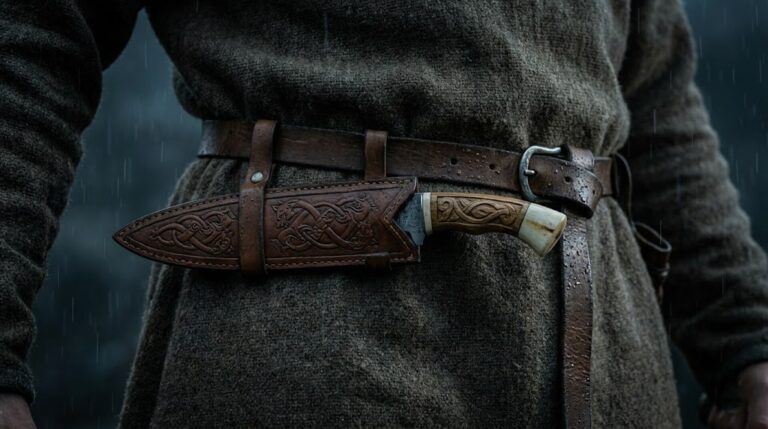
The Seax Knife: Why Every Viking Warrior Carried One
When we picture the Viking Age, our minds immediately conjure images of the bearded axe splintering a shield wall, or the legendary Ulfberht swords gleaming in the pale northern sun. In popular culture, movies, and video games, these are the weapons of heroes.
But historically, these were weapons of war, expensive, difficult to forge, and often reserved for the elite Huscarls or wealthy raiders.
There was another blade, far more ubiquitous and essential, that never left a Norseman’s side. From the humblest farmer tending his fields in Norway to the mightiest Jarl sailing for Wessex, every man (and many women) carried a Seax.
It was the multitool of the Viking Age, a blade used to butcher game, carve wood, eat dinner, and, when the shield wall broke, to fight for survival in close quarters.
In this definitive guide, we will explore the history of the Seax, analyze the iconic “Broken Back” shape, and explain why this single-edged knife is the true symbol of the Viking spirit.
What Exactly is a “Seax”?
If you are new to Norse history, the terminology can be confusing. You might hear words like Scramasax, Langseax, or simply Sax.
The word Seax (pronounced “sacks”) comes from Old English, closely related to the Old Norse sax. Quite literally, it just means “knife” or “cutting tool.”
More Than Just a Knife
However, in the archeological context of the 8th to 11th centuries, a Seax refers to a specific type of blade with distinct characteristics that separate it from a regular eating knife or a sword.
The 3 Key Characteristics of a Seax:
- Single-Edged: Unlike the Viking sword (which was double-edged), the Seax is sharp only on one side.
- Thick Spine: The back of the blade is exceptionally thick and heavy. This structural sturdiness allowed the user to hammer on the spine to split wood or bone without breaking the blade.
- No Crossguard: Most historical finds lack a metal crossguard. The handle was usually made of wood, bone, or antler, fitted directly onto the tang.
Historical Fact: The Seax was so culturally significant that entire tribes identified with it. The Saxons (the Germanic people who settled in England) likely derived their name from the knife they carried. To be a Saxon was to be a “Man of the Seax.”
Tool vs. Weapon: The Line is Blurred
Why did every Viking carry one? Because the Seax was not strictly a weapon. It was a tool of survival.
In the harsh environment of Scandinavia, you didn’t carry a sword to cut your meat or whittle a peg for your tent. A sword is balanced for fencing; it is too light and flexible for heavy work. A Seax, with its heavy spine and forward balance, functioned almost like a machete or a small cleaver.
It was the Everyday Carry (EDC) of the era. Whether repairing a longship’s rigging or defending against a sudden ambush, the Seax was the one item a Viking was never without.
But a knife wasn’t the only thing on their belt. To see what else they carried (and why they didn’t use backpacks), read our definitive guide on What Kind of Bags Did Vikings Use?.
The seax was one blade in a full arsenal, from the spear that ruled the battlefield to the swords named like people: our complete guide to Viking weapons and armor maps it all.

Anatomy of a Viking Blade
To identify a true Seax, you need to look beyond the handle. The construction of these knives was distinct from modern cutlery.
- The Spine: The back of the blade is thick—often 5mm to 8mm near the handle. This gave the knife weight and allowed the user to press their thumb or palm on the spine for controlled carving.
- The Tang: Most Seaxes featured a “hidden tang” (the metal tail of the blade goes inside the handle). The handle was usually made of wood (ash, oak), bone, or antler, held in place by friction, resin, or sometimes a single rivet.
- No Guard: Unlike a sword, there is rarely a metal crossguard between the blade and handle. This allows for a variety of grips, essential for a tool used for both skinning a deer and fighting in a shield wall.
The Iconic “Broken Back” Seax
When people say “Viking Seax,” they are usually picturing the Broken Back style (archeologically known as the Type IV or Anglo-Scandinavian style).
This is the most visually distinct type found in Britain and Scandinavia during the Viking Age.
Why the Strange Shape?
Imagine a straight blade where the spine runs parallel to the edge, but then suddenly angles sharply down towards the tip.
- The Geometry: This sharp angle creates a triangular point.
- The Physics: By removing metal from the tip, the balance point shifts back towards the hand, making the knife feel lighter and faster. However, the thick spine retains enough weight for chopping.
- The Utility: The sharp, fine point (similar to a modern “Wharncliffe” or “Sheepsfoot” blade) is incredible for detailed work like leatherworking or carving runes, while the flat edge is perfect for slicing food.
Collector’s Note: If you are buying a reproduction, the “Broken Back” Seax is the gold standard for a 10th-century Viking or Anglo-Saxon reenactment kit.
Size Matters: From Tool to War Sword
Seaxes weren’t “one size fits all.” Archeologists classify them into three main categories based on length and function.
A. The Hadseax (Hand Seax)
- Length: 3 to 5 inches (blade).
- Function: Pure utility. This was the “pocket knife” of the era. Every free man, woman, and even child would likely own one. It was used for eating, cutting thread, and small daily chores. It was often hung horizontally on the belt in a simple folded leather sheath.
B. The Broad Seax
- Length: 10 to 14 inches.
- Function: Heavy camp tool & sidearm. Too big for the dinner table, but small enough to carry all day. This served the function of a modern hatchet or machete. It could chop firewood, butcher a cow, or crack a skull if necessary. This is the most common size for the “Broken Back” style.
C. The Langseax (Long Seax)
- Length: 20 to 30 inches.
- Function: War. The Langseax blurs the line between knife and sword. It was a terrifying weapon, often featuring a longer handle for a two-handed grip.
- Why use it? Swords were incredibly expensive (requires complex steel welding). A Langseax was a solid chunk of iron/steel with a single edge, easier to forge, cheaper to buy, and brutally effective against mail armor due to its weight and stiffness.

The Unique “Horizontal Carry”
If you see a Viking in a movie wearing a large knife hanging vertically down their leg (like a modern soldier), it is historically incorrect.
The defining feature of the Seax was its sheath and how it was worn.
Archeological finds and pictorial evidence show that the Seax was almost always worn horizontally along the belt, resting across the stomach or the small of the back.
Why Wear It Horizontally?
This wasn’t just a fashion choice; it was practical engineering.
- Ease of Draw: With the handle sticking out sideways, the user could draw the blade across their body in one smooth motion. In a cramped shield wall or a crowded longship, this was faster than pulling a long blade vertically.
- Comfort: A long knife hanging vertically bangs against the leg while running or riding a horse. Worn horizontally, it stays snug against the torso.
- Safety: The edge was usually carried facing upwards inside the sheath. This ensured that the sharp edge didn’t cut through the leather and slice the wearer’s tunic (or skin) over time.
The Sheath: A Canvas for Art
For the Vikings, the sheath (scabbard) was often more expensive and decorated than the knife itself. It was a status symbol.
Construction
The sheaths were made of thick, vegetable-tanned leather. They were folded around the blade and riveted or stitched along the edge with copper alloy (bronze/brass) staples or leather thongs.
Decoration Styles
A “Jarl’s Seax” would be instantly recognizable by its sheath.
- Tooling: The leather was often tooled with intricate geometric patterns, knotwork, or runic inscriptions.
- Metal Fittings: Wealthy warriors added brass or silver chapes (tips) and collars to their sheaths.
- Suspension Loops: The sheath attached to the belt via two or three suspension loops. These loops distributed the weight and kept the heavy knife balanced horizontally.
Reenactor’s Tip: If you are building a kit, pay attention to the suspension. A proper Seax sheath should have at least two distinct attachment points to the belt to prevent it from flopping around.
The finest of these sheaths were never worn out. They went into the ground with their owner, alongside weapons, tools, horses and, in the richest graves, entire ships. What else went into a Norse burial, and what the archaeology can actually tell us about it, is set out in our guide to Viking funeral rites.
Seax vs. Sword: Which is Better?
This is a common debate. Why carry a Seax if you could have a sword?
| Feature | Viking Sword | Langseax (Long Seax) |
| Cost | Extremely High (The price of 16 cows) | Moderate (Affordable for freemen) |
| Edge | Double-edged | Single-edged |
| Use | Combat only | Combat & Utility |
| Armor Penetration | Good | Excellent (Stiff spine doesn’t flex) |
| Maintenance | High | Low |
The Seax was the “AK-47” of the Viking Age: rugged, reliable, and capable of punching through chainmail thanks to its thick, stiff spine which didn’t bend upon impact like some thinner sword blades.
Conclusion: The Mark of a Free Person
The sword might get all the glory in Hollywood, but the Seax built the Viking world.
It cleared the forests for farms, built the fastest ships in Europe, slaughtered the livestock for the winter feasts, and—when the time came—defended the home against raiders.
For the Norse people, the line between “tool” and “weapon” was often just a matter of necessity. The Seax embodies this philosophy perfectly: rugged, brutal, and undeniably effective.
If you are building an authentic Viking kit, the Seax is not optional. A sword was a luxury; a Seax was a necessity. Carrying one on your belt, worn horizontally in the historic style, connects you directly to the daily reality of the ancestors.
Frequently Asked Questions
What is the difference between a Seax and a Viking Sword?
A Seax is a single-edged knife with a thick spine and no crossguard, used as both a tool and a weapon. A Viking sword is double-edged, lighter, balanced for fencing, and designed strictly for combat.
Did Vikings really fight with Seaxes?
Yes. While the spear and axe were primary battlefield weapons, the Seax was the universal sidearm. In the tight crush of a shield wall, a shorter, heavier blade like a Langseax was often more effective than a long sword.
Why is it called a “Broken Back” Seax?
The name refers to the distinct shape of the blade’s spine (back). It runs straight from the handle and then angles sharply down towards the point, looking as if the back has been “broken.” This shape creates a fine point for detail work while keeping the blade heavy for chopping.
How do you pronounce “Seax”?
It is pronounced like “Sacks.”
How long is a seax?
Seax length varied enormously by function. The Hadseax, the everyday utility knife, had a blade of 3 to 5 inches. The Broad Seax, the camp tool and sidearm, ran 10 to 14 inches. The Langseax, a true war blade, reached 20 to 30 inches, blurring the line between knife and sword.
What were seaxes made of?
Seax blades were forged from iron, often with a steel edge welded on to hold sharpness, since solid steel was expensive. Handles were ash or oak wood, bone, or antler, fitted onto a hidden tang. The finest examples used pattern-welded steel, with twisted rods creating serpentine patterns in the blade.
Did Viking women carry seaxes?
Yes. The small utility seax was standard equipment for free women, used for food preparation, textile work, and daily tasks. Knives appear regularly in female graves across Scandinavia. The larger combat seaxes are found predominantly, though not exclusively, in male burials.
What was a seax used for?
The seax was the universal tool of the Viking Age: butchering game, carving wood, preparing food, cutting rope and leather, and eating. In combat it served as a sidearm, especially in the crush of a shield wall. It was the one blade every free Norse person, from farmer to Jarl, carried daily.
Music to read by
Each article has a soundtrack. Listen to Mythic Harmonies while you read.
Explore the music