
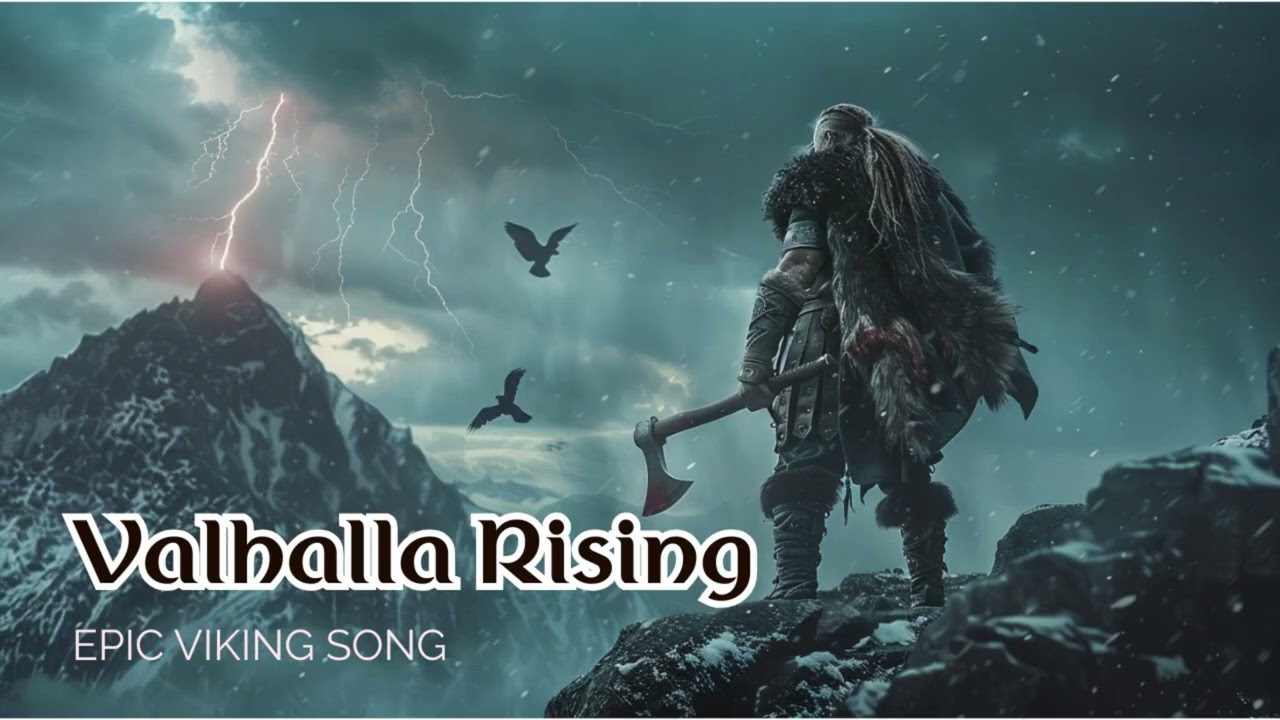
Valhalla Rising is a 3:49 original Mythic Harmonies Viking war song from the 2025 album Echoes of Valhalla. Sung in stylised Old Norse with an English translation, it follows a warrior from a blood-dark battlefield toward the imagined fire and gold of Odin’s hall. The lyrics, melody and performance are modern—not a surviving Viking Age chant or a reconstruction of lost Norse music.
The official video, complete Valhalla Rising lyrics and released translation appear below. The source guide then separates the song’s dramatic voice from the medieval evidence: who reaches Valhalla, what the hall is for, where ravens fit, and why “Valhalla rises” is modern poetic imagery rather than a phrase quoted from the Eddas.
Official release: listen to Valhalla Rising on Spotify · listen on Apple Music
What Is the Meaning of Valhalla Rising?
The title works on two levels. A fallen warrior imagines rising beyond the battlefield, while Valhalla itself seems to rise through flame and smoke. The recurring line “Valhǫll rís í elds loga” gives the song its central image: the hall is not calmly described in the distance; it appears as a destination summoned by the chorus.
That image belongs to this composition. Medieval poems call the hall Valhǫll and describe it in striking architectural and martial terms, but they do not preserve this refrain. “Valhalla Rising” is therefore an English song title and a modern interpretation, not the name of an attested Old Norse ritual or historical hymn.
Valhalla in the Medieval Sources
Grímnismál supplies several of the most important poetic details. Stanza 8 places Valhalla in Glaðsheimr and says Odin chooses the battle-slain there. Stanza 23 gives the hall 540 doors, with 800 einherjar passing through each when they go to fight the wolf. This is not simply a peaceful reward after death: the chosen warriors feast, fight and prepare for Ragnarök.
Snorri Sturluson later combines these traditions in Gylfaginning. His thirteenth-century account describes the einherjar fighting daily, returning to the hall and drinking together. It is an essential medieval synthesis, not an eyewitness report from the Viking Age. Readers can compare the Old Norse poem in the Grímnismál text hosted by Heimskringla and Snorri in Anthony Faulkes’s edition of Gylfaginning.
The lyric’s golden hall and endless feast draw on this source-world, but the burning ascent is the song’s own frame. Our full evidence-led article explains what Valhalla means in Norse mythology, including its name, inhabitants and role at Ragnarök.
Did Every Fallen Viking Warrior Go to Valhalla?
No. Even the poetic evidence about the battle-slain gives a more complicated answer. Grímnismál stanza 14 says Freyja chooses half of the slain and Odin receives the other half. The sources do not explain the selection as a simple test in which every brave fighter automatically enters Odin’s hall.
Norse ideas about death were also broader than these two destinations. Written sources name other divine or underworld settings, while archaeology reveals many regional and chronological differences in burial. The chorus “Valhalla calls, and we follow there” expresses one warrior’s conviction inside this song. It is not a universal creed that can be assigned to all Viking Age Scandinavians. See the evidence compared in Valhalla vs Fólkvangr.
Odin, Ravens and Thor in the Song
The first verse places Odin above the conflict while ravens fly across it. Ravens are a natural part of Old Norse battle poetry because carrion birds gather where people have fallen. Odin also has the named ravens Huginn and Muninn, who cross the world and report what they see and hear. The sources do not, however, say that the pair “mark the brave” for Valhalla. That idea has been removed from the historical explanation and remains only within the song’s dramatic atmosphere.
Thor enters the next verse as a giver of strength. That appearance enlarges the chorus from one god’s hall to a wider divine horizon. It should not be read as evidence for a documented battle liturgy in which Thor and Odin were invoked with these words. For the ravens’ attested roles and the limits of later symbolism, read Huginn and Muninn: names, sources and meaning.
How the Song Creates an Epic Viking War Sound
- A battlefield opening: blood, singing swords and broken shields establish conflict before the destination is named.
- A chorus that widens the space: the verses remain close to weapons and bodies; the refrain expands into mountains, sea, fire and a hall beyond sight.
- Repetition as momentum: three returns of “Valhalla rises” make the piece feel processional. Each recurrence moves the speaker further from battle toward acceptance.
- A final feast: the fifth stanza replaces breaking shields with golden halls and drinking. The change turns a war song into a death-and-memory narrative.
The result sits between cinematic battle music, dark Nordic folk and a choral war chant. It can accompany workouts, writing, tabletop battles or focused listening, but those are modern uses. Continue through the Epic War & Battle collection or browse the complete Old Norse lyrics songbook.
Valhalla Rising Lyrics and English Translation
Editorial note: the Old Norse text below reproduces the words as performed and released. It is a modern, stylised composition. The English is the released translation, not a claim that the lyrics preserve a Viking Age dialect, historical chant, pronunciation or ritual formula.
Original Lyrics (Old Norse)
Und blóði rauðr er jǫrð, Sverðr syngja, skjǫldr brǫst, Óðinn horfir, hrafnar fljúga, Deyjum vér, en sigr mun duga.
Valhǫll rís í elds loga, Hljóðr galdr í fjǫll ok sjó, Bræðr í dauða, sálir syngja, Valhǫll kallar, vér fylgjum þangað.
Stormr ok ís í hjarta brenn, Þórr með hamri, styrkr gef menn, Eiðr er bundinn, örlǫg skráð, Fyrir goð, vér stöndum ráð.
Valhǫll rís í elds loga, Hljóðr galdr í fjǫll ok sjó, Bræðr í dauða, sálir syngja, Valhǫll kallar, vér fylgjum þangað.
Blóðr mitt rennr á sverði hvass, Lífsins endi, dauðans gjǫf, Í gullna sali, feitr er veizla, Drekka vér með goðum æva.
Valhǫll rís í elds loga, Hljóðr galdr í fjǫll ok sjó, Bræðr í dauða, sálir syngja, Valhǫll kallar, vér fylgjum þangað.
English Translation
The earth runs red, soaked in blood, Swords are singing, shields are breaking, Odin watches, ravens flying, We may die, but victory survives.
Valhalla rises in flames of fire, Sacred chants echo in mountain and sea, Brothers in death, their souls now sing, Valhalla calls, and we march within.
Storm and ice burn in our hearts, Thor with hammer gives men strength, The oath is sworn, fate is carved, For the gods, steadfast we stand.
Valhalla rises in flames of fire, Sacred chants echo in mountain and sea, Brothers in death, their souls now sing, Valhalla calls, and we march within.
My blood flows on the sharpened sword, Life is ending, death a gift, In golden halls, the feast is vast, We drink with gods forevermore.
Valhalla rises in flames of fire, Sacred chants echo in mountain and sea, Brothers in death, their souls now sing, Valhalla calls, and we march within.
Sources and Editorial Method
- Poetic evidence: Grímnismál stanzas 8, 14 and 23 for Odin’s hall, Freyja’s share of the slain, the doors and the einherjar.
- Prose synthesis: Snorri Sturluson’s Gylfaginning for the daily fighting and feasting of the einherjar, read as a medieval account rather than an eyewitness record.
- Historical boundary: the sources do not preserve a song called Valhalla Rising, make Valhalla the destination of every dead warrior, or say Huginn and Muninn mark the brave.
- Music boundary: the lyrics, translation, melody and arrangement are original to Mythic Harmonies. The sources explain the imagery; they do not document this performance.
What is the meaning of Valhalla Rising?
The title imagines both a fallen warrior rising beyond the battlefield and Odin’s hall appearing through fire and smoke. It is a modern poetic image created for this original song, not a phrase or historical hymn preserved in the Eddas.
Is Valhalla Rising an authentic Viking song?
No. It is an original Mythic Harmonies composition in stylised Old Norse. Medieval Norse sources inform its Valhalla, Odin, raven and Ragnarök imagery, but the lyrics, melody and performance are not presented as surviving or reconstructed Viking Age music.
Did every Viking warrior go to Valhalla after death?
No. Grímnismál says Freyja chooses half of the battle-slain while Odin receives the other half, and Norse traditions include other destinations. The sources do not teach that every warrior or every Norse person automatically entered Valhalla.
Did Odin’s ravens choose or mark warriors for Valhalla?
The sources describe Huginn and Muninn flying across the world and reporting what they see and hear to Odin. They do not securely say that the pair choose, guide or mark warriors for Valhalla. Their battlefield role in this song is modern dramatic imagery.
Where can I listen to Valhalla Rising?
The exact 3:49 Mythic Harmonies release is available on Spotify and Apple Music under the title Valhalla Rising. The official YouTube video, complete Old Norse lyrics and English translation are embedded on this page.
More from Epic War Battle
March with the War-Band
New Old Norse chants every month. Join the listeners who never miss a release.