
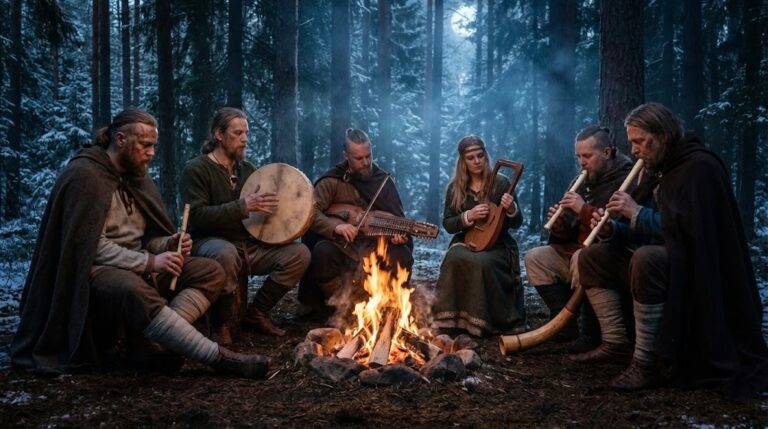
10 Best Viking Metal Bands: From Fury to Folk (2026 Guide)
- Viking metal was born in 1988 when Bathory’s Blood Fire Death traded black metal’s devilry for Odin, and today spans everything from Amon Amarth’s arena anthems to progressive experiments like Enslaved.
- A second movement plays no metal at all: the ritual reconstruction wave (Wardruna, Heilung, Skáld, Mythic Harmonies) rebuilds historical instruments and sings in Old Norse itself.
- This guide maps both branches: the ten essential artists from fury to folk, plus three listening paths to find your door into the North.
The sound of the North is not a single note. It is a spectrum, and it runs from a wall of distorted guitars to a single goat-horn note echoing across a fjord.
At one end stands viking metal: born in 1988 when a Swedish outsider named Quorthon decided black metal should sing about Odin instead of the devil, and today filling arenas behind Amon Amarth’s war drums. At the other end stands something older-sounding and stranger: the ritual reconstruction movement, where artists rebuild the actual instruments of the Viking Age and sing in Old Norse itself. Most “best viking metal” lists pretend these are the same thing. They are not, and knowing the difference is the key to finding the exact sound you are looking for.
This guide maps the whole territory: the ten essential artists from fury to folk, where each one sits on the spectrum, which one to start with depending on what you came for, and, at the end, an honest answer to the question nobody in the genre likes to ask: what did the Vikings actually hear?
The List at a Glance
| # | Artist | Country | Sound | Start here |
|---|---|---|---|---|
| 1 | Bathory | Sweden | The founding epic | Hammerheart |
| 2 | Amon Amarth | Sweden | Melodic death, arena-sized | The Pursuit of Vikings |
| 3 | Enslaved | Norway | Progressive black metal | Isa |
| 4 | Falkenbach | Germany | Epic folk-metal atmosphere | …When Gjallarhorn Will Sound |
| 5 | Týr | Faroe Islands | Ballad-driven prog metal | Hold the Heathen Hammer High |
| 6 | Wardruna | Norway | Ritual reconstruction | Helvegen |
| 7 | Heilung | DK/DE/NO | Amplified history, trance | Krigsgaldr |
| 8 | Mythic Harmonies | Belgium | Old Norse atmospheric | Fenrir Rís |
| 9 | Danheim | Denmark | Dark Nordic electro-folk | Berserkir |
| 10 | Skáld | France | Old Norse vocal poetry | Rún |
The order is chronological by wave, not a ranking: the pioneers first, the folk bridge second, the ritual turn third. Your personal number one depends entirely on which door you enter through, and this guide will point you to it.
The Pioneers: Black Metal Roots, Viking Heart
To understand where the genre is going, start with who forged it. These three took the most extreme sounds of their era and gave them a Norse soul.
1. Bathory: The Blueprint
It is impossible to discuss viking metal without bowing to Quorthon, the one-man storm behind Bathory. The band began as raw Swedish black metal, but with Blood Fire Death (1988) something unprecedented happened: the tempos slowed to a march, acoustic guitars and choirs entered, and the lyrics turned from cheap devilry to Odin, fate and the sea. Hammerheart (1990) completed the transformation, and the genre had its founding document. Every band below owes Quorthon a drinking horn.
The vibe: raw, epic, foundational. For fans of: history’s first drafts, imperfect and immortal.
2. Amon Amarth: The Conquering Kings
If Bathory is the grandfather, Amon Amarth is the dynasty. The Swedes call themselves melodic death metal, but their subject matter has been 100% Norse for three decades: Thor, Loki, the Jomsvikings, delivered in Johan Hegg’s tectonic growl over riffs that gallop like a cavalry charge. They made the genre stadium-sized, and their live shows, complete with a longship drum riser, are the closest metal gets to a raiding party.
The vibe: high energy, gym-ready, crushing. For fans of: workout playlists with a body count.
3. Enslaved: The Thinking Man’s Vikings
Enslaved started as teenage Norwegian black metal in the early 90s and never stopped evolving: progressive rock structures, psychedelic passages, clean-sung choruses trading with shrieks, and lyrics steeped in the runes and the deep mechanics of Norse cosmology. Thirty years in, they are the genre’s restless intellectuals, and their track Isa, named for the ice rune, remains a perfect gateway into their cold, shifting world.
The vibe: complex, icy, cerebral. For fans of: Pink Floyd and Burzum sharing a longhouse.
The Folk Bridge: When Metal Met Tradition
The second wave realized distortion alone could not carry the old world, so they brought the old melodies into the amplifiers.
4. Falkenbach: The Snowy March
A one-man German project (Vratyas Vakyas) and a masterclass in epic atmosphere: heavy guitars under clean, chanted vocals and synth textures that mimic folk instruments, less a battle than a long journey across snow. The track …When Gjallarhorn Will Sound borrows its title from the horn of Heimdall that will announce Ragnarök, and sounds exactly like what it names.
The vibe: heroic, melodic, proud. For fans of: solitary walks that feel like marches.
5. Týr: The Faroese Time Capsule
From the tiny Faroe Islands, Týr does something no one else on this list can: their vocal harmonies come directly from traditional Faroese ballads passed down orally for centuries, welded onto technical, progressive heavy metal. Singing in English, Faroese and Danish, they are a living bridge between the medieval North Atlantic and the electric present.
The vibe: vocal-heavy, technical, authentic. For fans of: choirs that predate electricity.
The Ritual Turn: Dark Folk & Amplified History
Then came the movement that dropped the electric guitars entirely and asked a more radical question: what if we rebuilt the sound itself?
6. Wardruna: The Reconstruction
Wardruna is less a band than a research project with a heartbeat. Founder Einar Selvik spent years learning to build and play the instruments of the Norse world, tagelharpa, kraviklyre, goat horns, and composes around the runes of the Elder Futhark themselves. The world discovered them through the Vikings TV soundtrack; the initiated stayed for Helvegen, a funeral song so powerful it has been sung at actual funerals.
The vibe: ritualistic, cinematic, profound. For fans of: music as ceremony.
7. Heilung: The Trance
Heilung call their genre “amplified history”, and no two words describe it better: throat singing, bone rattles, war chants and human pulse, performed in ceremonial paint by a collective that opens every show with the same ritual blessing. Where Wardruna reconstructs, Heilung possesses: their concerts are less performances than séances with a light rig.
The vibe: primal, shamanic, hypnotic. For fans of: losing track of the century you live in.
8. Mythic Harmonies: The Old Norse Storytellers
The newest wave of the ritual turn lives on digital platforms, and this is where our own project stands, so let us be exactly as honest here as everywhere else on this site. Mythic Harmonies makes atmospheric Old Norse music: every lyric sung in the reconstructed language of the skalds, every theme sourced from the Eddas, with the research published alongside the songs, from berserker chants to funeral hymns. Where the giants stage the ritual live, we build it as a world to step into: music for deep focus, reading, and the long road home from Valhalla.
The catalog runs from the wolf-fury of Fenrir Rís to the quiet of Echoes of the Fjord, and you can explore all of it on our music page, or read every song line by line, Old Norse beside its English translation, in the Old Norse Songbook.
The vibe: atmospheric, immersive, sourced. For fans of: Danheim’s darkness with the language turned all the way to authentic.
9. Danheim: The Producer
Danish producer Mike Olsen bridged a gap nobody saw coming: electronic production techniques and Viking aesthetics. Danheim’s tracks are dark, punchy and rhythmically modern under their skin drums and chants, which is exactly why they became the gateway drug of the entire Nordic dark folk scene, pulling in electronic listeners who did not know they wanted goat horns in their lives.
The vibe: dark, rhythmic, produced. For fans of: beats first, history a close second.
10. Skáld: The Poets
France’s Skáld takes its name from the court poets of the Norse world and honors it: Old Norse lyrics, percussive arrangements and stacked voices that treat the human throat as the lead instrument. Their breakout Rún proved a French vocal ensemble could carry the northern tradition as convincingly as any Scandinavian.
The vibe: vocal-driven, rhythmic, storytelling. For fans of: the words mattering as much as the wall of sound.
Honorable Mentions: The Neighboring Halls
Our readers keep the watchfire burning, and they are right to name names. Mithotyn, the Swedish 90s pioneers whose folk-laced black metal fed directly into the genre’s DNA before the members sailed on to form Falconer, deserve a horn raised in any pioneer conversation. Moonsorrow from Finland write hour-long pagan epics that many consider the genre’s artistic peak. Einherjer and Månegarm have flown the Norwegian and Swedish banners for three decades. And to the readers who proposed Powerwolf and Sabaton: mighty bands both, but their battles are werewolves and world wars rather than the Norse world, which is why they watch this list from the neighboring hall, horns raised in respect.
Viking Metal vs. Authentic Old Norse Music: What’s the Difference?
A confession that will annoy purists on both sides: none of this is what the Vikings actually heard. Viking metal is a modern genre ABOUT the Norse world, played on instruments the Norse never knew, and that is precisely its power: Amon Amarth’s galloping riffs translate the sagas into a language modern ears feel in the chest. The ritual branch works in the opposite direction: reconstructing the soundscape itself, the tagelharpa, the frame drum, the horn, and singing in Old Norse, the language the skalds actually used, the way the seeresses chanted their seiðr rituals.
Neither is “more Viking” than the other. The metal bands carry the fury; the reconstructionists carry the ritual. The honest difference is the question each answers: viking metal asks what did it feel like?, Old Norse music asks what did it sound like? Both questions are worth a lifetime, and the map above lets you chase either one.
How to Start Listening: Three Paths Into the North
The Fury Path. You want power, riffs, and a soundtrack for lifting heavy things. Start with Amon Amarth’s The Pursuit of Vikings, back-track to Bathory’s Hammerheart to hear where it all began, then let Enslaved’s Isa complicate everything you thought you knew.
The Story Path. You came for the myths and the words. Start with Skáld’s Rún, move to Týr’s Faroese ballads, then step fully into Old Norse with our own catalog, where every song comes with its sources.
The Ritual Path. You want to feel a thousand years fall away. Start with Wardruna’s Helvegen, let Heilung’s Krigsgaldr take the walls down, then put on Danheim or Mythic Harmonies and let the drums finish the work.
Three paths, one destination. Grab your horn, sit by the fire, and listen.
Band histories and discographies via official releases and label documentation; Bathory’s Blood Fire Death (Under One Flag, 1988) and Hammerheart (Noise, 1990); Einar Selvik’s published lectures on Norse instrument reconstruction; the Vikings (History Channel) soundtrack credits; Faroese kvæði ballad tradition documentation; reader contributions from the comments of this article.
Frequently Asked Questions
What defines viking metal?
Viking metal is defined by its themes, not one sound: Norse mythology, sagas and Viking history, set to metal ranging from black metal rawness to melodic death. The genre crystallized with Bathory’s Blood Fire Death in 1988, which traded satanic imagery for Odin and epic, mid-tempo grandeur.
Who invented viking metal?
Bathory, the Swedish project of Quorthon, is universally credited as the inventor. Blood Fire Death (1988) and Hammerheart (1990) established the blueprint: slower tempos, epic choirs, acoustic passages and Norse themes replacing black metal’s earlier imagery.
What is the best viking metal band?
By popularity, Amon Amarth: three decades of Norse-themed melodic death metal and the genre’s biggest stages. By historical importance, Bathory, who invented the form. By artistic ambition, many point to Enslaved or Finland’s Moonsorrow. The honest answer depends on which door you enter through.
Is Wardruna viking metal?
No, and the distinction matters. Wardruna plays no metal at all: it reconstructs Norse ritual music on historical instruments like the tagelharpa and goat horn. It belongs to the Nordic folk movement, the same branch as Heilung, Danheim, Skáld and Mythic Harmonies, loved by metal fans but musically its opposite.
What language do viking metal bands sing in?
Mostly English, for reach: Amon Amarth and Bathory sing English almost exclusively. Týr adds Faroese and Danish, Enslaved uses Norwegian and Old Norse, and the reconstruction projects go furthest: Wardruna in Norwegian and Old Norse, Skáld and Mythic Harmonies almost entirely in Old Norse.
Music to read by
Each article has a soundtrack. Listen to Mythic Harmonies while you read.
Explore the music
You forgot Mithotyn..
You also forgot Powerwolf and Saboton.