

Viking Clothing: What Norse Men and Women Really Wore
On this page 10 sections
- What We Actually Know: The Textiles of Birka and Hedeby
- Viking Men’s Clothing: Tunic, Trousers, Cloak
- Viking Women’s Clothing: The Apron Dress and Its Layers
- Colors and Dyes: Were Viking Clothes Drab?
- The Norse Wedding Dress: What Viking Brides Really Wore
- Jewelry and Accessories: The Wardrobe’s Metal
- Who Made the Clothes: Looms, Labor and Class
- Clothing Myths: What Vikings Never Wore
- Dress a Viking in Sixty Seconds
- Frequently Asked Questions
- Viking clothing was tailored, layered wool and linen: a fitted tunic, trousers and pinned cloak for men; a pleated linen underdress and the iconic apron dress with paired oval brooches for women.
- Their clothes were loudly colorful: dye analysis from the Birka and Hedeby graves reveals madder red, woad blue and weld yellow, with blue and red as the prestige colors, and a single linen tunic representing about 400 hours of work.
- No horned helmets, no studded leather, no kilts: the screen Viking is a costume. This guide rebuilds the real wardrobe from the archaeological record, piece by piece.
Walk through the market of Hedeby on a trading morning in the year 950, and the first thing that strikes you is not the smell of fish or the sound of hammers. It is the color. A merchant’s wife in a woad-blue apron dress, bronze brooches flashing at her chest. A young man in a madder-red tunic bargaining for a silver arm ring. A jarl’s retainer whose cloak is pinned at the shoulder with enough metal to buy a cow. Nobody, anywhere, is wearing studded black leather.
The screen Viking, all fur, grime and darkness, is a costume invented a thousand years after the fact. The real Norse dressed in tailored, layered, aggressively colorful wool and linen, and we know this with unusual precision, because their clothes survived in two extraordinary places: pressed against bronze in the graves of Birka, and buried in the harbor mud of Hedeby.
This guide rebuilds the real Viking wardrobe from those finds, layer by layer: what men wore, what women wore, what colors meant, what a bride actually looked like, and which myths deserve a permanent burial. By the end, you will be able to dress a Viking in sixty seconds, and spot a fake at a hundred paces.
What We Actually Know: The Textiles of Birka and Hedeby
Cloth rots. That is the fundamental problem with studying ancient clothing, and it is the gap into which a thousand costume myths have poured. But two sites changed everything we know.
At Birka, the great trading town on an island near modern Stockholm, more than a thousand Viking Age graves have been excavated, and in many of them, metal saved the fabric. Wherever a bronze brooch or an iron knife lay against cloth, the corroding metal preserved the textile pressed to it, sometimes down to the individual stitch. Textile archaeologists, above all Agnes Geijer and later Inga Hägg, spent decades reading these fragments like a forensic team: the weave, the thread count, the seams, the dye molecules. The finds are held today by the Swedish History Museum, which curates the Birka material.
At Hedeby, the Viking trading hub at the neck of the Danish peninsula, the evidence came from the water. Worn-out clothes had been torn into rags, coated in tar and stuffed into ship hulls as caulking, and the oxygen-poor harbor mud preserved them for a millennium. These scraps are priceless precisely because they are ordinary: not burial finery, but the everyday working clothes of real people, and they show something the myths never predicted. The garments were cut and tailored to fit, with curved seams and fitted sleeves, centuries before “tailoring” is supposed to have reached Europe.
One number puts the value of clothing into perspective. According to the National Museum of Denmark, producing a single linen tunic, from sowing the flax to the final stitch, took roughly 400 hours of work. A shirt was not fast fashion. It was two and a half months of someone’s labor, and people dressed accordingly: carefully, proudly, and for as long as the cloth would hold.
Wool was the everyday fiber: warm even when wet, water-shedding, woven at home on upright looms, often in fine diamond twill that took real skill. Linen from flax was the comfort layer against the skin, and a serious investment of labor. Silk reached elite graves at Birka along the eastern routes from Byzantium, cut into thin strips for trim: a finger’s width of silk said more than a yard of wool.

Viking Men’s Clothing: Tunic, Trousers, Cloak
The Norse male outfit was practical, layered, and far more fitted than any film has dared to show.
The Tunic (Kyrtill)
The centerpiece: a wool over-tunic reaching mid-thigh or the knee, pulled over the head, with sleeves fitted at the wrist and triangular gores sewn into the skirt so a man could stride, ride and fight without splitting a seam. Underneath, anyone who could afford it wore a linen under-tunic, the Viking Age undershirt, worth remembering that 400-hour price tag. Necklines and cuffs were finished with tablet-woven bands, the intricate patterned ribbons that were a Scandinavian specialty, and on rich garments, with strips of imported silk: a finger’s width of Byzantium said more than a whole yard of wool.
The Trousers
Two styles are attested, and the second one surprises everyone. Fitted wool trousers, cut close to the leg, appear in the Hedeby finds, some with sewn-in feet like medieval leggings. But the Gotland picture stones and the accounts of Arab travelers who met Norse traders in the east describe something else entirely: enormous baggy breeches, gathered and voluminous, bound below the knee, using meters of fabric as a walking display of wealth. Below either style, the lower legs were wrapped in winingas, long wool bands wound from ankle to knee, keeping the trousers snug and the legs warm. Soldiers were still using the identical solution in the trenches of the First World War.
The Cloak
A heavy rectangle of wool, thrown over the shoulders and pinned high on the right shoulder, never the left. The reason is pure function: it kept the sword arm free. In the sagas, you can read a man’s intentions from his cloak pin. For winter, weavers produced pile-woven cloaks with a deliberately shaggy surface that shed rain and imitated fur while staying lighter and faster to dry, one of the many textile tricks that helped the Norse survive the brutal Scandinavian winters.
The Shoes
Viking footwear was the turnshoe: soft leather stitched inside out, then reversed, producing a low ankle boot or slip-on fastened with a toggle or lace. Finds from York, Hedeby and the Oseberg ship burial show them in detail, along with their one great weakness: soles wore through in weeks, and shoemaking was as constant as bread-baking. No heels, no hobnails, and nothing that would survive a modern winter sale.

Viking Women’s Clothing: The Apron Dress and Its Layers
If one garment defines the Viking Age woman, it is the apron dress: the smokkr, also called the hangerock or strap dress. But it never worked alone. The full outfit was a system of layers, and every layer spoke.
Layer One: The Serk
A long linen underdress, ankle-length, long-sleeved, worn against the skin. In the richest Birka graves, the serk was finely pleated, and this detail deserves a moment of respect: linen does not hold pleats by itself. Every crease had to be set wet and pressed by hand with a heated smoothing stone or a glass linen-smoother, then redone after washing. Hours of skilled labor for a texture effect, on a garment worn mostly underneath another one. Some fashion instincts have not changed in a thousand years.
Layer Two: The Apron Dress
Over the serk came the wool apron dress: a tube or wrapped garment suspended from shoulder straps. The straps did not tie. They were fastened by a pair of oval brooches, domed bronze ornaments worn high on the chest like two gleaming shields in miniature. These paired brooches are the single most recognizable artifact of Norse women’s graves, found from Dublin to the Volga, and wherever archaeologists uncover a pair, they know a woman was buried in her full dress. The brooches were mass-produced in workshops, gilded for those who could pay, and they are how we can trace Norse women, not just Norse warriors, across the entire Viking world.
The Festoons: Wearing the Bank Account
Between the two brooches hung the display: strings of beads in glass, amber and imported carnelian, silver pendants threaded among them. And from the brooches or the belt hung the tools of authority: keys, scissors, a needle case, a small knife. In a world without pockets, a woman wore her competence where everyone could see it, and the keys were no metaphor. The woman who carried the keys controlled the stores, the silver and the household. Norse law took her side of the doorway seriously.
The Outer Layers
Over everything, a shawl or a caftan-style coat pinned with a third brooch, often trefoil-shaped. Married women likely covered their hair with a cap or kerchief; simple silk and linen caps survive from York and Dublin. And recent research keeps sharpening the picture: textile finds studied at Uppsala University suggest that along the eastern trade routes, Norse women’s dress could be openly showy, with silk ribbons, glittering ornaments and a cut designed to be admired around the fire, oriental influence stitched directly into Nordic fashion.

The linen smoother. Among the humblest finds from Norse women’s graves is a fist-sized dome of dark glass. It is an iron: heated and rubbed over damp linen to press those aristocratic pleats into the serk, one crease at a time. A thousand years before electricity, the Norse were literally ironing their underwear. Let no one call them barbarians again.
Colors and Dyes: Were Viking Clothes Drab?
No. This myth deserves the deepest grave in the article. The grey-and-mud Viking of television is a lighting decision, not history. Dye analysis on textile fragments from Birka, Hedeby, York and Dublin has recovered the actual molecules, and the palette they reveal is loud.
| Color | Dye source | What it meant |
|---|---|---|
| Red | Madder root, traded and imported | Prestige. Strongly attested at Hedeby; the color of display |
| Blue | Woad, or imported indigo | The elite color: frequent in rich graves, named constantly in the sagas |
| Yellow | Weld and local plants | Common, bright, affordable |
| Green | Woad overdyed with yellow | Two dye baths, therefore twice the cost |
| Purple tones | Lichens | Attested in the North Atlantic settlements |
| Browns, greys, whites | Natural sheep shades, walnut | The workday base layer of the whole society |
Now, the question everyone asks: did Vikings wear black? The honest answer is more interesting than yes or no. True jet black was nearly impossible to achieve with period dyes, and most working clothes lived in the natural wool spectrum. But the sagas repeatedly dress men in blár, a word covering the deep blue-to-blue-black range that woad could reach at maximum saturation, and they do it at very specific moments. When a saga character puts on his blár cloak, the audience knew what was coming: it is, again and again, the color men wear when they set out to kill. So the TV costume departments are wrong twice over. The Vikings were not dressed in black leather, and the darkness they did wear was rarer, bluer, and far more ominous than a biker jacket.
The Norse Wedding Dress: What Viking Brides Really Wore
Honesty matters more here than anywhere else in this guide, because the internet overflows with confident descriptions of “authentic Viking wedding dresses” that no source supports. Here is what the evidence actually says.
There was no white dress. The white gown is a 19th-century European fashion. A Norse bride wore the finest clothing she owned or could borrow: her best serk and apron dress in the strongest colors her family could afford, red being a natural candidate given its prestige, with every brooch, bead and silver ring the household could muster. A wedding was the public merger of two families, and the bride was its living balance sheet.
The head was the symbol, not the dress. The best-attested element of Norse bridal costume is the hair. A maiden wore her hair loose or bound with a circlet; marriage moved her to the covered head of a wife. The bridal linen and veil appear directly in the Poetic Edda: in the Þrymskviða, Thor must disguise himself as a bride to recover his stolen hammer, and the giants wrap him in bridal linen with a veil and the great necklace at his chest. The comedy only lands because every listener knew exactly what a bride was supposed to look like.
The families exchanged steel and invoked the gods. Later sources and saga episodes point to swords passing between families as pledges, and to the blessing of the union in the names of the fertility gods. In myth, Thor’s hammer is laid in the bride’s lap to hallow her, a scene that may echo a real gesture, and one more reason the hammer amulet meant so much (more on that just below).
If you are designing a Norse-inspired wedding today, the authentic move is not a costume from a catalog. It is the spirit: your strongest colors instead of white, meaningful hair, the family’s finest metal on display, and vows treated as law. That is better documented than any “Viking wedding dress” ever sold.

Jewelry and Accessories: The Wardrobe’s Metal
Norse clothing had no pockets and few buttons. Metal did the work of both, and it doubled as the family’s portable bank.
Brooches were the fasteners: paired ovals for the apron dress, trefoils for shawls, and the long penannular ring-pins that closed men’s cloaks, some with pins long enough to double as a last-resort weapon. Arm rings of silver were currency, oath-token and status in a single object: a generous chieftain literally “broke rings,” hacking silver off by weight to reward his men, which is why so much Viking silver survives as deliberately chopped pieces. Beads of glass, amber and carnelian hung between women’s brooches and at every prosperous throat.
Pendants carried belief. The most famous is the hammer. Small Mjölnir amulets in silver and iron appear across the entire Norse world, worn for protection and, in the conversion centuries, as a quiet declaration of loyalty to the old gods while crosses spread around them. What the hammer meant then, and what wearing one means now, has its own full story in our guide to Mjölnir, Thor’s hammer.
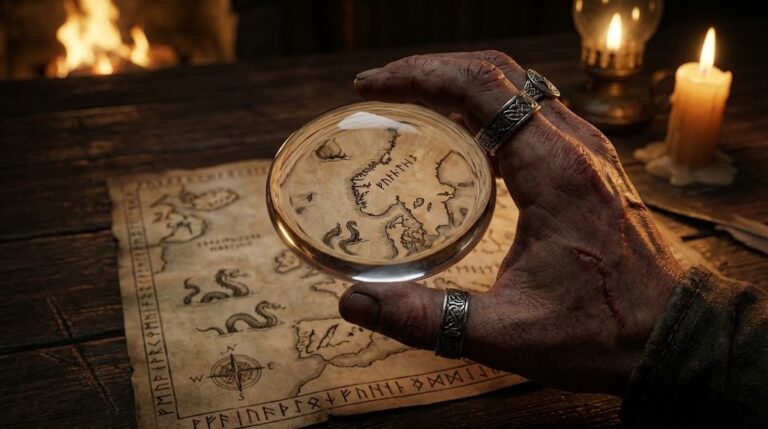
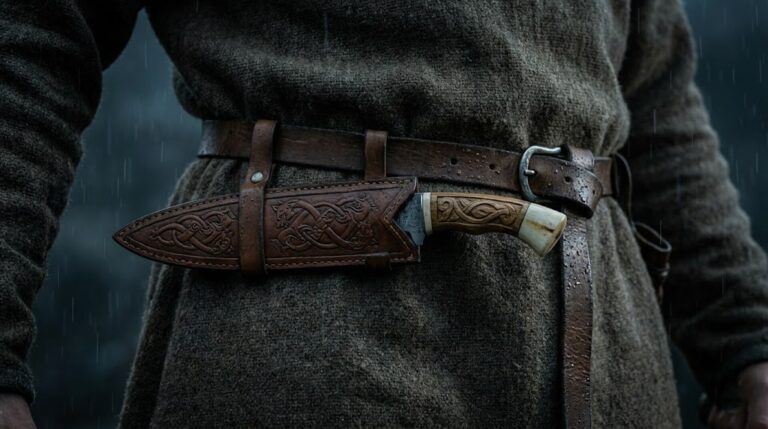
The belt completed the outfit. From it hung the pouch, the Norse answer to the missing pocket, explored in our guide to what kind of bags Vikings used, plus the fire-steel, and the one tool no Norse adult left home without: the knife, for many the iconic single-edged seax, worn horizontally along the belt. Beside it, very often, hung a comb in its carved case, because grooming was a daily discipline in Norse culture, as the grave evidence in our guide to Viking hygiene and the horn comb makes clear. Even eyesight may have had its accessory, if the enigmatic rock-crystal Visby lenses are anything to go by.

Who Made the Clothes: Looms, Labor and Class
Every garment in this article was made at home, by hand, by women, and that fact shaped Norse society more than any raid.
The evidence is everywhere archaeologists dig: spindle whorls, the small weights used to spin wool into thread, turn up in almost every Norse settlement and in women’s graves across the Viking world. Spinning was so constant that a woman likely spun whenever her hands were otherwise free, because a single garment needed kilometers of thread before weaving could even begin. The weaving itself happened on the warp-weighted loom, a tall frame leaning against the longhouse wall, its threads held taut by rows of stone or clay weights that survive by the thousand. From sheep to finished cloak, a household’s clothing represented months of skilled female labor every year, which is exactly why textiles ranked among the most valuable trade goods the Norse produced, and why a fine wall-hanging or a dyed cloak was a gift worthy of a king.
Clothing also drew the social map at a glance. A thrall (an enslaved person) wore coarse, undyed wool, the natural greys and browns of the sheep. A free farmer’s family wore the same solid wool, better cut, with color where the household could afford dye. The elite layered imported silk trim, glass beads, gilded brooches and the deep woad blues and madder reds that swallowed money in every dye bath. In a world without written name tags, your outfit announced your legal status before you spoke.
And the children? They dressed as miniature adults. The few children’s graves with textile traces, at Birka among others, point to scaled-down versions of the same tunics and dresses, cut from the same homespun. There was no separate “children’s fashion”, just smaller stitches on the same 400-hour economy, usually recut from worn adult clothes, because no one wasted two months of thread on a body that would outgrow it by winter.
Clothing Myths: What Vikings Never Wore
Time to take out the costume trash, side by side with the truth.
| The myth | The reality |
|---|---|
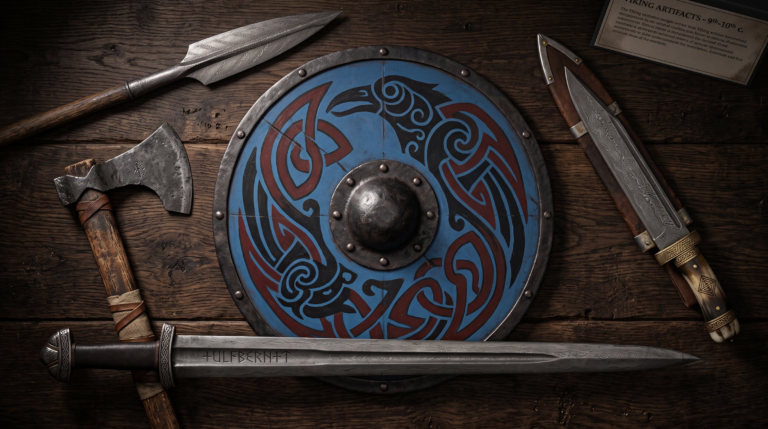
| Horned helmets | Not a single horned helmet exists in any Viking Age find. The image comes from 19th-century Romantic painters and Wagner’s opera costumes. Real Norse helmets were simple, smooth iron caps, and finding even those is extraordinarily rare: the full story of real Viking helmets and shields deserves its own telling. |
| Studded black leather armor | Wool and linen dominate the entire textile record. Leather was for shoes, belts, sheaths and bags. Serious protection meant a mail shirt over padded wool, for the few who could afford it |
| Kilts | The kilt is a Scottish garment from many centuries later. Norse men wore trousers, fitted or baggy, full stop |
| Filthy barbarians in shapeless rags | Tailored seams, pressed pleats, bright dyes and a comb in nearly every grave. Contemporary chroniclers complained the Norse were too well-groomed, not too little |
| Fur everywhere, worn like a costume | Fur was real but rationed: trim on cloaks, hats, and winter linings for those who could afford it. The everyday silhouette was tailored wool, not a bearskin draped over bare shoulders |
| Everything sleeveless | Sleeves were long and fitted, because Scandinavia is cold and wool is warm. The bare-armed berserker look is a poster, not a person |
Dress a Viking honestly and you get something far more striking than the costume: fitted, colorful wool, silver stacked on the arm, the hammer at the throat, seax and comb at the belt. Wealth you could see, belief you could wear, and not a horn in sight.

Dress a Viking in Sixty Seconds
As promised. The complete, archaeologically defensible checklist:
A man: linen under-tunic, knee-length wool kyrtill in a real color (red if he is showing off), fitted or baggy trousers, winingas wrapped ankle to knee, turnshoes, a cloak pinned at the right shoulder, and a belt carrying seax, pouch, fire-steel and comb. Silver arm ring if life has gone well. Hammer at the neck if the old gods still have his loyalty.
A woman: pleated linen serk to the ankle, wool apron dress in blue or red, two oval brooches at the chest with beads swinging between them, keys and needle case at the belt, shawl pinned with a trefoil brooch, cap or kerchief if she is married. She is carrying the household’s authority in plain sight, and she knows it.
That is the real Viking attire, for men and for women. It looked better than the movies, and every piece of it came out of the ground.
They dressed like people who knew exactly who they were. Our track Víkingr Hjarta (Viking Heart), sung in Old Norse, carries that same identity: the heart under the wool.
Inga Hägg, textile analyses of the Birka graves and the Hedeby harbor finds; Agnes Geijer, Birka III: Die Textilfunde aus den Gräbern (1938); Thor Ewing, Viking Clothing (Tempus, 2006); Penelope Walton Rogers, dye and textile analyses from Coppergate, York; The National Museum of Denmark, “Clothes and jewellery in the Viking Age”; The Swedish History Museum, Birka collections; Annika Larsson (Uppsala University), research on eastern-route Norse dress; the Poetic Edda (Þrymskviða), translated by Carolyne Larrington (Oxford University Press, 2014); the Oseberg burial finds and the Gotland picture stones.
Frequently Asked Questions
What did Viking women wear?
Viking women wore a long linen underdress (the serk), often finely pleated, under a wool apron dress (smokkr) suspended from shoulder straps and fastened by a pair of bronze oval brooches. Strings of glass and amber beads hung between the brooches, with keys, scissors and a knife at the belt.
Did Vikings wear black?
Rarely, and never as black leather. True jet black was nearly impossible with period dyes, but the sagas dress men in blár, a deep blue-black that woad could reach at full saturation, and it is repeatedly the color a man wears when he sets out to kill. Everyday clothing lived in natural wool shades and bright dyed colors.
What is a Viking apron dress?
The apron dress (smokkr or hangerock) was the defining garment of Norse women: a wool tube or wrapped dress worn over the linen underdress, hung from straps fastened by two oval brooches at the chest. Pairs of these brooches mark Norse women’s graves from Ireland to Russia.
What did Viking brides wear?
Not white: a Norse bride wore the finest, most colorful clothing and jewelry her family could display, with red a likely prestige choice. The best-attested bridal elements are the linen headdress and veil, which appear in the Eddic poem Þrymskviða, marking the transition from maiden to wife.
Did Vikings wear kilts?
No. The kilt is a Scottish garment from many centuries after the Viking Age. Norse men wore trousers, either fitted wool ones or the baggy gathered style shown on the Gotland picture stones, with lower legs wrapped in long wool bands called winingas.
What shoes did Vikings wear?
Vikings wore turnshoes: soft leather shoes and ankle boots stitched inside out, then reversed, and fastened with a toggle or lace. Finds from York, Hedeby and Oseberg show them clearly. They had no heels, wore out within weeks, and were repaired or replaced constantly.
What did Viking children wear?
Viking children dressed as miniature adults: scaled-down tunics, dresses and cloaks in the same homespun wool and linen, usually recut from worn adult garments. The few children’s graves with textile traces, at Birka among others, show no separate children’s fashion, only smaller versions of the family’s clothing.






All five albums and every single: 86 songs in WAV and MP3, yours to keep.