
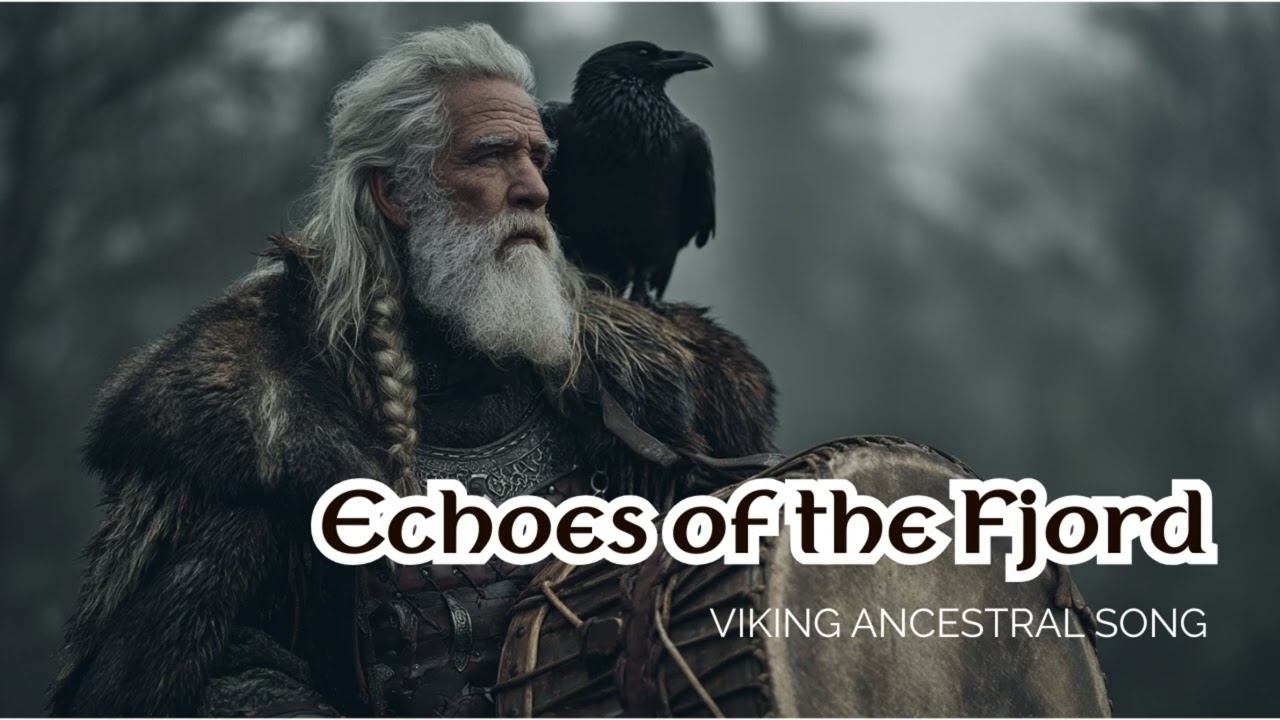
Echoes of the Fjord is an original English-language Mythic Harmonies song about memory moving through a northern landscape. An older speaker stands beside the water and hears family, inherited stories and the names of the dead in thunder, river, rock, trees and sea.
This page gives the complete Echoes of the Fjord lyrics, explains the song’s ancestral imagery and separates its modern poetic voice from what medieval Norse texts and Viking Age memorials actually preserve. The landscape is the storyteller inside this composition; it is not presented as a recovered Viking prayer or an ancient account of fjord worship.
Echoes of the Fjord at a Glance
- Track: Echoes of the Fjord
- Artist: Mythic Harmonies
- Language: English
- Official video: 4 minutes 38 seconds
- Streaming master: 4 minutes 37 seconds
- Album: Oaths of the North
- Core theme: ancestry experienced through memory, place and the passage of time
What Is Echoes of the Fjord About?
The opening verse gives the landscape a voice. Whispers rise from deep water, mountains guard sleeping souls and the wind carries memories of conflict and ancestry. The chorus then names the song’s central idea: the “soul of the North” survives not as a visible ghost, but as an echo heard by the living speaker.
The middle verses bring that vast scene into a family. Thunder resembles the father’s voice, the river the mother’s song, and trees and stones become prompts for remembered names. In the closing verse, the speaker sees age in the fjord’s reflection and follows earlier footsteps. The final change from “speaks to me” to “lives in me” completes the movement from listening to inheritance.
The Fjord as Memory, Not a Historical Deity
The fjord functions as a mirror and archive inside the song. It gathers mountain, water, wind and the speaker’s reflected face into one place where past and present appear to meet. That is a modern poetic construction. The lyrics do not name a fjord god, a rite or a specific medieval story.
Medieval Norse literature does contain landvættir, beings associated with and protective of land. The Viking Society’s Reader, Part II notes that their forms and interpretation vary across the surviving material. Echoes of the Fjord never uses that word, so the song should not be treated as a direct portrayal of those beings or as proof of one all-purpose “Norse animism.”
Names in Stone and the Evidence for Remembrance
“Every stone bears the warrior’s flame” is metaphor. Stones do not literally retain a person’s spirit in the surviving evidence. Yet the wider connection between stone, names and remembrance has a strong historical parallel: many Viking Age runestones were public memorials raised for the dead, recording kinship, journeys, deeds and loss.
The National Museum of Denmark explains that these monuments were placed where people could see them and often named both the commissioner and the person commemorated. Sweden’s National Heritage Board likewise describes them as memorial stones rather than ordinary grave markers. Most examples belong to particular late Viking Age contexts, and many include Christian crosses or prayers. They support a history of public remembrance—not the claim that every tree and rock was believed to hold a warrior.
Parents in Thunder and River
The lines about a father in thunder and a mother in the river make grief intimate without saying that either parent has literally become an element. The song keeps both people unnamed, allowing the listener to hear the images as memory, imagined presence or inherited guidance.
Thunder should not automatically be converted into Thor in this passage, nor the river assigned to a goddess the lyric does not name. Those additions would replace the song’s family story with a mythology lesson. The parent images work because they remain personal: familiar voices are recognized in sounds the speaker has heard throughout life.
Honor, Sacrifice and What Outlives a Person
The song briefly pairs honor with sacrifice, but it does not define a complete warrior code. Its larger concern is reputation carried forward. That idea has a medieval literary parallel in Hávamál 76–77, where possessions, kin and the self die while judgment or reputation after death endures. The parallel helps explain why a remembered name matters; it does not make every surrounding line a quotation from the poem.
The speaker’s final inheritance is therefore neither treasure nor victory. It is a way of walking: “Their steps I follow, brave and slow.” Memory becomes conduct in the present. This is the track’s most important shift, and it distinguishes the song from battle anthems in which ancestry is used only to intensify combat.
How the Song Creates Its Ancestral Echo
The writing expands and contracts in deliberate cycles. Each verse opens a new part of the landscape, while the same chorus returns to fjord, time, rock and sea. Repetition makes the past feel persistent rather than distant. The last chorus alters only its closing thought: what first spoke to the narrator now lives in him.
The official video lasts 4:38 and the verified Spotify and Apple Music masters last 4:37. The one-second difference falls within the catalogue’s matching rule and identifies the same Mythic Harmonies recording. The slow narrative and recurring chorus make it suited to reflective listening, memorial slideshows, landscape footage or quiet journeys, all modern uses rather than historical claims.
English Song and Norse-Language Companion Version
This page is for the English song “Echoes of the Fjord” and its exact lyrics. Mythic Harmonies also released the Norse-language companion Ekkó Fjǫrðar. That separate fiche owns its own transcription, translation and linguistic notes.
Keeping the two pages distinct lets listeners choose a language without presenting one recording as interchangeable with the other. For more translations across the catalogue, use the Mythic Harmonies Songbook. For the broader modern genre and its limits, continue with the evidence-led guide to Viking music.
Echoes of the Fjord Lyrics
The complete released English text appears below. These are original modern lyrics by Mythic Harmonies, not a translation of a surviving Viking Age poem.
Whispers rise from fjords so deep,
Where mountains guard the souls that sleep.
The wind it tells of battles won,
Of ancient blood beneath the sun.Echoes of the fjord, calling through time,
Voices of the old, in rhythm and rhyme.
Carved in the rock, sung by the sea,
The soul of the North still speaks to me.My father’s voice in thunder rolls,
My mother’s song in river flows.
They speak of fire, they speak of ice,
Of honor paid with sacrifice.Every tree remembers a name,
Every stone bears the warrior’s flame.
Through winter dark and summer bright,
Their wisdom shines in northern light.Echoes of the fjord, calling through time,
Voices of the old, in rhythm and rhyme.
Carved in the rock, sung by the sea,
The soul of the North still speaks to me.The fjord reflects my wrinkled face,
I walk alone, but not in place.
Their steps I follow, brave and slow,
Through snow and flame, through high and low.Echoes of the fjord, calling through time,
Voices of the old, in rhythm and rhyme.
Carved in the rock, sung by the sea,
The soul of the North still lives in me.Still lives in me…
Still lives in me…
Listen to Echoes of the Fjord
Watch the official 4:38 video above. The exact 4:37 release appears under the same title and artist on Spotify and Apple Music as the opening track of Oaths of the North.
Listen to Echoes of the Fjord on Spotify · Listen to Echoes of the Fjord on Apple Music
Sources and Further Reading
- Reader, Part II, Viking Society for Northern Research, for Hávamál and the annotated discussion of landvættir.
- National Museum of Denmark, “Rune stones”, for visible memorials, names, kin and commemoration.
- Swedish National Heritage Board, “Runstenar”, for the memorial function, placement and late Viking Age context of Swedish runestones.
- UNESCO, West Norwegian Fjords, for the real glacial landscape behind the song’s modern setting.
What is Echoes of the Fjord about?
Echoes of the Fjord is an original English Mythic Harmonies song about an older speaker hearing family, memory and inherited stories in a northern landscape. Its central movement goes from the past speaking to him to the past living within him.
Is Echoes of the Fjord an authentic Viking Age song?
No. Echoes of the Fjord is a modern original composition. Its fjord, memorial and ancestral imagery has historical parallels, but no medieval manuscript preserves these lyrics or this music as an ancient Viking song.
What language is Echoes of the Fjord sung in?
Echoes of the Fjord is sung in English. The separate companion Ekkó Fjǫrðar uses a stylized Norse-language text and has its own lyrics and translation page.
Does the song describe Norse land spirits?
Not directly. Medieval sources attest landvættir, but the lyrics never name them. The speaking wind, remembering trees and ancestral voices are best read as modern personification and memory rather than a reconstruction of one historical Norse belief.
Where can I listen to Echoes of the Fjord?
The official video is available on the Mythic Harmonies YouTube channel at 4:38. The verified 4:37 master is also available under the exact title Echoes of the Fjord by Mythic Harmonies on Spotify and Apple Music.
More from Mythology & Gods
March with the War-Band
New Old Norse chants every month. Join the listeners who never miss a release.