

What Kind of Bags Did Vikings Use? The Definitive Guide to Norse Carry Gear
- Viking clothing had no pockets at all: everything the Norse carried hung from the belt, swung from a brooch, rode in a bag or traveled in a chest.
- The three icons of Norse carry: the ornate Birka belt pouch with its steppe-influenced metal mount, the Hedeby shoulder bag that seals itself by gravity through wooden handles, and the sea chest, crowned by the Mästermyr find, the most complete craftsman’s toolbox of the Middle Ages.
- No backpacks: pack frames existed for hauling, but the everyday rucksack is a movie invention, buried here alongside the horned helmet.
Here is a detail that changes how you picture every Viking who ever lived: their clothes had no pockets. Not one. No trouser pockets, no tunic pockets, nothing sewn into a dress. For an entire civilization of traders, raiders, farmers and sailors, every coin, tool, amulet and fire-starter had to hang from a belt, swing from a brooch, ride in a bag, or live in a chest.
Which means the question “what kind of bags did Vikings use?” is not a trivia question. It is the question of how a pocketless civilization organized its entire portable life, and the answers, dug out of the graves of Birka and the harbor mud of Hedeby, are small masterpieces of design: a status-symbol wallet imported from the steppes, a shoulder bag that seals itself by gravity, and a toolbox so complete that when archaeologists opened it, a thousand years after its owner lost it, they found the entire working life of one Norse craftsman inside.
This is the definitive guide to Norse carry gear: what they used, what was inside, what it said about its owner, and the one thing they never carried.
The Pocket Problem: How a Civilization Carried Itself
The sewn-in pocket is a surprisingly late invention in European clothing, arriving centuries after the Viking Age. Norse dress, for all its tailoring and color (a wardrobe we rebuild piece by piece in our guide to what Vikings really wore), solved the carrying problem externally, and that constraint shaped a whole material culture.
The system had four tiers, and your gear told everyone your business at a glance. On the belt lived the daily essentials, hanging in plain sight beside the knife. Over the shoulder went the working loads: gathered herbs, food, wool, trade goods. In the chest traveled everything else, from a sailor’s worldly possessions to a craftsman’s entire livelihood. And for the humblest loads, woven baskets and folded birch bark did the quiet work that leather was too expensive for.
| Where | What | Who | Modern equivalent |
|---|---|---|---|
| On the belt | Pouch, knife, fire kit, comb | Everyone | Wallet, keys, phone |
| Over the shoulder | Hedeby bag, drawstring sacks | Workers, gatherers, traders | Messenger bag |
| In the chest | Clothes, silver, tools, trade goods | Sailors, craftsmen, travelers | Suitcase and toolbox |
| In basket and bark | Harvest, catch, food, bulk goods | Every household | Shopping bag, tupperware |
What you will not find anywhere in that system is the one item every movie adds by reflex, but we will bury the backpack properly at the end. First, the star of the show.
The Belt Pouch: The Viking’s Wallet
With no pockets, the belt became the command center of Norse daily life, and the belt pouch its most personal item.
The Birka Pouch: A Wallet From the Steppes
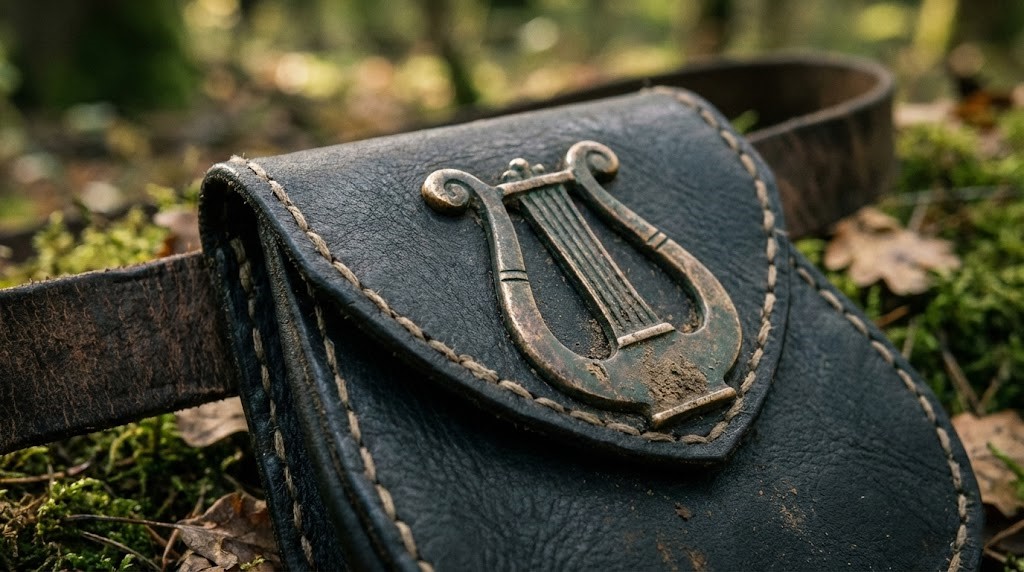
The most spectacular finds come from Birka, the great Swedish trading town. Several graves there held the remains of a very specific pouch: leather, closed by a decorated flap, crowned with an ornate lyre-shaped metal mount in bronze or silver. Reenactors call it the Tarsoly, borrowing the Hungarian word, and the borrowed name is the whole point: this pouch design comes straight from the mounted cultures of the eastern steppes, the Magyars and their neighbors, carried up the river routes into the Baltic.
Think about what that means for a moment. A merchant in 10th-century Sweden closed his silver behind a fitting whose design language came from horsemen three thousand kilometers away. The Birka pouch is not just a wallet: it is a passport stamp, proof of the eastern connections that made Birka rich, worn on the hip as deliberately as a modern luxury logo.
The Drawstring Pouch: Everyone Else’s Pocket
For the farmer, fisherman and thrall, the answer was simpler and older: a circle of leather (cow, goat or deer), holes punched around the rim, a thong threaded through, pulled tight. One piece, no seams, nearly indestructible. Archaeology finds them everywhere, and they hung where every Norse essential hung: on the belt, usually at the right hip, within reach of the same hand that drew the seax. Pouch and knife side by side: the original everyday carry.
The Hedeby Bag: Gravity-Powered Engineering
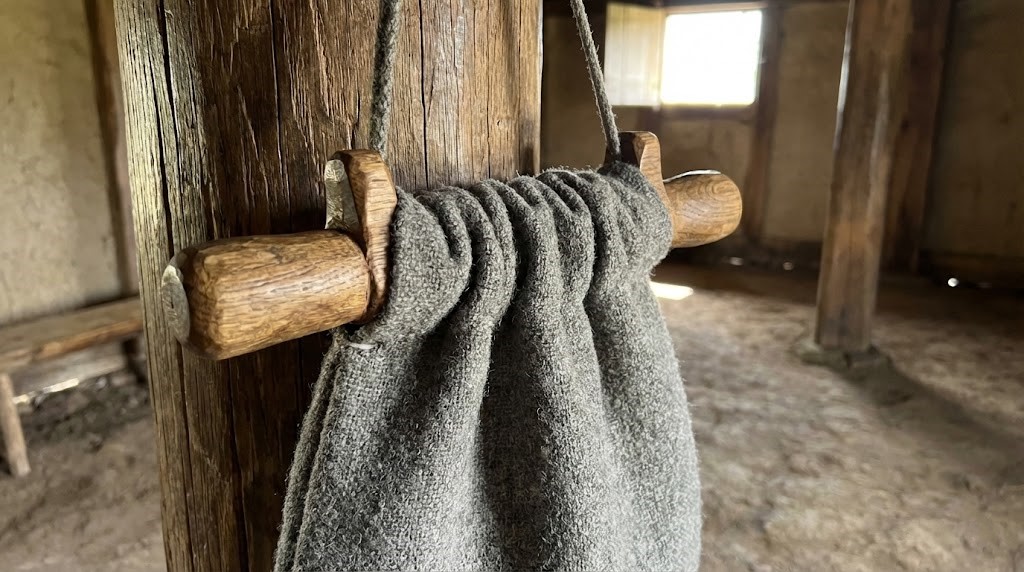
If the belt pouch was the wallet, the bag reconstructed from the finds at Hedeby, the great Danish trading port, was the messenger bag, and its design is so clever that modern makers still copy it exactly.
What survived in the harbor mud were pairs of shaped wooden handles, in ash and maple. From them, the bag rebuilds itself: a body of wool or felt sewn to the lower edge of each handle, a shoulder strap running through holes in the wood. And then the trick: hang the loaded bag from your shoulder and the weight of the contents pulls the two wooden strips together, sealing the bag shut by gravity alone. No buttons, no ties, no fumbling with cold fingers. Set it down and it falls open for both hands to work.
No zipper has ever been more elegant. It is the perfect design for gathering, foraging and market work, which is exactly why the Hedeby bag is the single most beloved reconstruction among modern reenactors: a thousand-year-old bag you could sell in a design store tomorrow.
Building a Hedeby bag? The historical footprint: two shaped wooden handles around 40 to 50 centimeters long (ash or maple), a body of undyed or plant-dyed wool or felt, and a strap threaded through the handle holes so the load pulls them shut. Keep hardware to zero: the original design needs no buckles, and every button you add subtracts a century of authenticity.
The Chest: A Viking’s Life in a Box
For everything too big for the belt and too precious for a cloth bag, the Norse answer was wood.
The sea chest was the sailor’s world: clothes, spare gear, silver, all locked under his own weight, since a rower’s chest doubled as his bench in many reconstructions of ship life. A man’s chest was legally and personally HIS in a way little else on a crowded ship could be.
And then there is the find that turns a furniture category into a human story: the Mästermyr chest. Around the year 1000, somewhere over what was then a lake on Gotland, a craftsman lost his entire toolbox, an oak chest with iron hinges and a lock. In 1936, a farmer’s plow found it. Inside lay more than two hundred objects: hammers, tongs, axes, saws, files, chisels, drill bits, raw iron, bronze scrap for recycling, even broken items awaiting repair. The whole working life of one Norse jack-of-all-trades, smith and carpenter at once, sealed in a box for nine centuries. If the Birka pouch is Viking bling and the Hedeby bag is Viking design, the Mästermyr chest is Viking WORK, and it is the most complete craftsman’s kit to survive from the entire European Middle Ages.
The Humble Carriers: Baskets, Bark and Nets
Not everything deserved leather. Woven baskets of willow and root carried the harvest and the catch; boxes folded from birch bark, the North’s original tupperware, held food and small goods; simple net bags stretched around loads that needed air. These humble carriers rarely survive a thousand years in the ground, but fragments from waterlogged sites and their unbroken use into modern Scandinavian tradition tell us they were everywhere. The leather pouch got the silver mounts and the grave burials; the basket did most of the actual carrying.
What Was Inside: The Norse Everyday Carry
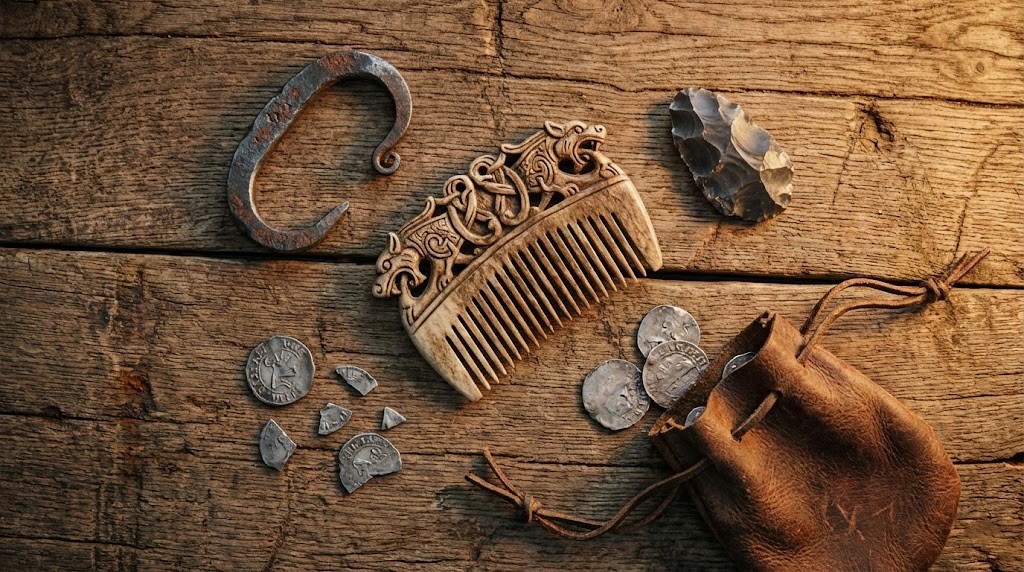
Grave finds let us do something wonderful: open a Viking’s bag. The kit is remarkably consistent, and remarkably familiar.
- Fire steel and flint: the non-negotiable. Fire was survival, and the C-shaped striker is one of the most common personal finds of the age.
- Hacksilver: currency by weight. Chopped pieces of arm rings, coins and jewelry, valued by the scale, not the face.
- The comb: antler or bone, in its own carved case, because grooming was a daily discipline, as our guide to Viking hygiene and the horn comb shows.
- Whetstone: a sharp knife was a working knife, and small belt whetstones, some doubling as pendants, kept it that way.
- Needle and thread: in a bone or bronze case, for repairing sails, clothes and luck.
- Amulets: a small Mjölnir, a bead, a coin with a hole. Protection travels light.
- And for the exceptional few: precision instruments. The rock-crystal Visby lenses were almost certainly carried in soft pouches exactly like these, padded against scratches, the most advanced objects in the North riding in the simplest.
Materials and Status: Reading a Bag Like a Business Card
Every material choice broadcast something. Leather, bark-tanned and tough, was the durable default. Wool and felt made the working shoulder bags. Fur-out pouches of otter, badger or squirrel added water resistance and swagger. And at the top, silk: thin strips of Byzantine silk trim found in elite Birka graves, edging pouches and clothes alike, the Viking Age equivalent of a designer label, imported along the same routes as the Tarsoly design itself. A Norse market crowd could price every person in it from ten paces, and the bags were part of the arithmetic.
How Women Carried: The Visible Purse
Norse women ran the household economy, and their carry system was deliberately VISIBLE. From the paired tortoise brooches of the apron dress hung chains and cords carrying keys, scissors, needle case and knife: the tools of authority, worn like jewelry, announcing exactly who controlled the stores and the silver. A hidden pouch says “I carry things”; hanging keys say “I decide things”. Women certainly used pouches and bags for gathering and storage too, but the brooch-hung toolkit is one of the most distinctive sights of the Viking Age, and one more reason the apron dress ensemble was a complete social technology, not just clothing.
The Backpack Myth (and What the Oseberg Frame Really Was)
Time to bury the rucksack. There is no evidence that Vikings used the double-strapped backpack as an everyday item. The famous wooden frame from the Oseberg ship burial shows that pack frames for hauling heavy loads existed, a logical tool for portages, where ships and cargo were carried overland between rivers. But a farmer did not walk to the field with a JanSport, and a raider did not storm a monastery wearing one. The everyday answer was always the belt, the shoulder and the chest. The movie Viking with a leather rucksack belongs in the same costume bin as his horned helmet, a myth we have already given its own burial.
Conclusion: A Thousand-Year-Old Lesson in Carrying Less
So, what kind of bags did Vikings use? A belt pouch that doubled as a status announcement. A shoulder bag that closes itself with physics. A chest that could hold a sailor’s world or a craftsman’s entire trade. Baskets and bark for the daily haul. And on every belt, the same compact kit: fire, silver, comb, blade, needle, luck.
There is something quietly instructive in it. A civilization with no pockets carried less, chose better, and made every carried object earn its place, then decorated the ones that mattered. Whether you are a reenactor completing a kit or simply someone who owns too many bags, the Norse system is a thousand-year-old argument for the same idea: carry what works, wear what counts.
They carried their music with them too, in memory and voice, the way travelers always have. Ours travels the same way: the songs of Mythic Harmonies, sung in Old Norse, are made for the road.
The Birka grave excavations and pouch mounts (Holger Arbman, Birka I); the Hedeby harbor finds, wooden bag handles, Wikinger Museum Haithabu; the Mästermyr chest and its contents, Swedish History Museum (Greta Arwidsson & Gösta Berg, The Mästermyr Find, 1983); the Oseberg ship burial finds, Museum of Cultural History, Oslo; silk finds from Birka (Agnes Geijer); the Visby lens pouches, Gotland Museum.
Frequently Asked Questions
Did Vikings have backpacks?
There is no clear archeological evidence of Vikings using double-strap backpacks. They primarily used shoulder bags (satchels) and belt pouches, or wooden chests for heavy transport.
What is a Viking belt pouch called?
In reenactment circles, the ornate pouches found in Sweden are often called a “Tarsoly” (borrowed from Magyar terminology) or simply a “Birka Pouch.”
How did Vikings carry water?
Vikings carried water, ale, or mead in skins (leather bladders), wooden canteens, or sometimes ceramic jugs, though leather skins were best for travel.
Did Vikings carry purses?
Yes, the belt pouch served the exact function of a modern purse or wallet, holding coins (hacksilver), fire kits, and personal tools.
Did Vikings have pockets?
No. Viking clothing had no pockets at all: tunics, trousers and dresses were sewn without them. Everything a Norse person carried hung from the belt (pouches, knife, fire kit, comb) or, for women, from the brooches of the apron dress. The belt pouch was, functionally, the Viking pocket.
What is a Hedeby bag?
The Hedeby bag is a Viking shoulder bag reconstructed from pairs of wooden handles found in the harbor of Hedeby, Denmark. A wool or felt bag hung from two shaped wooden strips: when carried, the weight of the contents pulls the strips together and seals the bag shut by gravity alone, with no buttons or ties needed.
Music to read by
Each article has a soundtrack. Listen to Mythic Harmonies while you read.
Explore the music