
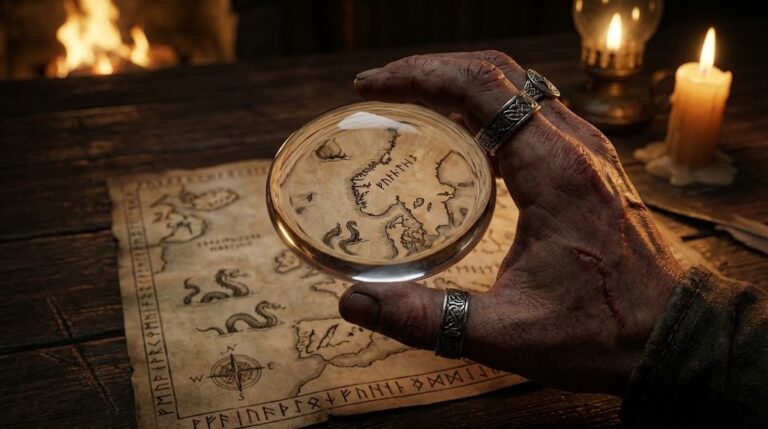
Did Vikings Wear Glasses? The Mystery of the Visby Lenses
- No, Vikings never wore glasses: spectacles were invented in Italy around 1286, two centuries after the Viking Age ended. But the real story is far stranger.
- The Visby lenses are precision optics from the Viking world: rock crystal lenses found on Gotland, ground to an aspheric profile that Europe would not formally describe until Descartes, and identified as true instruments by optical scientists in the 1990s.
- They were most likely “reading stones”: hand-held magnifiers for master craftsmen, seeresses and traders, doubling as fire-starting burning glasses, before the technology vanished with the eastern trade routes.
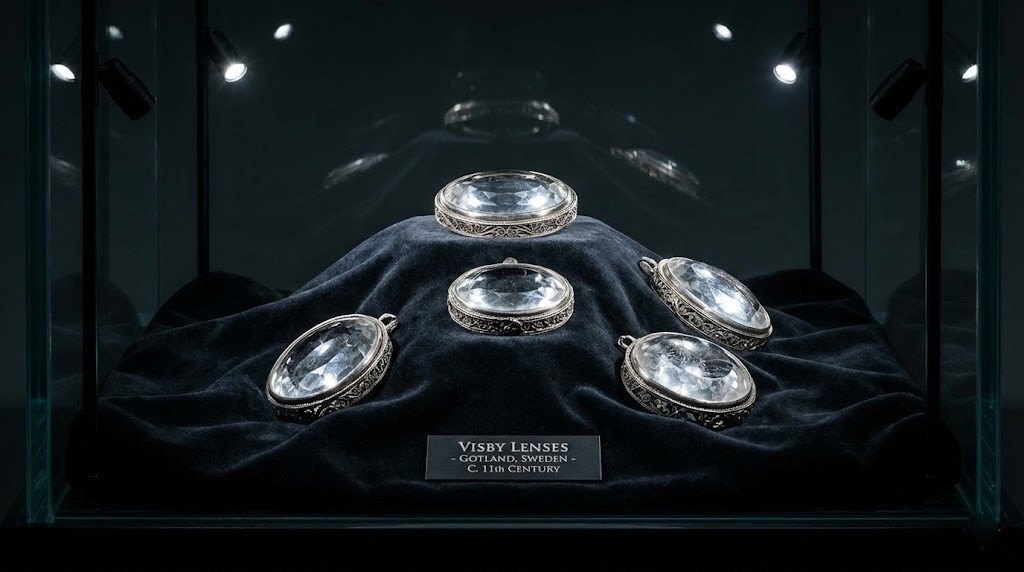
In a museum on the Swedish island of Gotland sit a handful of polished rock crystals that should not exist. For a century, they were cataloged as jewelry: pretty beads from Viking Age treasure, nothing more. Then, in the 1990s, a team of German optical scientists put them under modern instruments and found something absurd: several of these “beads” are precision lenses, ground to a mathematically sophisticated shape that Europe would not formally describe until Descartes, six hundred years later.
They are called the Visby lenses, and they are the reason the question “did Vikings wear glasses?” has a far better answer than a simple no. No, the Viking Age ended two centuries before the first spectacles were invented. And yet the Norse world held, in its hands, optical technology that would not be equaled for centuries, and used it in ways researchers are still arguing about.
This is the full story of the strangest artifacts in Viking archaeology: what they are, who made them, what they were for, and why the technology vanished.
The Question Behind the Question
Start with the simple chronology, because it disposes of the Hollywood version immediately. The Viking Age runs from roughly 793 to 1066 AD. The first wearable spectacles, the “rivet glasses” pinched onto the nose, appear in Italy, probably Pisa, around 1286 AD, more than two centuries after the last Viking king fell at Stamford Bridge. No Norseman ever wore frames. If a film shows you one, the props department invented it.
But dismissing the question there misses the real puzzle, and the real puzzle is in the objects the Norse left behind. Look closely at the silver filigree on a Viking brooch, the gold granulation of the Hiddensee treasure, the microscopic detail of the finest Mjölnir pendants: work so fine that an experienced jeweler today would reach for a loupe. Now remember that presbyopia, the age-related farsightedness that blurs close work, hits nearly every human eye after forty, and that the master craftsmen capable of such work were, almost by definition, no longer young.
So the honest question is not “did Vikings wear glasses?” but “how did aging Norse masters keep doing impossible close work?” And the answer, sitting in that Gotland museum, is that at least some of them may not have relied on young eyes at all.
The Discovery: Beads That Were Not Beads
The crystals came out of the ground on Gotland, the Baltic island that was the Viking world’s trading crossroads, many in association with 11th-century contexts around Visby. Some were mounted in silver, which is exactly why generations of archaeologists filed them as ornaments: mounted crystal, worn as a pendant, case closed.
The case reopened in the 1990s when a German team, the optical scientists Karl-Heinz Wilms, Olaf Schmidt and Bernd Lingelbach, subjected the crystals to proper optical analysis. Their results, published for the optics community, turned the jewelry drawer into a scientific anomaly. Several of the Visby crystals are true plano-convex lenses: flat on one side, precisely curved on the other, ground from rock crystal (clear quartz), a material far harder and optically purer than any glass the era could make.
What Makes Them Extraordinary
Three findings from the analysis explain why opticians still talk about these objects.
The shape is not a simple sphere. The best of the lenses are aspheric, ground toward the elliptical profile that minimizes spherical aberration, the edge-distortion that plagues simple curved lenses. That profile is a genuinely hard mathematical problem: René Descartes described the ideal surface in the 17th century, and grinding it accurately remained difficult long after. Someone in or before the 11th century solved it by hand, by eye, and by inherited craft skill.
The image quality is startling. The researchers reported that the finest Visby lenses produce a magnified image of a quality that European lens-making would not routinely match until the early modern era, with some popular accounts stretching the comparison to industrially ground lenses. However far one pushes that claim, the core finding stands: these are not decorative approximations of lenses. They are instruments.
And they magnify usefully. Placed flat-side down over fine work, text, or an intricate object, they enlarge it cleanly, exactly what a silversmith fighting presbyopia, or anyone examining tiny detail, would need.
The honest caveat, in the spirit of this site: the sample is small, wear and remounting complicate measurements, and “better than anything for 500 years” makes a better headline than a laboratory sentence. What is beyond dispute is that the Visby lenses are real, functional, sophisticated optical instruments from the Viking world, and that nobody expected them.
Who Held Them: The Reading Stone Theory
If the Norse had lenses but no frames, how were they used? The leading answer is the reading stone (the Lesestein of later medieval Europe): a magnifier you slide across the work rather than wear on your face. Medieval monks used exactly such plano-convex stones to read manuscripts right up until spectacles were invented, and the Visby lenses fit the role perfectly.
Who would have held one? This was no farmer’s tool: rock crystal, expert grinding and silver mounts put these objects firmly in elite hands.
The master craftsman is the strongest candidate. The microscopic granulation and filigree of top-tier Norse jewelry becomes far easier to explain with magnification on the workbench, and nearly impossible to explain without it once the maker’s eyes passed forty.
The Völva, the seeress, is a more speculative and more evocative candidate: a figure whose authority rested on seeing what others could not, holding a crystal that literally revealed the invisible. The ritual world of the seiðr practitioners prized exactly such objects of power, and a silver-mounted crystal pendant that was ALSO a working lens would have been a formidable tool of mystique.
And the merchant or navigator, on an island that lived by trade, would have found daily uses for magnification, from inspecting coin silver for forgery to reading worn markings.

The Other Powers: Fire, Wounds and the Sun
A polished convex crystal does more than magnify, and this is where the lenses’ story crosses into survival territory.
Fire, first. A good plano-convex lens is a burning glass: focus the low northern sun onto dry tinder and you have flame in seconds, without flint, steel or dry hands. On a waterlogged coastline, a fire-starter that lives in a pouch and never wears out is not a curiosity, it is equipment.
Wounds, possibly. Some writers speculate that focused sunlight could cauterize small wounds. It is physically plausible and historically undocumented, so file it as speculation, clearly labeled.
And the sun itself, by association. The famous Viking sunstone (sólarsteinn) of the sagas, the crystal said to locate the sun through overcast skies, is a different mineral solving a different problem: most researchers identify it as Iceland spar, calcite, which polarizes light rather than magnifying it. The Visby lenses are not sunstones, but together the two traditions make one point emphatically: the Norse relationship with optical crystals was practical, sophisticated, and far older than the textbooks assumed.
Where Did They Come From?
Here the mystery stays honest: nobody knows for certain.
The elegant hypothesis points east. Gotland sat at the western end of the Varangian trade routes that ran through the rivers of Russia to Byzantium and the Islamic world, where sophisticated lapidary traditions existed, and where the mathematician Ibn Sahl had described the geometry of refraction by the late 10th century. Imported lenses, or imported know-how, would explain the anomaly neatly, and the researchers themselves leaned toward an eastern origin for the grinding expertise.
But the counterpoint deserves its sentence: the lenses were found in Norse contexts, mounted by Norse silversmiths, on an island whose craftsmen were among the finest in northern Europe. Whether Gotlanders ground crystal to eastern designs, bought finished lenses, or developed the skill locally, the objects ended up as Norse possessions, used in Norse hands. The technology may have traveled; the tool belonged to the North.
Why the Technology Vanished
If the 11th-century Baltic held lenses of this quality, why did spectacles wait two more centuries, and why was the whole tradition forgotten?
Material economics. Rock crystal is brutally hard: grinding one aspheric lens meant enormous skilled labor on a rare material. Spectacles became a mass technology only when Italian workshops learned to grind cheap glass, moldable, abundant, and good enough. The Norse were expert glass bead makers but never took the leap to optical glass, and a technology that expensive stays a luxury, and luxuries travel with their trade routes.
And the routes died. The eastern connections that fed Gotland’s golden age withered through the 11th and 12th centuries. The Viking Age ended, the crystal trade faded, and the lenses went into the ground with their owners, cataloged as beads until three German opticians looked closer, nine hundred years later.
A Clearer View of History
So, did Vikings wear glasses? No. The closest thing to Viking eyewear was never worn on the face at all: the Viking lenses of Visby were held in the hand and slid across the work like a jeweler’s loupe, magnifying rune carvings, silver filigree and failing eyesight into focus.
But the better answer is what the lenses do to the stereotype. These are the same “barbarians” that television dresses in mud and rags, a costume our guide to real Viking clothing dismantles thread by thread, and here they are holding precision optics that baffled 20th-century scientists. The Visby lenses were likely carried in soft pouches to prevent scratching, one more precious item in the well-organized Norse kit we describe in our guide to what kind of bags Vikings used, by people who valued precision in everything: their ships, their silver, their sight.
They did not just conquer the seas. In their own quiet way, they conquered the limits of the human eye, and it took us nine hundred years to notice.
Karl-Heinz Wilms, Olaf Schmidt and Bernd Lingelbach, optical analyses of the Visby lenses (published from 1997 onward); the Gotland Museum (Fornsalen), Visby, which holds and displays the lenses; the history of rivet spectacles, Italy, c. 1286; research on the sólarsteinn and Iceland spar navigation (Ropars et al.); Ibn Sahl’s 10th-century treatise on refraction; the Hiddensee treasure, Stralsund Museum, for the fineness of Norse goldwork.
Frequently Asked Questions
Did Vikings have glasses?
No. The first wearable rivet spectacles were invented in Italy around 1286 AD, two centuries after the Viking Age ended. Vikings did not wear frames.
What are the Visby Lenses?
They are a collection of polished rock crystal (quartz) lenses found in Viking graves near Visby, Sweden. They are plano-convex and offer high-quality magnification, likely used as reading stones or burning glasses.
Did Vikings use telescopes?
There is much debate, but some researchers suggest the high-quality Visby lenses could theoretically be used as components for a primitive telescope. However, there is no physical evidence of a complete Viking telescope ever being found.
How did older Vikings work with bad eyesight?
They likely used “Reading Stones” (the Visby lenses) to magnify intricate work. For general farsightedness (presbyopia), they simply relied on younger apprentices for detailed tasks or accepted the limitation.
Where can I see the Visby lenses today?
The Visby lenses are held by the Gotland Museum (Fornsalen) in Visby, Sweden, the island where they were found. The museum’s Viking Age collections display the crystal lenses alongside the silver hoards of Gotland, the richest concentration of Viking treasure ever unearthed.
Music to read by
Each article has a soundtrack. Listen to Mythic Harmonies while you read.
Explore the music