
Viking Ships: Longships, Knarrs and the Ships in the Graves
On this page 14 sections
- Viking ships at a glance: quick facts
- What was a Viking ship?
- Types of Viking ships and their Old Norse names
- Dragon ships: did Viking ships have dragon heads?
- How were Viking ships built?
- How big and how fast were Viking ships? The main finds compared
- The great Viking ship finds, and where to see them in 2026
- Viking ship burials: Oseberg, Gokstad, Ladby and Salme
- How did the Vikings navigate?
- Ships in Norse myth: Skíðblaðnir, Naglfar and Hringhorni
- Ships on picture stones and stone ships
- Viking ship myths: shields, dragons and the Vikings TV series
- Frequently asked questions
- Sources and editorial notes
Viking ships were clinker-built wooden vessels of overlapping oak or pine planks held together with iron rivets, driven by oars and a single square sail and steered with a side rudder on the right-hand, starboard side. They ranged from fishing boats about 11 meters (36 feet) long to warships of more than 30 meters (100 feet), and the Norse sorted them into longships (langskip) for war and broader cargo ships such as the knörr (knarr) and the byrðingr.
This guide works from the ships that survive: the burial ships of Oseberg, Gokstad and Ladby, the five wrecks from Skuldelev near Roskilde, the warships of Hedeby and Roskilde 6. Every size, crew and speed comes from a named find, a museum page or a replica voyage; the saga quotations come from public-domain translations.
- One way of building: overlapping planks, iron rivets, one square sail, a steering oar on the starboard side.
- Longship or knarr: long and narrow with many oars for war; broad and deep with few oars for cargo. Snekkja, skeið and dreki are classes of longship in the sagas; no excavated ship can be matched to one of these names.
- “Drakkar” is not Old Norse: it is a French word first recorded in 1840, from Swedish drakar, “dragons”.
- The longest known: Roskilde 6, about 36 meters. Rebuilding the 30-meter Skuldelev 2 took 27,000 working hours.
Viking ships at a glance: quick facts
| Question | Short answer |
|---|---|
| What they were | Open, clinker-built ships for oars and sail, the vessels of the Viking Age (late 8th to 11th century). |
| Main types | Longships (langskip), named by size and status: karfi, snekkja, skeið, dreki. Cargo ships: knörr (knarr), byrðingr. |
| Materials | Cleft oak (pine in western Norway), iron rivets, tar; sails of wool or flax. |
| Size | From 11.2 m / 37 ft (Skuldelev 6, a fishing boat) to about 36 m / 118 ft (Roskilde 6, the warship of a king or earl). The famous burial ships: Oseberg 21.5 m, Gokstad 23 m. |
| Crew | 5–8 on the trader Skuldelev 3; 65–70 on the longship Skuldelev 2; probably 78 oarsmen on Roskilde 6. |
| Speed | Museum estimates: averages of 4–8 knots (7–15 km/h, 5–9 mph) under sail; top speeds from 8–10 knots for a small trader to 15–17 knots (28–31 km/h, 17–20 mph) for longships. Whole voyages were much slower. |
| Best-known finds | Oseberg, Gokstad and Tune (Museum of the Viking Age, Oslo, closed until its planned opening in late 2027); the five Skuldelev ships (Viking Ship Museum, Roskilde); Hedeby 1 (Haithabu, Germany); Roskilde 6, the longest known. |
What was a Viking ship?
A Viking ship was clinker-built: each plank (strake) overlapped the one below and was riveted to it, and frames and cross-beams inside stiffened the hull. The technique was centuries older than the Vikings. As the Viking Ship Museum in Roskilde explains, the overlaps act as a lengthwise stiffener, so frames can be spaced widely and the hull kept light, and the planks were split along the grain rather than sawn, which made thin boards strong.
What changed was the sail. The Nydam ship, built about 310–320 CE, was a large rowing boat with no mast. The larger Salme ship in Estonia, about 750, had a keel, and its excavator Jüri Peets read traces amidships as a mast and sail. The Oseberg ship of the 820s was built for both. A Viking ship was a hybrid: sail for distance, oars for calm, harbors and battle.
Types of Viking ships and their Old Norse names
The names come from texts, chiefly the sagas; the definitions below are those of Cleasby and Vigfússon’s Icelandic-English Dictionary (1874). No excavated ship carries a label, so matching names to finds is a modern exercise. One common English name is simply wrong: a “longboat” is the largest boat carried aboard a later sailing ship, in wide use from the 1500s. The Viking warship was the longship, langskip.
| Old Norse name | Also spelled | Meaning | Matching finds |
|---|---|---|---|
| langskip | longship (not “longboat”) | A warship, long and narrow, for oars and sail | Skuldelev 2 and 5, Hedeby 1, Roskilde 6 |
| karfi | karve, karvi | “swift-going ship, with six, twelve, or sixteen rowers on each side, esp. used on lakes or inlets”; a foreign word (compare Byzantine Greek karabos) | None can be named with certainty |
| snekkja | snekke | “a kind of swift-sailing ship, belonging to the kind of langskip”, often of twenty or thirty rooms | None can be named with certainty |
| skeið | skeid | a fast warship “of the class langskip, but distinguished from dreki” | None can be named with certainty |
| dreki | plural drekar; “drakkar” is French | “especially used of ships of war bearing a dragon’s head as beaks” | None named; Ladby’s iron fittings probably formed a dragon’s head and tail |
| knörr | knarr, knorr | “a kind of merchant-ship, opp. to langskip” | Skuldelev 1 (reconstruction: Ottar) |
| byrðingr | byrding | “a ship of burthen, merchant-ship”, the native Scandinavian word | None can be named with certainty |
| búza | busse, buss | “a sort of merchant-ship”, first recorded in 1251, after the Viking Age | None |
What is a longship? Langskip, karfi, snekkja, skeið and dreki
The sagas size a warship by its rúm, “rooms”, the spaces between thwarts where a pair of rowers sat. In Snorri’s saga of Olaf Tryggvason the Crane “was a snekkja” with “thirty benches for rowers”, “high in stem and stern, but was not broad” (chapter 79, trans. Laing). Olaf’s brother-in-law Erling brings skeið hina miklu, “the great skeið”, of thirty rooms (chapter 105 in the Old Norse text, 106 in Laing).
The classes overlapped: the dictionary notes that a verse may say skeið where the prose says snekkja. A dreki, “dragon”, was less a hull type than a mark of status; in the sagas it belongs to a king or great chieftain.
Knarr (knörr, knorr) and byrðingr: the Viking cargo ships
Thomas Ellwood’s 1898 Landnámabók glosses knörr as “a merchant ship, as distinguished from the langskip”; archaeology supplies the hulls. Skuldelev 1, built of pine in western Norway around 1030, is a deep, broad sea-going trader with decks fore and aft and an open hold; its reconstruction, Ottar, carries about 20 tons under a 90 m² sail and has four oars for harbor work. The Roskilde museum calls it “the type of ocean-going ship the Vikings called a knarr”. Skuldelev 3, an oak coastal trader 14 meters long, carried 4.6 tons with five to eight crew.
Longship vs knarr: what is the difference?
| Longship (Skuldelev 2) | Knarr (Skuldelev 1) | |
|---|---|---|
| Purpose | War: carrying fighting men fast | Trade: carrying cargo across open sea |
| Shape | About 30 × 3.8 m (reconstruction): roughly eight times as long as wide | 15.8 × 4.8 m (reconstruction): about three times as long as wide |
| Power | 112 m² sail and 60 oars | 90 m² sail; four oars for maneuvering |
| Crew | 65–70 | 6–15 |
| Wood | Oak, built near Dublin around 1042 | Pine, built in western Norway around 1030 |
Drakkar or dreki: is “drakkar” a Viking word?
No. The Trésor de la langue française dates French drakkar to 1840, in Auguste Jal’s Archéologie navale, and derives it from Swedish drakar, the plural of drake, “dragon”: a French singular built on a modern Swedish plural. It is not an Old Norse compound, whatever some websites say. The Old Norse word was dreki, plural drekar, and it named a grand dragon-headed warship, not every Viking ship.
Dragon ships: did Viking ships have dragon heads?
Some did. The best-known saga description is the dragon Olaf Tryggvason took from Raud the Strong, a chieftain in northern Norway:
“In front it had a dragon’s head, and aft a crook, which turned up, and ended with the figure of the dragon’s tail. The carved work on each side of the stem and stern was gilded. This ship the king called the Serpent. When the sails were hoisted they represented, as it were, the dragon’s wings; and the ship was the handsomest in all Norway.”
Snorri Sturluson, Óláfs saga Tryggvasonar, chapter 87, translated by Samuel Laing (1844)
Olaf then built a larger copy, Ormr inn langi, the Long Serpent: “The length of keel that rested upon the grass was seventy-four ells”, and “The long Serpent had thirty-four benches for rowers. The head and the arched tail were both gilt” (chapter 95). The ell was not a fixed measure; the Roskilde museum converts Snorri’s figures to “all of 43 m”. Snorri wrote some 230 years after the ship fought at Svolder in 1000, so the figure is tradition, not measurement. But Roskilde 6, about 36 meters and built a generation later, shows that ships on this scale existed.
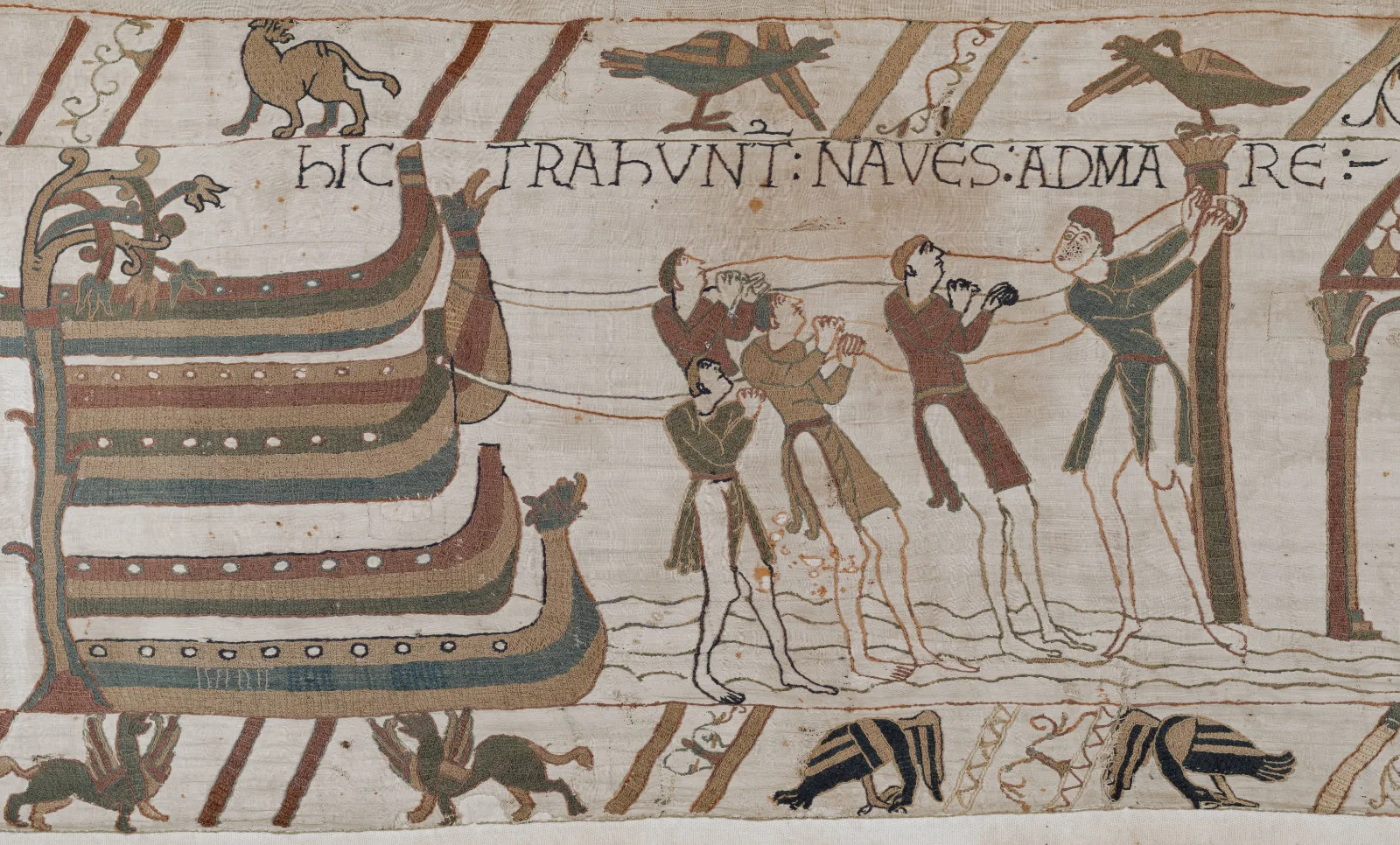
The finds are more modest. Oseberg’s stem ends in a carved, coiled serpent; the head on the ship today is a replica, and the original survived because grave robbers hacked it off and threw it deeper into the mound. At Ladby, small iron spirals at the bow and a spiked iron band at the stern are read by the Roskilde museum as decorations “probably shaped respectively as a dragon’s head and tail”. The Bayeux Tapestry, an 11th-century embroidery of the Norman Conquest, shows many ships with beast-headed stems.
How were Viking ships built?
Planks, rivets and caulking
The builders set up the keel and the two stems and raised the planking strake by strake, riveting each overlap with iron. The Long Serpent saga shows the order: the master builder goes home while “they were planking the ship” and returns to find it “planked up on both sides” (chapter 95). The Hedeby warship shows the skill: oak planks over 10 meters long, split radially from trunks more than a meter thick, held by unusually small, closely spaced rivets. Frames, cross-beams and a keelson to seat the mast stiffened the shell. The seams were caulked (at Gokstad, Ingvald Undset’s 1898 guide records “three thread’s yarn, spun of cow’s hair”) and the hull was tarred.
The steering oar on the starboard side
Viking ships had no sternpost rudder. They steered with a side rudder shaped like an oar blade, fixed on the right side near the stern and worked with a tiller. Old Norse called that side stjórnborði, the steering side, whence English “starboard”. Undset, describing the Gokstad rudder still in place:
“This fitting of the rudder, as a steering oar on the vessel’s starboard side, is everywhere the ancient and original method. Hence the name of «starboard». It was not till the later part of the middle ages that rudders were placed on the sternpost.”
Ingvald Undset, A Short Guide for the Use of Visitors to the Viking-Ship from Gokstad (Kristiania, 1898), p. 9
How long did it take to build a Viking ship?
The best answer comes from the Viking Ship Museum’s reconstruction of Skuldelev 2, built in 2000–2004 and named Havhingsten fra Glendalough, the Sea Stallion from Glendalough:
- 27,000 working hours for the hull, by 15–20 boatbuilders over four years; about 40,000 hours including tar, ironwork, rope and sail.
- By the museum’s preliminary calculation, seven months for a master builder, ten boatbuilders “and a large workforce in the forest”.
- Materials: 150 cubic meters of wood, including 14 oaks for the planks and 250 crooked oak pieces for frames; about 400 kg of iron; 8,000 rivets; 600 liters of tar.
Counting these resources, the museum notes, gives “a picture of the power structures” behind a longship.
The sail: wool, size and labor
No complete Viking sail survives, so sails are sized from the hulls, by the balance between hull, sail and rudder when sailing close to the wind: 112 m² for the Sea Stallion, 90 m² for Ottar, 46 m² for the small longship Skuldelev 5. Flax makes a light sail but is laborious to prepare and rots; wool is heavier, elastic and durable.
For Ottar the museum wove a wool sail in 2/1 twill, following an archaeological fragment from Trondenes in Norway. The wool came from as many as 200 Norwegian Spelsau sheep, about 500 grams each, and the cloth was rubbed with ochre and horse fat. The museum estimates that five people could spin and weave the cloth for Ottar’s sail in a year, and that a sail lasted about 30–50 years. A Sea Stallion sail in original materials would need about 200 kg of processed flax or wool.
How big and how fast were Viking ships? The main finds compared
Figures are those of the museums that hold the finds. Where only rivets survived (Ladby, Salme), the size is reconstructed from their pattern.
| Find | Date | Length × width | Oars / crew | Where now |
|---|---|---|---|---|
| Hjortspring (Als, Denmark) | 4th–3rd century BCE | Over 19 m; sewn planks, no iron | Paddled | National Museum of Denmark, Copenhagen |
| Nydam oak ship (Denmark) | Built 310–320 CE | 22.84 × 3.26 m | 15 pairs of oars, no mast | Gottorf Castle, Schleswig (Germany) |
| Salme II (Estonia) | c. 750 | c. 17–17.5 × 3 m | Keel; about 30 crew (estimate) | Excavated 2010–2012 |
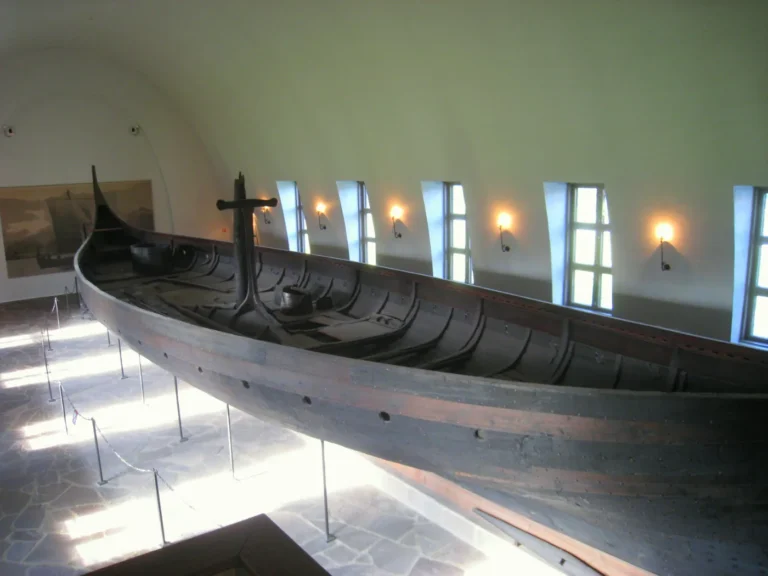
| Oseberg (Norway) | Built 820s, buried 834 | 21.5 × 5 m | 15 oar holes a side; 32 crew | Museum of the Viking Age, Oslo |
| Gokstad (Norway) | Built c. 890, buried c. 900 | 23 × c. 5 m | 16 oar holes a side; up to 67 crew | Museum of the Viking Age, Oslo |
| Tune (Norway) | Buried c. 910 | c. 18.7 × 4.2 m | About 26 men | Museum of the Viking Age, Oslo |
| Ladby (Funen, Denmark) | Built c. 900, buried c. 925 | Over 21.5 × almost 3 m | 15–16 pairs of oars | In its mound, Viking Museum Ladby |
| Hedeby 1 (Germany) | Built c. 985 | c. 30.9 × 2.7 m | Probably 30 pairs of oars | Viking Museum Haithabu |
| Skuldelev 1, ocean trader | c. 1030 | 15.8 × 4.8 m (reconstruction) | 4 oars; 6–15 crew | Viking Ship Museum, Roskilde |
| Skuldelev 2, great longship | c. 1042, Dublin | c. 30 × 3.8 m (reconstruction) | 60 oars; 65–70 crew | Viking Ship Museum, Roskilde |
| Skuldelev 3, coastal trader | c. 1040 | 14 × 3.3 m | 5 oar ports; 5–8 crew | Viking Ship Museum, Roskilde |
| Skuldelev 5, small longship | c. 1030 | 17.3 × 2.5 m | 26 oars; c. 30 crew | Viking Ship Museum, Roskilde |
| Skuldelev 6, fishing boat | c. 1030, western Norway | 11.2 × 2.5 m | 14 oars at first; 5–15 crew | Viking Ship Museum, Roskilde |
| Roskilde 6, warship of a king or earl | Built after 1025 (preliminary dendro date) | c. 36 × c. 3.7 m | Probably 78 oarsmen | Found 1997 in Roskilde harbor; conserved timbers shown in Copenhagen, London and Berlin in 2013–2015 |
Speeds are estimates. The Roskilde museum gives, for its reconstructions, an average of 4–5 knots and a top of 8–10 for the trader Skuldelev 3; 6–7 and about 15 for the small longship Skuldelev 5; 6–8 and 17 for the Sea Stallion, which manages about 2.5 knots under oars. The Oslo museum thinks Gokstad “could probably reach speeds of up to 11 knots”. Of the Sea Stallion’s top speed, its rig reconstructor Erik Andersen wrote in 2007: “we cannot as yet give the correct answer”.
Voyage speeds were far lower. In 2003 Ottar averaged 4.5 knots over 147 nautical miles from Anholt to Lyngør with a following breeze, but the whole passage from northern Zealand to eastern Norway, with a wait for a headwind to pass, took seven days: 1.3 knots.
Replica voyages: from the Viking of 1893 to the Sea Stallion
- Viking (1893). A copy of the Gokstad ship, built in Sandefjord by public subscription, crossed the Atlantic under Captain Magnus Andersen with eleven men chosen from 280 applicants and reached the World’s Columbian Exposition in Chicago in July 1893. The Friends of the Viking Ship keep it at Good Templar Park in Geneva, Illinois.
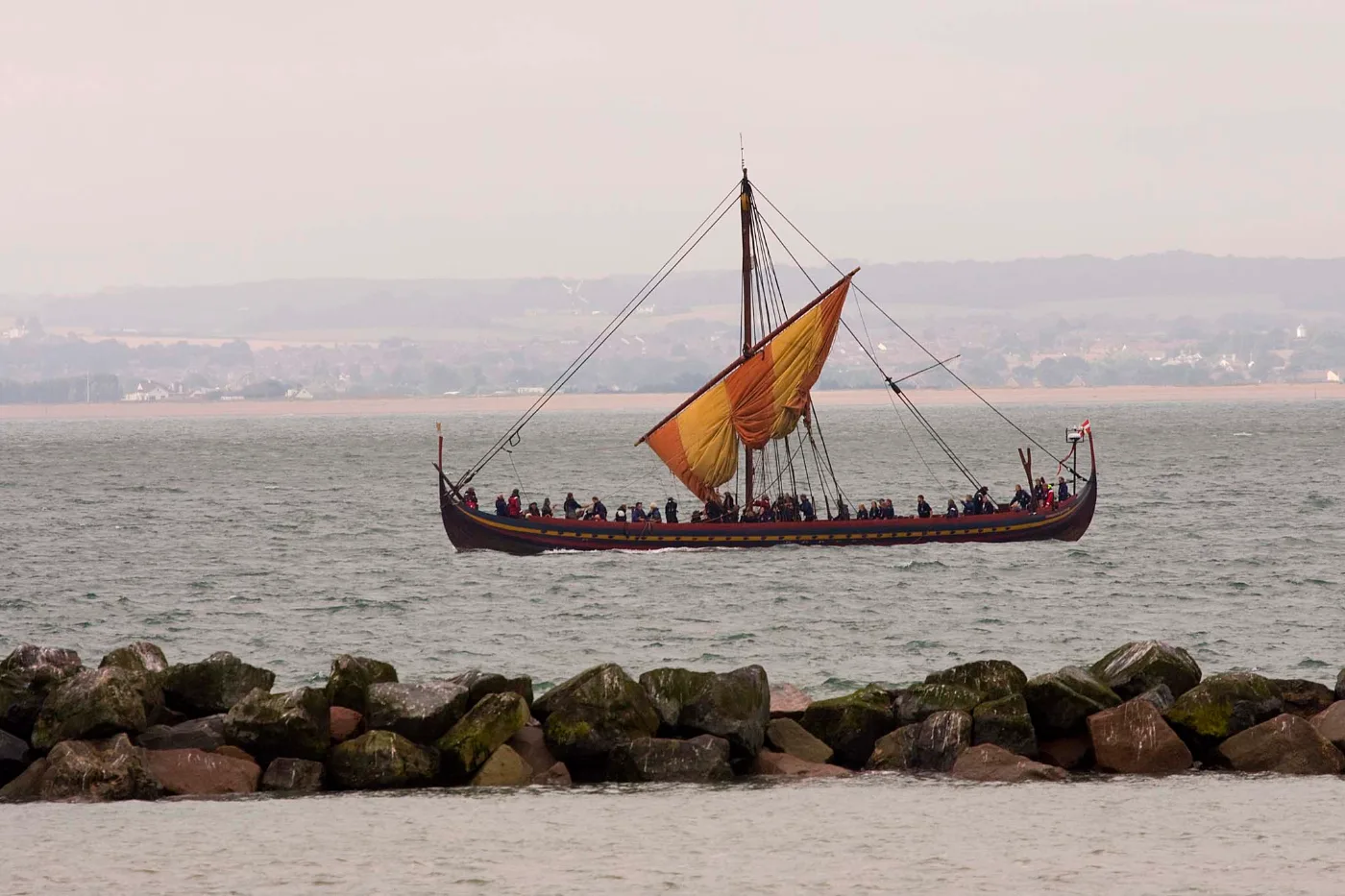
- Sea Stallion from Glendalough (2007–2008). The Skuldelev 2 reconstruction sailed from Roskilde to Dublin, where the original was built, from 1 July to 14 August 2007 by way of Orkney and Scotland, and back through the English Channel from 29 June to 9 August 2008: in the museum’s words, its most ambitious archaeological experiment.
- Saga Oseberg (2012). A first Oseberg copy sank within 20 seconds on its maiden voyage in 1987. Re-measuring the original, Vibeke Bischoff, Geri Rørvik and Knut Paasche found signs that it had been reassembled imperfectly for display, which may have doomed the first copy; the new one, launched in Tønsberg in 2012, crossed to Roskilde in 2015.
- Draken Harald Hårfagre (modern). A 35-meter ship launched in 2012, “not a replica of a known ship” but a reconstruction of a saga “Great Ship” (Mystic Seaport); it crossed the Atlantic in 2016 with 32 crew.
The great Viking ship finds, and where to see them in 2026
Before the Vikings: Hjortspring and Nydam
The Hjortspring boat, from a bog on the island of Als, is the oldest plank-built vessel found in Scandinavia: a war canoe of lime planks sewn with bast, without any metal. A 2025 study (University of Gothenburg with Lund University) dated its cordage to 381–161 BCE and found pine pitch in its caulking; since pines were rare in Denmark then, the authors suggest that boat and crew came from further east along the Baltic. It is shown at the National Museum of Denmark in Copenhagen. The Nydam oak ship, excavated in 1863, is a clinker-built rowing ship without mast or sail, built in 310–320 CE and sunk in the bog as war booty; Denmark lost it after the war of 1864, and it is displayed at Gottorf Castle in Schleswig, Germany.
The Oseberg ship, the Gokstad ship and Tune: the Oslo ships
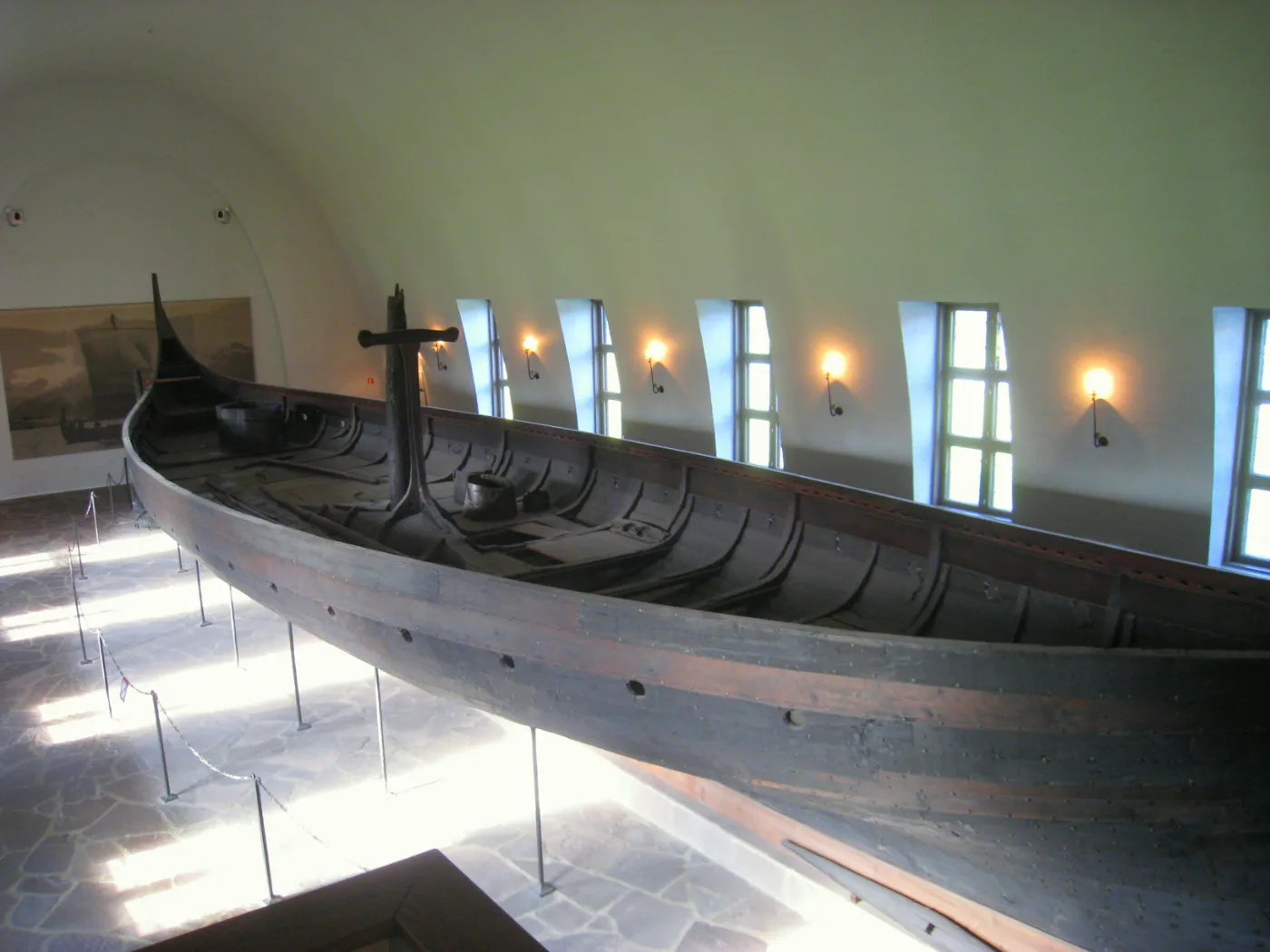
The three Norwegian burial ships were excavated from mounds: Tune in 1867, Gokstad in 1880, Oseberg in 1904. The Oseberg ship, found in 1903 on a farm near Tønsberg, was built of oak in south-western Norway in the 820s. It is the most richly carved, about 90 percent of the reconstructed ship is original timber, and the museum reckons its crew at 32: thirty rowers, a helmsman and a lookout. The Gokstad ship, built around 890 and dug out of the “King’s Mound” near Sandefjord by Nicolay Nicolaysen, is in the museum’s words “the world’s largest preserved Viking ship”: the largest that survives nearly whole, since the longer Hedeby 1 and Roskilde 6 survive only in part. No rowing benches survive, so its rowers probably sat on chests. Tune has never been taken apart and rebuilt, so every rivet is original.
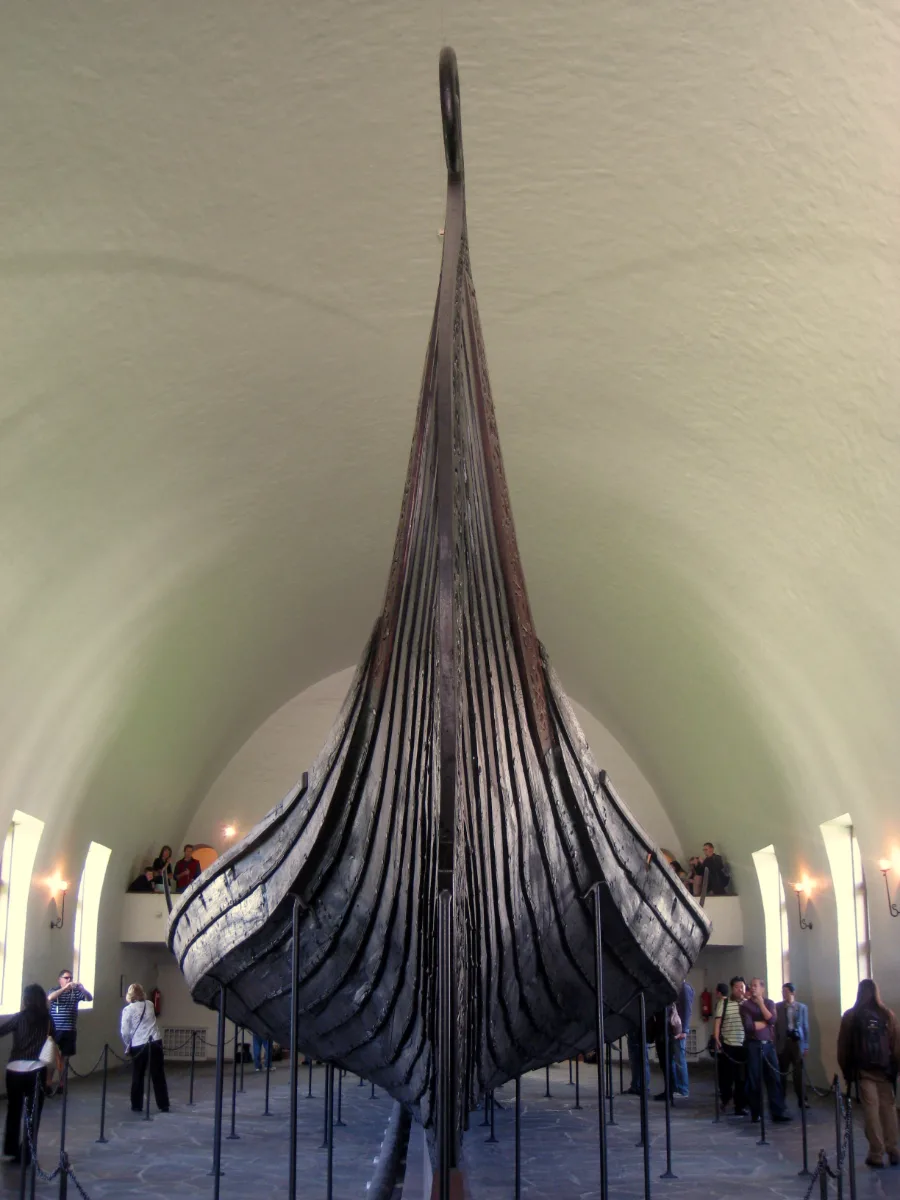
Can you see them now? Not yet. The old Viking Ship Museum at Bygdøy closed in 2021 for the building of the Museum of the Viking Age next to it. Oseberg was moved into the new building in September 2025, followed by Gokstad, Tune and the Oseberg sledges. In November 2026 the museum says it is working toward opening in late 2027, “although the date is subject to change”; its FAQ names November 2027. Meanwhile Viking-Age finds are shown at its sister museum, the Historical Museum in central Oslo, including, according to the museum, the original carved serpent head of the Oseberg ship.
The Skuldelev ships and Roskilde 6
Late in the Viking Age, five old ships were filled with stones and sunk, in two phases, across the channel of Roskilde Fjord at Skuldelev to block the sailing route to Roskilde. Archaeologists enclosed the site in a cofferdam, lowered the water step by step and excavated them in 1962: an ocean trader (Skuldelev 1), a great longship (2), a coastal trader (3), a small longship partly built of recycled timber (5) and a Norwegian fishing boat (6). The parts once numbered as a separate “ship 4” proved to belong to Skuldelev 2.
All five are shown in the Viking Ship Hall at Roskilde, and full-size reconstructions of each lie in the museum harbor. Digging that harbor in 1997 uncovered nine ships from the Viking Age and the Middle Ages, among them Roskilde 6: its keel alone measures 32 meters, and the museum reconstructs a total length approaching 36 meters, “the longest Viking ship yet discovered”.
Hedeby and Ladby
Hedeby 1, found by divers in the harbor of the trading town near Schleswig in 1953 and excavated at the end of the 1970s, was more than eleven times as long as it was wide, “the narrowest longship ever found” according to the Roskilde museum. Heavy charring suggests it ended as a fireship sent burning into the harbor. It stands in the ship hall of the Viking Museum Haithabu. The Ladby ship on Funen, found in the mid-1930s, survives only as rows of rivets and traces in the soil, but it still lies in its mound with its iron anchor and chain.
Viking ship burials: Oseberg, Gokstad, Ladby and Salme
The great ship graves belonged to a tiny elite; our guide to Viking funeral rites sets them against the many smaller boat graves and ordinary burials. In every excavated case the ship was hauled ashore and buried or burned on land.
- Oseberg (834): two women in a chamber behind the mast, with sledges, a wagon, beds, textiles, kitchenware and animals.
- Gokstad (c. 900): a powerful man, with three small boats, a game board and enough shields for the whole ship; Undset counted bones of at least 12 horses and 6 dogs.
- Ladby (c. 925): what the Viking Museum Ladby calls Denmark’s only Viking ship grave, with 11 horses and probably 4–5 dogs.
- Salme (c. 750): two ships on the Estonian island of Saaremaa holding 41 men, many with weapon injuries. Isotope analysis combined with the Scandinavian-style swords (Price and colleagues, Antiquity, 2016) points to the Mälaren region of central Sweden as their most probable homeland. In the larger ship 34 men lay in four layers; the Uppsala archaeologist John Ljungkvist called it a post-battlefield burial that “carries a lot of elements of a boat burial”.
- Gjellestad (found 2018): ground-penetrating radar revealed a ship about 20 meters long in a plowed-out mound in Østfold, Norway. A trial trench dated the grave between the late 8th and early 10th century, and because fungi were destroying the wood, the Museum of Cultural History began excavating it in June 2020, the first Norwegian ship grave dug in over a century.
One written eyewitness exists. Ahmad ibn Fadlan, envoy of the caliph al-Muqtadir to the Volga Bulghars in 921–922, watched the Rus burn a dead chief in his ship, hauled from the river onto a timber stack, together with an enslaved girl of his household killed for the rite. A Rus beside him mocked the Arab custom of burying the dead in the earth, and:
“And truly, not an hour passed before ship and wood and girl, with the dead man, had turned to ashes.”
Ibn Fadlan, our English translation from the German of C. M. Frähn, Ibn-Foszlan’s und anderer Araber Berichte über die Russen älterer Zeit (St Petersburg, 1823)
A round mound was raised over the place, with a wooden post bearing the dead man’s name and the Rus king’s. These Rus were traders on the Volga, far from Scandinavia: a parallel, not a picture of custom at home.
How did the Vikings navigate?
Most voyages followed coasts and rivers. The Roskilde museum lists the tools of “navigation by sense”: landmarks and cairns, birds, whales and currents, the smell of land, the position of the sun. The clearest firsthand account comes from Ohthere (Óttarr), a Norwegian from Hålogaland who described his travels to King Alfred of Wessex in the late ninth century; they were written into the Old English Orosius:
“Thither he said, that a man could not sail in a month, if he anchored at night, and every day had a fair wind. All the while he must sail near the land.”
Ohthere’s voyage from Hålogaland to Sciringesheal in southern Norway, Old English Orosius, book I, chapter 1, §18, translated by Joseph Bosworth (1859)
From Sciringesheal he sailed in five days “to the port which they call Haddeby”, the Hedeby of the longship. Open-sea crossings were another matter. Landnámabók, the Icelandic Book of Settlements, tells how Flóki Vilgerðarson sought the land later called Iceland:
“Floki took three ravens with him to sea. When he set free the first, it flew aft over the stem; the second flew up into the air and back to the ship again; but the third flew forth straightway over the stem, in the direction in which they found the land.”
Landnámabók, part I, chapter 2, translated by Thomas Ellwood, The Book of the Settlement of Iceland (Kendal, 1898)
Hence his name Hrafna-Flóki, “Flóki of the Ravens”. Ellwood notes that another copy says Flóki had consecrated the ravens before leaving Norway; whether that ties them to Odin’s ravens the text does not say.
The Uunartoq disc. In 1948 excavators at Uunartoq in Greenland found part of a circular disc with incised lines, dated to the 11th century, often read as a sun compass. The Roskilde museum thinks the Vikings “probably used a sun compass”; Balázs Bernáth, Gábor Horváth and colleagues (2014) find the disc’s “dimensions and incisions” “far from optimal” for that role and propose a “twilight board”, a sun compass combined with a horizon board for use when the sun is near the horizon.
The sunstone. The word sólarsteinn, “sun-stone”, occurs in a few medieval Icelandic texts; Cleasby and Vigfússon (1874), who list them, took it to be a lodestone (“a sun-stone or loadstone”), so the texts do not say what the stone was. Physicists have shown that a crystal of Iceland spar can locate a hidden sun (Ropars and colleagues, 2011), and such a crystal was found in an Elizabethan ship wrecked off Alderney in 1592 (Le Floch and colleagues, 2013). But no sunstone has been found in a Viking context, and “a clearly suitable mineral has not been found” (Roskilde museum). A possible method, not a proven practice.
Ships in Norse myth: Skíðblaðnir, Naglfar and Hringhorni
“Skídbladnir is best of ships and made with most skill of craftsmanship; but Naglfar is the largest ship; Múspell has it.”
Gylfaginning, chapter 43, translated by Arthur Gilchrist Brodeur (1916)
- Skíðblaðnir (Skidbladnir), made by the sons of Ívaldi for Freyr, has a fair wind as soon as its sail is hoisted, carries all the gods with their weapons, and folds “like a napkin” into a pouch (Gylfaginning 43; Grímnismál 43).
- Naglfar is made “of dead men’s nails” and steered by the giant Hrymr at Ragnarök (Gylfaginning 51); Völuspá 50 says only “Naglfar is loose” (trans. Bellows).
- Hringhorni, Baldr’s ship, “greatest of all ships”, will not move for his funeral until the giantess Hyrrokkin pushes it out “so that fire burst from the rollers” (Gylfaginning 49).
Ships on picture stones and stone ships
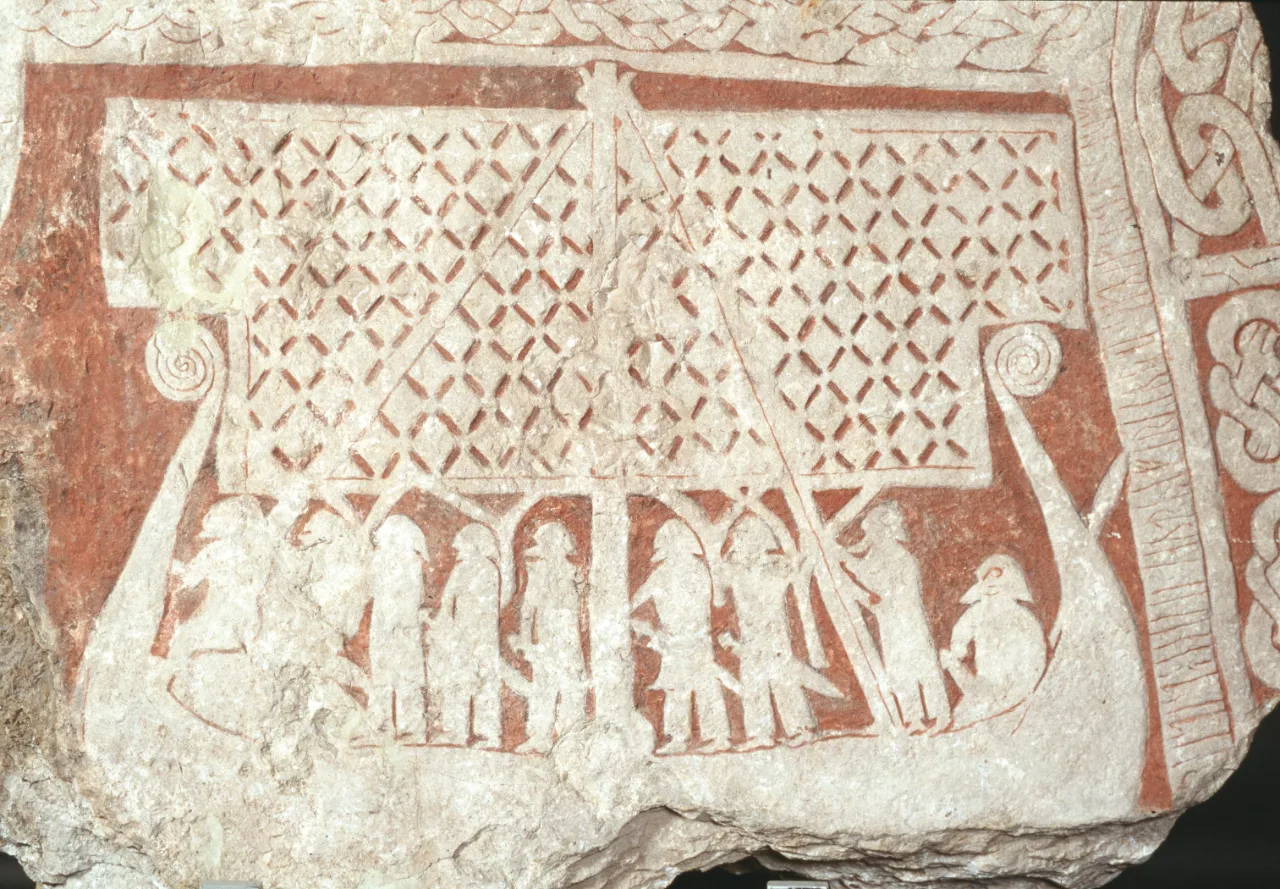
The picture stones of Gotland, memorial stones mostly without inscriptions, often show ships under sail; the Roskilde museum notes that they seem to end in the tenth century. The Tjängvide stone, dated by the Swedish History Museum to 800–1099, shows a crewed ship under a lozenge-patterned sail. The museum is cautious about reading such sails literally: the lattice could be sewn panels, reinforcing bands or decoration, and “it is not at all certain that the picture stones show wool sails”. Our evidence index of Viking symbols discusses the ship as an image.
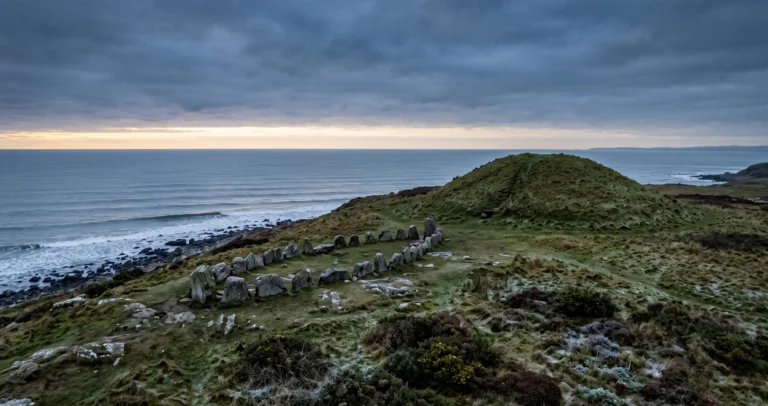
Ship settings are stones raised in the outline of a ship. Ales stenar at Kåseberga in Scania, Sweden’s largest preserved ship setting, is about 70 meters long and 19 wide, with 59 stones today. A 2013 report of the Swedish National Heritage Board sums up the dating: radiocarbon results and comparison with other large ship settings place it in the Late Iron Age (400–1050 CE). A Bronze Age date was proposed, among others by the excavator Märta Strömberg, who later changed her view. Its alignment with the solstices, pointed out by Hasse Alfredsson in 1975, has prompted “extensive discussions” (our translation).
Viking ship myths: shields, dragons and the Vikings TV series
Did Viking ships sail with shields along their sides? Not while rowing. The Gokstad ship was buried with shields along both rails, and Undset explained:
“… the ship, when buried (as also at other times, when adorned for festive occasions) had been decorated with shields on both sides; the shields appeared to have been painted alternately yellow and black. While the vessel was being rowed, the shields were removed, seeing that they reached so far down as to cover the openings for the oars.”
Ingvald Undset, A Short Guide for the Use of Visitors to the Viking-Ship from Gokstad (Kristiania, 1898), p. 7
Shield racks existed: fragments of one survive along the top strake of Skuldelev 5. In pictures, the Roskilde museum notes, rows of 10–30 shields or oars were a convention for showing a ship’s size.
“Every Viking ship was a dragon ship.” In the sources a dreki is a chieftain’s or king’s warship, and among the finds only a few, such as Oseberg and Ladby, show animal ornament at the stem. “Drakkar” is a 19th-century French word.
“Viking funerals were burning ships at sea.” Every excavated ship burial was on land; the burning ship comes from Baldr’s funeral and from Snorri’s legendary king Haki, sent out to sea “burning in clear flame” (Ynglinga saga 27, trans. Laing).
The TV series Vikings (History, 2013–2020). Its character Floki is “a genius ship builder” who “designs and builds the prototype of the new generation of Viking ships” (History channel cast page). That is drama: keeled ships, probably already under sail, existed by about 750 at Salme. The name recalls Hrafna-Flóki of Landnámabók.
Where to go next
Follow the ships into the myths and the graves
Viking ships carried the dead as well as the living, and the gods had ships of their own.
Frequently asked questions
What were Viking ships called?
The Norse called warships langskip, longships (not longboats: a longboat is a later ship’s boat), and named them by size and status: karfi or karve (a smaller galley), snekkja or snekke and skeið or skeid (fast warships of twenty to thirty or more rooms) and dreki, plural drekar, a dragon-headed ship of a king or great chieftain. Cargo ships were the knörr (knarr, knorr), the sea-going merchant ship, and the byrðingr, a ship of burden. The word drakkar is French, first recorded in 1840.
What is the difference between a longship and a knarr?
A longship was built for war: long, narrow and fast, with many oars as well as a sail. The reconstruction of Skuldelev 2 is about 30 m long and 3.8 m wide, with 60 oars and a crew of 65–70. A knarr was built for cargo: broad and deep, driven mainly by its sail. The reconstruction of Skuldelev 1 is 15.8 m long and 4.8 m wide, carries about 20 tons and has only four oars.
How long was a Viking longship?
From about 17 to 36 meters (57 to 118 feet). Among the finds, the small longship Skuldelev 5 is 17.3 m, the great longship Skuldelev 2 about 30 m, Hedeby 1 about 30.9 m, and Roskilde 6, the longest Viking ship yet found, about 36 m. The famous Oslo burial ships fall in between: Oseberg is 21.5 m and Gokstad 23 m long. Snorri’s Long Serpent is put at about 43 m by the Roskilde museum, but that figure comes from a saga written two centuries later, not from a find.
Did Viking ships have dragon heads?
Some did. In the sagas a dreki, dragon, is a king’s or chieftain’s warship with a dragon’s head at the prow and a tail at the stern; Snorri describes Raud the Strong’s ship this way (Óláfs saga Tryggvasonar 87). Among the finds, the Oseberg ship’s stem ends in a carved serpent, and iron spirals at the bow of the Ladby ship probably decorated a dragon’s head.
How long did it take to build a Viking ship?
For a large longship, months of work by a big team. The Viking Ship Museum in Roskilde spent 27,000 working hours over four years building the 30-meter Sea Stallion, a reconstruction of Skuldelev 2, and about 40,000 hours including tar, iron, rope and sail. It estimates that a master builder, ten boatbuilders and a large forest workforce could have built the hull in seven months.
How fast could a Viking ship go?
Museum estimates for reconstructions give averages of 4–8 knots (7–15 km/h, 5–9 mph) under sail and top speeds from 8–10 knots for a small trader (Skuldelev 3) to about 15–17 knots (28–31 km/h, 17–20 mph) for longships (Skuldelev 5, the Sea Stallion). The Oslo museum puts the Gokstad ship at up to about 11 knots. Over a whole voyage the average was much lower: in 2003 the knarr replica Ottar took seven days for a 189-nautical-mile passage, 1.3 knots, because it had to wait for the wind.
How many people were on a Viking ship?
It depended on the ship. The museums estimate 5–8 crew for the small trader Skuldelev 3, 6–15 for the ocean trader Skuldelev 1, about 30 for the small longship Skuldelev 5, 32 for the Oseberg ship, up to 67 for Gokstad and 65–70 for the great longship Skuldelev 2. Roskilde 6, the longest known Viking ship at about 36 m, probably had 78 oarsmen.
Did Vikings hang shields on the sides of their ships?
Yes, but not while rowing. The Gokstad ship was buried with shields along both rails, apparently painted alternately yellow and black, and Ingvald Undset’s 1898 guide explains that they were removed for rowing because they covered the oar holes. Fragments of a shield rack survive on Skuldelev 5. Rows of shields on pictures were also a convention for showing a ship’s size.
How did the Vikings navigate without a compass?
Mostly by landmarks, coasts, the sun, birds, whales and currents, as the Viking Ship Museum describes. Ohthere told King Alfred that the coastal passage south along Norway took a month even with a fair wind every day, anchoring at night and keeping close to the land. Landnámabók says Flóki released ravens to find Iceland. The Uunartoq disc from Greenland may be a sun compass, and sunstones of Iceland spar could have located a hidden sun, but both remain debated: no sunstone has been found in a Viking context.
Where can I see real Viking ships today?
The Viking Ship Museum in Roskilde, Denmark, shows the five Skuldelev ships and sails reconstructions of them. The Oseberg, Gokstad and Tune ships are in Oslo’s new Museum of the Viking Age, which says it is working toward opening in late 2027. The Hedeby longship is at the Viking Museum Haithabu in Germany, the Ladby ship lies in its burial mound on Funen, and the Nydam ship is at Gottorf Castle in Schleswig.
Sources and editorial notes
Written in November 2026. Ship figures are those published by the museum that holds each find or by its excavators; reconstructions are marked. Translations marked “our translation” are ours; other quotations follow the public-domain translations named. Chapters of Óláfs saga Tryggvasonar follow Laing unless stated.
- Museums: Viking Ship Museum, Roskilde (the Skuldelev ships and reconstructions, Roskilde 6, Hedeby, Ladby, sails, navigation, trial voyages); Museum of the Viking Age, Oslo; Viking Museum Ladby; Viking Museum Haithabu; Swedish History Museum.
- Texts: Snorri Sturluson, Heimskringla, trans. S. Laing (1844), with the Old Norse text on heimskringla.no; Gylfaginning, trans. A. G. Brodeur (1916); Poetic Edda, trans. H. A. Bellows (1923); Landnámabók, trans. T. Ellwood (1898); Old English Orosius, ed. and trans. J. Bosworth (1859); Ibn Fadlan, German trans. C. M. Frähn (1823); I. Undset, guide to the Gokstad ship (1898).
- Studies: R. Cleasby and G. Vigfússon, Icelandic-English Dictionary (1874); Trésor de la langue française, “drakkar” (CNRTL); T. D. Price et al., “Isotopic provenancing of the Salme ship burials in Pre-Viking Age Estonia”, Antiquity 90 (2016); B. Bernáth et al., Proc. R. Soc. A 470 (2014); Ropars et al., Proc. R. Soc. A (2011); Le Floch et al., Proc. R. Soc. A (2013); M. Andersson et al., Ales stenar i nytt ljus, UV Rapport 2013:80 (Riksantikvarieämbetet); M. Fauvelle et al., PLOS One (2025), on the Hjortspring boat; L. Gustavsen et al., “Gjellestad: a newly discovered central place in southeast Norway”, Antiquity (2020).




All five albums and every single: 86 songs in WAV and MP3, yours to keep.
The music of this site: original songs in Old Norse, written around these myths, with lyrics and translations. Listen free or own the complete collection.