
Viking Symbol Tattoos: What People Search vs What the Evidence Shows (2026 Study)
On this page 5 sections
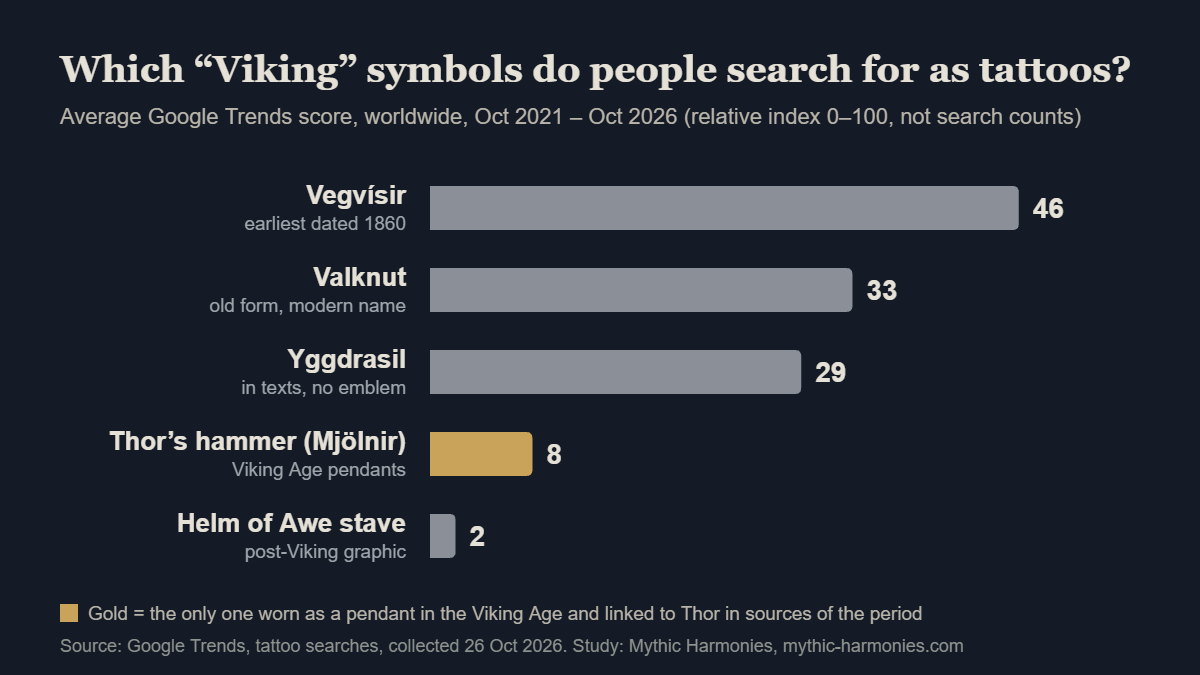
The “Viking” symbol most often searched for as a tattoo, Vegvísir, is not one the Vikings left behind. Over the past five years, Google searches for Vegvísir tattoos scored about five to six times higher than searches for Thor’s hammer tattoos (46 against 8 on Google Trends’ relative index). Vegvísir’s earliest securely dated appearance is in an Icelandic manuscript compiled in 1860, some 800 years after the Viking Age. Thor’s hammer is the only one of these emblems known from Viking Age pendants and tied to Thor in inscriptions of the period.
This short study sets three public datasets against the archaeological and manuscript record: Google Trends, Etsy listing titles and Wikipedia page views, all collected on 26 October 2026. The evidence for each symbol comes from our Viking symbols evidence index, which cites the museum catalogues, manuscripts and scholarly studies behind every verdict.
- About 5 to 6 to 1: searches for Vegvísir tattoos (“vegvisir tattoo” and “viking compass tattoo”) scored 46 over five years on Google Trends’ relative index (not a count of searches), against 8 for all the spellings of Thor’s hammer tattoos we tested.
- Thor’s hammer near the bottom: of five named symbol tattoos, Mjölnir ranks fourth over five years, ahead only of the Helm of Awe. Over the last twelve months, Vegvísir (33) and the Valknut (32) shared the top spot while Thor’s hammer scored 1.
- The “Viking” label sticks regardless of the evidence: on Etsy’s first results page, 88% of Vegvísir listings say “Viking” in the title, and so do two in three listings (147 of 220) across four symbols with no known Viking Age example. The share for Thor’s hammer pendants, a genuinely Viking Age symbol, is about the same: 63%.
- The older runes get the clicks: English Wikipedia’s Elder Futhark article, the rune row used before the Viking Age, was read 2.2 times as often as the Younger Futhark, the row Vikings actually wrote with.
Which Viking symbol tattoos do people search for most?
Google Trends does not give search counts. It gives an index from 0 to 100, relative to the busiest week among the terms compared together. We ran five five-year comparisons of tattoo terms (worldwide, web search, October 2021 to October 2026), each including “vegvisir tattoo” as an anchor. It scored 37 in all five, and “valknut tattoo” 33 in all five, so the figures below share one scale. Where a symbol has several common names, we added them up.
Average Google Trends score (relative index, 0–100). Gold = the only symbol worn as a pendant in the Viking Age and linked to Thor in sources of the period.
Source: Google Trends, collected by Mythic Harmonies on 26 October 2026. Vegvísir = “vegvisir tattoo” (37) + “viking compass tattoo” (9). Thor’s hammer = “mjolnir tattoo” (6) + “thor hammer tattoo” (2); “thor’s hammer tattoo” and “mjölnir tattoo” were below Google’s reporting threshold.
The gap is not a spelling effect. Thor’s hammer scored low under every name we tried, and alternative names for the other symbols (“aegishjalmur tattoo”, “valknot tattoo”, “odin’s knot tattoo”) were all below Google’s threshold, so they change nothing. Over the most recent twelve months the gap widened: Vegvísir scored 33 (30 plus 3 for “viking compass tattoo”) and the Valknut 32, against 1 for Thor’s hammer. Searches for “runes tattoo” (48) matched or beat every single symbol, but the term does not say which runes, a point we return to below.
These figures concern tattoo searches only. Searches for the bare words “Mjölnir” or “Thor’s hammer” are a different matter, because they also capture films, comics and games.
What the evidence says about each symbol
| Symbol | Earliest secure evidence | Verdict | Tattoo searches, 5 years (Trends) |
|---|---|---|---|
| Vegvísir | Icelandic manuscript ÍB 383 4to (“Huld”), compiled by Geir Vigfússon in 1860; also in two other nineteenth-century manuscripts, one of them not precisely dated | Nineteenth-century Icelandic magical sign, not a Viking compass | 46 |
| Valknut (three interlaced triangles) | Several objects from the seventh to ninth centuries | Old form; the name “Valknut” is modern and the original meaning is unknown | 33 |
| Yggdrasil | Medieval Old Norse poems and Snorri’s Edda | Real mythological tree; no standard Viking Age emblem | 29 |
| Thor’s hammer (Mjölnir) | Viking Age hammer pendants and hammer rings from graves and settlements; Thor invoked with his hammer on the eleventh-century Kvinneby amulet | Genuine Viking Age emblem; the name Mjǫllnir is known from thirteenth-century manuscripts | 8 |
| Helm of Awe (Ægishjálmr) | Name in medieval poetry; the familiar eight-armed stave in later Icelandic manuscripts | Medieval name, post-Viking graphic | 2 |
None of this makes Vegvísir less interesting. It belongs to a rich Icelandic tradition of magical signs that grew up long after the Viking Age, and its own history is worth telling. The problem is the label. Calling it a “Viking compass” suggests both that it is archaeologically Viking Age and that it was a navigational instrument. The manuscripts support neither claim.
How often do sellers call these symbols “Viking”?
We read the titles of every listing on the first page of Etsy search results for six symbols, 337 listings in all, and counted those containing the word “Viking”. The share is highest for Vegvísir (88%), a symbol first securely dated to 1860. Authenticity makes little difference: Thor’s hammer, which really was worn in the Viking Age, sits at 63%, between the Troll Cross (57%) and the Helm of Awe (73%).
| Etsy search | Listings on page one | Title says “Viking” | Share | Viking Age example known? |
|---|---|---|---|---|
| vegvisir | 56 | 49 | 88% | No (earliest dated 1860) |
| valknut | 58 | 48 | 83% | Form yes, name no |
| helm of awe | 56 | 41 | 73% | No (the graphic is post-Viking) |
| mjolnir pendant | 59 | 37 | 63% | Yes |
| troll cross | 53 | 30 | 57% | No (pendant form created in the late twentieth century) |
| web of wyrd | 55 | 27 | 49% | No (earliest known print 1993) |
Many of the remaining titles say “Norse” or “Nordic” instead. Counting those as well, 170 of the 220 listings for the four modern or post-Viking symbols (77%) present them as Viking, Norse or Nordic.
Readers look up the older runes, not the Viking ones
Popular “Viking rune” designs are often based on the 24-rune Elder Futhark. That row was used from about 150 CE until it gave way, between about 650 and 800, to the 16-rune Younger Futhark, the row Vikings wrote with. Wikipedia readers, too, favour the older row. Between October 2025 and September 2026, the English Wikipedia article on the Elder Futhark had 287,833 views, against 133,079 for the Younger Futhark, a ratio of 2.2 to 1. The Elder Futhark is also the older and more studied alphabet, so these views are not all mistaken; but they show where attention goes. Our Elder Futhark guide explains both rows and where each rune name comes from.
Interest in these symbols goes well beyond tattoo searches. Across all language editions, Wikipedia’s Vegvísir articles were read 221,212 times in the same twelve months, the Valknut articles 380,094 times and the Mjölnir articles 543,362 times, a figure that includes readers arriving from Marvel films and games.
Method and limits
- Google Trends (collected 26 October 2026): worldwide, all categories, web search, past five years, plus a past-twelve-months check, which is a separate comparison on its own scale. The values are averages of a relative index, rounded by Google, not search counts. A 0 means the volume is below Google’s reporting threshold, not that nobody searched. Because each average is rounded, the five-year ratio is approximate (between about 4.5 and 6.7 to 1). All search terms are in English, so the results mainly reflect English-language searches. Google Trends works on a sample, and repeated queries can differ by a few points.
- Etsy (26 October 2026): first page of results for each search, browsed from Belgium without filters, sponsored listings included and duplicate titles removed: 337 listings in all. Etsy showed titles machine-translated into French; “viking” is spelled the same in both languages, and the wider count includes “norse” and words beginning with “nordi-”. Results are personalised and change daily, so the shares describe one snapshot, not the whole market.
- Wikipedia: page views classified as user traffic (identified bots excluded) from the Wikimedia Pageviews API, October 2025 to September 2026, for the English article and every language edition linked to it.
- Evidence verdicts come from the evidence index, which cites the Swedish History Museum, the Handrit.is manuscript catalogue, Bauer and Pesch (2023), the Kvasir Symbol Database and other sources for each symbol.
- Disclosure: Mythic Harmonies sells Norse-inspired music and apparel (wolf, Odin, Valkyrie and Berserker designs). It sells no jewellery or tattoo designs.
The raw figures and the Google Trends links are in the data file (CSV), and the chart is available as an image (PNG). Journalists, teachers and researchers are welcome to quote the findings or reproduce the chart with a credit and a link to this page.
Study by Calogero Nicosia, Mythic Harmonies. Data collected on 26 October 2026.




All five albums and every single: 86 songs in WAV and MP3, yours to keep.