
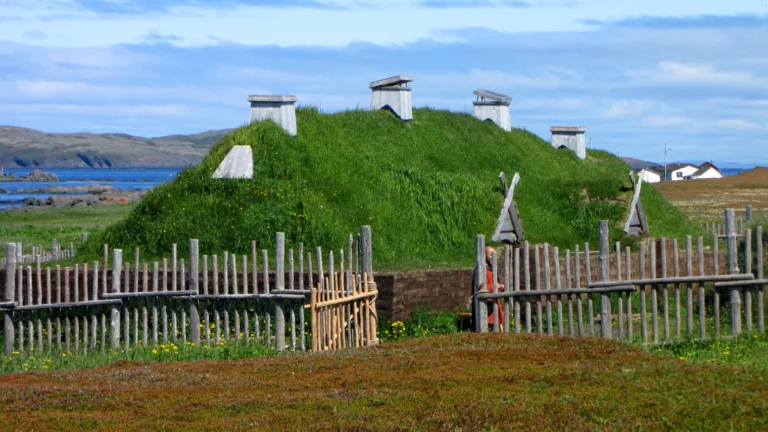
Vinland: The Vikings in America and the Evidence
On this page 14 sections
- Vikings in America at a glance: quick facts
- How do we know the Vikings reached America? The evidence by date
- Greenland: the base for the voyages west
- The voyages in the sagas: who reached America first?
- The two Vinland sagas: Grænlendinga saga and Eiríks saga rauða
- Helluland, Markland and Vinland: what the names mean and where they were
- L’Anse aux Meadows: the only confirmed Norse site in the Americas
- The Skrælings: the Norse meet the peoples of North America
- Why did the Vikings leave Vinland?
- After Vinland: the Markland ship of 1347 and the end of Norse Greenland
- Claims and hoaxes: what the evidence says
- Did the Vikings discover America? Leif Erikson Day and Columbus
- Frequently asked questions
- Sources and editorial notes
Yes: Norse seafarers from Greenland reached North America around the year 1000, some five centuries before Columbus, and called the best land they found Vinland. The proof is L’Anse aux Meadows in Newfoundland, the only confirmed Norse site in the Americas, where wood cut with metal tools has been dated to the year 1021; almost everything else we know comes from two Icelandic sagas written down two centuries or more after the voyages.
This guide sets out the evidence in order of strength: the excavated site and its date, the earliest written mentions, then the two sagas, which tell the story differently. It ends with the claims that do not hold up. Saga quotations follow Arthur Middleton Reeves’s public-domain translation, The Finding of Wineland the Good (1890), unless marked as our own translation.
- One confirmed site: L’Anse aux Meadows, at the northern tip of Newfoundland, found in 1960 by Helge Ingstad and excavated from 1961 by Anne Stine Ingstad, a UNESCO World Heritage Site since 1978.
- A precise year: three pieces of wood from three different trees, cut with metal blades, were felled in 1021 (Kuitems and others, Nature, published online 2021).
- The first written mention: Adam of Bremen, around 1075, heard of an island called “Winland” from the king of Denmark and explained the name by wild vines.
- Two sagas, two versions: Grænlendinga saga gives the discovery to Leif Erikson after Bjarni Herjólfsson’s sighting; Eiríks saga rauða makes Leif a castaway and puts Thorfinn Karlsefni and Gudrid at the center.
- No second site, no other proof: the Kensington runestone, the Vinland Map (20th-century ink, Yale 2021) and Point Rosee (no Norse evidence) have all failed the test.
Vikings in America at a glance: quick facts
| Question | Short answer |
|---|---|
| When? | From about 1000 into the 1020s. The only exact date is 1021, the year wood found at L’Anse aux Meadows was felled. |
| Who came first? | Bjarni Herjólfsson sighted land without landing (Grænlendinga saga); Leif Erikson (also spelled Eriksson; Old Norse Leifr Eiríksson) is the first named European to land and explore. |
| Where to? | Helluland, Markland and Vinland: probably Baffin Island, Labrador and, in Birgitta Wallace’s view, the coasts around the Gulf of St. Lawrence. No Norse site is confirmed in the present-day United States. |
| Confirmed site | L’Anse aux Meadows, Newfoundland, Canada, the only one outside Greenland: eight turf buildings, about 800 artifacts (UNESCO). |
| How many, how long? | Room for 70 to 90 people, used for “a matter of years rather than decades” (Birgitta Wallace, Parks Canada). |
| First European child born in America | Snorri, son of Thorfinn Karlsefni and Gudrid (Guðríðr Þorbjarnardóttir), in both sagas. |
| Last recorded voyage | 1347: a Greenland ship that had sailed to Markland (Icelandic annals). |
| Leif Erikson Day | October 9 in the United States, authorized by Congress in 1964. |
How do we know the Vikings reached America? The evidence by date
Until 1960 the voyages were known only from texts; archaeology has since confirmed the core of the story.
| Source | Date | What it tells us |
|---|---|---|
| L’Anse aux Meadows (archaeology) | Wood felled in 1021 | A Norse base with halls, iron-making and boat repair |
| Adam of Bremen, Gesta, book IV | About 1075 | An island “Winland” with wild vines and unsown grain, as the Danes reported |
| Ari Þorgilsson, Íslendingabók | About 1122–1133 | The people of Wineland, “whom the Greenlanders call Skrellings” |
| Icelandic annals | Entries for 1121 and 1347 | A bishop of Greenland seeks Vinland; a ship returns from Markland |
| Eiríks saga rauða | 13th century; copies in Hauksbók (early 14th century) and Skálholtsbók (15th century) | Leif blown off course; Karlsefni’s great expedition |
| Grænlendinga saga | 13th or 14th century (disputed); copy in Flateyjarbók (about 1390) | Bjarni’s sighting, then five voyages from Greenland |
The oldest text was written in Germany, in Latin. Adam of Bremen wrote his history of the archbishops of Hamburg-Bremen in 1072–1075, drawing on the court of King Svein Estridsson of Denmark. Describing the northern islands, he adds:
Praeterea unam adhuc insulam recitavit a multis in eo repertam occeano, quae dicitur Winland, eo quod ibi vites sponte nascantur, vinum optimum ferentes. Nam et fruges ibi non seminatas habundare, non fabulosa opinione, sed certa comperimus relatione Danorum.
“Besides, he told of yet another island, found by many in that ocean, which is called Winland, because vines grow wild there and yield the best wine. And that unsown crops abound there we have learned not from fanciful opinion but from the reliable report of the Danes.”
Adam of Bremen, Gesta Hammaburgensis ecclesiae pontificum IV, 38 (ed. Lappenberg, 1876; IV, 39 in Schmeidler’s 1917 edition), our translation
“He” is King Svein: Adam named his source because the claim sounded like a tall tale. About fifty years later the Icelandic priest Ari Þorgilsson (Íslendingabók, chapter 6) wrote that Greenland’s first settlers found traces showing “that that manner of people had been there who have inhabited Wineland, and whom the Greenlanders call Skrellings” (trans. Reeves): a passing mention, as of a place his readers already knew.
Greenland: the base for the voyages west
The road to America ran through Greenland. Erik the Red (Eiríkr rauði), outlawed in Iceland for killings, spent three years exploring the coast, then returned to found a colony. Ari says he named it Greenland “and said, that it must persuade men to go thither, if the land had a good name” (trans. Reeves), and dates the settlement fourteen or fifteen winters before Iceland adopted Christianity in 1000, so around 985. Erik farmed at Brattahlíð in the Eastern Settlement.
Greenland lacked timber good enough for building, as Parks Canada points out. Birgitta Wallace, the Parks Canada archaeologist who has written most about the American voyages, estimates that the colony began with about 400 to 500 people and later grew to at least 2,000: enough to launch a few expeditions, not to people a second colony.
The voyages in the sagas: who reached America first?
The sagas count winters, not calendar years; modern dates come from Ari’s chronology. Chapter numbers follow the Íslendingasögur text on sagadb.org.
Bjarni Herjólfsson: the first sighting
In Grænlendinga saga (chapter 2), the merchant Bjarni Herjólfsson sails from Iceland to join his father in Greenland, loses his way in fog and north winds, and sights three unknown lands before finding Greenland. He never lands; when his crew asks to go ashore for wood and water, he answers: “Ye have no lack of either of these.” Wallace dates the voyage to 985 or 986 but notes there is no proof Bjarni existed; Eiríks saga ignores him.
Leif Erikson names Helluland, Markland and Vinland
Who was Leif Erikson? The sagas make him the son of Erik the Red and his wife Þjóðhildr, and give no year of birth or death. Grænlendinga saga (chapter 3) calls him “a large and powerful man, and of a most imposing bearing, a man of sagacity, and a very just man in all things”; Eiríks saga (chapter 5) gives him a son, Thorgils, by Thorgunna, a woman he met in the Hebrides on his way to Norway.
Some years later Erik’s son Leif buys Bjarni’s ship and sails with 35 men to find those lands (chapter 3). The first is flat rock running up to glaciers, “entirely devoid of good qualities”: “To this country I will now give a name, and call it Helluland.” The second is low and wooded, with white sands: “This land shall have a name after its nature, and we will call it Markland.” Further on, the crew winters by a river and a lake, builds “a large house” and finds huge salmon. Then Leif’s German foster-father Tyrkir comes back from a walk:
“I have found vines and grapes.” … “Of a certainty it is true,” quoth he, “for I was born where there is no lack of either grapes or vines.”
“… and from its products Leif gave the land a name, and called it Wineland.”
Grænlendinga saga, chapter 4 (Flateyjarbók), translated by Arthur Middleton Reeves (1890)
On the way home Leif rescues fifteen castaways from a skerry and is “afterward called Leif the Lucky”. Eiríks saga (chapter 5) tells it differently: King Olaf Tryggvason sends Leif from Norway to bring Christianity to Greenland, and on the way he is “tossed about upon the ocean” and finds lands where “there were self-sown wheat fields and vines growing there”, and trees called mösurr, which Cleasby and Vigfússon gloss as maple. Snorri’s Heimskringla follows this version. (Eiríksson simply means “Erik’s son”: see our guide to Viking names.)
Thorvald and Thorstein: the first fight and a failed voyage
Leif’s brother Thorvald winters at “Leif’s booths” (Leifsbúðir) and explores for two summers (chapter 5). His men find three skin boats with three men under each and kill eight of them; a fleet of skin boats returns, and an arrow kills Thorvald. A third brother, Thorstein, sets out to fetch the body, is driven about the sea all summer and dies in the Western Settlement (chapter 6), leaving his widow Gudrid free to remarry.
Thorfinn Karlsefni, Gudrid and Snorri, the first European child born in America
The Icelandic merchant Thorfinn Karlsefni (Þorfinnr karlsefni) marries Gudrid and leads the largest attempt at settlement. In Grænlendinga saga (chapter 7) he takes sixty men, five women and livestock to Leif’s houses, which Leif “would lend … but not give”. In the first summer local people come out of the woods with furs to trade; Karlsefni builds a palisade, and “it was at this time that Gudrid, Karlsefni’s wife, gave birth to a male child, and the boy was called Snorri.” After a fight in the second winter they return to Greenland.
Eiríks saga (chapters 8–12) makes this one great expedition of 160 people. They pass Helluland, Markland, Kjalarnes (Keel Cape) and the long Wonder-strands (Furðustrandir), and winter at Straumfjörðr, “Stream-firth”. When food runs short, the pagan hunter Þórhallr credits Thor with a stranded whale: “Did not the Red-beard prove more helpful than your Christ?” The meat makes everyone ill. Karlsefni then sails south to Hóp, a lagoon where wild wheat and vines grow, trades and fights with the local people, and returns north. Snorri is born in the first autumn and is three years old when they leave.
In the end the couple settle at Glaumbær in northern Iceland; after Karlsefni’s death Gudrid makes a pilgrimage “to the South” and ends her life as a nun, and three bishops are counted among their descendants (Grænlendinga saga, chapter 9), a family pride that matters for judging the sagas.
Freydís Eiríksdóttir: two opposite portraits
Erik the Red’s daughter Freydís is a hero in one saga and a murderer in the other. In Eiríks saga (chapter 11), as Karlsefni’s men flee an attack, she mocks them (“Had I but a weapon, methinks, I would fight better than any one of you!”), lags behind because she is “not hale”, which Reeves explains as a euphemism for pregnant, and picks up a dead man’s sword:
“… she stripped down her shift, and slapped her breast with the naked sword. At this the Skrellings were terrified and ran down to their boats, and rowed away.”
Eiríks saga rauða, chapter 11 (Hauksbók), translated by Arthur Middleton Reeves (1890)
In Grænlendinga saga (chapter 8), Freydís sails to Vinland with two Icelandic brothers, Helgi and Finnbogi, hides five extra men aboard, tells her husband the brothers struck her, and has their men seized in their sleep and killed. When no one will kill the five women, she says “Hand me an axe!” and does it herself. Leif learns the truth but says, “I have no heart … to punish my sister, Freydis, as she deserves.” Which portrait is closer to the real woman cannot be known.
The two Vinland sagas: Grænlendinga saga and Eiríks saga rauða
| Grænlendinga saga (Saga of the Greenlanders) | Eiríks saga rauða (Saga of Erik the Red) | |
|---|---|---|
| Written | 13th century for most handbooks; after 1310 for the Icelandic scholars Wallace follows | 13th century |
| Surviving copy | Flateyjarbók (GKS 1005 fol.), about 1390, in two parts inserted into the saga of King Olaf Tryggvason | Hauksbók (AM 544 4to), early 14th century; Skálholtsbók (AM 557 4to), 15th century |
| Discovery | Bjarni sights land; Leif sets out to find it | Leif is blown off course on a mission voyage |
| Voyages | Bjarni, Leif, Thorvald, Thorstein (fails), Karlsefni, Freydís | Thorstein (fails), then one expedition under Karlsefni |
| Base in America | Leif’s booths (Leifsbúðir) | Straumfjörðr in the north, Hóp in the south |
| Thorvald’s death | Arrow in a fight with the local people | Arrow shot by a one-legged being (einfætingr) |
| Freydís | Plots the killing of her partners | Pregnant, faces the attackers alone |
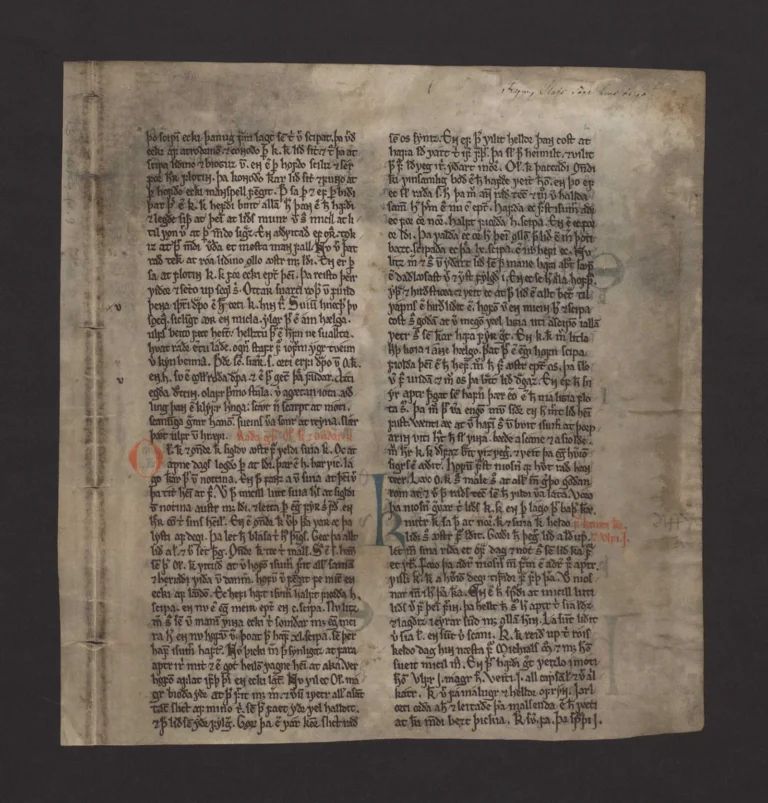
The manuscripts. Flateyjarbók, the largest of all medieval Icelandic manuscripts, was written around 1390 by two priests for Jón Hákonarson; Reeves identified the scribe of the Vinland chapters as Jón Þórðarson. It returned from Copenhagen to Iceland in 1971. Hauksbók was written partly by the lawman Haukr Erlendsson (died 1334) and partly by his secretaries; Wallace, following Stefán Karlsson, dates his heavily edited Eiríks saga to about 1306–1308. Wallace reports that Hauksbók is considered the more accurate version, but many editors take the younger Skálholtsbók (early 15th century) as closer to the lost original, and many modern translations follow it; Reeves, quoted here, translated Hauksbók.
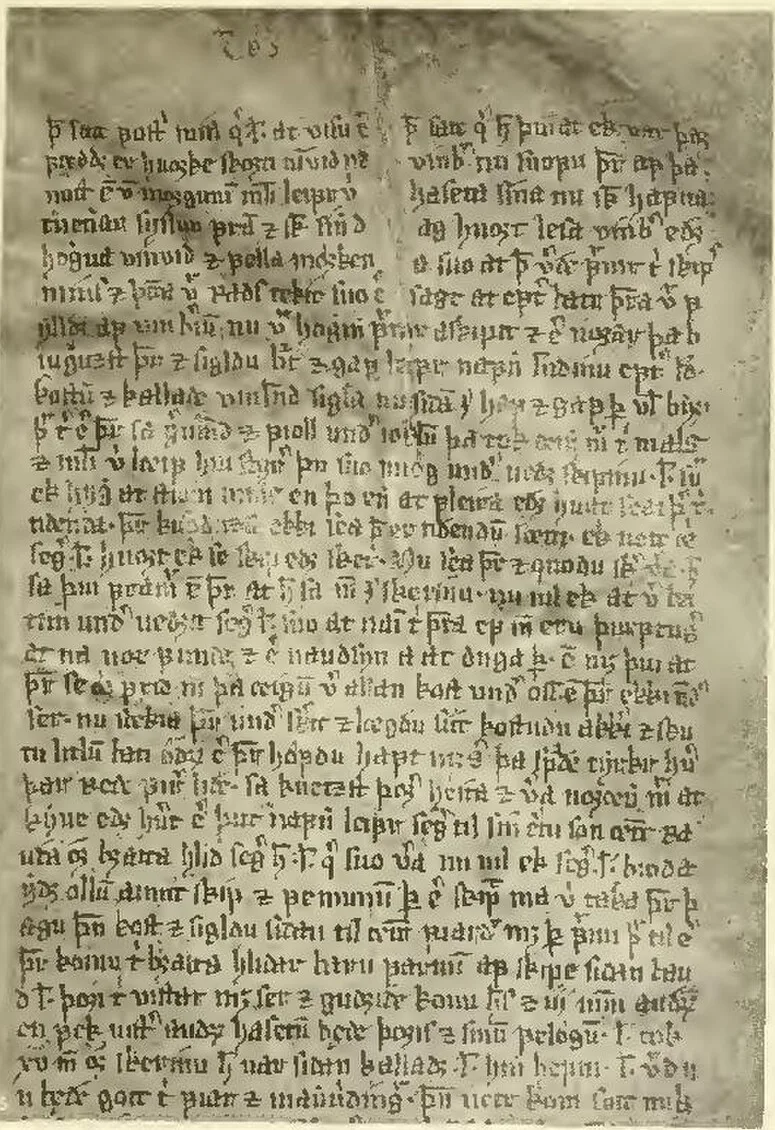
How far can we trust the Vinland sagas?
Wallace sums up the modern view of the sagas: they rest on real events of the early 11th century but “were written to serve thirteenth- and fourteenth-century political ends”. Following Icelandic scholars, she argues that Eiríks saga magnified Karlsefni and Gudrid because their descendants included Bishop Björn Gilsson, whose canonization was sought, and Haukr Erlendsson himself; Grænlendinga saga is, in her words, “less tendentious”. She also argues that both sagas describe the same events, Leif’s booths being a blend of Straumfjörðr and Hóp: her interpretation, not a consensus.
Archaeology confirms the frame: a Norse base built by people from Greenland and Iceland, with women present, used briefly, and a starting point for trips south. The 2021 dating study notes that “both the archaeological and written records are consistent with a very brief occupation”. The dialogue, numbers and motives remain literature.
Helluland, Markland and Vinland: what the names mean and where they were
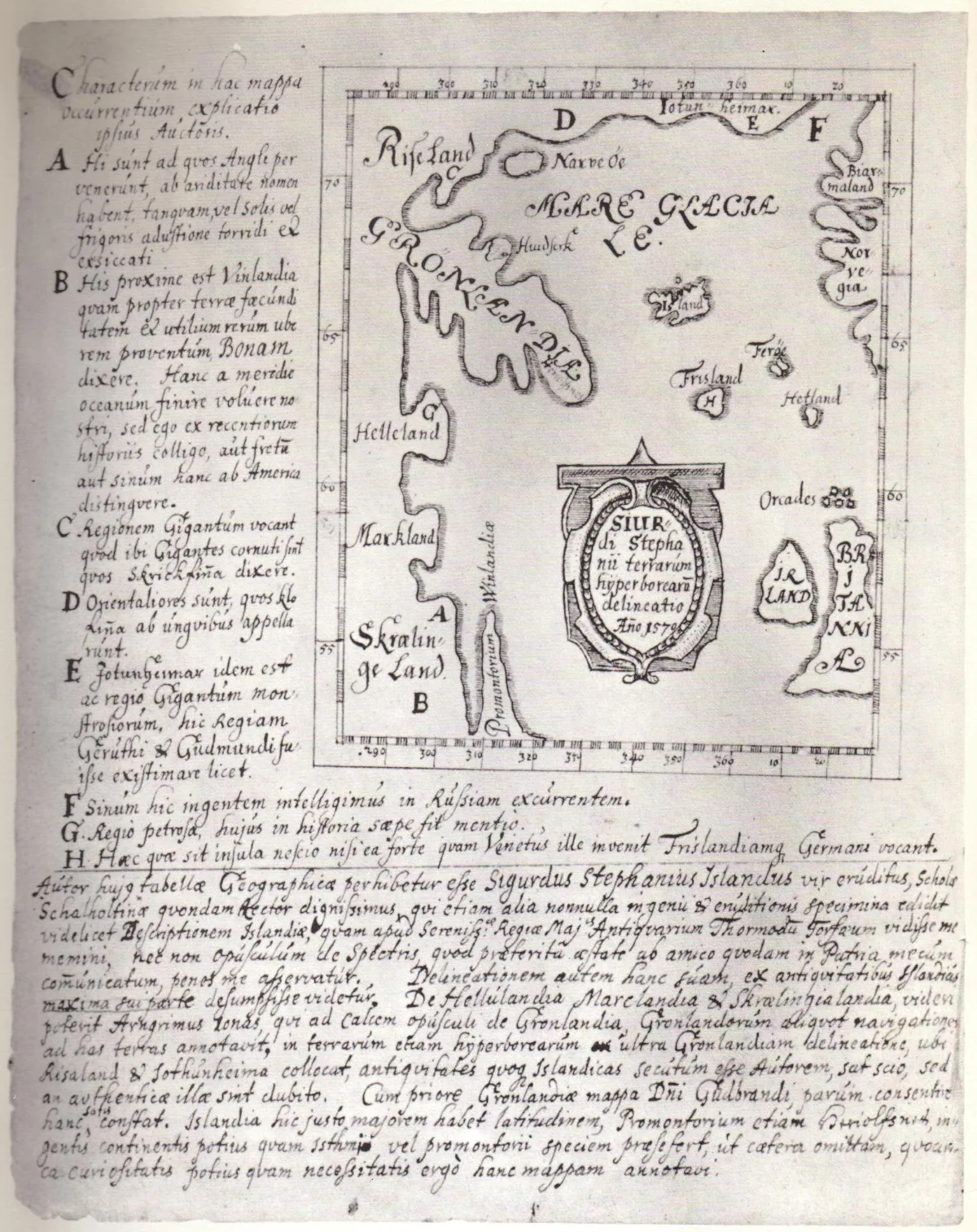
Helluland is “the land of flat stone”, from hella, a flat stone; Markland is “Forest-land”, from mörk, a forest (Reeves); Vinland (Vínland) is “Wineland”. Helluland is usually identified with Baffin Island and Markland, “probably”, with the east coast of Labrador (Store norske leksikon). Hóp is, in Cleasby and Vigfússon’s dictionary (1874), “a small landlocked bay or inlet, connected with the sea so as to be salt at flood tide and fresh at ebb”.
Wine or meadow? The debate over the name Vinland
Every medieval source that explains the name ties it to grapes. But Old Norse also had vin, with a short vowel, “a meadow”. The Swedish philologist Sven Söderberg first proposed reading the name that way in a lecture of 1898 (printed in 1910). Its best-known champion was the Norwegian explorer Helge Ingstad, who argued in Landet under Leidarstjernen (1959) that Vinland lay north of the range of wild grapes and took up Söderberg’s reading of vin as natural meadow (Store norske leksikon); Magnús Stefánsson and Erik Lönnroth later argued the same. Wallace notes that this reading “has never been accepted by Norse philologists”. Cleasby and Vigfússon had already noticed why: vin survives in Norwegian place names such as Bergen (Björgvin), but “In Icel. these names are unknown,—shewing that as early as the time of settlement the word had fallen into disuse”.
Archaeology then tilted the question. Butternuts found at L’Anse aux Meadows grow only much further south, in the same zone as wild grapes (Vitis riparia): “This debate can now be closed,” wrote Wallace; the Norse “did, in fact, visit areas where grapes grew wild.” She also explains the saga’s cargo of vínviðr, “wine-wood” (Cleasby and Vigfússon): wild vines climb trees, so the trees were felled with the grapes.
Where was Vinland?
Since Carl Christian Rafn’s Antiquitates Americanae (1837), writers have placed Vinland at many points along the coast. Wallace treats it as a region. L’Anse aux Meadows was Straumfjörðr, the northern gateway (“There is little doubt that L’Anse aux Meadows was Straumfjord”), and Hóp a summer camp on the southern shore of the Gulf of St. Lawrence, most likely in the Miramichi area of New Brunswick, where butternuts, wild grapes and salmon all occurred. Vinland, on this view, was the coast around the Gulf, from the Strait of Belle Isle to the Northumberland Strait. No site has yet been found at Hóp, and none in what is now the United States (on the claims made there, see the hoaxes below).
L’Anse aux Meadows: the only confirmed Norse site in the Americas
The discovery: Helge and Anne Stine Ingstad, 1960–1968
In 1960 the Norwegian Helge Ingstad was searching the coast for Norse landing places. At L’Anse aux Meadows, on the northern tip of Newfoundland, a local man, George Decker, showed him a group of overgrown ridges (Parks Canada). From 1961 to 1968 his wife, the archaeologist Anne Stine Ingstad, led the excavations with teams from Norway, Iceland, Sweden and the United States; Parks Canada excavated again in 1973–1976. UNESCO, which listed it in 1978, calls it “the first and only known site established by Vikings in North America”.
What was found
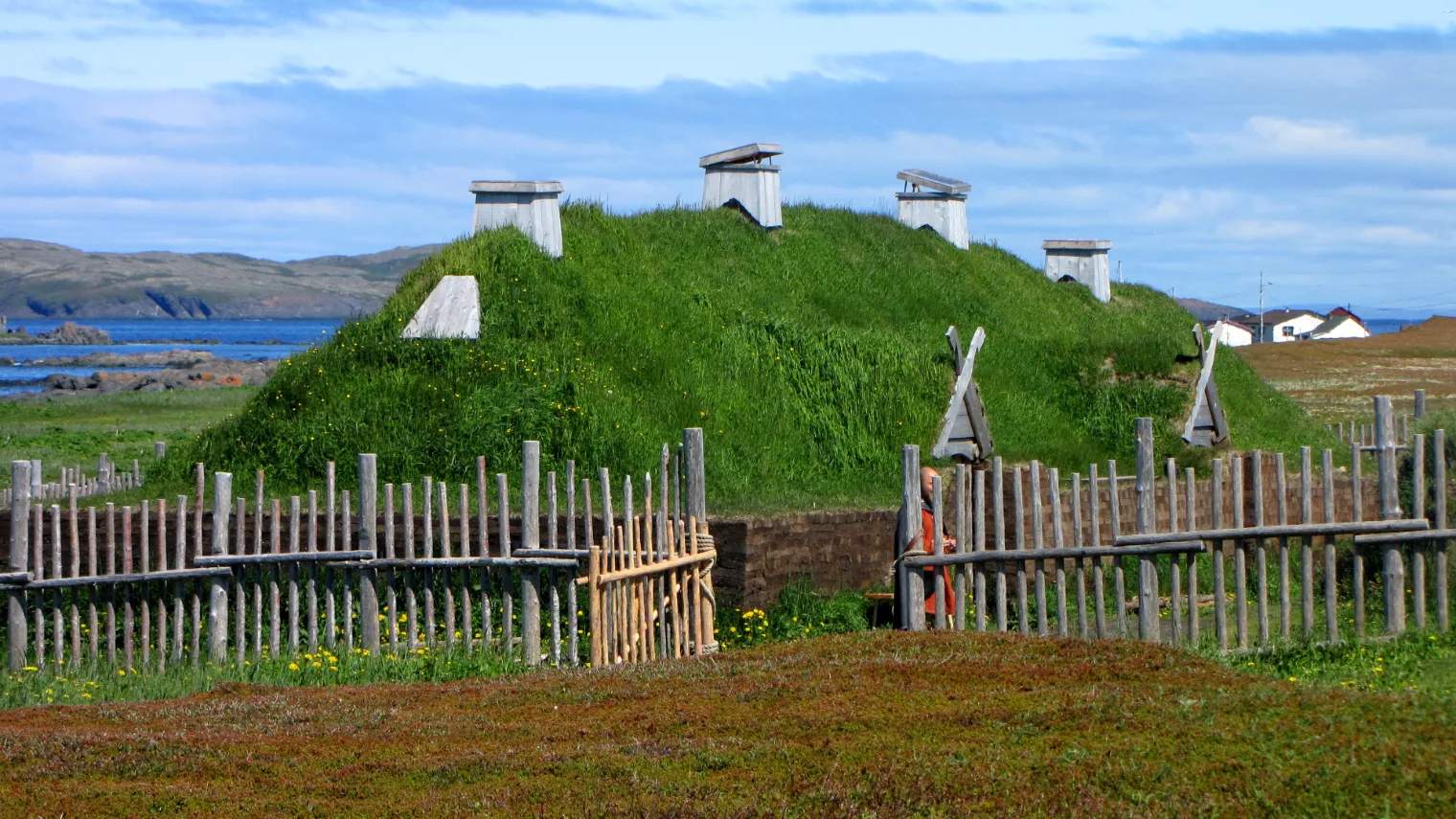
The ridges were the lower walls of eight buildings of turf over timber frames, in the Icelandic style of around 1000: three large halls, a small house, three huts and a furnace hut where bog iron was smelted, apparently just once (Wallace). UNESCO counts “approximately 800 wooden, bronze, bone, and stone artefacts”. The most telling are 99 fragments of iron boat nails, the waste of ship repair; slag from iron-making, unknown to the region’s Indigenous peoples; a bronze ring-headed cloak pin of a type made in Norse Ireland and Scotland; a soapstone spindle whorl, a needle whetstone and a bone needle, tools linked with women’s work; and jasper fire-strikers from Greenland and Iceland.
From the sleeping space in the halls, Wallace estimates 70 to 90 occupants, mostly but not only men, from every social rank. The middens are tiny, the buildings never repaired, and there are no barns or livestock bones: a base for exploration and ship repair, used for “a matter of years rather than decades”, then left in an orderly way.
1021: the year the wood was cut
In 2021 a team led by Margot Kuitems and Michael Dee of the University of Groningen, with Birgitta Wallace, used a sharp rise in atmospheric radiocarbon caused by cosmic radiation in AD 993, recorded in tree rings of that year all over the world. In three pieces of wood from three different trees (fir and juniper or thuja), they found the 993 ring and counted out to the bark edge: all three trees were felled in 1021. All had been cut with metal blades, and “such implements were not manufactured by the Indigenous inhabitants of the area at the time.”
“Our new date lays down a marker for European cognisance of the Americas, and represents the first known point at which humans encircled the globe.”
M. Kuitems and others, “Evidence for European presence in the Americas in AD 1021”, Nature 601 (2022), pp. 388–391, published online 20 October 2021
It is a year when Norse people were there, not necessarily the first or the last.
The butternuts: proof of voyages further south
Among the woodworking waste lay three butternuts and a butternut burl cut with a metal knife. Butternut (Juglans cinerea) does not grow in Newfoundland; its northern limit runs through the inner Miramichi region of New Brunswick, the Saint John River and the St. Lawrence valley (Wallace). Someone had been there and come back, as the sagas’ crews do when they go south for grapes and timber.
Visiting L’Anse aux Meadows today
Parks Canada runs the site, open in summer (June 1 to October 2 in 2026). The original remains are reburied, their outlines marked on the ground; nearby stand full-scale turf reconstructions with costumed interpreters, and a visitor center with original finds. The replicas show how turf houses kept out the northern winter.
The Skrælings: the Norse meet the peoples of North America
Skrælingar (in English usually Skraelings or Skrellings) is what the Norse called the people they met, not these people’s name for themselves, and the sagas see them only through Norse eyes. Nobody lived at L’Anse aux Meadows during the Norse stay, though Indigenous groups camped there for thousands of years before and after: Dorset people more than two centuries earlier, ancestors of the Beothuk later (Parks Canada; Wallace). For Hóp, Wallace argues that the canoe-using people of the saga fit the ancestors of the Mi’kmaq, whose canoes were partly of skin.
The sagas describe both trade and violence. In Grænlendinga saga (chapter 7) the visitors bring furs and want weapons, which Karlsefni forbids; they take milk instead. In Eiríks saga (chapter 11), “Especially did the strangers wish to buy red cloth”, a strip “a span in length, which they would bind around their heads”, until the Norse cut it to a finger’s width. Fighting breaks out in both sagas, and the Norse are not the innocent party: Thorvald’s men kill eight men they find under their boats (Grænlendinga saga 5), Karlsefni’s men kill five more found asleep (Eiríks saga 11), and on the way home they seize two boys in Markland and take them to Greenland (Eiríks saga 12). As Parks Canada puts it, “Greatly outnumbered, the Norse returned to Greenland.”
Why did the Vikings leave Vinland?
In Eiríks saga (chapter 11) Karlsefni concludes that “although the country thereabouts was attractive, their life would be one of constant dread and turmoil” because of its inhabitants. Wallace adds Greenland’s side: building L’Anse aux Meadows took 60 to 90 workers some six to eight weeks, a crew a colony of about 500 could hardly spare. Vinland offered timber, grapes and nuts, but not what Greenlanders needed from Europe (flour, salt, sword blades, silver, fine cloth), and the goods Europe wanted in return, walrus and narwhal ivory and sea-mammal products, came from the Arctic to the north.
After Vinland: the Markland ship of 1347 and the end of Norse Greenland
Several Icelandic annals record under 1121 that “Bishop Eric of Greenland went in search of Wineland” (Annales regii, trans. Reeves); nothing more is known. Markland, closer and wooded, was still visited two centuries later:
“There came also a ship from Greenland, less in size than small Icelandic trading vessels. It came into the outer Stream-firth. It was without an anchor. There were seventeen men on board, and they had sailed to Markland, but had afterwards been driven hither by storms at sea.”
Elder Skálholt Annals (AM 420 a 4to), year 1347, translated by Arthur Middleton Reeves (1890). This “Stream-firth” is Straumfjörður in western Iceland, not the Straumfjörðr of Vinland; the Flateyjarbók annals give eighteen men
That ship is known only because a storm drove it to Iceland. Wallace concludes that “sporadic voyages to relatively nearby Markland continued, and there is some evidence for forages, both planned and unplanned, into the Arctic”. Norse Greenland itself did not last. The Western Settlement was abandoned around the middle of the 14th century; one of the last written records is a wedding in Hvalsey church in 1408; the Eastern Settlement seems to have held out until about 1450 (Store norske leksikon).
No dates. The sagas count winters, not years. “Around 1000” comes from Ari’s chronology and from Snorri, who ties Leif’s voyage to the conversion of Iceland; the only exact year, 1021, comes from tree rings.
No colony. No medieval text describes a permanent settlement in Vinland, and the only confirmed site, L’Anse aux Meadows, was a base, not a farm.
Claims and hoaxes: what the evidence says
Many objects have been offered as proof that the Norse went deeper into North America. None has proved a second Norse site.
| Claim | Where, when | What the evidence says |
|---|---|---|
| Kensington runestone | Douglas County, Minnesota; found 1898 | Inscription dated 1362, dismissed as a fake by experts from 1899 on. Expert opinion: not authentic. |
| Vinland Map | Yale University; made public 1965 | Ink full of a titanium compound first produced in the 1920s: “The Vinland Map is a fake” (Yale, 2021). |
| Newport Tower | Newport, Rhode Island | Mortar radiocarbon-dated to AD 1635–1698 (95% range): “A pre-Columbian date can almost certainly be excluded.” |
| Maine penny | Naskeag Point, Brooklin, Maine; found 1957 | A genuine Norwegian penny of Olaf Kyrre (1067–1093) in an Indigenous site; whether it was planted is debated, and many scholars think it came by Indigenous trade. |
| Spirit Pond stones | Phippsburg, Maine; found 1971 | Read by a Harvard scholar as “a few Norse words in a sea of gibberish”. |
| Point Rosee | Codroy Valley, Newfoundland; dug 2015–2016 | Final report: “no evidence whatsoever for either a Norse presence or human activity” before the historic period. |
The Kensington runestone
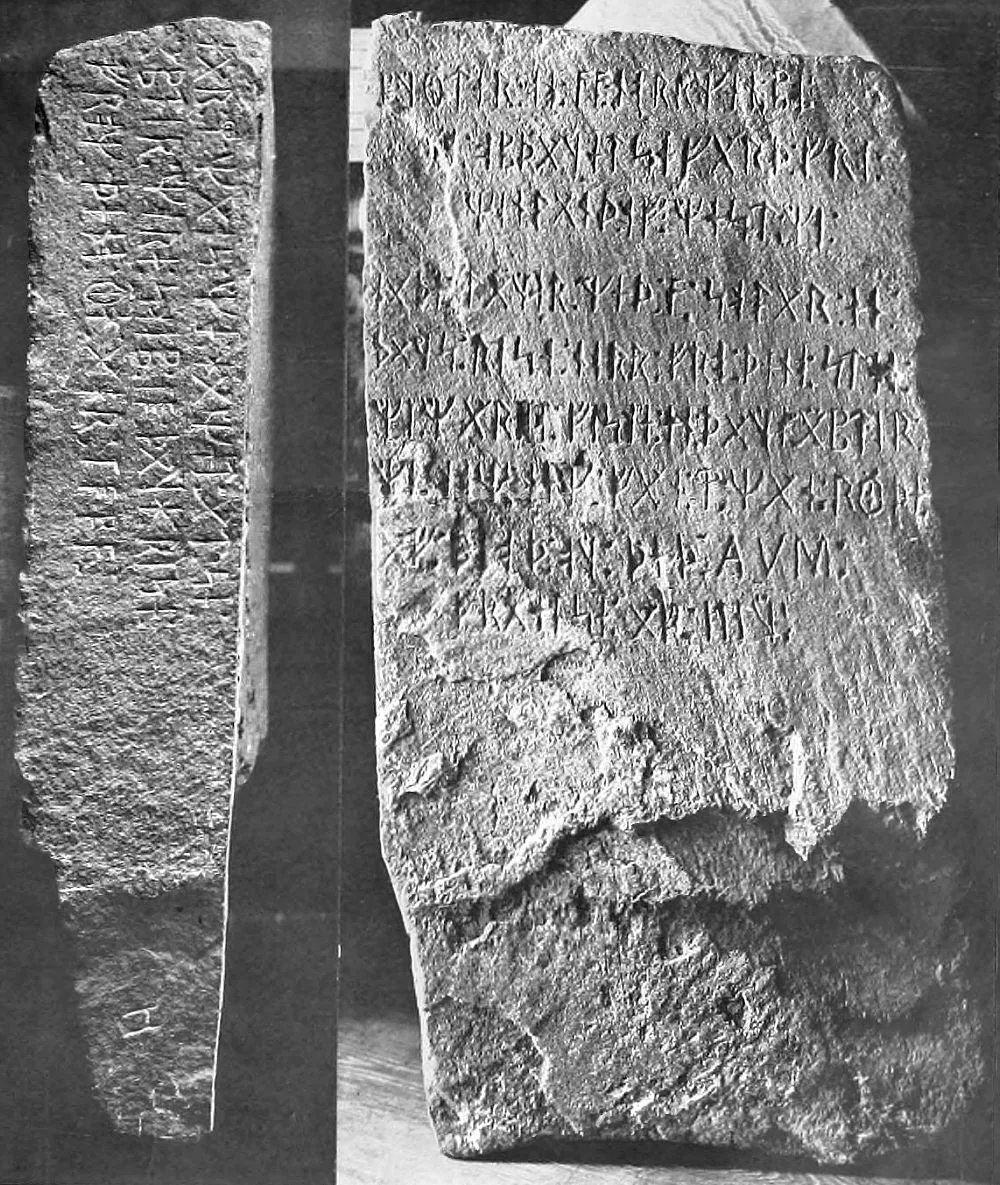
The Swedish immigrant farmer Olof Ohman said he found the slab in the fall of 1898 while clearing land near Kensington, Minnesota. Its runes tell of “8 Goths [Swedes] and 22 Norwegians on an exploration journey from Vinland through the West”, of ten men found dead, and end with “Year 1362” (as translated by MNopedia, the Minnesota Historical Society’s encyclopedia). Experts in 1899 found too many discrepancies with 14th-century Scandinavian, and MNopedia concludes that “expert opinion favors the conclusion that the inscription is not authentic.” (For the runes the Vikings actually used, see our Elder Futhark guide, which also covers the Viking-Age Younger Futhark.)
The Vinland Map and the other false leads
Yale announced the Vinland Map in 1965 as a 15th-century map showing an island, “Vinilanda Insula”, west of Greenland. Its parchment is medieval, but a 1973 study found anatase, a form of titanium dioxide used commercially only from the 1920s, in the ink, and Yale’s 2021 analysis found titanium throughout the lines and text, plus a Latin note on the back overwritten in modern ink. “There is no reasonable doubt here,” said Raymond Clemens, curator at Yale’s Beinecke Library.
Point Rosee, in southwestern Newfoundland, was identified from satellite images by Sarah Parcak; digs in 2015 and 2016 first suggested a bog-ore roasting site, but later examination refuted most of those signs (The Canadian Press, 2018). Most archaeologists and historians hold that the Newport Tower was built in the mid-1600s for Rhode Island’s first governor, Benedict Arnold (The New York Times, 1993), which the mortar dates support. The Maine penny is the hardest case: the Oslo numismatist Svein Gullbekk finds that “There is little doubt that the coin is a genuine Viking penny” and judges the find itself plausibly genuine, but, as many scholars argue (Bangor Daily News, 2024), one perforated coin in a Wabanaki settlement points to Indigenous trade, not to a Norse landing in Maine.
Did the Vikings discover America? Leif Erikson Day and Columbus
They were the first Europeans known to reach it, nearly five centuries before Columbus’s first voyage in 1492 (the one exact date, 1021, is 471 years earlier). But they did not discover an empty land: Indigenous peoples had lived there for thousands of years, and the sagas themselves describe meeting them. And unlike Columbus’s voyages, theirs left no lasting colony.
In the United States, October 9 is Leif Erikson Day: a joint resolution of Congress (Public Law 88-566), approved on September 2, 1964, authorizes the president “to proclaim October 9 of each year” as such, and presidents do so every year (in 2025, Proclamation 10979). The date is not in the sagas; it marks the arrival in New York of the Norwegian emigrant ship Restauration on October 9, 1825 (Store norske leksikon).
Vinland Saga. Makoto Yukimura’s manga, which ended in July 2025, and its anime adaptation (from 2019) follow a fictional Thorfinn Karlsefni: the name is the saga’s, the story is invented.
Vikings: Valhalla. Netflix’s series (from 2022) makes Leif Erikson and Freydís Eiríksdóttir, “our ferocious Greenlanders” in Netflix’s own words, leading characters of a drama, not a documentary.
Where to go next
Follow the voyagers home
The Vinland crossings depended on ocean-going ships, on Greenland’s turf farms and on families whose names tell their story.
Further reading: both Vinland sagas in English in Reeves’s free translation (1890), Birgitta Wallace’s “The Norse in Newfoundland” (2003, open access) and Parks Canada’s pages on L’Anse aux Meadows.
Frequently asked questions
Did the Vikings really reach America before Columbus?
Yes. Norse seafarers from Greenland reached North America around the year 1000, about five centuries before Columbus’s first voyage in 1492. The proof is archaeological: L’Anse aux Meadows, at the northern tip of Newfoundland in Canada, is a Norse base with turf buildings, iron-working and boat-repair waste. Wood cut there with metal tools has been dated to the year 1021 by a study published in Nature in 2021. It is still the only confirmed Norse site in the Americas outside Greenland. The Norse were the first Europeans known to get there, but they did not discover an empty land: Indigenous peoples had lived there for thousands of years, and the sagas describe meeting them.
Who was the first European to reach America?
According to the Saga of the Greenlanders, the first to see the American coast was Bjarni Herjólfsson, who was blown off course on his way to Greenland and never went ashore. The first named European to land and explore was Leif Erikson (also spelled Eriksson; Old Norse Leifr Eiríksson), son of Erik the Red, around 1000. The Saga of Erik the Red tells it differently: Leif came upon the new lands by accident on his way home from Norway. The sagas were written two centuries or more later, so the details are uncertain.
Where was Vinland?
Vinland was the name the Norse gave to the best land they found south of Greenland, beyond Helluland (probably Baffin Island) and Markland (probably Labrador). The Parks Canada archaeologist Birgitta Wallace argues that it was a region around the Gulf of St. Lawrence: L’Anse aux Meadows in Newfoundland was its northern base, the Straumfjörðr of the sagas, and the southern camp of Hóp lay probably in northeastern New Brunswick. No site has yet been found at Hóp, and the exact limits of Vinland remain debated.
What does Vinland mean?
Vinland (Old Norse Vínland) means Wineland. Adam of Bremen, writing around 1075, already explained the name by wild vines, and the Saga of the Greenlanders says Leif named the land after the grapes his foster-father Tyrkir found. A minority view, first proposed by the Swedish philologist Sven Söderberg in 1898 and championed by Helge Ingstad, reads Vin-land with a short vowel as ‘meadow land’, but Norse philologists have not accepted it, and butternuts found at L’Anse aux Meadows show that the Norse did reach areas where wild grapes grew.
When did the Vikings come to America?
The sagas give no calendar years, but their chronology points to the years from about 1000 into the 1020s: the archaeologist Birgitta Wallace places Bjarni’s sighting in 985 or 986, and Snorri Sturluson sets Leif’s voyage in the year Iceland became Christian, 1000. The only exact date is 1021, the year three trees were felled with metal tools at L’Anse aux Meadows, identified from a radiocarbon spike caused by cosmic radiation in AD 993. Icelandic annals still record a ship that had sailed to Markland in 1347.
How long did the Vikings stay in America, and why did they leave?
Not long. The remains at L’Anse aux Meadows show a base for some 70 to 90 people used for a matter of years rather than decades, with no repairs to the buildings and no farm animals. The Saga of Erik the Red says Karlsefni left because conflict with the local people made life one of constant fear. Archaeologists add that Greenland’s small population could not support a colony so far away, and that Vinland did not offer the goods the Greenlanders needed from Europe.
Who were the Skraelings?
Skrælingar was the Norse name for the Indigenous peoples they met in North America; it was not their own name. No one was living at L’Anse aux Meadows during the Norse stay, though Dorset people had camped there earlier and ancestors of the Beothuk later. Birgitta Wallace suggests that the canoe-using people the sagas place at Hóp were ancestors of the Mi’kmaq. The sagas describe trade in furs, milk and red cloth, and violence on both sides.
Who was the first European child born in America?
Snorri, son of the Icelandic merchant Thorfinn Karlsefni and of Gudrid (Guðríðr Þorbjarnardóttir), is the first child of European parents known to have been born in the Americas. Both Vinland sagas say he was born in Vinland, in the early 11th century. He grew up in Iceland, where his parents farmed at Glaumbær; the Saga of the Greenlanders lists three bishops among his descendants.
Did the Vikings reach the United States? Is the Kensington runestone real?
There is no proof that they did. No Norse site has been found in the present-day United States, and the furthest south the evidence reaches is the butternuts at L’Anse aux Meadows, which came from New Brunswick or the St. Lawrence valley. The Kensington runestone, reported found by the farmer Olof Ohman in Minnesota in 1898 and dated 1362 in its text, is almost certainly not authentic: experts found its runes and language inconsistent with 14th-century Scandinavian as early as 1899. The Newport Tower dates from the 17th century, and many scholars think the genuine Norse penny found in Maine arrived through Indigenous trade, not with Norse sailors.
Can you visit L’Anse aux Meadows?
Yes. L’Anse aux Meadows National Historic Site, at the tip of Newfoundland’s Great Northern Peninsula, is run by Parks Canada and is open in summer (June 1 to October 2 in 2026). The original remains are reburied for protection and their outlines are marked, and full-scale turf reconstructions and a visitor center with original finds stand nearby. The site has been a UNESCO World Heritage Site since 1978.
Sources and editorial notes
Written in November 2026. Saga chapter numbers follow the Íslendingasögur text on sagadb.org; English quotations from the sagas, Íslendingabók and the annals follow A. M. Reeves (1890), which is in the public domain. Translations marked “our translation” are ours from the Latin.
- Texts: A. M. Reeves, The Finding of Wineland the Good (Oxford, 1890); Grænlendinga saga and Eiríks saga rauða, Old Norse text and J. Sephton’s translation (1880), sagadb.org; Adam of Bremen, Gesta Hammaburgensis ecclesiae pontificum, ed. J. M. Lappenberg (2nd ed., 1876); Snorri Sturluson, Heimskringla, trans. S. Laing (1844); R. Cleasby and G. Vigfússon, Icelandic-English Dictionary (1874).
- Archaeology and dating: B. Wallace, “The Norse in Newfoundland: L’Anse aux Meadows and Vinland”, Newfoundland Studies 19 (2003); M. Kuitems and others, “Evidence for European presence in the Americas in AD 1021”, Nature 601 (2022); Parks Canada, L’Anse aux Meadows National Historic Site; UNESCO World Heritage List, no. 4; Store norske leksikon, “Vinland”, “L’Anse aux Meadows”, “Leiv Eiriksson”, “Markland”, “Grønlands historie til 1500”, “Flateyjarbók”, “Hauksbók”.
- Claims and hoaxes: P. Nelson, “Kensington Runestone”, MNopedia; Yale News, 1 September 2021; J. Heinemeier and H. Jungner, “Carbon-14 Dating”, Newport History 68 (1997); T. Breton, The New York Times, 28 September 1993; S. H. Gullbekk, “The Norse Penny Reconsidered”, Journal of the North Atlantic 33 (2017); E. Burnham, Bangor Daily News, 13 November 2024; H. McKenzie-Sutter, The Canadian Press, 31 May 2018. Map: Royal Danish Library, GKS 2881 4to; University of Victoria, Great Unsolved Mysteries in Canadian History, “Maps”.



All five albums and every single: 86 songs in WAV and MP3, yours to keep.
The music of this site: original songs in Old Norse, written around these myths, with lyrics and translations. Listen free or own the complete collection.