
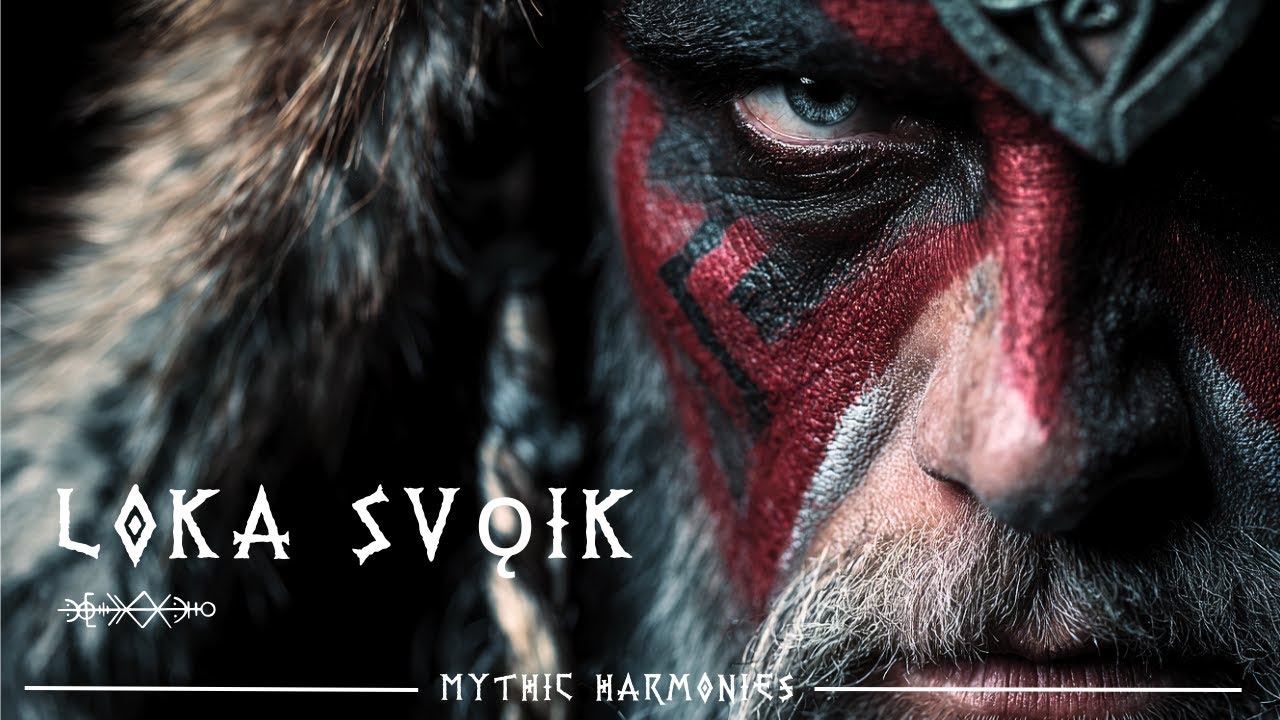
Loka Svǫik (“Loki’s Deceit”) is a 3:38 Mythic Harmonies song about broken trust, Loki’s shifting place among the gods and the movement from accusation to punishment and Ragnarök. Its fire, hidden ropes and shadow-filled refrain create a modern dramatic portrait; they are not a recovered Viking Age hymn.
This page preserves the complete Loka Svǫik lyrics and released English rendering. It also separates what the medieval poems say from Snorri Sturluson’s later prose synthesis and from the song’s own inventions. For the wider source map, read the evidence-led guide to Loki in Norse mythology.
Loka Svǫik at a Glance
- Artist: Mythic Harmonies
- Released title: Loka Svǫik (“Loki’s Deceit”)
- Duration: 3:38
- Language: stylized Old Norse with an English artistic rendering
- Core imagery: deceit, oaths, fire, binding, shadows and the approach of Ragnarök
- Historical status: modern composition informed by medieval Norse literature
What Does Loka Svǫik Mean?
Loka is the genitive form of Loki’s name: “of Loki.” The intended sense of the second element is deceit, treachery or betrayal. The transparent English title is therefore Loki’s Deceit, which is also the title used for the same master on Spotify and Apple Music.
There is an important spelling limit. Standard dictionary headwords use svik, not the ornate title form Svǫik. The released spelling remains part of the artwork and catalog identity, but it should not be presented as the only normalized medieval form. The University of Copenhagen’s Dictionary of Old Norse Prose is the appropriate place to test headwords and attested forms rather than reverse-engineering grammar from modern fantasy spelling.
The Song and the Surviving Sources
The surviving record does not offer one continuous biography written in the Viking Age. Loki appears across eddic poems, early skaldic poetry and Snorri’s thirteenth-century Edda. These witnesses overlap, but they do not always tell the same story or give Loki one stable moral function.
Loka Svǫik compresses that difficult archive into a clear dramatic arc: a figure born in lies, an oath-breaker, a betrayer, a prisoner and finally a force in the world’s ending. That arc works as songwriting. It must not be mistaken for a verbatim medieval account.
Who Is Loki in Norse Mythology?
Snorri names Fárbauti as Loki’s father and Laufey or Nál as his mother. He places Loki among the Æsir while describing him as cunning and destructive. Elsewhere, Loki travels with the gods, creates crises, solves some of them and enables the acquisition of treasures that include Mjölnir. Calling him simply “the god of chaos” or “the god of mischief” hides this instability behind a modern job title.
His kinship also resists a clean gods-versus-giants chart. A jötunn is not automatically an elemental monster or a member of a separate biological species. Loki’s parents and children connect several groups, while the narratives repeatedly place him inside divine company before his final break with it.
Is Loki Odin’s Blood-Brother?
In Lokasenna, Loki reminds Odin that the two mixed blood in former days and says Odin once refused drink unless it was brought to both of them. “Blood-brother” is a useful modern shorthand for that claim, but the poem does not preserve a full initiation rite, a date or a prose contract. Loki is certainly not Thor’s biological brother in the medieval sources.
The allusion gives the song’s betrayal theme real literary depth: Loki speaks from within a relationship, not merely as a stranger attacking Asgard. Yet the lyrics’ “he betrays his brother, his father ends” cannot be assigned literally to one secure family event. It is poetic compression, not a genealogical statement.
Loki, Baldr and the Limits of a Single Version
Snorri’s Gylfaginning gives the familiar sequence: Loki learns that mistletoe has not sworn to spare Baldr, fashions a missile, places it in the blind Höðr’s hand and guides the shot. He later prevents Baldr’s release by refusing to weep in the form of the giantess Þökk. This is strong evidence for Snorri’s narrative, not permission to flatten every surviving tradition into it.
The song turns Baldr’s death into the first domino of Ragnarök. The sources place the death before the final catastrophe, but they do not state a simple mechanism in which killing the “god of light” automatically starts Fimbulvetr. The causal language belongs to the composition.
The Binding, Sigyn and the Venom
After Loki’s capture, Snorri describes a severe punishment: Váli is changed into a wolf, Narfi is killed, Loki is bound with his son’s entrails, and Skaði fixes a venomous snake above him. Sigyn holds a bowl under the drops. When she empties it, venom reaches Loki and his convulsions are said to cause earthquakes.
The lyric reverses this pressure with “No chain can bind his cunning hand.” That line anticipates release rather than denying the binding episode: at Ragnarök the bonds break. The hidden ropes and blood-on-stone images are the song’s own dark connective tissue, not descriptions of a recovered ritual.
Loki at Ragnarök
In Snorri’s final battle, Loki comes free and joins the forces moving against the gods. He and Heimdall fight and kill one another. This makes Loki a participant in Ragnarök, but “architect of the apocalypse” is too tidy: Fenrir, Jörmungandr, Surtr, human conflict, cosmic collapse and many other actors have their own roles.
The complete sequence belongs to the source-based Ragnarök guide. The song Ragnarǫk Rís owns the full world-ending ensemble; this fiche stays with Loki’s deceit, binding and final return.
Loki’s Children Are Not Extensions of One Villain
Fenrir, Jörmungandr and Hel are often grouped as engines of Ragnarök, while Sleipnir comes from a very different story. Treating all of them as Loki’s deliberate master plan imports a modern supervillain structure. The medieval narratives give each figure a separate trajectory and give the gods’ own fear and choices causal weight.
For that reason, Fenrir Rís owns the wolf’s release and Jǫrmungandr Rís owns the World Serpent’s emergence. Loka Svǫik does not need to absorb their search intent to explain Loki well.
Was Loki Born of Fire, Lies or Chaos?
No surviving source says Loki was literally born from fire or lies. Attempts to make him a fire god often build speculative chains from names and later comparison. The opening “Born of fire, born of lies” is therefore an immediate artistic declaration, not an etymological fact.
“Chaos” is equally modern as a fixed divine office. The sources show clever speech, shape-changing, assistance, humiliation, hostility and catastrophic betrayal. The song selects the last side of that range and amplifies it; the broader Loki article retains the contradictions.
What the Song’s Story Actually Dramatizes
The first verse establishes a figure who cannot be stabilized: fire, lies, a serpent tongue and shifting eyes. The refrain names him “master of deceit” and projects private treachery onto a falling world. The middle verse moves through hearts and oaths toward an ambiguous broken family. The final verse turns consequence into landscape: blood on stone, blackening heaven and no path back.
This is narrative compression rather than a catalogue of myths. Its strongest hook is the movement from intimate betrayal to cosmic scale. No claim is made here about uncredited scales, drums or vocal techniques that cannot be verified from the released recording and credits.
Linguistic Transparency
The text is stylized rather than a uniformly normalized medieval composition. The title’s Svǫik sits beside the dictionary form svik. Forms and constructions including fǫddr ór lýgi, flöktit augu, Kafli dreifr, lævísi hǫnd, Lævíss kvæðit, verǫld fellr, eiða hann beygir, forlǫg spunnin á dulin strengr, engi veg til baka, goðin svikinn and með Loka hǫnd should not be cited as secure prose models without philological review.
The English block is the released artistic rendering, not a word-for-word grammatical gloss. Both versions remain unchanged below so listeners can compare the published texts without silent correction.
How Loka Svǫik Differs from the Other Ragnarök Songs
Loka Svǫik owns the Loki-deceit title, broken oaths, hidden ropes, binding and the “shadows rise at Loki’s call” refrain. Ragnarǫk Rís owns the panoramic rise of Ragnarök. The Howl of Fenrir owns Fenrir’s English unbinding narrative, while Surtr’s Flame owns the fire-bearer.
The encyclopedic Loki guide owns identity, family, shape-changing and the full source map. This music fiche answers the track-specific intent: meaning, story, language limits, complete text and verified listening links.
Is Loka Svǫik an Authentic Viking Song?
No. It is a modern Mythic Harmonies composition. Loki’s parentage, his place among the gods, the blood-mixing claim in Lokasenna, Snorri’s Baldr narrative, the binding with Sigyn and the final clash with Heimdall are source-based. The exact lyric, melody, fire-birth, hidden ropes and call that raises shadows are modern creative choices.
That distinction does not weaken the song. It tells listeners what kind of object they are hearing: contemporary music in conversation with medieval evidence, not an archaeological reconstruction or an anonymous chant transmitted from the Viking Age.
Sources and Evidence
The principal prose witness used here is Anthony Faulkes’s Viking Society edition of Edda: Prologue and Gylfaginning, especially the chapters on Loki, Baldr, the binding and Ragnarök. The Viking Society edition of Skáldskaparmál supplies the wider context in which Loki’s schemes also secure important divine treasures. Lokasenna supplies the blood-mixing allusion and the poem’s conflict at Ægir’s feast.
These are medieval literary witnesses copied and edited in later contexts, not recordings of a uniform pre-Christian creed. Where they disagree or leave gaps, this page names the uncertainty instead of filling it with a modern system.
Where to Listen to Loka Svǫik
Watch the official 3:38 Loka Svǫik video on YouTube. The same Mythic Harmonies master is distributed under the translated title Loki’s Deception, also 3:38, on Spotify and Apple Music. Artist, album identity and duration confirm the match.
Loka Svǫik Lyrics & Translation
The complete released text follows. The historical notes above explain where it uses medieval material and where it moves into modern poetic invention.
Original Lyrics (Old Norse Style)
Fǫddr ór eldi, fǫddr ór lýgi, Orms tunga, ok flöktit augu. Fjǫturr heldr eigi lævísi hǫnd, Kafli dreifr yfir land.
Loki, meistari blekkingar, Eldr brennr í augum hans. Lævíss kvæðit, verǫld fellr, Skuggar rísa við Loka kall.
Hjǫrtu brýtr, eiða hann beygir, Bróðr hann svíkr, ok faðir fellr. Í reyknum hljóma hans hláttr, Forlǫg spunnin á dulin strengr.
Loki, meistari blekkingar, Eldr brennr í augum hans. Lævíss kvæðit, verǫld fellr, Skuggar rísa við Loka kall.
Blóð á stein, himinn sortnar, Engi friðr, engi veg til baka. Hvíslit lýgi, goðin svikinn, Með Loka hǫnd, endirinn smíðaðr.
Loki, meistari blekkingar, Eldr brennr í augum hans. Lævíss kvæðit, verǫld fellr, Skuggar rísa við Loka kall.
Loki… svikari… Kafli… ævinliga.
English Translation
Born of fire, born of lies, The serpent’s tongue, the shifting eyes. No chain can bind his cunning hand, Dark chapters spread across the land.
Loki, master of deceit, Fire burns within his eyes. A treacherous song, the world shall fall, Shadows rise at Loki’s call.
Hearts are broken, oaths he bends, He betrays his brother, his father ends. His laughter echoes through the smoke, Fates are spun on hidden ropes.
Loki, master of deceit, Fire burns within his eyes. A treacherous song, the world shall fall, Shadows rise at Loki’s call.
Blood on stone, the heavens blacken, No peace remains, no path back then. Whispers of lies, the gods betrayed, With Loki’s hand, the end is made.
Loki, master of deceit, Fire burns within his eyes. A treacherous song, the world shall fall, Shadows rise at Loki’s call.
Loki… betrayer… The chapter… eternal.
What does Loka Svǫik mean?
The intended meaning is ‘Loki’s Deceit’: Loka means ‘of Loki,’ while the normalized dictionary form for deceit or treachery is svik. Svǫik is retained as the released artistic spelling.
Is Loki Odin’s blood-brother in Norse mythology?
Lokasenna says Loki and Odin mixed blood in former days. ‘Blood-brother’ is a useful shorthand, but the poem does not preserve a full ritual contract, and Loki is not Thor’s biological brother.
Did Loki kill Baldr?
In Snorri’s Gylfaginning, Loki learns of the mistletoe exception, fashions the missile and guides blind Höðr’s shot. Other evidence is less uniform, so the statement should be attributed to Snorri’s narrative rather than treated as every source’s identical version.
Was Loki a fire god or the god of chaos?
The surviving sources do not assign Loki a secure formal office as fire god or god of chaos. Those labels simplify a figure who helps, harms, changes shape, speaks cunningly and finally turns against the gods.
Is Loka Svǫik an authentic Viking Age song?
No. It is a modern Mythic Harmonies composition. Several characters and episodes come from medieval Norse literature, but the exact lyric, melody, fire-birth, hidden ropes and shadow-raising call are modern.
More from Mythology & Gods
March with the War-Band
New Old Norse chants every month. Join the listeners who never miss a release.