
Viking Rune Tattoos: What Each Symbol Really Means (Before You Ink It Forever)
On this page 9 sections
- Did Vikings Actually Tattoo Runes on Their Bodies?
- The Myth-Buster: One Rune Does Not Mean One Word
- The Runes: Historical Meanings vs. Modern Interpretations
- The Symbols You Need to Research Before Tattooing
- Bindrunes: Historical Forms, Modern Tattoo Designs
- Elder Futhark or Younger Futhark?
- Before You Book the Appointment
- Carve It in Sound First
- Frequently Asked Questions
You have made the decision. A rune tattoo. Something ancient, something meaningful, something that connects you to a tradition stretching back over a thousand years.
Before you sit in that chair, there are three things worth knowing. First, most online “rune meanings” mix medieval material with modern occult and tattoo traditions. Second, one account describes body markings among the tenth-century Rus, but no surviving evidence proves a standard Viking practice of tattooing runes. Third, several runic forms have been appropriated by hate groups, so context and design details matter.
This guide separates sound value, reconstructed rune name, historical evidence, and modern tattoo meaning. Before choosing a design, use the broader evidence index of real, later, and modern Viking symbols to verify its date and status. The aim here is an informed tattoo, not a false claim of archaeological certainty.
Listen to Mythic Harmonies on Youtube and Spotify.
Did Vikings Actually Tattoo Runes on Their Bodies?
This question deserves an honest answer before anything else, because the entire premise of “Viking rune tattoos” rests on it.
The short answer is: we do not know for certain, and the evidence we have does not specifically involve runes.
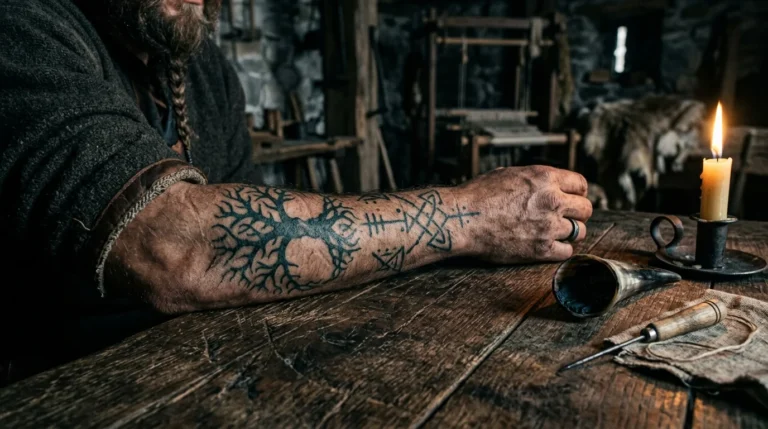
The primary historical source is Ahmad ibn Fadlan, a 10th-century Arab diplomat from the Abbasid Caliphate who traveled to the Volga River region in 921 to 922 CE. He encountered a group of traders he called the Rus, generally understood by modern historians to include men of Scandinavian origin. His account, preserved in a medieval manuscript, describes them as covered from their fingernails to their necks with dark green markings of trees and other figures.
This is compelling evidence that at least some Norse-connected people in the Viking Age had body markings. But there are important qualifications. Ibn Fadlan’s Rus were a specific group operating in eastern trade networks, not a representative sample of all Scandinavian peoples. His account survives only through later manuscript copies and therefore cannot be verified as a word-for-word transcript. And most significantly, he describes trees and abstract figures, not runes. The popular image of a Viking with runic inscriptions on his arms is a modern construction with no direct historical support.

The archaeological record offers no confirmation. Human skin does not survive for a thousand years in the soil conditions of Scandinavia, so the absence of physical evidence proves nothing either way. Small pointed iron and bone tools found at Viking Age sites have been suggested as possible tattooing instruments, but without clear contextual evidence no tool has been universally accepted as such by the archaeological community.
The honest position: Vikings may have tattooed. Some probably did. Runic tattoos as a distinct Viking practice? Not attested in any source we possess.
This does not make a rune tattoo illegitimate or inauthentic. It simply means the practice is a modern one drawing on ancient symbolism, not an ancient practice being continued. That is a fine thing to do with clear eyes.
The Myth-Buster: One Rune Does Not Mean One Word
Before the rune-by-rune guide, the single most important thing to understand about the rune meanings you will find everywhere online.
The popular format is: rune name, rune shape, one-word keyword. Fehu: wealth. Uruz: strength. Algiz: protection. Clean, simple, tattoo-ready.
The problem is that this format is historically misleading. Each rune in the Elder Futhark had a range of associated concepts, not a single fixed meaning. Our knowledge of these meanings comes primarily from three medieval rune poems, none of which gives a single-word keyword for anything. They give images, comparisons, and paradoxes. Fehu is described as a comfort to all men but also as a cause of strife between kin when it circulates. Uruz is described as the proud fierce animal that is now gone. These are not simple positive keywords.
Many of the meanings assigned to runes in modern tattoo culture trace back not to medieval sources but to 19th and 20th-century occultist traditions, particularly the work of Guido von List, an Austrian mystic who in the early 1900s developed his own runic system called the Armanen runes that were not historically attested at all. These invented meanings entered popular consciousness and are still circulated today as if they were ancient.
This does not mean you cannot get a rune tattoo with personal meaning. It means knowing the difference between what the original sources actually say and what has been added since.
The Runes: Historical Meanings vs. Modern Interpretations
What follows uses the medieval rune poems as primary sources and notes clearly where modern interpretive traditions have added meanings beyond the historical record. For the full scholarly breakdown of all 24 runes, see the complete Elder Futhark guide.

ᚠ Fehu
Historical meaning: Cattle, movable wealth. The Old English Rune Poem describes it as a comfort to all men but stresses that it must circulate freely or it causes conflict. The rune carried an implicit warning: hoarded wealth corrupts.
Common modern tattoo meaning: Prosperity, abundance, new beginnings.
What changed: The modern positive framing strips the original complexity. Fehu was not simply “good fortune.” It was wealth with an obligation attached.
ᚢ Uruz
Historical meaning: The aurochs, the wild extinct ancestor of cattle. An animal of enormous dangerous power that could not be tamed. The Old Norse Rune Poem describes it as iron, cold, hardness.
Common modern tattoo meaning: Strength, physical power, vitality.
What changed: The modern reading is reasonably close to the historical one. The key nuance lost is that Uruz was specifically the power of the wild and untamed, not merely “strength” in a general sense.
ᚦ Thurisaz
Historical meaning: Giant (þurs), specifically the dangerous chaotic class of giant in Norse mythology, and thorn. The Old English Rune Poem calls it sharply painful to anyone who seizes it. The Old Norse poem describes it as the torment of women. This is one of the most complex and ambivalent runes in the alphabet.
Common modern tattoo meaning: Protection, defensive force, Thor’s power.
What changed: The association with Thor is a modern interpretation not clearly supported in the medieval poems. The thorn and giant associations are older and point to a force that can protect but causes harm when mishandled.
ᚨ Ansuz
Historical meaning: God, specifically one of the Aesir, and the breath of Odin. The rune is connected to inspired speech, poetry, and divine communication. The Old Icelandic poem directly identifies Ansuz with Odin himself.
Common modern tattoo meaning: Communication, wisdom, inspiration.
What changed: The modern reading is reasonably faithful to the historical one.
ᚱ Raidho
Historical meaning: Riding, a journey on horseback, movement with purpose and rhythm. Not just travel but the right path taken at the right time.
Common modern tattoo meaning: Journey, travel, change.
What changed: The modern reading preserves the core meaning fairly well, though it loses the sense of orderly movement with correct timing that the medieval sources emphasize.
ᚲ Kenaz
Historical meaning: Torch, controlled fire. The light of the craftsman’s workshop and the illumination that comes from directed effort. The Old English poem describes it as a fire that glows in the dark hall.
Common modern tattoo meaning: Knowledge, creativity, fire energy.
What changed: The modern reading is broadly consistent with the historical one.
ᚷ Gebo
Historical meaning: Gift, but gift in the full Norse sense of a transaction that creates obligation and bond. Gift exchange in Norse culture was a fundamental act of relationship building, not simple generosity.
Common modern tattoo meaning: Generosity, love, partnership.
What changed: The modern reading loses the reciprocity element that was central to the Norse concept. Gebo was not simply “love.” It was the bond created by exchange, with implied responsibility on both sides.
ᚹ Wunjo
Historical meaning: Joy, the happiness of belonging to kin and community, the state of having enough and being at peace with one’s people.
Common modern tattoo meaning: Happiness, joy, harmony.
What changed: The modern reading is fairly consistent, though it tends to individualize a rune that was originally about communal belonging.
ᚺ Hagalaz
Historical meaning: Hail, the sudden catastrophic weather event that destroys crops without warning. Pure external disruption over which no one has control. The Old Norse poem calls it cold grain and the sickness of serpents.
Common modern tattoo meaning: Transformation through challenge, destructive but clearing force.
What changed: The modern meaning adds a redemptive arc. The original sources do not. Hagalaz was simply violent external force. The idea that destruction leads to transformation is a modern spiritual layering.
ᚾ Nauthiz
Historical meaning: Need, necessity, constraint. The grinding pressure of genuine lack. Associated in the poems with the fire drill, two pieces of wood producing warmth through friction and need.
Common modern tattoo meaning: Endurance, necessity as a teacher, constraint as a catalyst.
What changed: The modern reading captures something real about the original but tends to romanticize what the poems describe with considerably more discomfort.
ᛁ Isa
Historical meaning: Ice, stillness, suspension of all movement. The broad bridge that may or may not hold. A state in which nothing grows and nothing changes.
Common modern tattoo meaning: Introspection, clarity, stillness.
What changed: The modern reading gives Isa a positive meditative quality. The original sources are neutral at best and cautionary at worst.
ᛃ Jera
Historical meaning: The year, the harvest, the cycle that returns if you have done the work of the season. The reward of patience and right action through proper time.
Common modern tattoo meaning: Harvest, cycles, patience rewarded.
What changed: The modern reading is close to historical. One note: Jera was specifically the agricultural year and its completion, not cycles in a general cosmic sense.
ᛇ Eihwaz
Historical meaning: The yew tree, the tree that lives for thousands of years and is both poisonous and sacred. Associated with the boundary between life and death, and with Yggdrasil itself. Eihwaz sits at the center of the 24-rune sequence.
Common modern tattoo meaning: Endurance, connection to the world tree, death and renewal.
What changed: The modern reading is reasonably consistent with the historical depth of this rune.
ᛈ Perthro
Historical meaning: Uncertain. Most likely a lot-casting cup or gaming piece. Associated with fate, chance, and the Norse understanding that destiny is visible and can be consulted through proper ritual.
Common modern tattoo meaning: Mystery, fate, hidden knowledge.
What changed: The mystery framing is modern. The historical connection to lot-casting and fate is genuine but more concrete than the modern reading implies.
ᛉ Algiz
Historical evidence: the reconstructed name and interpretation are disputed. Elk and elk-sedge are among the proposals, while the relevant Old English poem belongs to the later Anglo-Saxon Futhorc tradition.
Common modern tattoo meaning: protection, spiritual defense, or connection to the divine.
What changed: “Protection rune” is a popular modern reading, not one universal Viking definition proved by Elder Futhark inscriptions. Algiz also requires the modern-context caution discussed below.
ᛊ Sowilo
Historical meaning: The sun, specifically the Norse sun goddess Sól who drives the sun chariot across the sky each day until Ragnarök. All three rune poems describe the sun in terms of its effects on human life: the joy of the sailor finding harbor, the brightness that guides the journey.
Common modern tattoo meaning: Victory, success, positive energy, solar power.
What changed: The modern meaning has drifted from the specific Norse solar mythology. More importantly, Sowilo requires critical caution for tattoos, also addressed below.
ᛏ Tiwaz
Historical meaning: The god Týr, who sacrificed his right hand to keep his oath when Fenrir was bound. The rune represents self-sacrifice for the community, justice upheld at personal cost, and courage in service of what is right. A guiding star that does not fail.
Common modern tattoo meaning: Justice, courage, warrior spirit.
What changed: The modern reading captures the core meaning. However, Tiwaz also requires specific caution for tattoo purposes.
ᛒ Berkano
Historical meaning: The birch tree, the first tree to push through frozen ground in spring. Associated with new beginnings, regeneration, and the feminine principle in Norse tradition.
Common modern tattoo meaning: Growth, femininity, new beginnings, birth.
What changed: The modern reading is consistent with the historical one.
ᛖ Ehwaz
Historical meaning: The horse, specifically the relationship between horse and rider as a partnership of trust and cooperative movement. Not the horse alone but the bond between two beings working together.
Common modern tattoo meaning: Movement, travel, partnership.
What changed: The partnership element is often lost in modern readings, which tend to treat Ehwaz as simply a travel or movement rune.
ᛗ Mannaz
Historical meaning: Human being, mankind. The rune carries both the dignity and the transience of human life. The Old Norse poem describes man as the increase of the dust.
Common modern tattoo meaning: Humanity, the self, intelligence.
What changed: The modern reading tends to center on individual identity. The historical meaning was more collective and more explicitly connected to mortality.
ᛚ Laguz
Historical meaning: Water, lake, the fluid and uncontrollable forces that must be navigated rather than conquered. The Old Norse poem describes it as a waterfall running from a mountain, beautiful but fatal if you fall in.
Common modern tattoo meaning: Flow, intuition, the unconscious, psychic ability.
What changed: The psychic ability association is a modern occultist addition not present in the medieval sources. The flow and navigation meanings are historically consistent.
ᛜ Ingwaz
Historical meaning: The god Ing, an older name for Freyr, the Vanir deity of fertility and the harvest. The rune carries the sense of internal gestation, potential building before it is expressed.
Common modern tattoo meaning: Fertility, internal growth, the hearth and home.
What changed: The modern reading is broadly consistent, though it often loses the specific Freyr connection.
ᛞ Dagaz
Historical meaning: Day, specifically the liminal moment of dawn when night ends and day begins. The threshold between two states, belonging entirely to neither.
Common modern tattoo meaning: New beginnings, breakthrough, balance of opposites.
What changed: The modern reading is reasonably consistent with the historical one.
ᛟ Othala
Historical meaning: Ancestral property, inherited land, the estate passed through a family across generations. The accumulated heritage of those who came before.
Common modern tattoo meaning: Ancestry, heritage, homeland.
What changed: See the appropriated symbols section below. This rune requires careful consideration before tattooing.
The Symbols You Need to Research Before Tattooing
This section is not political commentary. It is practical information. Getting a tattoo without knowing the full context of the symbol is simply poor preparation, and several runes carry associations that have nothing to do with Norse history and everything to do with 20th-century hate movements.

The problem originated with Guido von List, an Austrian nationalist mystic who in the early 1900s invented a pseudo-runic system called the Armanen runes, claiming they were the original source of all runic alphabets. This was historically false, but his work became extremely influential in nationalist German circles in the 1920s and 1930s. The Nazi party and the SS subsequently adopted several runic symbols, partly from List’s invented system and partly from the genuine historical Elder Futhark and Younger Futhark, reinterpreting them to serve their ideology.
As a direct result, several runes today carry a double context that anyone considering a tattoo should understand clearly.
Sowilo (ᛊ): In its historical form, a sun rune. In its doubled form as the SS insignia, one of the most widely recognized symbols of the Nazi paramilitary organization. The doubled Sowilo, known as the SS rune, appears frequently in neo-Nazi contexts today. A single Sowilo is less charged but still worth placing in clear historical and personal context.
Tiwaz (ᛏ): The rune of the just god Týr. Also used by Nazi Germany for the leadership schools of the Sturmabteilung. According to the Anti-Defamation League, Tiwaz remains one of the most commonly appropriated runic symbols by white supremacist groups today, partly because it is described by some as the “warrior rune.”
Othala (ᛟ): The ancestral land rune. Used as a divisional insignia by two Waffen SS divisions during World War II. According to the ADL, it is “commonly seen in tattoo form” among neo-Nazi groups today. A winged or seriffed form of Othala is especially associated with these groups.
Algiz (ᛉ): Often marketed today as a protection rune. Its inverted form was used by the Nazis to mark SS graves, and both orientations can appear in present-day extremist contexts. Context, styling, and combination determine how it may be read.
None of this means these runes are permanently compromised or that using them makes someone a hate group sympathizer. The ADL explicitly states that these symbols must always be evaluated in context, and that they are also used by non-racist pagans and scholars of Norse history. The point is simple: if you tattoo one of these symbols, some people will see it through the lens of its 20th-century appropriation rather than its Norse historical meaning. Knowing this before you tattoo is better than discovering it afterward.
The safest approach if you want to use one of these runes is to combine it with clearly historical Norse context and be prepared to explain the symbol’s actual origins when asked.
Bindrunes: Historical Forms, Modern Tattoo Designs
Combined runic forms are historical. A modern tattoo that combines keyword meanings into a personal sigil is modern. Keeping those two facts together is the honest starting point for a bindrune tattoo.

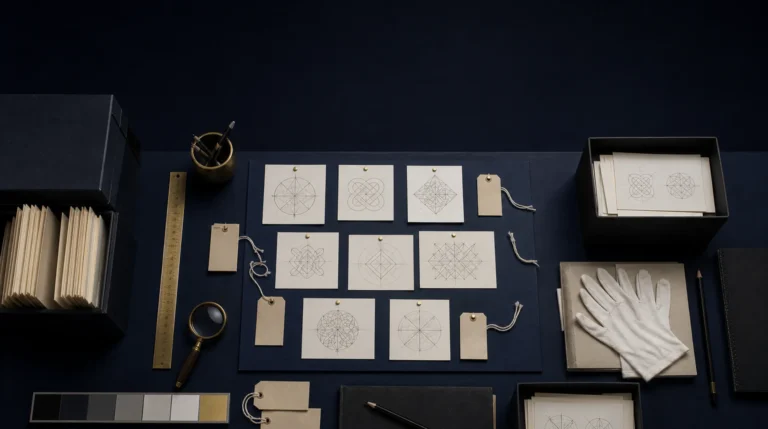
Editorial illustration of a modern bindrune concept—not an archaeological object.
A bindrune combines two or more runic characters in one written form. Historical examples occur in inscriptions and on objects, but their purposes vary: some are orthographic, space-saving, decorative, inscription-specific, or—where the wider context supports it—possibly magical. Their existence does not prove that Viking Age people built personal sigils by combining fixed one-word powers.
For a tattoo, a newly composed bindrune can encode a personal statement as contemporary art using historical letterforms. It should not be described as a recovered Viking formula unless it reproduces a documented inscription with an established reading.
Start with the intended word or phrase, choose the historically appropriate rune row, and have the transliteration checked before merging any strokes. That produces a more defensible design than selecting modern keywords and working backward.
Elder Futhark or Younger Futhark?
A practical question that many tattoo guides gloss over.
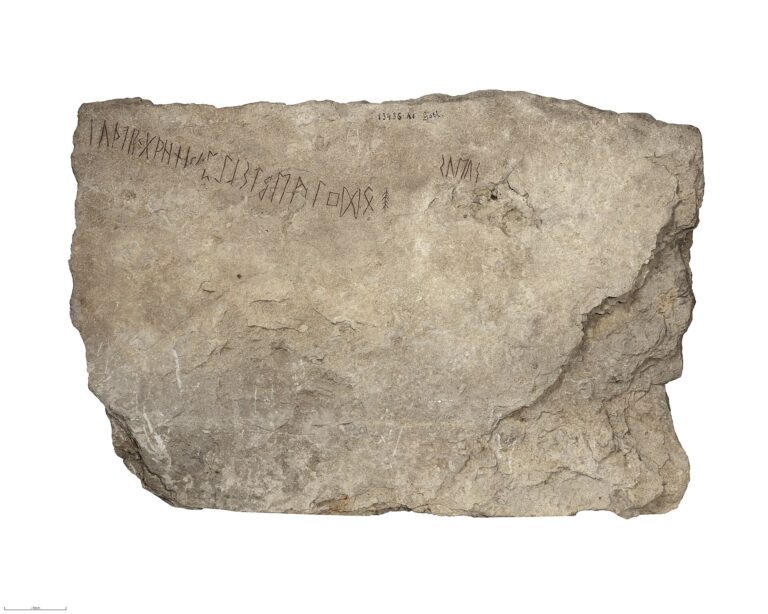
The Elder Futhark has 24 characters and is conventionally dated to about 150–650 CE. It is an earlier Germanic runic row, not the alphabet that defines most of the Viking Age. Its modern popularity in tattoos does not make its one-word symbolic meanings securely ancient.
The University of Copenhagen dates the 16-character Younger Futhark to about 725–1075. If a tattoo is meant to reproduce Viking Age Scandinavian language, Younger Futhark is normally the period-appropriate starting point; the translation and spelling still need to be checked.
Mixing rune rows without a documented historical reason creates a modern eclectic design. That is not inherently wrong, but it should be labelled modern rather than presented as a standard Viking Age inscription.
Before You Book the Appointment
Four practical points that apply regardless of which rune you choose.

Research the symbol independently before relying on any single source. The quality of online rune information varies enormously. Sites that give you a clean keyword with no sources should be treated with skepticism. Compare against the actual rune poems, which are available in academic translations.
Find a tattoo artist who knows the symbols. A rune drawn incorrectly will be noticed immediately by anyone in Norse history or pagan communities. Small angular symbols leave very little margin for artistic variation before they become unrecognizable or read as a different rune entirely.
Know what you are putting on your body permanently. The Norse themselves understood the weight of runic inscription. The Hávamál warns against carving runes carelessly or without deep knowledge of what they carry. A permanent tattoo is exactly the kind of commitment they had in mind.
Consider the historical context, not just the modern keyword. Fehu is not simply “abundance.” Thurisaz is not simply “protection.” Hagalaz is not simply “transformation.” The runes were understood as real forces with real complexity, and the best rune tattoos are the ones chosen by people who understand that complexity.
Carve It in Sound First
The Norse said runes were meant to be sung as much as carved: the Hávamál describes Odin “singing” them. A rune you are about to wear for life deserves to be met in every form it took, sound included. Before you make one permanent in skin, hear what they sound like in Old Norse: our track Syng Rúnar (Sing the Runes) does exactly what its name commands.
Frequently Asked Questions
What rune means strength?
No single Elder Futhark rune directly maps to “strength” as a keyword. Uruz, representing the aurochs, comes closest, being associated with raw physical power and untamed vitality. Tiwaz, representing the god Týr and his sacrifice for justice, is associated with a different kind of strength, the courage to bear cost for what is right.
What is the most popular rune for tattoos?
Algiz (protection), Tiwaz (courage/warrior), Uruz (strength), and Sowilo (success) are among the most frequently chosen. However, popularity in tattoo culture does not necessarily correlate with historical depth or personal relevance.
Did Vikings actually have runic tattoos?
There is no direct historical evidence of runic tattoos in the Viking Age. Ahmad ibn Fadlan’s 10th-century account describes Norse-connected people with dark body markings of trees and abstract figures, but not runes specifically. The concept of runic tattoos as a Viking practice is a modern construction.
What rune means protection?
No rune has one securely documented universal meaning equivalent to the English word “protection.” Algiz is a popular modern choice, but its historical name and interpretation are disputed. For a historically defensible design, begin with a correctly translated inscription and the appropriate rune row rather than a one-word symbol chart.
Are rune tattoos cultural appropriation?
The Elder Futhark is the writing system of ancient Germanic and Scandinavian peoples, not a living indigenous tradition with an active community making claims about its use. Most scholars and practitioners of Norse paganism welcome genuine engagement with the tradition. The more relevant concern is accuracy: using the symbols with understanding of what they actually mean and where they come from, rather than as generic “Viking aesthetic.”
Which runes should I avoid for a tattoo?
Not “avoid” exactly, but Sowilo, Tiwaz, Othala, and Algiz all have documented histories of appropriation by hate groups in the 20th century and continue to appear in neo-Nazi contexts. This does not make them off-limits, but it means going in with full information about how they may be read by others.
What is a bindrune tattoo?
Combined runic forms are historically attested, but a modern tattoo built by merging fixed keyword meanings into a personal sigil is a modern composition. A historically informed bindrune should begin with a checked word or inscription in the appropriate rune row and should not be presented as a recovered Viking formula.
Ahmad ibn Fadlan, Mission to the Volga, trans. James E. Montgomery (NYU Press, 2017); the three medieval rune poems (Old English, Old Norwegian, Old Icelandic); the Hávamál from the Poetic Edda, trans. Carolyne Larrington (Oxford University Press, 2014); Michael Barnes, Runes: A Handbook (2012); Anti-Defamation League, Hate Symbols Database (entries: Tyr rune, Othala rune, SS bolts); on Guido von List and the Armanen runes, standard histories of 20th-century runic occultism.



All five albums and every single: 86 songs in WAV and MP3, yours to keep.