
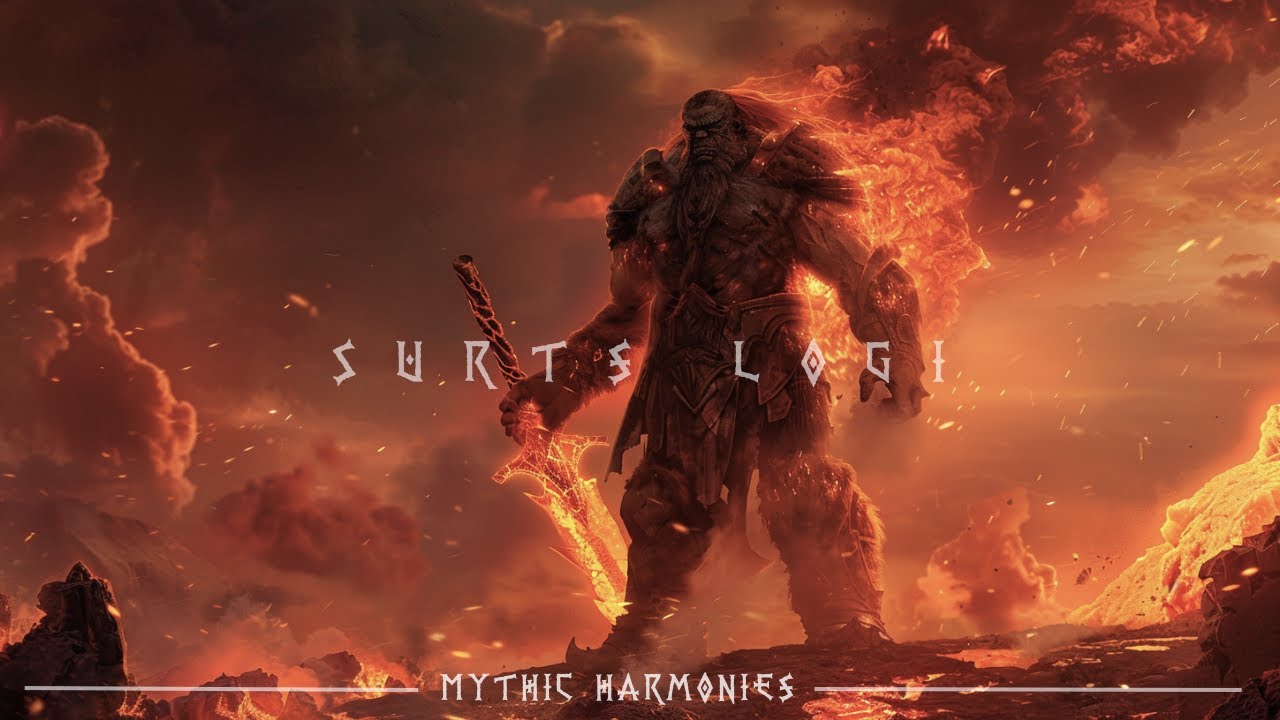
Surtr’s Flame is a 3:55 Mythic Harmonies fire song performed in stylized Old Norse with a released English adaptation. Its scene is deliberately narrow and musical: Surtr rises, the chorus shouts “Eldr! Eldr!”, the sky and ground convulse, and the final refrain leaves the listener inside Ragnarök’s blaze. Play the official master above, then read the complete published words below.
The track draws on Surtr’s southern approach, his bright weapon, his clash with Freyr and the world-fire. It also invents a reopened Ginnungagap, universal death and several dramatic actions that the medieval witnesses do not state. This fiche identifies that boundary without diluting the song into a general mythology article.
Surtr’s Flame at a Glance
| Artist | Mythic Harmonies |
|---|---|
| Type | Modern original Ragnarök fire song |
| Duration | 3:55 |
| Language | Stylized Old Norse with English adaptation |
| Central figure | Surtr |
| Defining hook | “Eldr! Eldr! Surtr kveðr!” |
| Official master | YouTube |
| Streaming status | No exact title-and-duration match verified on Spotify or Apple Music |
What Is the Surtr’s Flame Song About?
The first verse makes Surtr’s appearance immediate: sword, broken world, burning earth and an ignited sky arrive in four short lines. The chorus then reduces the catastrophe to a shouted name—fire—before the second verse brings down Ásgarðr and opens Ginnungagap. A final verse puts the sword in Surtr’s hand, fractures mountains and closes on his laughter.
That sequence belongs to this 3:55 recording. For the broader order of Fimbulwinter, the released monsters, the gods’ combats, survivors and renewal, use the source-led Ragnarök guide. Ragnarǫk Rís keeps its own multi-scene prophecy song; Jǫtnar rísa keeps the collective giants intent. They should not compete for this track’s title, chorus or exact words.
What Does “Surtr’s Flame” Mean?
The title is an English possessive phrase: the flame associated with Surtr. Old Norse Surtr is commonly glossed as “black” or “the black one.” Connecting that name specifically to a body charred by fire is an attractive modern explanation, not something the poems themselves narrate.
The title therefore promises a modern song about Surtr’s destructive fire; it is not presented as a recovered medieval song-name. The first line, Surtr rís, does clearly mean “Surtr rises,” which makes it the most secure compact statement in the text.
How the Song Builds the World-Fire
The arrangement’s main device is verbal repetition. “Eldr!” is struck twice at the start of each chorus, Surtr’s name follows, and the same eight-line refrain returns after each narrative block. The short phrases make the vocal delivery feel processional and give the listener fixed points inside an otherwise collapsing landscape.
The ending removes most of the syntax—“Eldar… brenna… / Surtr hlær…”—until only fire, burning and laughter remain. That is a compositional ending, not a claim about an ancient performance practice. No surviving source preserves this melody, tempo, instrumentation or chorus.
Surtr in the Medieval Sources
In Vǫluspá, Surtr comes from the south with destructive fire or the harm of branches, while light shines from his sword. Mountains collapse, beings fall and flame reaches heaven. Snorri’s Gylfaginning places Surtr at the frontier of the fiery region called Muspell, holding a burning sword; at the final conflict he advances, overcomes and burns the world.
Those texts support the song’s southern fire, weapon and world-burning. They do not give a biography in which Surtr is demonstrably “older than Odin,” a conventional king of every fire giant or an inevitable moral cleanser waiting for a signal through measured eons. “Ruler of Muspelheim” is a useful modern shorthand, but the witnesses are terser and less systematic.
The Flaming Weapon and Freyr’s Last Fight
Surtr’s bright or burning weapon is source-based, and Freyr does fall against him. Snorri explains the defeat through the excellent sword Freyr had given to Skírnir while arranging the courtship of Gerðr. This is the clearest documentary core behind the track’s sword-centered imagery.
A frequent retelling adds that Freyr fights Surtr with an antler. The prose does say Freyr killed the jötunn Beli with a hart’s antler after giving away the sword, but that is an earlier encounter. It does not explicitly equip Freyr with the antler for the final duel. Nor do the sources define him simply as a “god of peace” so that his death becomes a fixed allegory of peace losing to destruction.
Does Ginnungagap Reopen at Ragnarök?
The song says Ginnungagap opnast víð, rendered in the released English version as “Ginnungagap opens wide.” Ginnungagap belongs to cosmogonic accounts of the beginning, but neither Vǫluspá nor Gylfaginning says that Surtr literally reopens it at Ragnarök.
The line is a modern circular image: creation’s gap returns as the old order breaks. It works inside the track without being presented as a lost stanza. The sources instead describe an earth sinking into the sea, an immense fire and, afterward, a renewed earth rising green again.
Destruction, Survivors and Renewal
“Æsir deyja” and the English “the gods all perish” compress the disaster beyond the surviving accounts. Odin, Thor, Freyr, Týr, Heimdall and Loki die in the final cycle, but Víðarr and Váli survive; Snorri also names Móði and Magni, while Baldr and Hǫðr return. Líf and Lífþrasir preserve humankind.
Surtr’s own fate after the burning is not securely narrated. The line “Surtr laughs… eternal” is therefore atmosphere, not evidence that he survives forever. The renewed world matters because it distinguishes the source tradition from the song’s chosen ending: this master stops at the fire and withholds the green return.
Language Notes on the Published Text
The released text is stylized Old Norse, and the English block is an artistic adaptation rather than a philological line-by-line translation. Surtr rís, verǫld brennr and Surtr hlær communicate clearly. Other phrases sacrifice normalized grammar or literal meaning to rhythm.
- með loga sverð conveys a flame-sword image, but með normally governs the dative and the phrase is not normalized prose.
- jǫtnar þverr does not literally mean “the giants weep”; þverra concerns diminishing, and the published number agreement is unstable.
- Endir koma, örlǫg menn, Ginnungagap opnast víð and fjǫll brotnar use forms or agreements that would differ in normalized Old Norse.
- Ásgarðr fellr, engi stærr, heimr opnar, vér brennum bráð and final eilífa do not map literally onto the polished English lines.
The exact released words remain below so listeners can identify what is sung. The notes disclose the distance between performance text and normalization; they do not silently rewrite the song.
Is Surtr’s Flame an Authentic Viking Age Song?
No. It is a modern Mythic Harmonies composition inspired by medieval Norse poetry and Snorri’s prose. Surtr, the southern approach, the shining weapon, Freyr’s defeat and the world-fire are source-based. The melody, repeated “Eldr!” chorus, reopened Ginnungagap, laughter and exact wording are newly composed.
Surtr’s Flame Lyrics and English Translation
The two blocks below preserve the complete released text exactly. The English is the official adaptation, not a normalized literal edition.
Surtr rís, með loga sverð, Brýtr hann heim, brennr jǫrð. Eldar hvín, himinn glóð, Ragnarǫk, vér sjáum blóð.
Eldr! Eldr! Surtr kveðr! Logar heimr, ok jǫtnar þverr. Eldr! Eldr! verǫld brennr, Endir koma, örlǫg menn.
Himinr skelfr, foldin hrær, Ásgarðr fellr, engi stærr. Ginnungagap opnast víð, Æsir deyja, rǫk er tíð.
Eldr! Eldr! Surtr kveðr! Logar heimr, ok jǫtnar þverr. Eldr! Eldr! verǫld brennr, Endir koma, örlǫg menn.
Logar rjúfa, fjǫll brotnar, Sverð í hendi, heimr opnar. Surtr hlær, við blóð ok glóð, Ragnarǫk, vér brennum bráð.
Eldr! Eldr! Surtr kveðr! Logar heimr, ok jǫtnar þverr. Eldr! Eldr! verǫld brennr, Endir koma, örlǫg menn!
Eldar… brenna… Surtr hlær… eilífa.
English Translation
Surtr rises with a flaming sword, He breaks the world, the earth is scorched. Fires howl, the sky ignites, Ragnarök brings blood to sight.
Fire! Fire! Surtr speaks! The world ablaze, the giants weep. Fire! Fire! the earth shall burn, The fate of men shall soon return.
The heavens shake, the ground will roar, Asgard falls, it stands no more. Ginnungagap opens wide, The gods all perish, fate decides.
Fire! Fire! Surtr speaks! The world ablaze, the giants weep. Fire! Fire! the earth shall burn, The fate of men shall soon return.
Flames will sunder, mountains fall, Sword in hand, he burns it all. Surtr laughs through blood and flame, Ragnarök consumes the same.
Fire! Fire! Surtr speaks! The world ablaze, the giants weep. Fire! Fire! the earth shall burn, The fate of men shall soon return!
Fires… burning… Surtr laughs… eternal.
Sources Behind Surtr and the World-Fire
- Edward Pettit, trans., The Poetic Edda, especially Vǫluspá for Surtr’s approach, the sword-light, collapse, fire and renewed earth.
- Anthony Faulkes, ed., Snorri Sturluson, Edda: Prologue and Gylfaginning, for Muspell, Surtr’s weapon, Freyr’s missing sword, the burning and the survivors.
- Dictionary of Old Norse Prose, used with the edition evidence to check the name and published word forms.
Where to Listen to Surtr’s Flame
Watch the exact 3:55 Surtr’s Flame master on YouTube. Authenticated searches found no Mythic Harmonies track matching both this title and duration on Spotify or Apple Music. The fiche therefore keeps the official Spotify artist page and Apple Music artist page rather than attaching a different fire or Ragnarök song.
What is the song Surtr’s Flame about?
It is a 3:55 modern Mythic Harmonies song that follows Surtr’s rise, a repeated fire chorus, the collapse of the world and a final image of his laughter. It uses source-based Ragnarök figures but creates its own sequence and wording.
What language is Surtr’s Flame sung in?
It is performed in stylized Old Norse with a released English adaptation. Several phrases communicate clearly, while others use non-normalized grammar or freer meanings for meter and sound; both published blocks are preserved exactly on the fiche.
Does Surtr fight Freyr at Ragnarök?
Yes. The medieval sources place Freyr against Surtr, and Snorri links Freyr’s defeat to the excellent sword he gave to Skírnir. The often-repeated antler detail belongs explicitly to Freyr’s earlier fight with Beli, not securely to the final duel.
Does Ginnungagap reopen at Ragnarök?
Not in the surviving medieval accounts. The song’s reopened Ginnungagap is a modern circular image connecting cosmic beginning and ending; the sources instead describe world-fire, an earth sinking into the sea and a renewed earth afterward.
Where can I listen to Surtr’s Flame?
The exact 3:55 official master is embedded from the Mythic Harmonies YouTube channel. No matching Spotify or Apple Music track was verified, so the fiche links to the official artist profiles rather than a different recording.
More from Epic War Battle
March with the War-Band
New Old Norse chants every month. Join the listeners who never miss a release.