
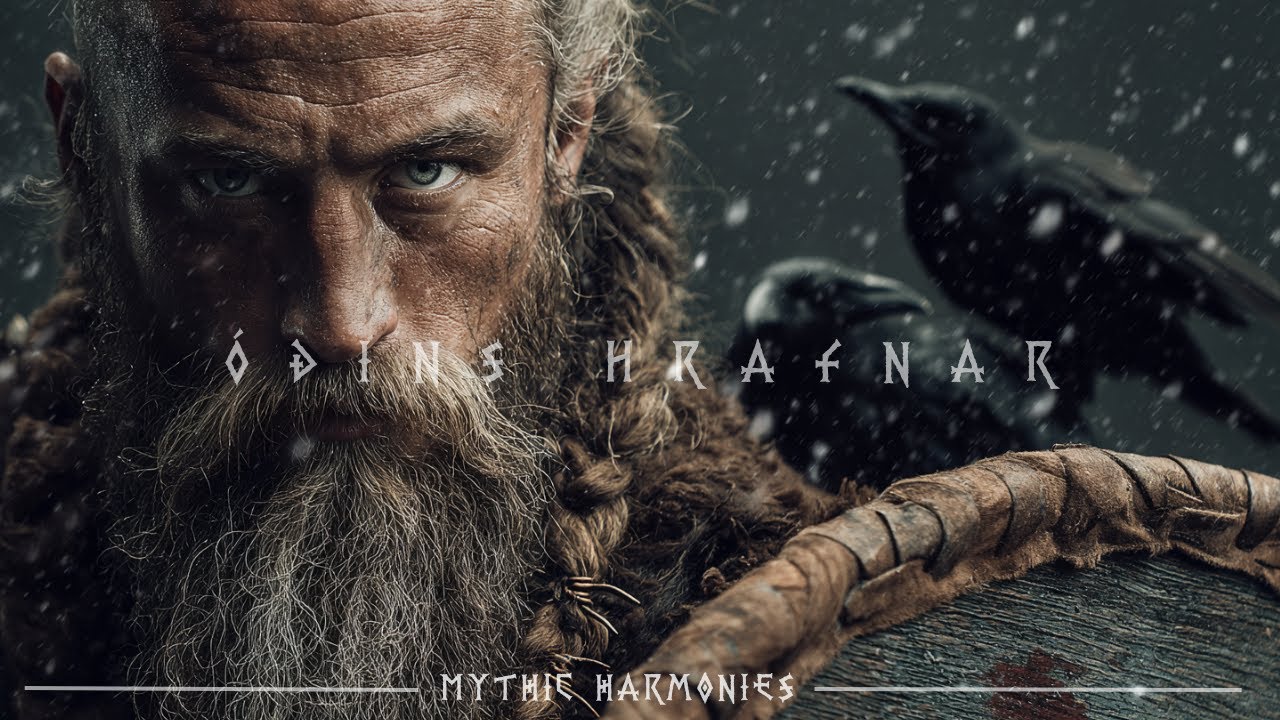
Óðins Hrafnar, “Odin’s Ravens,” is a 3:59 original Mythic Harmonies song released as HRAFNAR ÓÐINS on the 2026 album Gods of War. Sung in stylised Old Norse with an English translation, it follows Huginn and Muninn as they fly, observe and return to Odin. This is a modern artistic composition—not a surviving Viking Age chant or a reconstruction of lost Norse music.
The page title Óðins Hrafnar (“Odin’s Ravens”) and the official release title HRAFNAR ÓÐINS reverse the same two words. Below you can hear the official video, read the complete lyrics and released translation, and compare the song with the two central medieval accounts: Grímnismál stanza 20 and Snorri Sturluson’s Gylfaginning chapter 38.
Official release: listen to HRAFNAR ÓÐINS on Spotify · listen on Apple Music
What Does Óðins Hrafnar Mean?
Óðins is the genitive form of Óðinn, while hrafnar is the plural of hrafn, “raven.” The title therefore means “Odin’s ravens.” The streaming form HRAFNAR ÓÐINS places the noun first. Both point to Huginn and Muninn, the named birds associated with Odin in Eddic poetry and Snorri’s prose.
The title is modern. The medieval sources name the pair, describe their flight and connect them with Odin, but they do not preserve this song, its refrain or a historical ritual called Óðins Hrafnar. That distinction lets the music be evocative without turning it into evidence.
Huginn and Muninn in Grímnismál 20
The earliest central text is Grímnismál stanza 20. Odin says that Huginn and Muninn fly over the world every day. He fears that Huginn may not return, yet he is more anxious about Muninn. The stanza is short and deliberately enigmatic: it gives the daily flight, the names and Odin’s fear, but does not explain exactly why he fears for one more than the other.
Huginn is conventionally translated “Thought,” from the semantic field of Old Norse hugr; Muninn is commonly rendered “Memory” or “Mind.” These glosses are useful, but the poem does not present a philosophical diagram in which Odin literally sends detachable pieces of his soul outside his body. Reading the birds as mental faculties is a persuasive interpretation of their names, not a scene the stanza fully spells out.
The Old Norse can be checked in the Grímnismál text hosted by Heimskringla. Our longer guide compares translations and later interpretations of Huginn and Muninn, Odin’s ravens.
What Snorri Says the Ravens Do
In Gylfaginning chapter 38, Snorri says two ravens sit on Odin’s shoulders and tell him everything they see and hear. He sends them out at dawn to fly over the whole world, and they return at breakfast. Because of this connection, Odin is called a raven-god. The prose turns the poem’s mysterious daily flight into a clear information network.
That account supports the song’s returning messengers and its refrain “Speak of truth.” It does not make Odin omniscient: the very act of gathering reports implies that knowledge must be sought. Nor does the text say Huginn and Muninn control politics, start wars, avert Ragnarök or whisper from a “Blue Hall.” Those were unsupported additions in the previous page and have been removed.
Anthony Faulkes’s edition of the Prologue and Gylfaginning provides the Old Norse text and English editorial apparatus. Snorri wrote in thirteenth-century Christian Iceland, so his synthesis is invaluable but later than the Viking Age it describes.
Are Huginn and Muninn Fylgjur or Parts of Odin’s Soul?
The surviving passages do not call the ravens fylgjur. A fylgja is a distinct and complicated figure in Old Norse literature, sometimes appearing in animal or female form and connected with a person or family. Applying that label to Huginn and Muninn may be a modern comparative theory, but it should not be stated as settled historical fact.
The same caution applies to “shamanic projections” or astral travel. Some scholars and modern practitioners interpret the birds as extensions of Odin’s mind because of their names and journey. Grímnismál never says Odin’s consciousness leaves his body, and Gylfaginning describes external birds that return with reports. The evidence permits symbolic readings; it does not force one single metaphysical system. For the wider terminology problem, see our guide to Norse seiðr and the limits of “shamanism”.
Odin’s Ravens, Battle and the Valkyries
Ravens are carrion birds, so they became powerful signals of battle in Old Norse poetry. Poets could describe a warrior as feeding the raven or satisfying birds and wolves. Odin is also closely connected with war and the battle-slain. These traditions make raven imagery at a battlefield historically intelligible without requiring every literary raven to be Huginn or Muninn.
The sources do not securely say that Odin’s named ravens scout for the bravest warriors, help Valkyries choose the dead or evaluate a fighter who sees them. Gylfaginning assigns the choosing role to Valkyries sent by Odin; Grímnismál also says Freyja receives half of the slain. The lyric “Bringing Odin news of war” works as modern poetry because the birds are observers. It should not be expanded into a documented selection process.
How the Music Turns Flight into Refrain
- A repeated command: “Huginn! Muninn! Fly now” gives each chorus forward motion and makes the singer sound both authoritative and anxious.
- A daily cycle: storm, day, night, fire and frost create a journey that keeps returning to Odin, mirroring the rhythm described by Snorri.
- Observation before battle: the song is less a charge than a watch. Its central action is seeing, carrying and speaking.
- A dissolving ending: the final words reduce the narrative to ravens, flight and sight, leaving the cycle open rather than announcing a conclusion.
The result fits focused listening, writing, reading and strategy-game soundscapes. These are modern uses, not evidence for a Viking ritual practice. Continue through the Mythology & Gods collection or browse the complete Old Norse lyrics songbook.
Óðins Hrafnar Lyrics and English Translation
Editorial note: the Old Norse text below reproduces the words as performed and released. It is a modern, stylised composition. The English is the released translation, not a claim that the lyrics preserve a Viking Age dialect, historical chant, pronunciation or ritual formula.
Original Lyrics (Old Norse)
Hrafnar fljúga, í storma hátt, Huginn sefr, en Muninn máttr. Óðinn lít, frá hǫllu blá, Vitr ok dómr, þeir færa þá.
Huginn! Muninn! fljúgið nú! Raddir guðs, í vindum bú. Huginn! Muninn! yfir fold, Segið frá, með sanni told.
Dagrs ok nátt, þeir fljúga víð, Fær’ Óðni orð, af mannligt stríð. Hrafnar syngja, í loga, í frost, Minni lifir, í dauðans kost.
Huginn! Muninn! fljúgið nú! Raddir guðs, í vindum bú. Huginn! Muninn! yfir fold, Segið frá, með sanni told.
Vængr í ský, svartir sem nótt, Heimr allr titrar, orð hafa sótt. Óðinn hlýðir, við eld ok blóð, Hrafnar bera, ættanna mód.
Huginn! Muninn! fljúgið nú! Raddir guðs, í vindum bú. Huginn! Muninn! yfir fold, Segið frá, með sanni told!
Hrafnar… fljúga… Óðins sjón… eilífa.
English Translation
The ravens fly through storm and sky, Huginn sleeps, but Muninn flies. Odin watches from halls of blue, They bring him wisdom, old and true.
Huginn! Muninn! Fly now, fly! Voices of God in the winds so high. Huginn! Muninn! Over the earth, Speak of truth, of mortal worth.
By day and night they soar afar, Bringing Odin news of war. Ravens sing through fire and frost, Memory lives, though life be lost.
Huginn! Muninn! Fly now, fly! Voices of God in the winds so high. Huginn! Muninn! Over the earth, Speak of truth, of mortal worth.
Their wings in cloud, as black as night, The world itself trembles at their sight. Odin listens, through fire and blood, The ravens bear the spirit’s flood.
Huginn! Muninn! Fly now, fly! Voices of God in the winds so high. Huginn! Muninn! Over the earth, Speak of truth, of mortal worth!
Ravens… fly… Odin’s sight… eternal.
Sources and Editorial Method
- Poetic evidence: Grímnismál stanza 20 for Huginn and Muninn’s daily flight and Odin’s unequal fear for their return.
- Prose evidence: Gylfaginning chapter 38 for the ravens sitting on Odin’s shoulders, seeing and hearing across the world, and returning with reports.
- Interpretive boundary: “Thought” and “Memory” are conventional glosses; fylgja, soul-flight and consciousness-projection theories are not explicit identifications in those passages.
- Music boundary: Óðins Hrafnar/HRAFNAR ÓÐINS, its lyrics, translation, melody and arrangement are original to Mythic Harmonies.
What does Óðins Hrafnar mean?
Óðins Hrafnar means “Odin’s Ravens.” The official Spotify and Apple Music release reverses the word order as HRAFNAR ÓÐINS. Both titles refer to Huginn and Muninn.
Is Óðins Hrafnar an authentic Viking chant?
No. It is an original Mythic Harmonies song in stylised Old Norse. Grímnismál and Gylfaginning inform its imagery, but the lyrics, translation, melody and performance are not surviving or reconstructed Viking Age music.
What do Huginn and Muninn mean?
Huginn is conventionally translated “Thought,” while Muninn is usually rendered “Memory” or “Mind.” Their names invite symbolic interpretation, but the medieval passages do not present one complete doctrine of Odin’s soul or consciousness.
Did Huginn and Muninn help Valkyries choose warriors?
The surviving central passages say the ravens fly across the world and report what they see and hear to Odin. They do not securely say that Huginn and Muninn select the slain, evaluate warriors or help Valkyries decide who enters Valhalla.
Where can I listen to HRAFNAR ÓÐINS?
The exact 3:59 Mythic Harmonies release is available on Spotify and Apple Music as HRAFNAR ÓÐINS on the album Gods of War. The official video and complete bilingual lyrics are embedded on this page.
More from Mythology & Gods
March with the War-Band
New Old Norse chants every month. Join the listeners who never miss a release.