
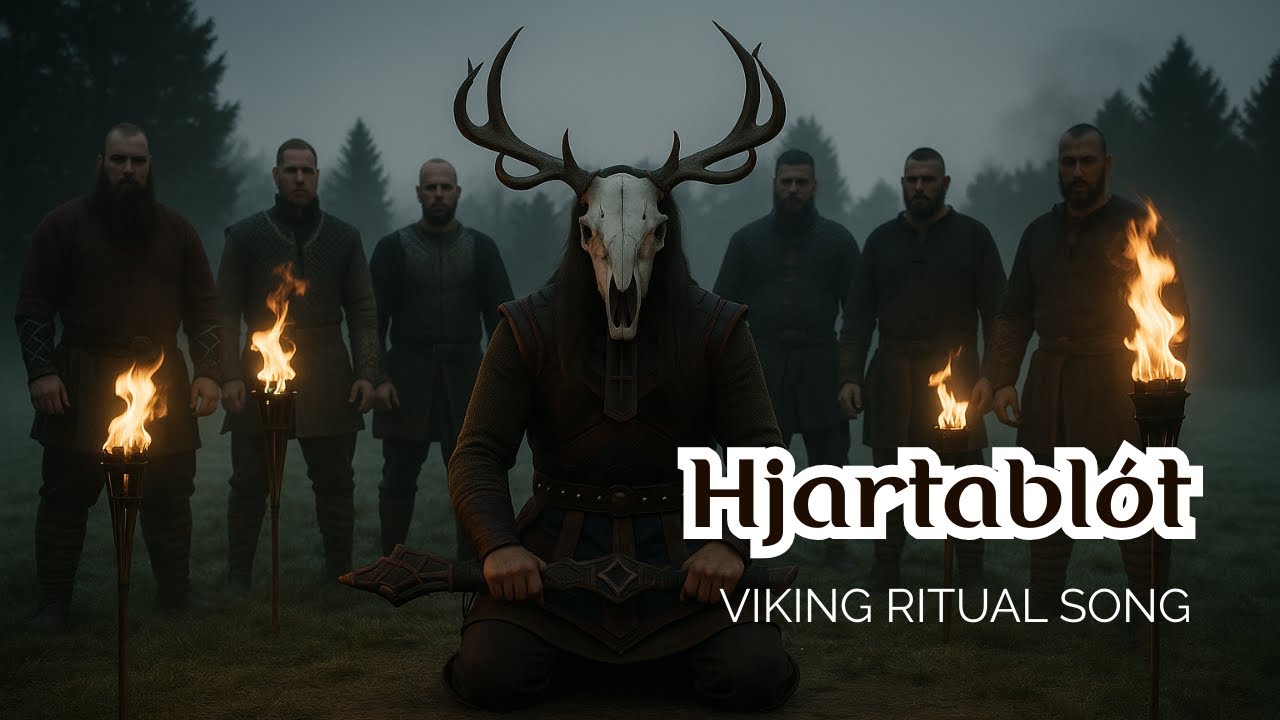
Hjartablót (“Heart Sacrifice”) is a 4:05 Mythic Harmonies ritual-styled song. A group facing battle calls on Odin, Thor, Freyja and the gods, carries a “heart of embers” and asks for courage, protection and a path through glory and doom.
This page preserves the complete Hjartablót lyrics and their released English rendering. The song borrows the language of blót, prayer, blood, fate and seiðr, but its private heart-offering and three-god invocation are a modern composition—not a recovered Viking Age ceremony.
Hjartablót at a Glance
- Title: Hjartablót (“Heart Sacrifice”)
- Artist: Mythic Harmonies
- Duration: 4:05 on YouTube, Spotify and Apple Music
- Voice and scene: collective pre-battle invocation
- Named figures: Odin, Thor and Freyja
- Historical status: original modern song using stylized medieval-language text
What Does Hjartablót Mean?
Hjarta means “heart.” Blót can refer to a sacrifice, sacrificial feast or act of cultic worship. The compound therefore communicates “heart sacrifice” or “offering of the heart.” That meaning fits the song’s inner fire, resolve and willingness to face death.
The title is transparent as a modern poetic formation, but this page does not claim that Hjartablót is an attested medieval name for a rite. The University of Copenhagen’s Dictionary of Old Norse Prose and Michael Barnes’s Old Norse glossary document the component vocabulary; they do not establish the song’s exact compound as a historical ceremony.
What Was a Blót?
A blót was an offering within pre-Christian Scandinavian religion, often understood as an exchange seeking divine goodwill. The National Museum of Denmark’s overview of Viking blót sacrifices connects such acts with weather, fertility and luck in battle. Archaeological evidence includes deposited weapons and cult activity at elite residences.
Written descriptions add feasting, animals, blood, ale and toasts, but they were recorded by later or external authors and cannot be treated as one fixed liturgy for every region and century. Scale also varied: a magnate’s public feast is not the same thing as a private modern meditation using Norse imagery.
Is a “Heart Sacrifice” Historically Attested?
Not as the specific inward rite performed by this song. The lyric offers no animal, object, feast or named ritual action. Its sacrifice is metaphorical: courage and life are placed at risk, fear is mastered and the heart becomes an ember before battle.
Historical sources do attest sacrifice, communal consumption and vows, while archaeology records varied deposits and ritual sites. They do not give us this title, this wording or an instruction to “offer one’s fear and will.” Hjartablót uses a documented religious term to frame a new dramatic scene.
Odin, Thor and Freyja Are Not a Fixed Ritual Triad
The refrain invokes Freyja, Thor and Odin in quick succession. All three are major figures in surviving Norse material, yet no cited source establishes this exact trio, order and wording as a standard pre-battle formula. The combination belongs to the song.
The National Museum’s summary of Hákonar saga góða instead describes a feast with an initial toast to Odin for the king and victory, followed by Njörðr and Freyr for peace and prosperity, personal vows and remembrance of dead kin. That later prose account is valuable evidence, but it is not the script of Hjartablót.
Why Does the Song Address Odin?
The opening “Father Odin, be near to us” makes Odin the first recipient of the prayer. His links with war, victory, the slain, poetry and rulers make that choice intelligible. The internal guide to Odin the All-Father traces those roles and their source limits in detail.
Even so, “Father Odin” should not be expanded into the claim that every Viking warrior prayed to him before battle. Religious allegiance differed by community and context. Inside this track, Odin’s dramatic function is simple: lead the speakers through the danger they have chosen to face.
What Does Thor Do in the Refrain?
Þórr sjái is most naturally read as “may Thor see” or “let Thor behold.” The released English turns that into the direct appeal “Thor, look upon us.” The line asks for attention; it does not say Thor consecrates the group, guarantees victory or witnesses a historically documented oath.
Thor’s protective and giant-fighting roles make him a powerful pre-battle presence in modern Norse-inspired art. For the site’s dedicated musical answer about his call and warlike force, continue to Kall Þórs. On this page he remains one voice in a three-part invocation.
Why Are Freyja and Seiðr Present?
The refrain asks Freyja to hear, and the next verse names seiðr. Snorri’s Ynglinga saga associates Freyja with teaching seiðr to the Æsir, while eddic material connects her with Fólkvangr and a share of the battle-slain. Those strands explain why a modern songwriter might place her beside fate and battle.
The lyric does not show a seeress performing a recorded procedure, nor does it say Freyja chooses these particular speakers after death. The deeper source distinctions belong to the site’s guide to Freyja, seiðr and Fólkvangr; Hjartablót uses the association as a compressed invocation.
Blood, Faith and the “Heart of Embers”
The first verse carries faith “in our blood,” and the refrain asks the gods to preserve the blood. Historical blót descriptions can involve animal blood, but nothing in the song depicts collection, sprinkling or consumption. Its blood is bodily lineage, life and vulnerability rather than an explicit ritual substance.
The “heart of embers” is likewise poetic. No source cited here establishes an ember-heart as a Norse anatomical belief, warrior initiation or magical object. It gives the track its central transformation: the body threatened by cold death generates its own inner fire.
Prayer on the Brink of Battle
The speakers do not ask for an easy life. They ask the gods to be near, see, hear, preserve and lead. Sword, storm, grinding teeth and trembling earth keep the prayer inside a battle setting, while repeated first-person plural forms turn private fear into collective resolve.
That does not make the song a safe ritual prescription. It can be heard as music, used for focus or placed in a fictional scene, but the page makes no medical, spiritual or historical promise. The emotional effect belongs to the listener; authenticity depends on how accurately the work is labelled.
How the Song Moves from Fear to Resolve
The opening appeal locates the group in war’s shadow. The second stanza lets death blow like a storm while the speakers stand firm. The refrain widens the prayer from Odin to Freyja, Thor and the gods, then the final verse reaches the brink of combat with fire within and earth trembling below.
The repeated refrain does not report victory. “Glory and doom” holds success and destruction together, which is more interesting than a guaranteed blessing. Hjartablót ends at commitment: the group walks forward without knowing which side of fate it will meet.
How Literal Is the English Rendering?
The English block is a released artistic rendering, not a scholarly word-for-word translation. The source-language text is stylized and not uniformly normalized. Constructions such as vér biðja þér, Hugr vér bera, trú í blóð and vér stendum fastr do not present standard agreement or case throughout.
Other passages are uncertain: meðr stormi sinum, Tennr gnasta, vér berjast logar and the closing vei should not be treated as secure normalized phrasing. “We blaze in battle,” “sacred names” and “glory and doom” are interpretive choices rather than transparent equivalents of every word. Both published blocks remain unchanged below.
How Hjartablót Differs from the Other Ritual Songs
Hjartablót owns the ember-heart, the pre-battle collective prayer and the Odin–Thor–Freyja invocation. Fjǫrblótr owns the life-offering title, blood-rite subtitle and circle of fire. Blót við Tungl owns the moonlit offering and seiðr-focused setting.
Hrafnablót is the dedicated raven-offering composition, while Eiðr ok Blóð answers the oath-and-blood intent. These pages may share ritual vocabulary, but each keeps a separate narrative, image set and search answer.
Is Hjartablót an Authentic Viking Ritual Song?
No. It is an original modern Mythic Harmonies composition. Blót, Odin, Thor, Freyja, seiðr, prayer and battle all have historical or literary points of contact, but no surviving source preserves this lyric, melody, three-god formula or inward heart sacrifice.
The evidence-led reading is richer than a false reconstruction: a documented ritual term becomes the frame for a modern song about choosing courage. Where the sources stop, the page names the imaginative step instead of hiding it.
Where to Listen to Hjartablót
Watch the official 4:05 Hjartablót video on YouTube. The matching Mythic Harmonies master also runs 4:05 on Spotify and Apple Music. Artist, title and duration match exactly.
Hjartablót Lyrics & Translation
The complete released words follow. The first block preserves the stylized source-language text; the second preserves its published English artistic rendering.
Original Lyrics (Old Norse Style)
Faðir Óðinn, sé oss nær Í skugga stríðs, vér biðja þér Hugr vér bera, hjarta af glóð Sverð í hendi, trú í blóð
Þó dauðr blási meðr stormi sinum Vér stendum fastr, með örlǫg innan Tennr gnasta, sál mín logar Vér syndum eigi, vér berjast logar
Forn þrá í hjarta glóð Biðjum goðin, varðveita blóð Freyja heyr, Þórr sjái Óðinn leið oss til dýrðar vei
Á brún stríðsins, vér snúum eigi Fjǫr í dóm, með seiðr og heiti Eldr innan, jǫrð skelfr djúpt Biðjum goð: vér gangum trúpt
Forn þrá í hjarta glóð Biðjum goðin, varðveita blóð Freyja heyr, Þórr sjái Óðinn leið oss til dýrðar vei
English Translation
Father Odin, be near to us In the shadow of war, we pray to you We carry spirit, a heart of embers Sword in hand, faith in our blood
Though death blows with his storm We stand firm, with fate within Teeth grind, my soul is burning We do not sin, we blaze in battle
Ancient longing, embers in the heart We pray to the gods, preserve the blood Freyja, hear us, Thor, look upon us Odin, lead us toward glory and doom
On the brink of war, we do not turn back Life in judgment, with magic and sacred names Flame within, the earth trembles deep We pray to the gods: we walk in faith
Ancient longing, embers in the heart We pray to the gods, preserve the blood Freyja, hear us, Thor, look upon us Odin, lead us toward glory and doom
What does Hjartablót mean?
Hjarta means ‘heart,’ while blót can mean a sacrifice, sacrificial feast or act of cultic worship. The modern poetic compound means ‘Heart Sacrifice,’ but it is not presented here as the documented name of a Viking Age rite.
Is Hjartablót a real Viking ritual song?
No. It is a modern Mythic Harmonies composition. Blót, the named gods, seiðr and battle prayer have historical or literary points of contact, but this lyric, melody, three-god formula and inward heart sacrifice are modern.
Were Odin, Thor and Freyja invoked together before battle?
All three appear in Norse sources, but no source cited here establishes this exact trio, order and wording as a standard pre-battle formula. Their combined invocation belongs to the song.
Does the song describe a historical blood sacrifice?
No explicit sacrifice is performed in the words. Blood represents life, kinship and vulnerability. Historical blót descriptions can involve animal blood, but that does not make the song’s ember-heart a recovered rite.
Where can I listen to Hjartablót?
The exact Mythic Harmonies recording runs 4:05 on the official YouTube video, Spotify and Apple Music. Artist, title and duration match on all three platforms.
More from Funeral & Ritual
March with the War-Band
New Old Norse chants every month. Join the listeners who never miss a release.