
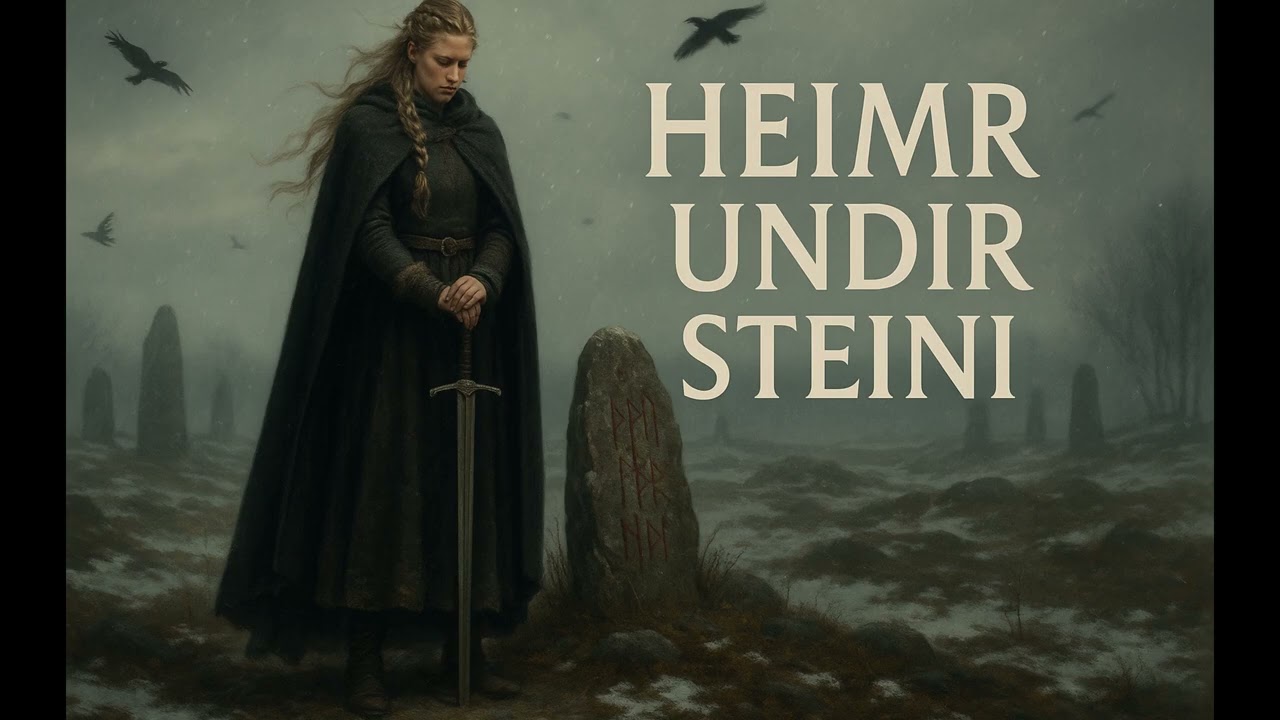
Heimr undir steini (“World Beneath the Stone”) is a 4:55 Mythic Harmonies funeral lament. A solitary narrator stands in rain beside a fallen beloved, lays words beneath a stone, remembers a broken shield and tries to turn grief into a song that can outlive the grave.
This page preserves the complete Heimr undir steini lyrics and their released English rendering. Burial mounds, stone settings and visible memorial stones all belong to the Viking Age record, but they are not interchangeable. The intimate funeral scene here is a modern composition, not a surviving Norse rite or medieval lament.
Heimr undir steini at a Glance
- Title: Heimr undir steini
- Artist: Mythic Harmonies
- Duration: 4:55 on YouTube; 4:54 on Spotify and Apple Music
- Voice and form: female-led modern funeral lament
- Central images: stone, rain, broken shield, blood, song and remembered fire
- Historical status: original composition using stylized medieval-language text
What Does Heimr undir steini Mean?
Heimr can mean “world,” “home” or an inhabited realm. Undir means “under” or “beneath,” and the following dative steini comes from steinn, “stone.” The compact title therefore means “world beneath a stone”; the released English rendering, “World Beneath the Stone,” supplies a natural definite article.
The phrase is intelligible, but it is not cited here as a documented name for the Norse afterlife or for a standard grave type. Inside the song, “world” is personal: the dead person’s resting place, remembered life and continuing presence in the mourner.
A Stone Is Not Automatically a Runestone
The lyric says the mourner lays words “beneath the stone”; it does not say those words are carved in runes. Viking Age graves could be covered by stone settings or mounds, while rune-stones were public monuments carrying inscriptions. Treating every grave stone as a rune-stone would merge different kinds of evidence.
The National Museum of Denmark explains that Viking Age rune-stones were commonly raised in memory of the dead and made visible near travelled places. Crucially, they were not necessarily placed at the burial of the person commemorated. The song’s stone can remain evocative without being mislabelled as an inscribed grave marker.
What Viking Age Graves Actually Show
There was no single “Viking funeral.” Cremation, inhumation, stone settings, earth mounds, chamber graves and boat burials appear in different regions, periods and social settings. The Swedish History Museum’s evidence-reviewed overview of Iron Age burials shows both cremation and later inhumation, with varied treatment of remains and grave goods.
Some wealthy people were placed in wooden chambers dug into the earth or set within mounds. The National Museum’s account of Viking Age chamber graves documents that specific elite form. None of this proves that the unnamed warrior in Heimr undir steini received a particular archaeological rite; the song deliberately leaves the burial unspecific.
The Mourner and the Fallen Warrior
The official video presents the track as a female lament, and the lyric calls the dead person “my beloved.” That gives the scene an intimate point of view, but the narrator is not identified as a historical shieldmaiden, priestess or valkyrie. She is the speaking character of this song.
Her first action is verbal rather than ceremonial: “I lay my words.” The verse then moves from public signs of battle—the fallen warrior and broken shield—to a private response, “my heart still stands.” The contrast makes survival feel difficult rather than triumphant.
The Broken Shield and the Sword
A broken shield establishes death after combat, but the song does not name a battle or historical person. Archaeology does show that weapons could accompany some dead. Shield bosses survive more often than wooden boards, and the National Museum notes that shields were placed in graves for a final journey in its study of Viking shields.
That evidence does not turn “go—with sword and with brother” into a universal funeral instruction. The line belongs to the mourner’s farewell. It can suggest equipment and fellowship without claiming that every warrior was buried armed or accompanied by another person.
Do the Gods Watch Over the Dead?
The chorus asks or asserts that “the gods watch over you.” It names no god, destination or mechanism. The lyric never says that the warrior enters Valhalla, Fólkvangr or Hel, and the stone itself is not identified as a gateway to another realm.
Surviving Norse sources preserve several destinations and overlapping ideas about the dead. Archaeological graves also changed across conversion to Christianity. The most accurate reading is therefore local to the song: the mourner hopes the beloved is not abandoned. It is not evidence for a single Norse doctrine in which all gods supervise every grave.
“Your Blood Became a Path”
The chorus turns two wounds into movement. The warrior’s blood becomes a path; the mourner’s wound becomes a song. Nothing in the verse says that literal blood was poured at the burial or used to guide the soul. The imagery joins sacrifice in battle to the survivor’s act of remembrance.
The second verse continues that transformation by counting steps on “wounded ground” and building the dead person’s journey with each breath. The English says “I build your mound,” while the source-language line does not securely and literally name a mound. The burial mound is part of the artistic rendering.
Memory Without a Universal Afterlife Claim
The outro gives the song its answer to loss: “Your world still lives… in me.” That is a modern statement of carried memory, not proof that Viking Age Scandinavians believed a dead person’s complete world literally inhabited a mourner.
Visible memorials do show that names, kinship, deeds and emotion mattered. Rune-stones could identify who raised the monument and whom it honoured; some inscriptions even voice grief. Heimr undir steini internalizes that commemorative act: instead of raising a public inscription, the narrator makes the wound into a private song.
How Literal Is the English Rendering?
The English block is a released artistic rendering, not a word-for-word scholarly translation. The source-language text is stylized and includes forms that are non-standard or uncertain. Engin fyrirk does not securely yield “without blame,” lióð uses a non-normalized spelling, and ek byggi þín far is not a literal equivalent of “I build your mound.”
Likewise, með sverð ok með bróð communicates the intended sword-and-brother image but does not present a secure normalized construction. Both published blocks remain unchanged below. Declaring the gap is more useful than silently correcting a work that listeners know from the recording.
How This Lament Differs from Other Funeral Songs
Heimr undir steini owns the stone-side female lament, the beloved warrior, rain and the world carried inside the mourner. Viking Funeral at Sea owns the ship and sea-farewell intention. Echoes of the Fallen is an English collective lament, while Call of Valhalla names the hallward journey directly.
Those songs can share grief without sharing the same search answer. This page is the destination for the exact title, the “World Beneath the Stone” meaning and this bilingual text; the broader evidence belongs to the site’s guide to Viking funeral practices.
Is Heimr undir steini an Authentic Viking Lament?
No. It is a modern Mythic Harmonies composition. The vocabulary, memorial stones, mounds, grave goods and broken-warrior imagery have historical points of contact; this lyric, melody, female narrator and exact funeral scene are modern.
The strongest historical approach is transparent rather than theatrical: keep the burial evidence varied, do not turn every memorial stone into a rune-inscribed grave, and do not present the song’s gods, blood path or living inner world as a recovered doctrine.
Where to Listen to Heimr undir steini
Watch the official 4:55 Heimr undir steini video on YouTube. The matching Mythic Harmonies master runs 4:54 on Spotify and Apple Music. Artist and title match exactly, and the one-second platform difference is within the verified tolerance.
Heimr undir steini Lyrics
The complete released words follow. The first block preserves the stylized source-language lyric; the second preserves its published English artistic rendering.
Original Lyrics (Old Norse Style)
[Verse 1] Undir steini, ek leggi orð Til þess sem barðisk, til þess sem fór Skjǫldr hans brotnar, hjarta mitt stendr Í regni, ek syng — hann var minn eldr
[Chorus] Heimr undir steini, sofðu með styrk Goð vaka yfir þér, engin fyrirk Blóð þitt varð vegr, sár mitt varð lióð Minn kæri, farðu — með sverð ok með bróð
[Verse 2] Ek sá þik falla, en eigi í skǫmm Þú steigst í dauða með æru sem rǫmm Ek tel mín spor á moldu sár Með hverju andvarp, ek byggi þín far
[Chorus] Heimr undir steini, sofðu með styrk Goð vaka yfir þér, engin fyrirk Blóð þitt varð vegr, sár mitt varð lióð Minn kæri, farðu — með sverð ok með bróð
[Outro] Undir steini… Heimr þinn lifir… Í mér…
English Translation
[Verse 1] Beneath the stone, I lay my words For he who fought, for he who passed His shield is broken, my heart still stands In the rain I sing — he was my flame
[Chorus] World beneath the stone, sleep with strength The gods watch over you, without blame Your blood became a path, my wound became a song My beloved, go — with sword and with brother
[Verse 2] I saw you fall, yet not in shame You stepped into death with noble flame I count my steps on wounded ground With every breath, I build your mound
[Chorus] World beneath the stone, sleep with strength The gods watch over you, without blame Your blood became a path, my wound became a song My beloved, go — with sword and with brother
[Outro] Beneath the stone… Your world still lives… In me…
What does Heimr undir steini mean?
Heimr means ‘world’ or ‘home,’ undir means ‘under’ or ‘beneath,’ and steini is the dative of steinn, ‘stone.’ The title means ‘world beneath a stone,’ rendered naturally as ‘World Beneath the Stone.’
Is Heimr undir steini a real Viking funeral song?
No. It is a modern Mythic Harmonies composition. Mounds, stone settings, memorial stones and grave goods are historical, but this lyric, melody, female narrator and exact funeral scene are modern.
Is the stone in the song a Viking rune-stone?
The lyric does not say that the stone is inscribed. Viking Age rune-stones often commemorated the dead but were public monuments and were not necessarily placed at the person’s burial. Grave stone settings and rune-stones should not be treated as the same object.
Is the English section a literal translation?
No. It is the released artistic rendering. The source-language lyric is stylized and includes uncertain or non-normalized forms, so both published blocks are preserved without presenting the English as a scholarly word-for-word translation.
Where can I listen to Heimr undir steini?
The official YouTube video runs 4:55. Spotify and Apple Music carry the matching Mythic Harmonies master at 4:54, with the same artist and exact title.
More from Funeral & Ritual
March with the War-Band
New Old Norse chants every month. Join the listeners who never miss a release.