
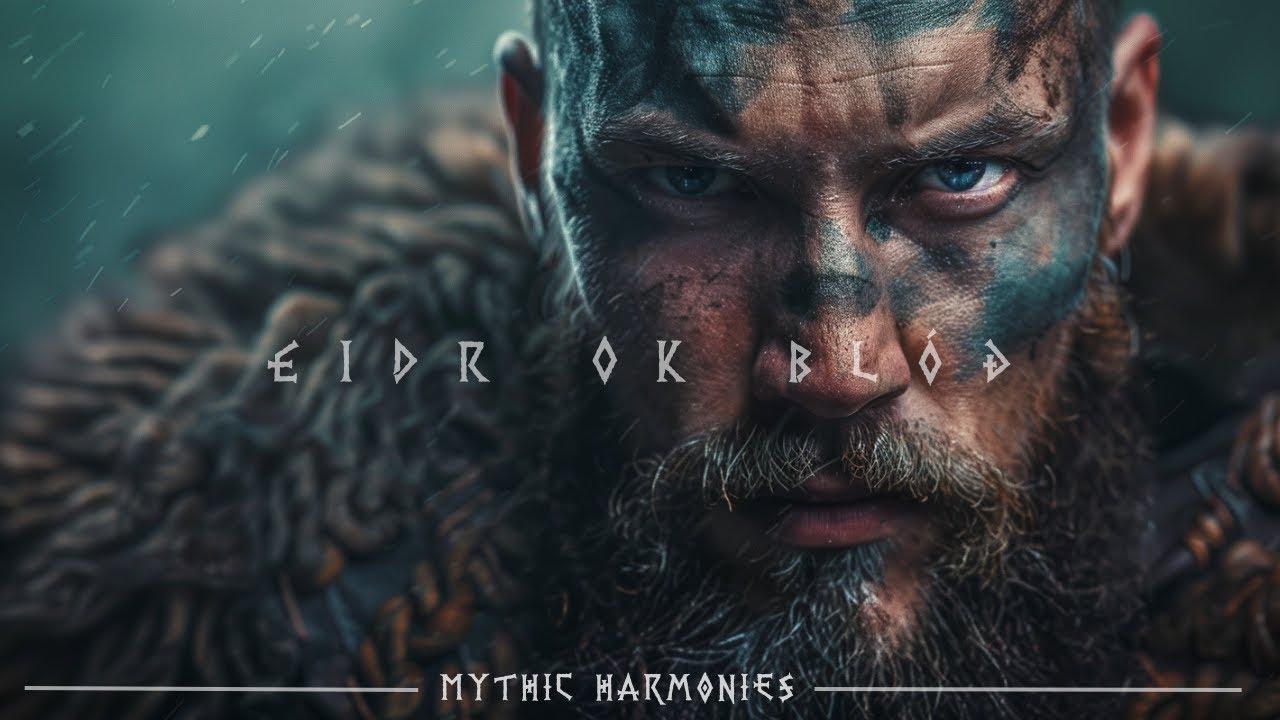
Eiðr ok Blóð (“Oath and Blood”) is a 3:21 Mythic Harmonies chant in stylized Old Norse. Its compact lyric turns an oath into a sword, blood into a visible mark, and a group of brothers standing shield to shield into the human image of a promise kept under pressure.
This page preserves the complete Eiðr ok Blóð lyrics and English translation exactly as released. The composition is modern, not a recovered Viking Age chant. Its blood, stone and brotherhood imagery can be compared with medieval texts, but no single saga scene proves a universal Norse “blood-oath ritual.”
Eiðr ok Blóð at a Glance
- Title: Eiðr ok Blóð
- Direct title meaning: Oath and Blood
- Artist: Mythic Harmonies
- Language: stylized Old Norse with an artistic English translation
- Duration: 3:21 on YouTube and Apple Music; 3:20 on Spotify
- Core images: sword, blood, stone, brothers, shields and judgment
- Historical status: modern original composition
What Does Eiðr ok Blóð Mean?
Eiðr means “oath,” ok means “and,” and blóð means “blood.” The title therefore translates directly as Oath and Blood. Unlike titles that depend on a freer English subtitle, the three words here state the song’s central pairing without requiring a hidden ritual meaning.
The title does not by itself name a fixed historical ceremony. It tells us what the modern lyric joins: a spoken commitment and a physical sign. That distinction matters because “blood oath” is a broad modern label, while medieval narratives preserve different promises, legal oaths and bonds in different settings.
What Is the Song About?
The opening couplet gives the song its governing metaphor: the oath is a sword, blood is a mark, and spoken words are bound. The second movement places the speaker’s oath in darkness, stone and cold earth before introducing betrayal and its imagined consequence. The refrain then changes the scale from one speaker to a collective “we.”
A single verse supplies the human scene: brothers stand shield to shield, their hearts striking like hammer blows while wounds multiply. The last refrain removes most narrative detail and compresses the piece into four declarations—ancient word, no flight, continued resistance and endurance to the end. It works as a modern vow-song because repetition carries more weight than plot.
“The Oath Is a Sword” Is a Metaphor
The lyric does not describe someone swearing upon a named weapon. It says that the oath is a sword. The comparison gives speech an edge: a promise can defend a group, bind its members and expose the person who breaks it. “Carved in stone” extends the same poetic logic by making words feel durable and difficult to reverse.
Weapons and oaths do appear together in medieval and comparative evidence, but that does not turn every sword in a modern song into an archaeological ritual object. Here the strongest reading begins with the words actually sung: sword, stone and blood are images for pressure, permanence and consequence.
What Does Blood Mark in the Song?
Blood first appears as spor, a mark, track or trace. It then falls onto cold earth. The English version makes that sequence legible as a sign of commitment, but the song never identifies a named legal formula, cult site or period object. Blood is the lyric’s proof that the vow has moved beyond casual speech.
The image should therefore be read before it is historicized. It may recall scenes known from later saga literature, yet the composition’s meaning does not depend on claiming that all Viking warriors sealed loyalty in the same way.
Brotherhood and the Gísla saga Comparison
A useful comparison appears in Gísla saga Súrssonar. In a later Icelandic literary account, four men attempt to become foster-brothers beneath raised turf: they draw blood, let it fall into the exposed earth and intend to swear mutual vengeance. The scene is relevant because Eiðr ok Blóð also joins oath, blood, earth and brotherhood.
It is not a script for reconstructing every Norse oath. The saga was written down centuries after the period it depicts, the proposed bond in that episode breaks down before completion, and one narrative scene cannot establish a universal rite. The song uses a related cluster of images to create its own compact, modern declaration.
Shield to Shield Describes the Song’s Group
“With brothers we stand, shield to shield” is the composition’s only developed battle image. It shows proximity and mutual exposure: no speaker can keep the line alone. The phrase supports the refrain’s move from “my oath” to “we stand,” but it does not identify a specific formation, battle or archaeological event.
This keeps the track distinct from songs whose main subject is the shield wall itself. On this page, shields matter because they make loyalty visible. The central search intent remains the title, lyrics, translation and meaning of Eiðr ok Blóð.
Language and Translation Notes
The released text is best described as stylized Old Norse, not as a normalized medieval edition. The title is straightforward, and several short clauses are transparent. Elsewhere, agreement and idiom are uneven: forms such as rofin ei for, eiðr ok sinn, Stendr vér við and aldri deil should not be silently regularized.
The English block is an artistic translation. For example, lið can denote a group, company or following, while “bond” selects the relationship the song wants to emphasize. Hamars gjǫld becomes “hammer blows,” and the English smooths several compressed or uncertain Norse lines into a coherent chant. Both released blocks remain unchanged below so readers can compare them.
Is Eiðr ok Blóð an Authentic Viking Chant?
No. Eiðr ok Blóð is an original modern Mythic Harmonies song. No surviving Viking Age inscription or medieval manuscript preserves this lyric, translation, melody or 3:21 arrangement. Its imagery is Norse-inspired, while its evidence status remains modern.
That does not make the historical comparison meaningless. It simply keeps the layers visible: the song supplies the experience; dictionaries and grammar help assess the language; saga literature offers a later narrative parallel; scholarship tests how cautiously that parallel can be used.
How the 3:21 Recording Builds Pressure
The text is deliberately economical. A two-line thesis opens the piece, one darker stanza raises the cost of betrayal, and the repeated four-line refrain turns private commitment into a collective response. The shield-to-shield verse is the only extended scene, so it lands as the song’s human center rather than one episode among many.
The final variation shortens the language again. Instead of explaining the oath, it names what remains: the old word, refusal to flee, the group still standing and the end it accepts. The whispered or sustained title at the close leaves the central pair—oath and blood—after the rest of the argument has fallen away.
Related Oath Songs Without Cannibalization
This fiche owns the exact title Eiðr ok Blóð, its Norse-and-English text, the “oath is a sword / blood is a mark” couplet and the compact shield-to-shield refrain. For the later saga image of foster-brotherhood beneath turf, continue with The Blood Oath and its brotherhood ritual narrative.
For the imagined place where words become judgment, read Eiðr Hǫll and the Hall of Oaths. For honor, kin and a personal battlefield pledge, use Blóð ok Heiðr: Blood and Honor. Each page answers a different intent instead of competing for the same generic “Viking oath song” query.
Eiðr ok Blóð Lyrics (Old Norse and English)
The first block is the released performed text; the second is the official artistic English translation. Both are reproduced unchanged.
Old Norse:
Eiðr er sverðr, blóð er spor,
orð eru bundin, rofin ei for.Í myrkri stendr eiðr minn,
rist í stein, eiðr ok sinn.
Blóð fellr lágt á kalda mold,
sá er svíkr, mun deyja skjǫlt.Eiðr ok blóð! Bundit fast!
Eiðr ok blóð! Aldri kast!
Eiðr ok blóð! Stendr vér við!
Eiðr ok blóð! Líf ok lið!Við bræður stendr, skjǫldr við skjǫldr,
hjarta slær sem hamars gjǫld.
Sár eru mörg, en hugr er heill,
dómr kemr seint, en aldri deil.Eiðr ok blóð! Bundit fast!
Eiðr ok blóð! Aldri kast!
Eiðr ok blóð! Stendr vér við!
Eiðr ok blóð! Líf ok lið!Eiðr ok blóð! Fornt er orð!
Eiðr ok blóð! Engi flótti!
Eiðr ok blóð! Við stöndum enn!
Eiðr ok blóð! Til enda menn!Eiðr… ok blóð…
English translation:
The oath is a sword, blood is the mark,
Words are bound, never undone.In darkness my oath stands,
Carved in stone, oath and self as one.
Blood falls low upon cold earth,
He who betrays shall die swiftly.Oath and blood! Bound tight!
Oath and blood! Never cast aside!
Oath and blood! We stand by it!
Oath and blood! Life and bond!With brothers we stand, shield to shield,
Hearts beat like hammer blows.
Many wounds, yet the spirit is whole,
Judgment comes late, but never divided.Oath and blood! Bound tight!
Oath and blood! Never cast aside!
Oath and blood! We stand by it!
Oath and blood! Life and bond!Oath and blood! Ancient is the word!
Oath and blood! No escape!
Oath and blood! We still stand!
Oath and blood! Men to the end!Eiðr… ok blóð…
Listen to Eiðr ok Blóð
Watch the official 3:21 YouTube video, stream the matching 3:20 master on Spotify, or open the 3:21 release on Apple Music. Artist, title and duration agree within the one-second matching rule.
Sources and Further Reading
- Michael Barnes, A New Introduction to Old Norse: Grammar, Viking Society for Northern Research.
- Dictionary of Old Norse Prose, University of Copenhagen.
- Gísla saga Súrssonar, for the attempted foster-brother oath beneath raised turf; treated here as a later literary witness, not a universal ritual manual.
- Simon Nygaard, “Being Óðinn Bursson”, in Social Norms in Medieval Scandinavia, for a scholarly discussion of warrior-band obligation and the limits of reconstructing performance.
Questions About Eiðr ok Blóð
What does Eiðr ok Blóð mean?
Eiðr means “oath,” ok means “and,” and blóð means “blood,” so the title translates directly as “Oath and Blood.” It names the song’s central images, not a single documented historical ceremony.
Is Eiðr ok Blóð an authentic Viking Age chant?
No. It is a modern original Mythic Harmonies song in stylized Old Norse. No Viking Age inscription or medieval manuscript preserves this lyric, translation, melody or arrangement.
Did Vikings swear blood oaths like this song?
Later saga literature includes a foster-brotherhood scene in which blood falls into earth beneath raised turf, but one literary episode cannot establish a universal Viking blood-oath ritual. The song creates its own modern scene from related imagery.
Is the English version a literal translation?
It is an artistic translation. The title is direct, but several compressed or non-normalized Old Norse lines are smoothed in English. Both released texts are preserved unchanged on this page.
Where can I listen to Eiðr ok Blóð?
The official YouTube video and Apple Music track run 3:21; Spotify lists the matching Mythic Harmonies master at 3:20. Artist, title and duration match within one second.
More from Epic War Battle
March with the War-Band
New Old Norse chants every month. Join the listeners who never miss a release.