
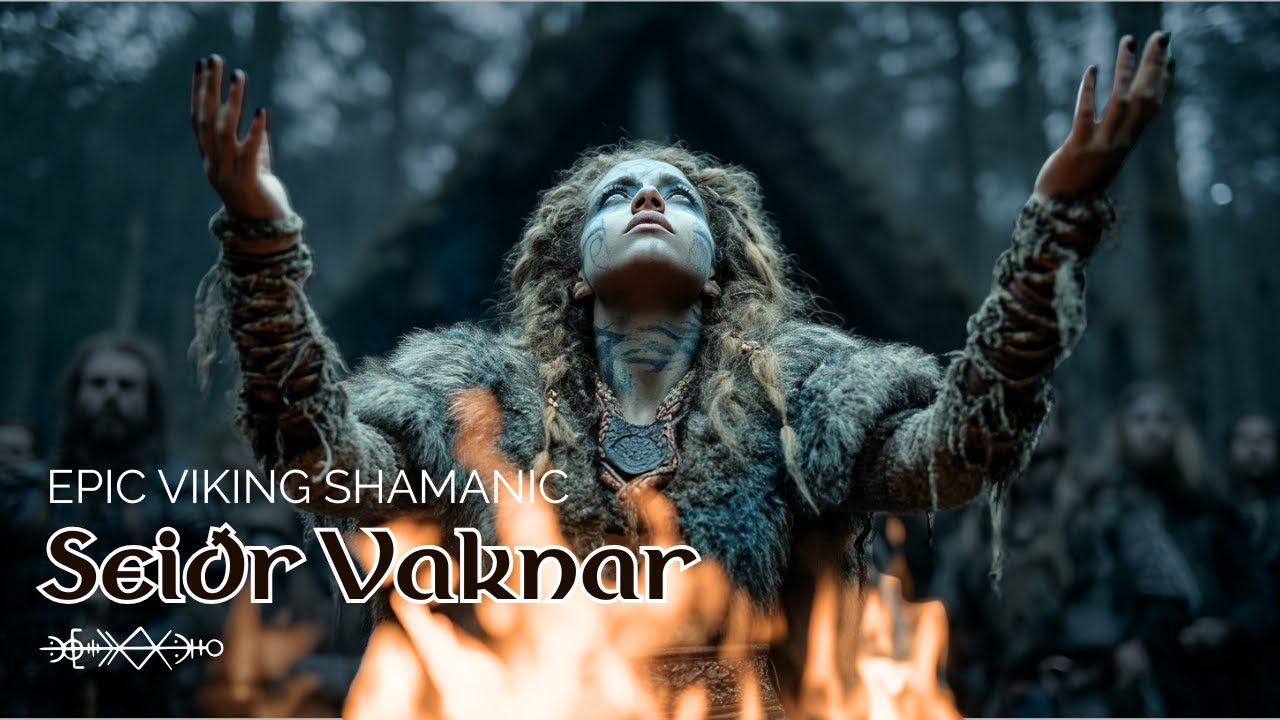
Seiðr Vaknar (“Seiðr Awakens”) is a 3:50 Mythic Harmonies ritual-war song in Old Norse-styled language. Fire, wind, mountains and ravens open the scene; a repeated command to sing drives the center; horns, wolves and marching kin then lead to a final invocation of Odin, Thor and Freyr before battle.
Play the complete master above. The matching distributed track is titled The Seiðr Awakens and runs 3:49 on Spotify and Apple Music, within one second of the video. This is a modern composition inspired by medieval descriptions and Viking Age material—not a surviving seiðr chant or a reconstruction of one ceremony.
Seiðr Vaknar at a Glance
| Artist | Mythic Harmonies |
|---|---|
| Song | Seiðr Vaknar |
| English title | Seiðr Awakens |
| Duration | 3:50 on YouTube; 3:49 on Spotify and Apple Music |
| Language | Old Norse-styled text with English artistic translation |
| Core movement | Awakening elements → sung refrain → marching war-band → three-god invocation |
| Status | Original modern composition, not an attested ritual text |
What Is Seiðr Vaknar About?
The song begins by making the landscape respond: seiðr awakens, fire burns, wind sings and mountains shake. Ravens and dreams stir as battle approaches. The second verse brings the action closer to the body—hammer, earth, blood, sacrifice and strength—then the chorus interrupts the narrative with four direct commands to sing.
After the refrain, horns sound, fires blaze, a seiðkona sings, wolves howl and the war-band rises. The closing invocation names Odin, Thor and Freyr and asks for strength in war. Its arc is cosmic awakening → offered energy → repeated vocal focus → collective movement → divine appeal. The seiðr is not described as a spell with instructions; it is the atmosphere and force through which the group prepares itself.
What Does “Seiðr Vaknar” Mean?
Seiðr is the Old Norse term conventionally used for a complex of magical practices, and vaknar means “awakens.” The direct title is therefore Seiðr Awakens. The distributed English wording The Seiðr Awakens identifies the same 3:49 master; the article is not claiming that medieval speakers used an English definite article around the Norse term.
Translating seiðr simply as “magic” is convenient but broad. The sources connect it with foreknowledge, altered fortune, harm, loss of strength or understanding, and practices associated with specialists. They do not reduce it to one standardized “battle trance,” weather spell or fate-weaving system.
Seiðr in the Sources—and in This Song
Snorri’s Ynglinga saga says Freyja first taught seiðr among the Æsir and attributes to Odin knowledge of fate, death and misfortune as well as the power to affect people’s minds and strength. This is a thirteenth-century prose account, valuable but later than the Viking Age it imagines. Lokasenna also accuses Odin of practising seiðr and ties the charge to gendered shame. Together they show power, danger and contested status, not a neutral handbook.
The National Museum of Denmark connects staffs and unusually furnished graves with völur and describes song, a special seat and trance in saga traditions. Archaeology supports the existence of specialist identities and objects, while the detailed performance sequence depends heavily on later texts such as Eiríks saga rauða. It should not be projected unchanged onto every region or century.
Seiðr Vaknar makes its own ritual from these materials. It adds the elemental opening, male war-band, repeated “sing” refrain, wolves and three named gods. Calling the sound “shamanic” describes the track’s modern trance-oriented aesthetic; it is not a claim that seiðr and every global form of shamanism are identical.
The Seiðkona, War-Fetters and the Three Gods
The lyric names a seiðkona, a woman who practises seiðr. That is not automatically the same office as every völva, prophetess or ritual specialist, although the categories can overlap in the literary record. The line translated “men are bound” does not explicitly name Herfjötur, a valkyrie-name meaning “army-fetter,” nor prove a specific seiðr technique that paralysed warriors. In the Norse line, mennir binda is itself grammatically unstable and reads closer to active “men bind” than passive “men are bound.”
Odin has the clearest literary connection with seiðr. Freyja is important to Snorri’s transmission story but is not named in this song. Thor and Freyr are invoked at the end, yet the lyric does not establish them as seiðr practitioners. Freyr’s Vanir identity alone does not make him an essential battle-magician, and “peace god” versus “warrior king” is too simple a binary. The trio is the composition’s dramatic choice.
How the Recording Creates Focus
A steady pulse and repeated vocal cells give the 3:50 master its forward pressure. The chorus does not explain a spell; it makes “sing” the spell-like action. Layered voices widen the group, while the later horns and wolves raise the intensity before the names of the gods arrive as the final peak.
Listeners may use the piece for concentration, creative work or fictional ritual scenes, but those modern uses should not be converted into historical evidence. The arrangement is a contemporary composition, not a clinically validated method for inducing trance and not a Viking Age score.
Old Norse Language Note
The title and several short phrases are clear, but the published text mixes Old Norse vocabulary with modern grammar. A singular vindr does not agree with plural syngja, while plural fjǫll requires a plural verb rather than skelfr. Eldr brenn lacks the expected historical ending, and draumar hrær does not produce the English “dreams stir” as written.
Elsewhere, mennir is not the normal plural of maðr; fórn vér gefa would require a first-person plural verb; styrkr vér hefja has an unstable case; seiðkona syngja mismatches singular subject and plural verb; and ætt mín liga does not straightforwardly mean “my kin stands.” In the final couplet, við is a preposition (“with/against/by”), not the pronoun “we,” which is vér. The English is therefore an artistic translation, not a literal normalized edition.
Where This Fiche Fits
This page owns the 3:50 Seiðr Vaknar master, its awakening refrain, seiðkona, marching kin and Odin–Thor–Freyr invocation. Syng Rúnar owns a separate song about singing runes. Runes of Fire keeps its English emotional fire-and-rune composition. The distinctions prevent three ritual-themed fiches from competing for the same title, lyrics or listening intent.
Seiðr Vaknar Lyrics & Translation
The published Old Norse-styled text and English artistic translation are reproduced below without silent correction.
Original Old Norse-Styled Text
Seiðr vaknar, eldr brenn,
Vindr syngja, fjǫll skelfr.
Hrafnar vaka, draumar hrær,
Óðinn kallar, stríð er nær.Hamarr slær í moldar hjarta,
Dauði vakir, mennir binda.
Blóð ok eld, fórn vér gefa,
Goðin hlýða, styrkr vér hefja.Syng, syng, hjarta þitt,
Syng, syng, í myrkri mitt.
Syng, syng, við eldr ljós,
Syng, syng, við goða rós.Horn gjalla, véllar brenna,
Seiðkona syngja, draumar renna.
Úlfar grenja, mennir stíga,
Stríðsdagr rís, ætt mín liga.Syng, syng, hjarta þitt,
Syng, syng, í myrkri mitt.
Syng, syng, við eldr ljós,
Syng, syng, við goða rós.Óðinn! Þórr! Freyr!
Gef oss styrkr í stríðarsverð.
Óðinn! Þórr! Freyr!
Við stríð lifum, við stríð deyjum.
English Artistic Translation
Seiðr awakens, fire burns,
Winds sing, mountains shake.
Ravens watch, dreams stir,
Odin calls, battle is near.The hammer strikes the heart of earth,
Death awakens, men are bound.
Blood and fire, sacrifice we give,
The gods listen, strength we raise.Sing, sing, your heart,
Sing, sing, in my darkness.
Sing, sing, with fire’s light,
Sing, sing, with the gods’ rose.Horns echo, fires blaze,
Seeresses sing, dreams flow.
Wolves howl, men march,
The day of battle rises, my kin stands.Sing, sing, your heart,
Sing, sing, in my darkness.
Sing, sing, with fire’s light,
Sing, sing, with the gods’ rose.Odin! Thor! Freyr!
Give us strength in battle’s sword.
Odin! Thor! Freyr!
In war we live, in war we die.
Listen on Spotify and Apple Music
The exact distributed release appears as The Seiðr Awakens on Spotify and The Seiðr Awakens on Apple Music, both 3:49. They match the 3:50 video within one second. Browse every complete text in the Songbook of the North.
Sources and Editorial Method
- National Museum of Denmark, “Viking seeresses” and “The magic staffs of the Viking seeresses?”.
- Alison Finlay and Anthony Faulkes (trans.), Heimskringla I, Ynglinga saga 4 and 7.
- Edward Pettit (ed.), Lokasenna, especially the accusation of Odin’s seiðr practice and its gendered insult.
- Michael Barnes, A New Introduction to Old Norse, Part I: Grammar.
Editorial note: the sources establish seiðr, specialists, material associations and later literary descriptions. The exact rite, refrain, war-band, gods, words and music of Seiðr Vaknar are modern creative choices.
Frequently Asked Questions
What does Seiðr Vaknar mean?
It means “Seiðr Awakens.” Seiðr is an Old Norse term for a complex of magical practices; translating it simply as “magic” is useful but broader than the medieval evidence.
What is Seiðr Vaknar about?
The song awakens fire, wind, mountains and ravens, repeats a command to sing, then moves through horns, wolves and marching kin to a final invocation of Odin, Thor and Freyr before battle.
Is Seiðr Vaknar an authentic Viking ritual chant?
No. It is an original modern Mythic Harmonies composition. Medieval texts and Viking Age finds inform its imagery, but the exact words, music, ceremony and war-band are not a surviving rite.
Was seiðr the same as shamanism?
Some scholars and museums use shamanic comparison for trance and spirit-travel elements, but the terms are not interchangeable labels for one universal practice. Here “shamanic” describes the recording’s modern aesthetic.
Where can I listen to Seiðr Vaknar?
The 3:50 YouTube master is embedded at the top. The matching track, titled The Seiðr Awakens, runs 3:49 on both Spotify and Apple Music and is linked directly below the lyrics.
More from Funeral & Ritual
March with the War-Band
New Old Norse chants every month. Join the listeners who never miss a release.