
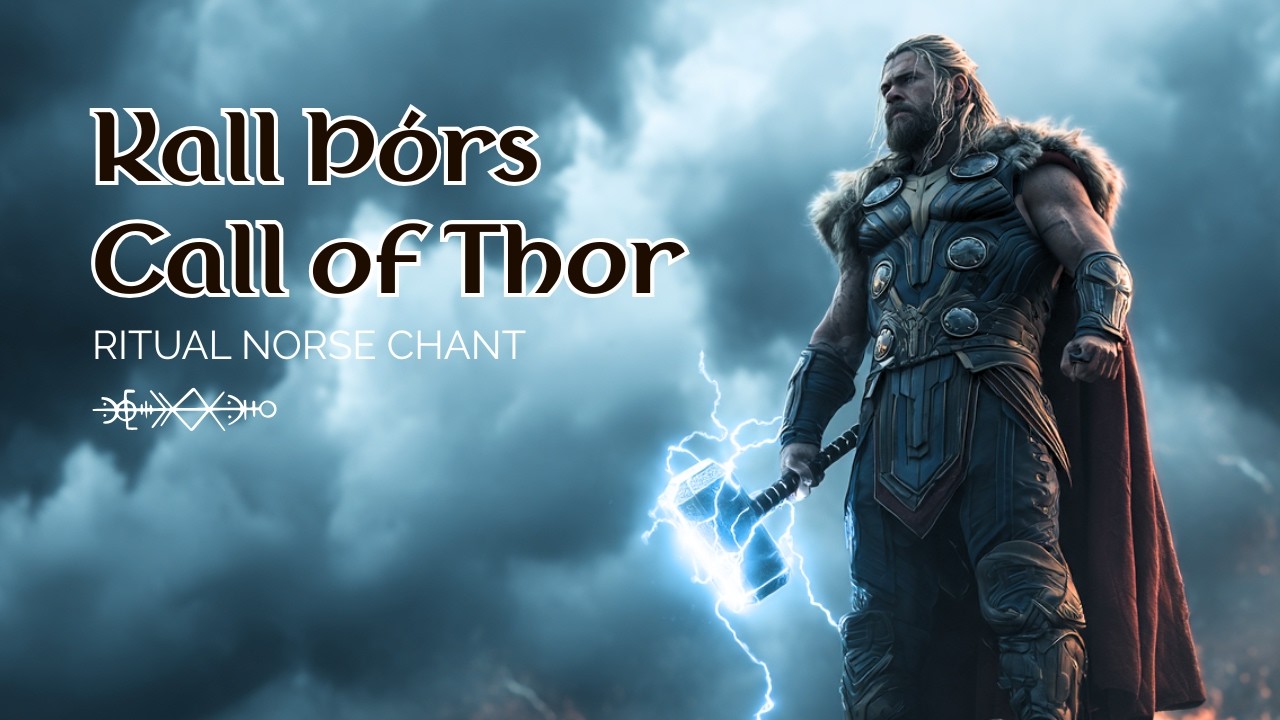
Kall Þórs (“Call of Thor”) is a 2:57 Mythic Harmonies song built around storm, Mjölnir and a repeated invocation of Thor as defender of Midgard. Its speakers bind faith with sword and shield, face a terror-filled storm and answer thunder with a promise that they will never die.
This page preserves the complete Kall Þórs lyrics and their released English rendering. Thor’s hammer, goat-drawn chariot, giant-fighting and hallowing functions are source-based; this exact war chant, shield-wall prayer and eternal-power refrain are a modern composition.
Kall Þórs at a Glance
- Title: Kall Þórs (“Call of Thor”)
- Streaming title: Thor’s Call
- Artist: Mythic Harmonies
- Duration: 2:57 on YouTube; 2:56 on Spotify and Apple Music
- Central images: storm, splitting sky, Mjölnir, sword, shield and Midgard
- Historical status: original modern song using stylized medieval-language text
What Does Kall Þórs Mean?
Kall is a “call,” “cry” or summons, and Þórs is the genitive of Þórr, “of Thor.” “Call of Thor” is therefore a direct and natural translation. Depending on context, the phrase can suggest Thor’s own call or a call addressed to him; the chorus performs both possibilities.
The streaming release reverses the English word order to Thor’s Call. Artist, recording and duration match, so it is the same master rather than a separate song. The page keeps the original-language H1 while documenting the distributed title.
What the Sources Say about Thor
In Snorri’s Gylfaginning, Thor is described as the foremost or strongest of the gods. He possesses Mjölnir, a belt of strength and iron gloves; rides in a chariot drawn by two goats; and repeatedly confronts jötnar. Eddic poems give him comic, violent and protective roles rather than one abstract job description.
The Viking Society’s edition of Edda: Prologue and Gylfaginning provides the prose evidence. It supports Thor’s immense strength and hammer, but it does not preserve the chorus of Kall Þórs or say every warrior used a standard call before battle.
Was Thor the “God of the Common People”?
Thor was widely important, and place-names, personal names and hammer pendants show broad social reach. The popular contrast “Odin for kings, Thor for common farmers” is still too neat. Norse worship varied by region, period, household and political setting, and the sources do not issue exclusive social memberships to the gods.
Thor could matter to farmers, sailors, warriors and elites. Odin could also appear beyond royal circles. Calling Thor an accessible defender captures part of his later image, but it should not become a census result about what every social class believed.
Is Thor the Protector of Midgard?
The song calls him verndr Miðgarðs, “defender of Midgard.” That title fits his repeated battles against beings who threaten gods or humans and his close association with the human world. Medieval poetry also uses protective language around Thor, though wording and interpretation vary by source.
It does not follow that Midgard is simply surrounded by a single land whose inhabitants constantly attack with blizzards and fire, or that Thor’s sole cosmic purpose is border patrol. The jötnar include relatives, partners and knowledge-holders as well as opponents. The dedicated Jǫtnar rísa page preserves that complexity.
How Was Mjölnir Forged?
Skáldskaparmál tells how Loki wagers his head against the dwarf Brokkr and his brother Sindri’s skill. While Brokkr works the bellows, a fly—Loki in disguise—bites him. The interruption leaves Mjölnir with a short fore-end or handle, yet the gods judge the hammer the finest defence against frost-giants.
The hammer can strike its chosen target, does not fail, returns to Thor’s hand and can be carried inside his shirt. The scholarly Viking Society edition of Skáldskaparmál preserves the episode. The song’s “Mjölnir awakens” is new personification, not part of the forging story.
Did Mjölnir Bless Weddings and Funerals?
Mjölnir is more than a weapon in the texts. In Þrymskviða, the disguised Thor’s stolen hammer is placed in the bride’s lap to hallow her and the marriage. In Snorri’s account of Baldr’s funeral, Thor hallows the pyre with Mjölnir.
These scenes justify speaking of hallowing, but they do not establish one universal hammer liturgy for weddings, births, funerals and battle. The song calls Thor a protector and friend; it does not actually stage a marriage, funeral or recovered consecration rite.
Thunder, the Chariot and the Two Goats
Thor travels in a chariot drawn by Tanngnjóstr and Tanngrisnir. One prose story has him slaughter the goats for a meal, preserve their skins and bones, then restore them with Mjölnir; a damaged thigh bone leaves one goat lame. These are specific narrative details, not evidence that every thunderclap was ritually decoded in the same way.
Thor’s name and identity are inseparable from thunder, and later retellings often hear the chariot’s wheels in the sky. Kall Þórs turns that association into split heavens, fire and singing thunder. The page does not claim that an uncredited drum pattern literally reconstructs Mjölnir’s impact.
Thor and the Jötnar Are Entangled
Thor kills many jötnar and is their great opponent, but his own mother Jörð belongs to giant-kind in Snorri’s genealogy. His encounters also range from direct combat to trickery, contests, hospitality and journeys. The boundary he defends is therefore mythically important but genealogically porous.
The song chooses the clearest martial version: Thor is friend, defender and source of strength. That is its dramatic focus, not proof that every jötunn personifies natural chaos or that Thor exists only to destroy them.
Does Calling Thor Guarantee Courage or Victory?
The chorus is a declaration, not a documented magical contract. “Eternal is his power” and “we shall never die” build courage by refusing the outcome the speakers fear. Norse stories do not make Thor invulnerable: at Ragnarök he kills the World Serpent, walks nine steps and dies from its venom.
Listeners can use the track for exercise, writing or a fictional scene, but those are modern uses. It offers no medical, spiritual or performance guarantee, and it should not be presented as a safe reenactment script for an attested blót.
How the Song Builds the Storm
The opening verse makes storm and flame rise before Thor gives strength and Mjölnir strikes. The chorus names him thunder-god and defender of Midgard. A second verse places blood on earth, splits the sky and binds collective faith to sword and shield.
The short bridge makes Mjölnir itself awaken in the dark. When the final chorus returns, the track has moved from weather outside the speakers to resolve inside them. No enemy or battle result is shown; the call is the event.
How Literal Is the English Rendering?
The English block is a released artistic rendering, not a scholarly word-for-word translation. The source-language text is stylized and not uniformly normalized. Hjarta menn does not literally give the well-formed “hearts of men,” and Mjǫllnir högg uses a form that does not straightforwardly equal “Mjölnir strikes.”
Vélandr guðr is uncertain and is rendered “Sacred god”; Ævinlangr is closer to lifelong than an automatic “eternal.” Forms such as Blóðrunn jǫrð, hjarta syngja, vér aldri deyja, Þrumr and goðrinn should not be presented as uniformly normalized. Both published blocks remain unchanged below.
How Kall Þórs Differs from the Other Thor Songs
Kall Þórs owns the repeated call, Midgard-defender title, Mjölnir awakening and collective “we shall never die.” Þrumr Þórs owns the thunder-of-Thor title and its own refrain. Hjartablót places Thor inside a three-god pre-battle invocation.
Oath to the Gods owns the English Odin-and-Thor oath intent. This fiche remains the destination for the exact Kall Þórs wording, its bilingual text and the hammer-centred call.
Is Kall Þórs an Authentic Viking War Chant?
No. It is an original modern Mythic Harmonies composition. Thor, Mjölnir, the goats, the chariot, giant-fighting and hallowing have medieval sources. This lyric, melody, shield-and-sword vow, awakened hammer and repeated call do not survive from the Viking Age.
The historically responsible description is “modern song built from sourced mythology.” It preserves Thor’s force without turning a new chorus into an ancient ritual.
Where to Listen to Kall Þórs
Watch the official 2:57 Kall Þórs video on YouTube. The same Mythic Harmonies master is distributed as Thor’s Call at 2:56 on Spotify and Apple Music. Artist, album and one-second duration tolerance confirm the translated-title match.
Kall Þórs Lyrics & Translation
The complete released words follow. The first block preserves the stylized source-language text; the second preserves its published English artistic rendering.
Original Lyrics (Old Norse Style)
Stormr rís, logar brenna, Þórr veitir styrk, hjarta menn. Mjǫllnir högg, eldr ok duna, Vélandr guðr, verndr ok vinr.
Kall Þórs! Kall Þórs! Þrumguðrinn, verndr Miðgarðs. Kall Þórs! Kall Þórs! Ævinlangr er mátt hans!
Blóðrunn jǫrð, himinn klofnar, Sverð ok skjǫldr, trú vér bindum. Í ógnar stormi, hjarta syngja, Heiðr til Þórs, vér aldri deyja.
Kall Þórs! Kall Þórs! Þrumguðrinn, verndr Miðgarðs. Kall Þórs! Kall Þórs! Ævinlangr er mátt hans!
Mjǫllnir vaknar, eldr í dǫkkri nótt, Þrumr syngja, goðrinn rís.
Kall Þórs! Kall Þórs! Þrumguðrinn, verndr Miðgarðs. Kall Þórs! Kall Þórs! Ævinlangr er mátt hans!
English Translation
The storm rises, flames burn, Thor gives strength to the hearts of men. Mjölnir strikes, fire and thunder, Sacred god, protector and friend.
Call of Thor! Call of Thor! Thunder god, protector of Midgard. Call of Thor! Call of Thor! Eternal is his power!
Blood runs on earth, the sky splits, With sword and shield, we bind our faith. In the storm of terror, hearts sing, Honor to Thor, we shall never die.
Call of Thor! Call of Thor! Thunder god, protector of Midgard. Call of Thor! Call of Thor! Eternal is his power!
Mjölnir awakens, fire in the dark night, Thunder sings, the god rises.
Call of Thor! Call of Thor! Thunder god, protector of Midgard. Call of Thor! Call of Thor! Eternal is his power!
What does Kall Þórs mean?
Kall means a call, cry or summons, and Þórs means ‘of Thor.’ The title translates directly as ‘Call of Thor’; streaming services use the reversed English title Thor’s Call for the same recording.
Why is Thor called the protector of Midgard?
Thor repeatedly confronts beings who threaten gods and humans, so the protective title fits his source tradition. It does not mean every jötunn is a natural disaster or that border patrol is Thor’s only mythic role.
Could Mjölnir hallow as well as fight?
Yes. Þrymskviða places the hammer in a bride’s lap to hallow her, and Snorri has Thor hallow Baldr’s funeral pyre. These scenes do not prove one universal hammer ritual for every life event.
Is Kall Þórs an authentic Viking war chant?
No. It is a modern Mythic Harmonies composition. Thor, Mjölnir, the goats, giant-fighting and hallowing are source-based, but this lyric, melody, vow and repeated call are modern.
Why is Kall Þórs called Thor’s Call on streaming services?
Thor’s Call is the translated title of the same Mythic Harmonies master. YouTube runs 2:57; Spotify and Apple Music run 2:56, within the verified one-second tolerance.
More from Mythology & Gods
March with the War-Band
New Old Norse chants every month. Join the listeners who never miss a release.